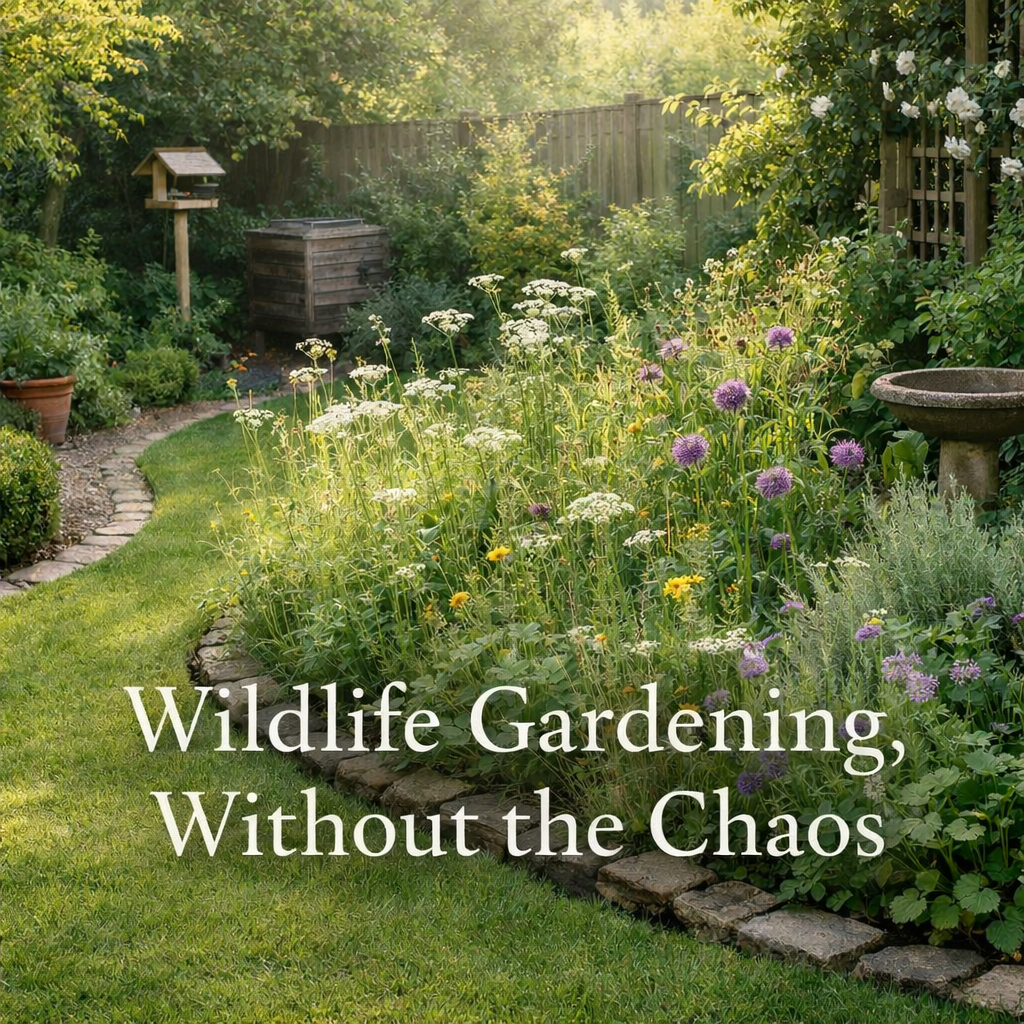
| A Garden That Looks Cared For, and Is Epilogue By the end of this series, you may feel that little has been asked of you, and that is deliberate. There is no dramatic turning point, no moment when the garden becomes something else, no insistence that care must look unfamiliar to count. Instead, the ideas have circled around a quieter centre. Again and again, we have returned to the same tension: the contrast between wanting to support life and wanting to live comfortably alongside it; between generosity and order; between stepping back and staying involved. These are not contradictions to be resolved, but conditions to be held in balance. A garden that supports wildlife does not do so by accident, nor by surrendering fully to growth. What it needs most is consistency—not of appearance, but of attention. Attention that notices edges blurring, plants dominating, or systems becoming predictably problematic. Throughout the episodes, structure has kept reappearing, not as a limitation, but as a form of permission. The contrast between neat edges and wild centres enables both to exist without apology. Selective weeding, rather than indiscriminate clearing, creates space for variety rather than erasure. Feeding birds thoughtfully supports presence, in contrast to practices that create dependence. Compost, when seen as infrastructure rather than sentiment, becomes fertile rather than fraught. Rewilding, scaled for a town garden, is not a dramatic withdrawal, but a gradual softening of control. None of these practices is especially radical. What makes them effective is their sustained nature. Wildlife responds to stability. Soil improves when undisturbed. Birds return because food sources are varied and reliable. Insects thrive because they are not removed mid-cycle. Even the garden itself settles, with change happening slowly enough to notice, not abruptly enough to need correction. There is also something worth saying about reassurance. Many people hesitate at the edge of wildlife gardening, not because they lack interest, but because they fear losing something they value: clarity, neighbourly ease, or the sense that the garden is still under their care. This series has tried to show that care does not disappear when you make space for life. It simply becomes less theatrical. A garden that looks cared for often is cared for. Paths are still walked; edges are still held. Decisions are still made, but now the contrast is clear: they are informed by patience rather than urgency, by observation rather than anxiety. In town gardens especially, this matters. These are shared landscapes, even when fences suggest otherwise. What happens within them affects what happens beyond. Wildlife gardening that ignores this reality tends not to last. Wildlife gardening that works with it quietly endures. If there is a single thread that runs through all of this, it is not wildness or restraint, but stewardship—the balance between the two. It is a willingness to stay present: to notice when something is working and let it continue, or when it is tipping and to intervene before frustration sets in. Supporting life means accepting this balance, rather than seeking perfection. In the end, the most successful wildlife gardens are rarely the loudest or the most visually dramatic. They are the ones who feel settled. The ones where people feel comfortable spending time. The ones where life arrives not because it is being forced or enticed, but because conditions quietly suit it. A garden that looks cared for, and is—one that welcomes life, endures seasons, and quietly reflects its steward’s attentive hand. That enduring balance—subtle, steady, unmistakable—has always been the aim. |

| About our writing & imagery Most articles reflect our real gardening experience and reflection. Some use AI in drafting or research, but never for voice or authority. Featured images may show our photos, original AI-generated visuals, or, where stated, credited images shared by others. All content is shaped and edited by Earthly Comforts, expressing our own views. |

