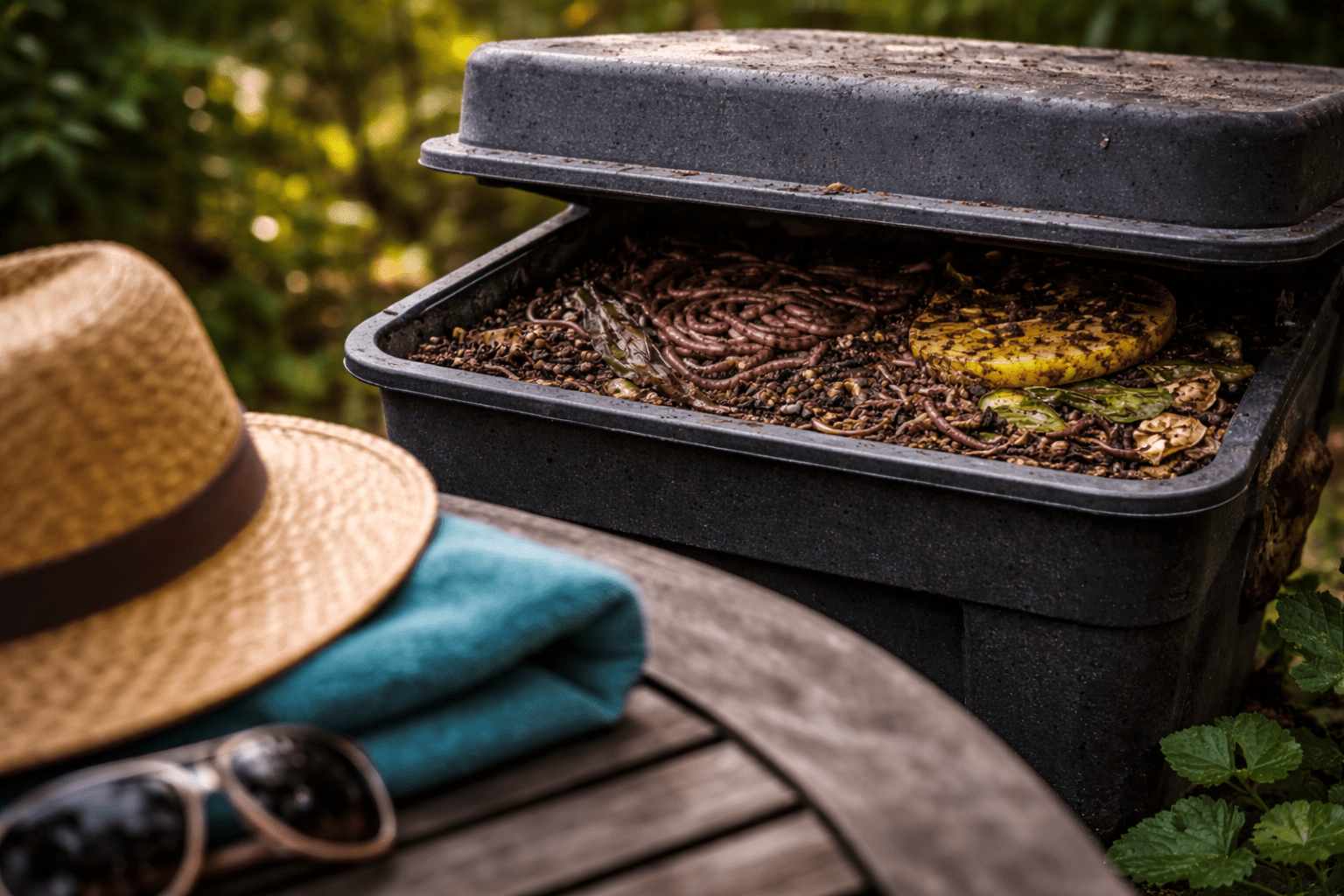
| Absence Absence is rarely planned in worm farming, yet it often reveals a central lesson: good care is less about constant attention and more about creating conditions where the system runs itself. Absence arrives disguised as a weekend away, a busy patch at work, an illness, a stretch of weather that keeps you out of the shed. The bin is closed with a brief glance, perhaps a small adjustment made out of guilt, and then attention moves elsewhere. When people return, they often expect consequences. Something neglected, something spoiled, something undone. What they find instead is frequently a system that looks much the same — or, quietly, better. Worm farms don’t notice our absence; they respond only to conditions. If those are stable, human presence barely matters. This can be unsettling, as it challenges the idea that care is measured by frequent intervention. Worms reward restraint, not effort. One of the most common mistakes made before leaving a worm farm alone is pre-feeding. The impulse is understandable. Food feels like care, and care feels like responsibility. People add an extra portion “to see them through”, imagining the worms working steadily in their absence, grateful for the provision. What actually happens is less reassuring. Activity slows once the bin is closed and temperatures shift. Food that would have been manageable under normal rhythms accumulates. Moisture builds. Microbial activity spikes unevenly. The system is asked to handle a peak when it was designed for flow. This pattern reveals a deeper misunderstanding: worms do not eat on our schedule. They do not speed up because we are away, nor do they suffer because we are not watching. They work according to temperature, moisture, microbial readiness, and density. Feeding beyond those limits does not create security; it creates pressure. Many of the problems people return to after a short absence were introduced in the first place to prevent them. Absence often shows how worm farming is about managing our own anxiety. We like feeling needed, but systems run best at the edge of attention. A bin that collapses after a week of neglect was never stable to begin with. There is also the question of scale. Small, heavily managed systems tend to be more fragile in the absence of precise inputs because they rely on precise inputs to remain balanced. Larger, looser systems often cope better because they contain buffers — more bedding, more structure, more microbial diversity. This does not mean bigger is always better, but it does suggest that resilience grows from the margin, not control. Systems that can tolerate inconsistency are kinder to live with over time. People often ask how long a worm farm can be left alone, as though there is a fixed threshold beyond which neglect begins. The more honest answer is that it depends on how the system has been treated while you were present. A bin accustomed to constant adjustment becomes dependent on it. One that has been allowed to find its own rhythm tends to maintain it when left alone. Absence, in this sense, is not a separate condition. It is a continuation of whatever patterns were already in place. There is something quietly instructive about returning to a worm farm after time away. The first instinct is to intervene immediately — to stir, to feed, to fix whatever might have happened unseen. Resisting that impulse can be revealing. Often, the bin needs nothing more than observation. Worms redistribute themselves. Smells settle. Moisture equalises. The system catches up without help. What feels like recovery is often simply continuity resuming. Absence also highlights the difference between attention and interruption. Looking is not the same as doing. Many experienced keepers learn to check a bin without changing anything, to register its state without imposing a response. This habit becomes especially valuable after time away. Instead of correcting imagined problems, you allow the system to show you what has actually shifted. The information gained is far more reliable than assumptions formed in advance. There is a broader lesson here about trust. Worm farming, like many slow practices, improves when trust replaces vigilance. Not blind trust — systems can and do fail — but informed trust grounded in familiarity. You know how your bin behaves when healthy. You recognise the smell, the texture, the distribution of life. Absence does not erase that knowledge. If anything, it sharpens it by removing the noise of constant interaction. It’s also worth acknowledging that absence can be permanent. Some people step away from worm farming entirely, intentionally or otherwise. Life changes. Priorities shift. Bins are forgotten. When this happens, outcomes vary. Some systems collapse into anaerobic messes. Others settle into something like a slow compost heap, worms persisting where conditions allow. Neither outcome is a moral judgement. Worm farming is not a contract. It is a practice that works when it fits the shape of your life and fails when it doesn’t. The idea that worm farms require ongoing commitment can unnecessarily discourage people. In reality, many systems benefit from being treated as background rather than a project. They work best when folded quietly into daily life, not elevated to a task list. Absence reveals this truth because it removes intention from the equation. What remains is the system itself, operating — or not — on its own terms. Absence also challenges the idea of control. When you are not there, you cannot correct deviations in real time. You cannot respond to every fluctuation. And yet, most fluctuations resolve on their own. This can be humbling. It reminds us that worm farming is not about managing outcomes, but about setting conditions and stepping back. The work happens whether we are present or not. In time, many keepers come to see absence as a test rather than a risk. If a system can survive being left alone, it is probably well-designed. If it cannot, something needs to change — not to make it more demanding, but to make it more forgiving. Designing for absence means designing for life as it actually unfolds, not for ideal routines. There is a quiet comfort in knowing that worms do not need constant reassurance. They do not miss us. They do not wait. They continue their work slowly, adapting to what is available, indifferent to schedules and intentions. Absence strips worm farming back to its essentials. What remains is a reminder that good systems continue to function even when attention drifts elsewhere. When you return, the most respectful action is often to do very little. Open the lid. Notice. Close it again. Let the system speak before you respond. Absence, handled well, becomes not a lapse in care but part of the rhythm itself — a pause that confirms whether what you’ve built can stand without you. And if it can, that quiet independence is not a failure of care. It is its success. |
| About our writing & imagery Many of our articles are written by us, drawing on real experience, reflection, and practical work in gardens and places we know. Some pieces are developed with the assistance of AI, used as drafting and research tools rather than as a voice or authority. Featured images may include our own photography, original AI-generated imagery, or—where noted—images kindly shared by other creators and credited accordingly (for example, via Pixabay). All content is shaped, edited, and published by Earthly Comforts, and the views expressed are our own. |

