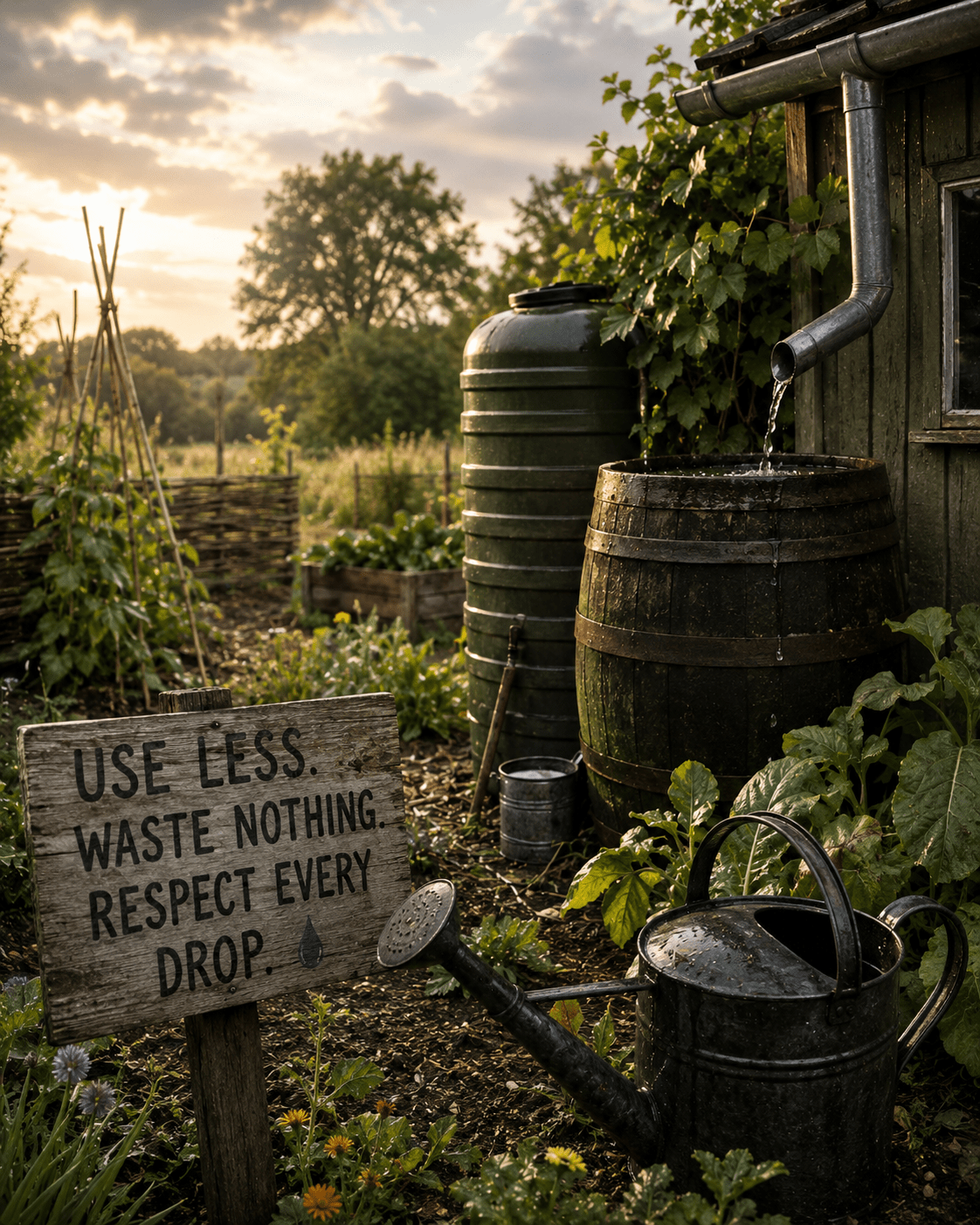
| There are certain moments in gardening that quietly remind you who’s really in charge. You can spend a morning improving the soil, carefully plant something you’ve wanted for months, stand back feeling quietly pleased with yourself, and then watch three weeks of dry weather unravel your plans with remarkable efficiency. Nature simply isn’t interested in negotiating. That has always been one of the things I enjoy most about gardening. It keeps you honest. We like to think we’re creating gardens, but in reality, we’re entering into an agreement with the weather, the soil and whatever else happens to be living there. Most years, the arrangement works reasonably well. Some years it doesn’t, and the garden politely reminds us that our influence has limits. Water sits at the centre of that relationship, although most of the time we hardly notice it. We notice sunshine because it’s pleasant. We notice rain because it interrupts whatever job we’re doing. Water itself tends to disappear into the background, quietly flowing through hoses, filling watering cans and disappearing into the soil without demanding much attention. Like electricity or broadband, we only really appreciate it when it isn’t behaving as expected. It struck me recently that perhaps we’ve become a little too comfortable with certainty. We don’t generally ask whether water will be available tomorrow; we simply assume it will be. If a dry spell arrives, we turn on the tap. If the borders begin to look thirsty, we fetch the hose. Even during the occasional hosepipe ban, most of us carry on believing it’s a temporary inconvenience rather than a sign that water may not always be so dependable. But what if certainty slowly disappeared? Not the water itself. That would make for an entirely different story. Imagine instead that finding water simply became less predictable. Reservoirs still existed, taps still worked more often than they didn’t, and rain continued to arrive, but rarely when anyone needed it. Every season became a little more uncertain than the last. You’d never quite know whether next week’s forecast would bring a welcome soaking or another fortnight of cloudless skies and cracked soil. The interesting thing is that gardeners would probably notice long before anyone else. We’ve always measured the year rather differently. While most people divide time into months, gardeners divide it into dry spells, late frosts, decent downpours, and those glorious mornings when you discover the overnight rain has quietly watered everything while you were asleep. We become surprisingly attached to weather forecasts, not because we’re fascinated by meteorology but because tomorrow’s rainfall often determines today’s work. I imagine the first conversations would begin quite innocently. Someone would mention installing another water butt. A neighbour would proudly announce they’d connected all their shed guttering into a collection system. Garden centres would discover that every rain barrel, water tank and length of downpipe had mysteriously disappeared from the shelves by the second weekend of spring. There would, of course, be one person who’d been harvesting rainwater for twenty years. There always is. He’d explain, with admirable patience and only the faintest hint of satisfaction, that he’d been saying this would happen for years. Secretly, I suspect he’d be delighted that everyone else had finally caught up, although he’d probably pretend otherwise. The amusing part is that gardeners have been quietly preparing for this future without ever really admitting it. Every layer of mulch spread across a border, every compost heap built to improve soil structure, and every drought-tolerant shrub planted after one particularly unforgiving summer has been a small investment in resilience. We rarely describe it that way. We simply call it good gardening. I’ve often noticed that experienced gardeners waste remarkably little water. Not because someone has instructed them to be careful, but because they’ve learned how much effort it takes to replace what the sky usually provides for free. Watering cans are carried with purpose. Borders are soaked deeply rather than sprinkled half-heartedly. Plants are watered at the base rather than showered from above. None of it feels especially revolutionary. It’s simply the quiet accumulation of habits learned over years of watching what works and what doesn’t. If water became genuinely difficult to find, those habits would become far more valuable than any expensive irrigation system. Knowledge has always travelled surprisingly well through gardens. Gardeners borrow cuttings, exchange seeds, and quietly pass on ideas over garden gates. I suspect they would begin sharing water-saving techniques with exactly the same generosity. One person discovers that a deeper mulch keeps borders damp for another week. Someone else experiments with clay pots buried beneath vegetables to release moisture slowly into the soil. Before long, entire neighbourhoods are comparing water butts instead of lawnmowers. The irony, of course, is that many of the gardens we’d admired for decades might suddenly look rather impractical. Vast lawns, immaculate bedding displays and thirsty hanging baskets have always depended upon abundance. Once abundance becomes uncertain, beauty begins to change. A border filled with plants that happily survive long, dry summers starts looking every bit as impressive as one demanding constant attention. Gravel gardens, Mediterranean herbs, and deep-rooted perennials quietly shift from fashionable to sensible choices. Lawns, meanwhile, may finally find themselves on the losing side of the argument. I’ve never had anything against lawns. They have their place, and there are few things more satisfying than neat stripes on a healthy stretch of grass. Yet I’ve often wondered whether we’ve become slightly too attached to the idea that every garden should resemble a small cricket pitch. Grass has spent decades persuading us that it deserves enormous amounts of our time and water, while vegetables, fruit bushes and young trees have looked on with understandable confusion. If water became difficult to find, I suspect priorities would shift remarkably quickly. The tomatoes would begin making a far stronger case for themselves than the third mowing of the week. Perhaps that’s the real lesson in all this. Gardens have never been static. They have always evolved alongside the conditions around them. We simply tend to notice the change after it has happened rather than while it’s taking place. If the world became just a little drier each year, the transformation wouldn’t arrive with dramatic headlines or apocalyptic scenes. It would begin quietly, with gardeners making small decisions that gradually became new habits, until one day we realised we’d been gardening rather differently for quite some time, and that the future had already started to shape the garden. |
| About our writing & imagery Most articles reflect our real gardening experience and reflection. Some use AI in drafting or research, but never for voice or authority. Featured images may show our photographs, original AI-generated artwork, or, where stated, credited images shared by others. All content is shaped and edited by Earthly Comforts, expressing our own views. |


Great post! And it would be a good exercise in respecting our resources to have to seriously consider what the future holds for us.
My favorite part: “Grass has spent decades persuading us that it deserves enormous amounts of our time and water, while vegetables, fruit bushes and young trees have looked on with understandable confusion.”
Thanks!
—Shirley
LikeLiked by 1 person
Good morning Shirley, thank you for your comment. The future l fear and feel is not bright when it comes to resources.
LikeLike