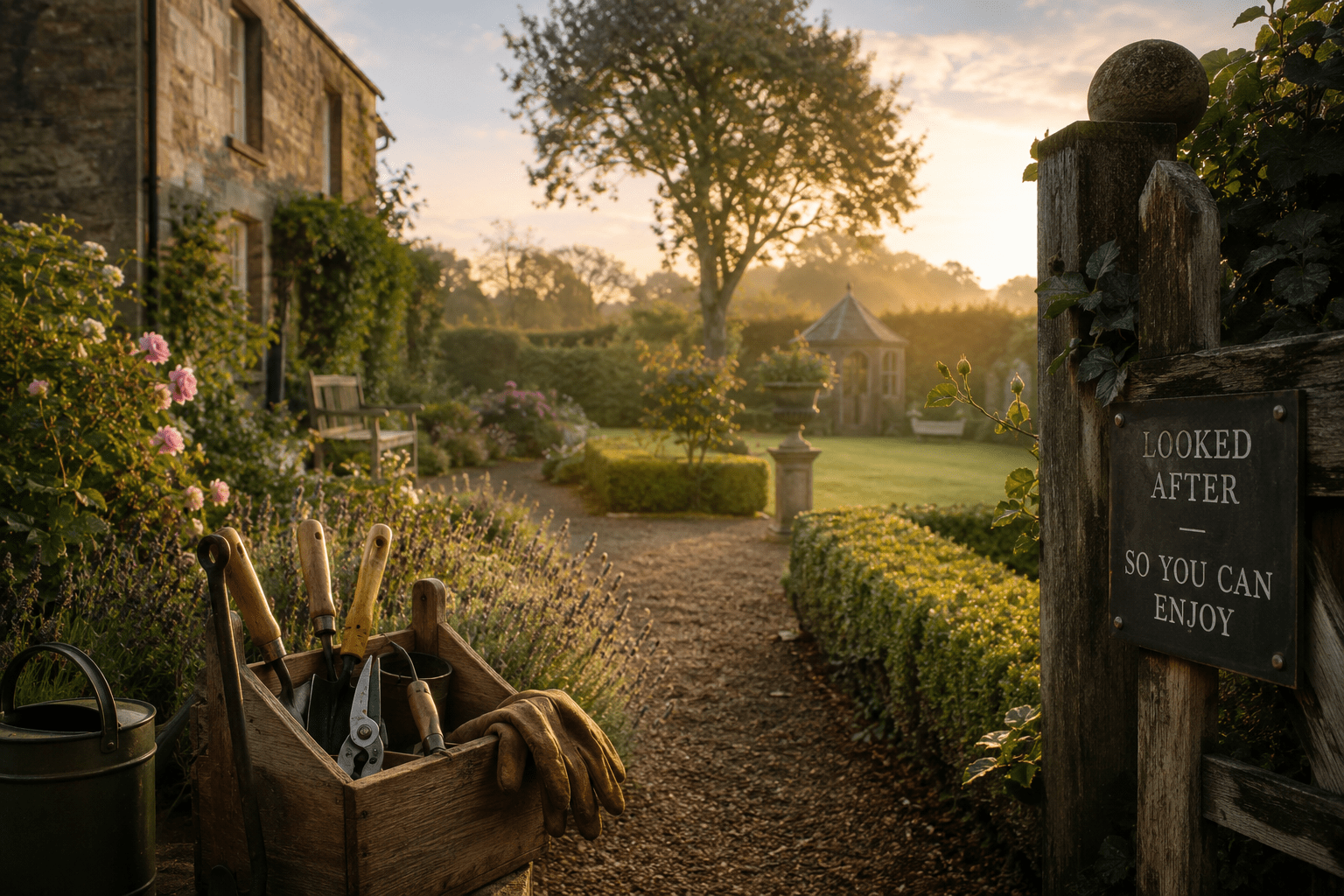
| The Quiet Luxury of Being Looked After |
| Luxury is an interesting word. Mention it, and most people immediately picture something expensive. A large house tucked away behind electric gates, perfectly clipped topiary, an immaculate lawn without a daisy in sight, perhaps a gardener moving silently through herbaceous borders that seem to flower on command. We have become rather good at confusing luxury with cost, as though the value of something can always be measured by the number on the invoice. The older I become, the less convincing that definition feels. Some of the wealthiest properties I’ve worked in have lacked the one thing that really makes a place feel cared for. Equally, some of the smallest gardens have possessed an atmosphere that no amount of money could ever buy. The flowers themselves are rarely the deciding factor. Neither is the size of the lawn, the rarity of the plants, nor the quality of the paving. Those things certainly contribute to a garden, but they are not what creates that quiet sense that everything is as it should be. I’ve gradually come to believe that true luxury is something much less obvious. It is the absence of worry. That thought first occurred to me a couple of years ago, although I didn’t recognise it immediately. I had been looking after a client’s garden for some time and, during an ordinary conversation, they thanked me for noticing a loose fence panel after a period of high winds. I remember feeling slightly puzzled by their gratitude because, to me, mentioning it had seemed the most natural thing in the world. The fence wasn’t on the day’s list of jobs, and repairing it wasn’t part of that particular visit. It simply looked different from the week before, and I thought they ought to know. Only later did I realise what they had really been thanking me for. It wasn’t the fence. It was the reassurance that somebody else had been paying attention. That distinction has stayed with me ever since. When people employ a gardener, they naturally expect the practical work to be done well. Lawns should be cut neatly, hedges should be trimmed with care, and borders should gradually become healthier rather than more neglected. Those things are fundamental. Without them, there is little point in talking about philosophy because the foundations of the work have not been established. Yet I increasingly suspect that those practical tasks are only the visible part of the relationship. Beneath them sits something quieter. Clients begin to relax because they know someone familiar is walking through the garden every week or every fortnight. They know that if the greenhouse glass cracks after a storm, someone will notice. If a shrub suddenly looks unhealthy, somebody will mention it before the problem becomes serious. If the compost bins are ready to be turned, the bird feeders have emptied, or a self-seeded ash sapling has appeared behind the shed, those things are unlikely to remain unnoticed for very long. Most of those observations never become dramatic conversations. In fact, they are often so ordinary that they are forgotten almost as quickly as they are made. Yet taken together, they create something surprisingly valuable. They remove countless tiny anxieties that would otherwise sit quietly in the back of a homeowner’s mind. I don’t think that’s really about gardening. I think it’s about trust. Long before Earthly Comforts existed, I spent years working in hospitality and, for a period, as a butler. Looking back, I can see that those professions quietly taught me something I didn’t fully appreciate until much later. The finest service rarely draws attention to itself. In fact, if somebody constantly notices the service, it has probably become too visible. The best service is almost invisible because life simply flows more smoothly. Things are where they ought to be. Small problems disappear before they become larger ones. Responsibilities are carried out quietly without the need for constant discussion. Gardens respond remarkably well to that same philosophy. A visitor walking through a well-looked-after garden might admire the borders or comment on the healthy lawn, but they are only seeing the final result. They are not seeing the hundreds of small decisions that made those things possible. They don’t see the weeds removed while they were still seedlings, the branch pruned before it rubbed against a roof tile, the support added to a young tree before the autumn gales arrived or the conversation that persuaded a client to move a shrub before it became hopelessly overcrowded. Much of the work that matters most is invisible precisely because it happened early enough to prevent a problem. There is, I think, a lesson there that reaches well beyond gardening. The older I become, the more I admire people whose work quietly improves other people’s lives without demanding recognition. The caretaker who notices the leaking tap before the ceiling is damaged, the receptionist who remembers a nervous visitor’s name, the chef who sends out a meal exactly as requested without making a performance of accommodating a dietary requirement, or the neighbour who quietly puts your bins away while you’re away for the weekend. None of these people would usually describe themselves as providing luxury. And yet they are. Not luxury in the commercial sense, but in the human sense. They create a world where someone can think about something other than the next problem waiting to be solved. I sometimes wonder whether that is what clients are really buying when they invite us into their gardens year after year. They certainly expect practical gardening, and quite rightly so, but I suspect they are also buying something much harder to describe. They are buying continuity. Familiarity. Reassurance. The comforting knowledge that another pair of experienced eyes has quietly become interested in a place that matters deeply to them. That understanding has gradually changed the way I think about Earthly Comforts. There was a time when I measured success by how much work we completed during a visit. I still care enormously about doing good work, but I no longer believe that productivity alone tells the whole story. Sometimes the most valuable thing we do on a particular morning is simply notice that everything is progressing exactly as it should. No urgent conversations are needed, no hidden problems have emerged, and the garden is quietly getting on with being a garden. Strangely enough, that can be one of the most satisfying visits of all. Perhaps that is the quiet luxury of being looked after. It isn’t the feeling of somebody doing everything for you. It is the confidence that somebody cares enough to notice when something needs doing at all. |
| About our writing & imagery Most articles reflect our real gardening experience and reflection. Some use AI in drafting or research, but never for voice or authority. Featured images may show our photos, original AI-generated visuals, or, where stated, credited images shared by others. All content is shaped and edited by Earthly Comforts, expressing our own views. |

