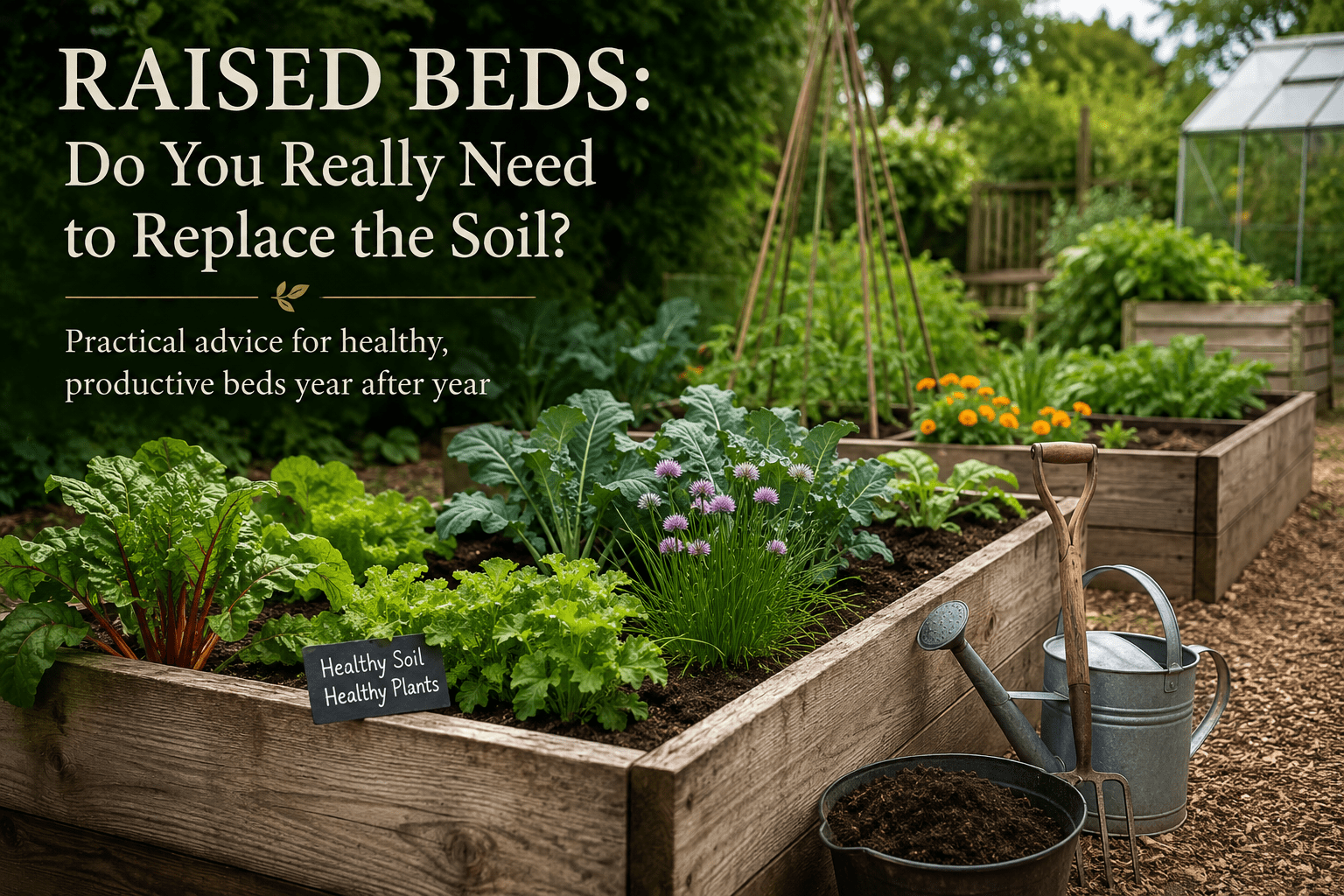
| Do You Really Need to Replace the Soil? |
| One of the things I enjoy most about being a working gardener is the conversations that happen every day. Whether I’m with clients, chatting to neighbours over the garden fence, speaking to fellow allotment holders or responding to readers of The Journal, I’m constantly being asked questions about plants, gardens and growing. Some questions are very specific, while others are ones that I know many gardeners have quietly been wondering themselves. Recently, Graham asked me a question that I suspect many people who grow vegetables in raised beds have asked at some point. “Have you any advice for those who can only grow in raised beds? How is it best to maintain the quality of the soil or compost that is in these beds?” It’s an excellent question because raised beds have become one of the most popular ways to grow fruit, vegetables and herbs. They make gardening more accessible, warm up earlier in spring, often have better drainage, and allow productive growing in places where the natural soil may be poor or even non-existent. However, unlike a traditional vegetable patch, raised beds are a contained growing system. Nothing is naturally washed back into them, so many gardeners eventually begin to wonder whether the compost has reached the end of its useful life. The good news is that, in our experience, the answer is almost always no. Here at Earthly Comforts, we also have an allotment in Sandwich where much of our produce is grown in raised beds. We’ve learnt that healthy raised beds behave much like healthy garden soil. They are living systems. Beneath the surface are countless earthworms, fungi, bacteria and other microscopic organisms quietly breaking down organic matter and recycling nutrients. The aim isn’t simply to grow plants; it’s to look after the soil that grows them. One of the first things we’ve noticed over the years is that the soil level naturally drops. This often worries new gardeners, who assume the compost is somehow disappearing or wearing out. In reality, what you’re seeing is completely natural. Organic matter gradually decomposes, the soil settles, and every crop you harvest removes a small amount of nutrients and biomass from the bed. A raised bed that was once full to the brim may sit several centimetres lower after a year or two, but that doesn’t mean it’s failing. It simply means it’s time to feed it. Rather than emptying the beds and starting again, we top them up each year. Usually, this means adding a generous layer of good-quality compost or well-rotted manure to the surface in autumn or early spring. We don’t spend hours digging it in. Nature has been doing that job far more efficiently than us for millions of years. Earthworms gradually draw organic matter down through the soil, while microorganisms continue to break it apart, improving both the structure and fertility of the bed. Healthy soil always comes first. If the soil is thriving, the plants usually follow. Of course, feeding the soil doesn’t mean we ignore the plants themselves. This growing season we’ve supplemented our vegetables with Tomorite, particularly for tomatoes and other fruiting crops that benefit from additional potassium. We’ve also been making our own liquid weed feed by soaking suitable weeds in water, allowing the nutrients to leach into the liquid, then straining it and using it as a natural fertiliser. It’s a wonderfully satisfying way of turning garden waste into something useful. Alongside that, we’ve applied seaweed feed during the growing season, providing valuable trace elements that support healthy, vigorous growth. One thing that’s had just as much impact this year has been the weather. It’s been a remarkably warm growing season and, while many crops have responded with exceptional growth, they’ve also demanded far more attention when it comes to watering. One lesson we’ve found particularly valuable is to water deeply rather than little and often. A quick sprinkle may dampen the surface, but it rarely encourages roots to grow downwards. Instead, we prefer to give the beds a thorough soak before allowing the surface to begin drying again. That encourages roots to search deeper in the soil for moisture, producing stronger, more resilient plants that cope far better when the next hot spell arrives. Like many gardeners, we’ve also continued experimenting with different ways of managing pests. This year Suze has been trialling Vitax Slug Gone Wool Pellets around some of our more vulnerable plants. They’re certainly more expensive than many traditional slug deterrents, and they do have a rather distinctive smell when first applied, but we’ve both been impressed by how effective they’ve been. As a bonus, the wool gradually breaks down, returning organic matter to the soil rather than simply acting as a temporary barrier. Crop rotation is another simple habit that’s worth adopting wherever space allows. Even if you only have two or three raised beds, moving crops around from year to year helps reduce the build-up of pests and diseases while preventing one area from continually losing the same nutrients. It doesn’t have to be complicated; even a modest rotation can make a noticeable difference over time. Perhaps the biggest lesson we’ve learnt is that raised beds aren’t static structures filled with compost. They’re constantly changing. Every season, the soil matures a little more, the biology beneath the surface becomes richer, and the growing conditions improve—provided we continue to give something back. A little compost, sensible feeding, deep watering during dry spells and regular additions of organic matter are usually all that’s needed to keep a raised bed productive for many years. So thank you, Graham, for asking such a thoughtful question. I suspect you’re not the only one who’s wondered whether raised beds eventually need replacing. In our experience, they don’t. Look after the soil, and the soil will look after your plants. As always, if you’ve discovered techniques that work particularly well in your own raised beds, I’d love to hear about them. Gardening has always been one of those wonderful pursuits where we never stop learning from one another. |
| About our writing & imagery Most articles reflect our real gardening experience and reflection. Some use AI in drafting or research, but never for voice or authority. Featured images may show our photos, original AI-generated visuals, or, where stated, credited images shared by others. All content is shaped and edited by Earthly Comforts, expressing our own views. |

