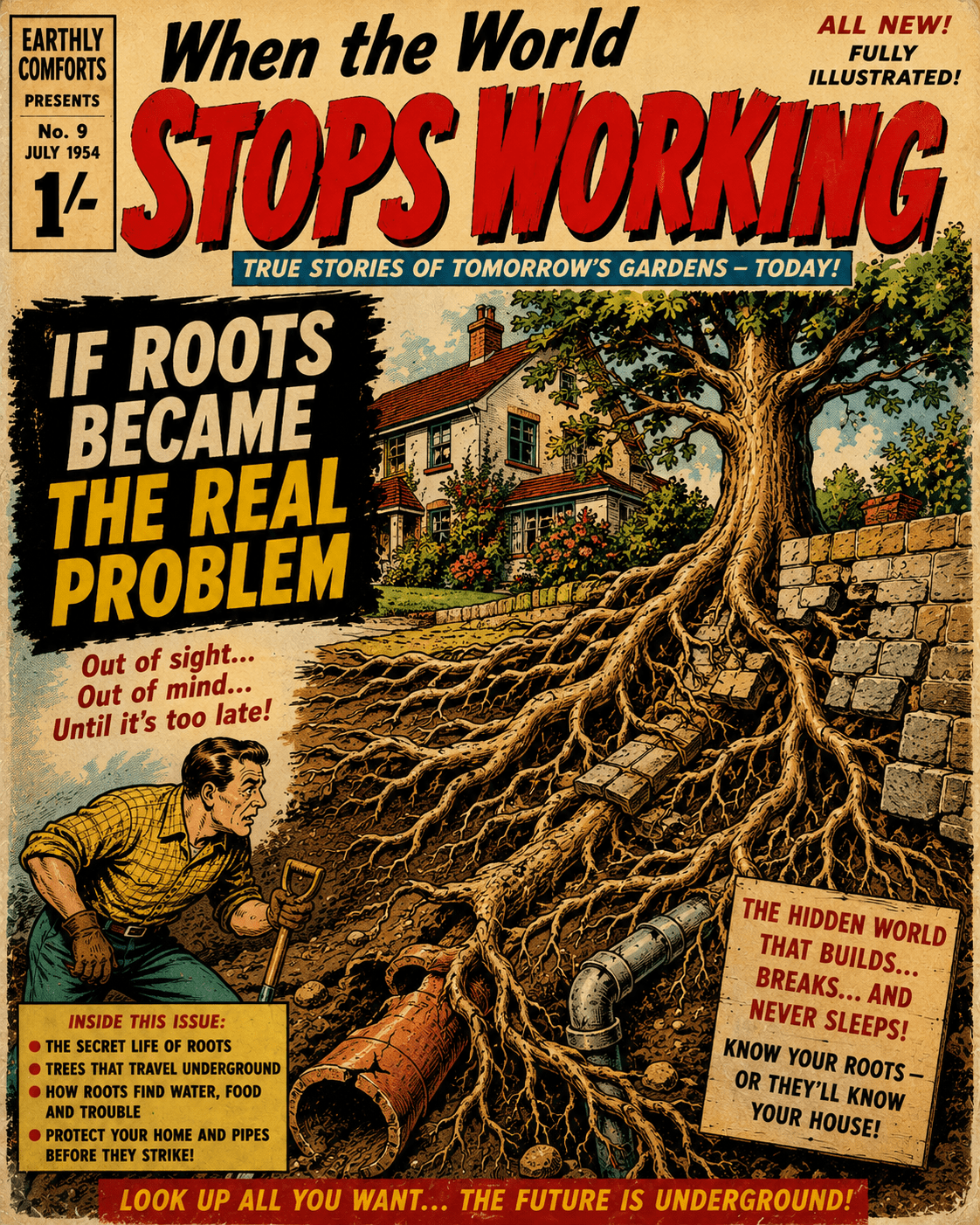
| Most gardeners spend their lives looking in the wrong direction. Not deliberately, of course. It’s simply where the interesting bits are. We admire flowers, inspect leaves, worry about blossom, prune branches and congratulate ourselves when a shrub finally flowers after three years of patient encouragement. Everything that catches our attention happens above the soil. Beneath our feet, meanwhile, something else is happening entirely, because the real work has always been underground. Every healthy tree is quietly extending its reach. Shrubs are searching for water we never knew existed. Perennials are preparing next year’s display while we’re still admiring this one. Worms, fungi, bacteria and millions of unseen organisms are busily keeping the whole enterprise alive. The remarkable thing is how little we think about any of it. Out of sight really does become out of mind, until, occasionally, a root reminds us that it exists. Perhaps it lifts a paving slab by half an inch. Perhaps it finds a crack in a drain. Perhaps a shrub you’ve ignored for years suddenly proves considerably larger below ground than above it. It’s enough to remind you that plants don’t merely occupy the space you can see. They’ve been making other arrangements all along. That thought stayed with me after removing an old conifer hedge. Above ground, the job looked straightforward enough. A chainsaw, a few hours of hard work and the hedge had disappeared. Or so it appeared. The roots had rather different ideas. Hours later I was still discovering them: thick ones, fine ones, roots disappearing beneath fences, beneath paths and beneath places where no sensible root ought to have been. It was like dismantling an underground city that nobody had bothered to mention. Which made me wonder what might happen if roots quietly became the real problem. Not because they suddenly grew teeth or developed sinister intentions—nothing so dramatic—but simply because they stopped accepting the limits we’d always assumed they respected. At first, nobody would notice very much. A patio would develop an unexpected ridge. A driveway would seem less level than it had been the previous summer. One or two garden walls might acquire interesting new cracks that nobody could quite explain. Surveyors would blame the weather. Builders would blame poor craft. Gardeners would quietly suspect something else. The truth is that roots are astonishingly patient. Unlike branches, they don’t need to hurry. Nobody sees them. Nobody prunes them. Nobody compliments their appearance. They continue exploring, inch by inch, following moisture, nutrients, and opportunities wherever they lead. If branches are the public face of a plant, roots are its long-term strategy. Imagine if that strategy became just a little more ambitious. Trees we’d planted twenty years earlier would begin introducing themselves to neighbouring gardens from below rather than above. Flower beds would become unexpectedly crowded long before the plants themselves appeared to touch. Lawns would develop mysterious humps that seemed to wander gently across the garden over several years. Nothing would happen quickly. That would be the unsettling part. Roots don’t invade; they negotiate. One millimetre today, another tomorrow, another next week. By the time you realise they’ve arrived, they’ve already been there for years. Gardeners would probably notice first because we spend so much time disturbing the soil. Every spadeful tells a story. You quickly learn the difference between healthy fibrous roots and those thick woody cables that seem capable of towing a small caravan. Digging would become rather like archaeology, every border revealing hidden networks stretching far beyond anything we’d imagined. Some plants would inevitably acquire reputations. Bamboo, naturally, would become even less welcome at neighbourhood meetings. Poplars would develop something approaching a criminal record. Willows would continue pretending complete innocence while quietly investigating every nearby water pipe. Meanwhile, the little herbaceous perennials we’d always considered harmless would be getting on with life beneath the surface without attracting the slightest suspicion. Never underestimate the quiet ones. The first real change, however, wouldn’t be in gardening at all. It would be in construction. Driveways would need deeper foundations. Garden walls might require root barriers before they required bricks. Architects would begin consulting arborists before drawing extensions. Insurance companies, never slow to identify a new category of paperwork, would almost certainly invent the phrase “progressive subterranean vegetation displacement.” They’d probably shorten it to something equally alarming. Gardeners, on the other hand, would respond rather differently. Instead of asking what looked beautiful together, we’d begin asking what lived well together underground. We’d leave more room between trees, think twice before planting vigorous species close to old walls, and value compost even more highly because healthy, open soil encourages roots to spread naturally rather than forcing them to search relentlessly for every available pocket of moisture. We’d spend less time fighting what happened above the ground and considerably more time understanding what was happening beneath it. Perhaps we should have been doing that all along. The fascinating thing about roots is that they rarely seek conflict. A root doesn’t crack a wall because it dislikes masonry. It cracks a wall because the tiniest gap offers moisture, shelter or opportunity. Nature isn’t usually destructive out of malice. It’s simply persistent. Perhaps that’s the lesson. We often imagine strength as something loud and immediate. Storms break branches. Gales fell trees. Floods reshape landscapes in a matter of hours. Roots achieve remarkably similar things; they take twenty years to do it. There’s something rather humbling about that. The older I become, the more I realise that gardens are defined just as much by what we cannot see as by what we can. Every magnificent tree depends upon an invisible foundation. Every healthy border owes its success to an underground world that most of us never think about until we accidentally put a spade through it. Maybe that’s why roots deserve a little more respect. Not because they’re dangerous, but because they’ve quietly been doing the real work all along. If roots ever became the real problem, I don’t think it would be because they’d changed. I think it would be because we’d finally started paying attention. And perhaps that’s true of rather more than just gardens. |
| About our writing & imagery Most articles reflect our real gardening experience and reflection. Some use AI in drafting or research, but never for voice or authority. Featured images may show our photographs, original AI-generated artwork, or, where stated, credited images shared by others. All content is shaped and edited by Earthly Comforts, expressing our own views |


Wonderful! Thank you for sharing your thoughts. Loved it!
LikeLike