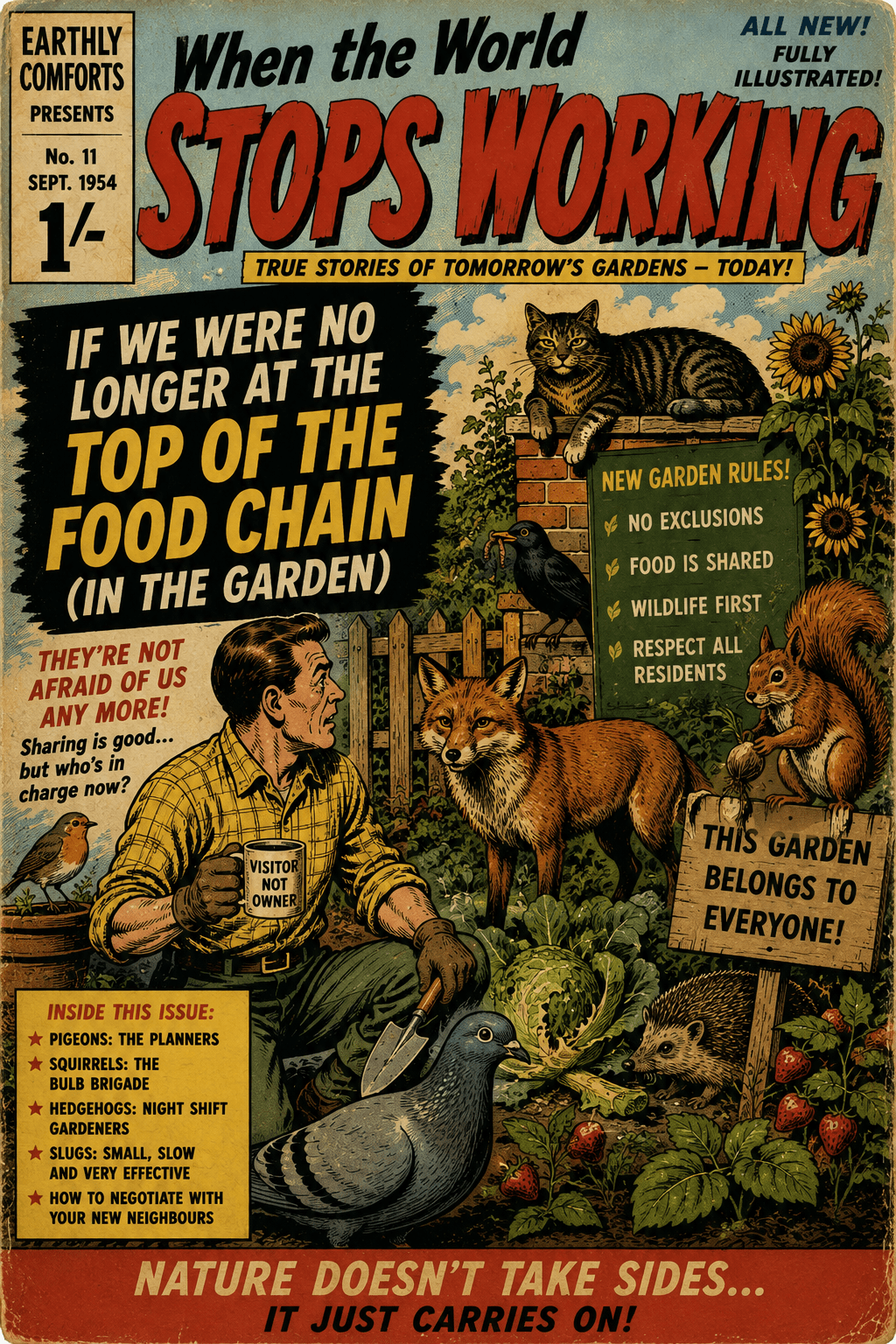
| (in the Garden) |
| One of the great comforts of gardening is that very little in the garden is genuinely interested in eating you. You may be scratched by a rose, stung by nettles, pecked by an indignant robin defending its nest or ambushed by an unexpectedly low branch while carrying a wheelbarrow, but by and large the relationship between gardener and garden has always been reassuringly one-sided. We grow the vegetables, prune the shrubs and occasionally lose a battle with the brambles, yet we’ve never seriously questioned who occupies the top of the pecking order. The garden has always felt like our territory. Or perhaps that’s simply what we’ve chosen to believe. Spend enough time outdoors, and you begin to realise that you’re already sharing your workspace with an astonishing number of creatures. Foxes patrol the borders after dark. Badgers wander through as though inspecting the place. Hedgehogs work the night shift with admirable determination, while birds, insects and countless unseen residents carry on their daily routines with very little regard for our carefully organised plans. Most of the time, they tolerate us. We rather flatter ourselves by assuming the arrangement works the other way around. That thought occurred to me while kneeling in a border one summer afternoon. I became aware of a blackbird watching every movement I made, patiently waiting for the moment I uncovered another worm. It wasn’t frightened. If anything, it seemed mildly impatient that I wasn’t digging quickly enough. To the blackbird, I wasn’t the owner of the garden. I was simply a rather inefficient assistant helping with lunch. It made me smile. Which, inevitably, led me to wonder. What if, without ever becoming larger or more aggressive, the balance quietly shifted? Not across the whole world, but within the boundaries of the average garden. What if humans slowly stopped being the species that everything else instinctively gave way to? Nothing dramatic would happen at first. The birds might become a little bolder. Robins, already famous for following gardeners from border to border, would begin regarding us less as mysterious giants and more as useful colleagues. Magpies would stop waiting until we’d walked away before inspecting freshly planted bulbs. Squirrels would abandon the pretence of being startled whenever we appeared, instead carrying on their business with the relaxed confidence of regular customers who know the shopkeeper won’t object. Gardeners would notice before anyone else. We always do. There would be stories about foxes refusing to leave patios, pigeons calmly finishing their meal while people stood a few feet away and hedgehogs wandering beneath garden benches without the slightest concern that anyone happened to be sitting there. Most people would dismiss them as charming anecdotes. Gardeners, however, would quietly recognise that something had changed. Respect had become familiarity. And familiarity has a habit of changing relationships. The real shift wouldn’t involve predators in the traditional sense. It would be much subtler than that. Every creature would begin to behave as though it possessed equal rights in the garden. The lettuce you’d carefully nurtured for weeks would become communal property. Strawberries would disappear the day before you intended to pick them. Newly planted bulbs would be excavated with astonishing efficiency by squirrels that no longer felt the slightest need to wait until nightfall. You’d find yourself negotiating rather than defending. There is, I suspect, a certain irony in this. Gardeners already spend a surprising amount of time accommodating wildlife. We plant pollinator-friendly flowers, leave untidy corners for insects, build ponds, install bird boxes and celebrate the return of species that have struggled elsewhere. We encourage biodiversity because we understand that healthy gardens are shared places. What we perhaps don’t expect is for the other residents to become quite so enthusiastic about the invitation. The pigeons would almost certainly organise themselves first. I’ve never entirely trusted pigeons. They possess the unmistakable air of creatures who’ve already held a committee meeting and forgotten to invite the rest of us. If they ever realised gardeners posed very little threat, I suspect they’d begin holding planning meetings on shed roofs before breakfast. Their agenda would probably consist of only one item. “Whose cabbages shall we inspect today?” Meanwhile, slugs would continue proving that size has never been an adequate measure of influence. They don’t need speed, intelligence or dramatic entrances. They require one damp evening and your brief lapse in concentration. Entire vegetable gardens have already learned this lesson the hard way. Perhaps we’re not quite as high up the food chain as we’d like to imagine. The longer I garden, the more I realise that nature has very little interest in hierarchy. Every species is simply trying to make a living. Birds hunt insects. Hedgehogs hunt slugs. Aphids feed on roses. Ladybirds feed on aphids. Compost worms quietly recycle yesterday’s waste into tomorrow’s soil. The garden is less like a battlefield than a remarkably complicated village where everyone seems to know somebody else’s business. Humans have always assumed we sit slightly above the conversation. Perhaps we’ve merely been another participant all along. If the balance continued shifting, gardeners would adapt remarkably quickly. We’d stop trying to exclude wildlife completely and become better at sharing. Protective netting would become more thoughtful than defensive. Fruit trees might produce enough for everyone rather than only for us. Borders would include plants chosen not just for beauty but also for the food and shelter they offered year-round. We wouldn’t surrender the garden. We’d renegotiate the agreement. That, after all, is what good gardeners have always done. We rarely succeed by imposing our will indefinitely. The finest gardens are partnerships, not dictatorships. They acknowledge that every bee, every worm, every fungus beneath the soil and every blackbird tugging at a worm has a part to play in keeping the whole system functioning. Perhaps we’ve mistaken management for ownership. There is one final thought that rather amuses me. If we genuinely slipped a little lower in the garden’s food chain, I don’t imagine nature would celebrate. There would be no victory parade led by badgers or triumphant speeches delivered by robins from the top of the compost heap. The garden would carry on, exactly as it always has, with each creature taking its share and getting on with life. The only species likely to notice would be us. And perhaps that says rather more about humanity than it does about the garden. After all, every gardener eventually learns the same lesson. We don’t really own the places we care for. We borrow them for a while, encourage them where we can and leave them, hopefully, a little healthier than we found them. The birds, the insects, the foxes and the worms have always understood that. It has simply taken the rest of us rather longer to catch up. |
| About our writing & imagery Most articles reflect our real gardening experience and reflection. Some use AI in drafting or research, but never for voice or authority. Featured images may show our photographs, original AI-generated artwork, or, where stated, credited images shared by others. All content is shaped and edited by Earthly Comforts, expressing our own views. |

