| It Isn’t the Gardens |
| A client asked me an interesting question the other day. “What would you say are your top ten stresses? It’s the gardens, right?” Nope. It’s everything else, actually. There are no stressful gardens. Difficult gardens, certainly. Neglected gardens, absolutely. Rock-hard soil, enormous hedges, awkward ponds, mountains of green waste and things growing where nobody in their right mind would have planted them. But stressful? No. The gardens are why I do this job. Give me an overgrown garden, and I can normally see a way forward. It might take hours, days, or months, but it is a practical problem: assess it, work out what needs to be done, and get on with it. Running the business that allows us to do that is another matter entirely. So, after thinking properly about that client’s question, these are probably my top ten stresses of 2026. |
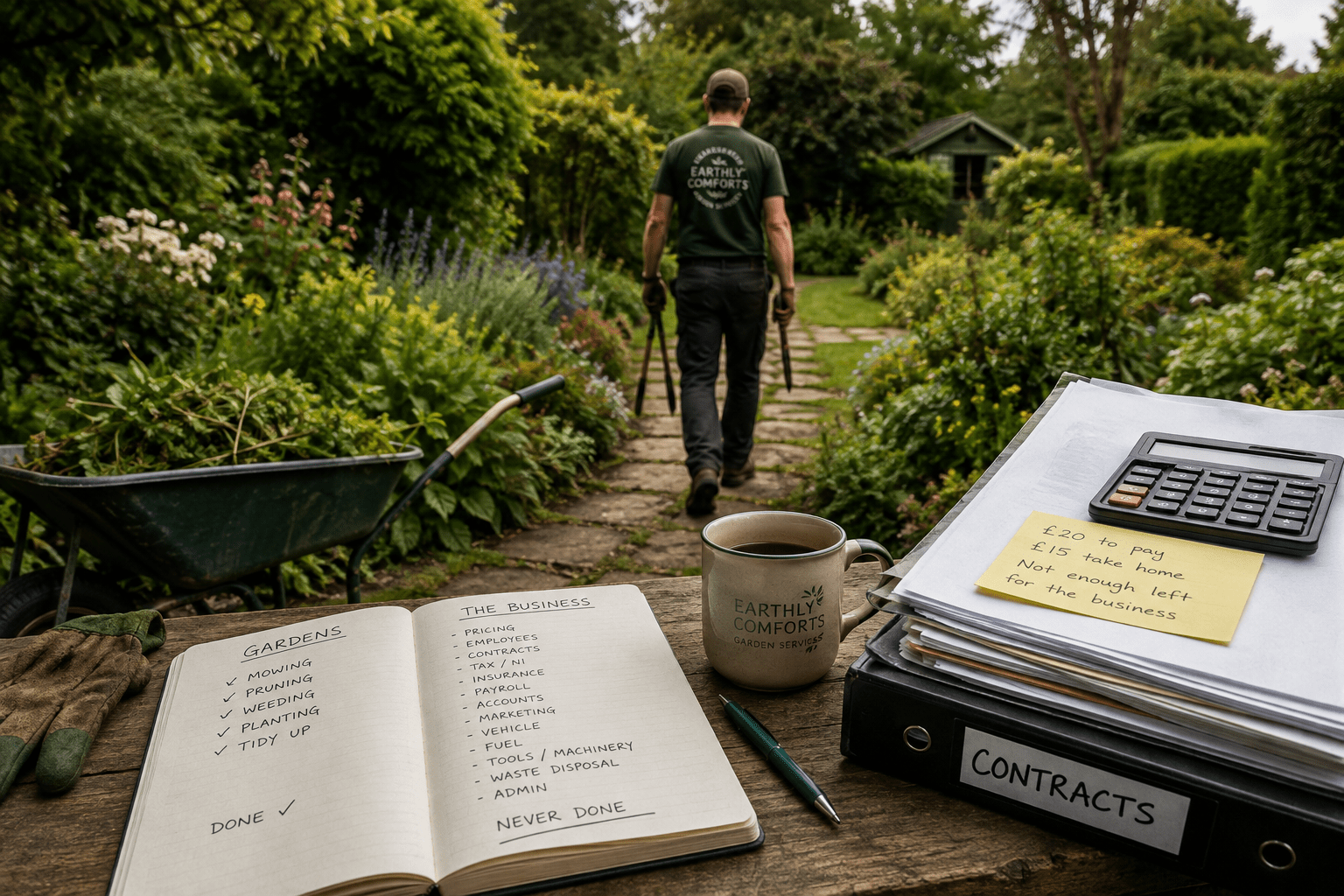
| 1. Working Out What Gardening Actually Costs Setting a sustainable price has been one of the hardest things we have done. Once you employ people, you cannot simply look at what other gardeners charge and choose a similar figure. You have to understand what providing an hour of professional gardening actually costs. Butler K demonstrated that rather neatly. When he was self-employed, we paid him £15 an hour, and he dealt with his own tax and National Insurance. Once employed, if we want him to walk away with roughly £15-£16 an hour after deductions, we need to pay him around £20 an hour. And £20 isn’t the end of the calculation. Employment brings additional costs, even when the company still has insurance, machinery, vehicles, fuel, administration, waste, repairs, and numerous other overheads to cover. That makes one thing painfully obvious. We cannot pay a gardener £20 an hour while looking after a garden that pays the company £20 an hour. The cost of living matters too. We could make the arithmetic easier by paying people less, but gardening is skilled, physical work and people need to be able to live on what they earn. The question, therefore, isn’t “How much can we get away with charging?” It is, “What do we need to charge to employ people properly and still have a viable business?” |
| 2. The Employer Who Works Seven Days One of the stranger things I have discovered about employing people is that having employees doesn’t necessarily mean the owner works less. At this stage, for me, it has meant almost the opposite. The business has to generate enough to pay employees properly before I can think about what I earn myself. I have reached the point where I have little choice but to work seven days a week. Otherwise, I can end up earning less than the people I employ. That is stressful. It also changes how you look at turnover. Money coming into the company isn’t the same as money belonging to the person who owns it. Once wages and all the other costs have been paid, the amount remaining can be surprisingly small. I expected employing people to bring new responsibilities. I hadn’t expected one of those responsibilities to be discovering that I needed to work seven days a week to afford to employ them. |
| 3. Convincing People What Gardening Is Worth Having calculated what professional gardening really costs, you then encounter another problem. Some people don’t believe gardening should cost that much. There is still a perception that a gardener is somebody who arrives with a mower, cuts the grass for an hour and disappears with £15 or £20. Yet wages, machinery, vehicles, fuel, insurance, waste disposal and administration have all become considerably more expensive. The cost of living has changed as well. If gardening businesses don’t increase what they pay, good people will understandably find work elsewhere. So we find ourselves trying to market professional gardening at a price higher than some people think gardening is worth. The cost of providing the service has moved considerably faster than the public perception of what a gardener ought to cost. |
| 4. Becoming an Employer — and the Contracts Butler K originally worked with us on a self-employed basis. He wanted something different: he wanted to be properly employed by Earthly Comforts. We agreed, and that seemingly straightforward decision changed an enormous amount behind the scenes. PAYE, National Insurance, holidays, payroll, insurance and employment rights became our responsibility. It also changed the way we looked at every garden because once you understand the real cost of employing the person standing in it, some of the old hourly rates no longer make sense. Then there are employment contracts. They are hard graft. I remember employment contracts in the 1980s and 1990s being four pages long. Today, even a fairly basic, properly prepared contract can easily run to ten or fifteen pages. Working hours, seasonal variations, breaks, holidays, bank holidays, probation, duties, sickness, notice periods, and numerous other eventualities must all be considered. Gardening doesn’t fit neatly into a standard nine-to-five template either, because our working year changes with daylight, weather, seasons and workload. I don’t object to employees having proper protection—quite the opposite. If somebody works for us, I want them to know where they stand and to be treated properly. I underestimated how much work goes into producing the piece of paper that says so. |
| 5. Sole Trader to Limited Company Earthly Comforts began as a sole-trader business four years ago. In 2026, we began moving it into a limited company, which sounds considerably easier than it actually is. Banking, accounting, insurance, payroll, assets, invoices and responsibilities all have to move from one structure into another. Meanwhile, the gardening business continues to operate during the transition. There isn’t a convenient button marked “Become Ltd”. At times I rather wish there were. |
| 6. Goodbye Manual Administration Much of our administration grew organically alongside the business. Eventually, we reached the point where manual systems could no longer support where Earthly Comforts was headed. That has meant moving administration into the digital world and, particularly, changing from manual invoicing to QuickBooks. In the long term, it should make things considerably easier. Getting there has been anything but simple. You have to learn the new system while making sure nothing disappears from the old one. At the same time, invoices still need to be sent, payments still need to be recorded, and employees still need to be paid. Digital administration may eventually save us time. During the transition, it seems remarkably good at consuming it. |
| 7. Finding and Employing the Right People Finding somebody who likes gardening isn’t the same as finding somebody who can work as a gardener. The job is physical, skilled and extraordinarily varied. We need people who can work in real residential gardens, learn, use machinery safely, deal appropriately with clients and recognise the limits of their own knowledge. Then we have to make sure we’re using those people sensibly. There is little point in paying an experienced gardener to spend hours hauling green waste if someone on a lower wage can do the work perfectly well. Growing a workforce isn’t simply about having more people. It is about having the right people doing the right work at the right cost. Building that team has been considerably harder than I imagined. But this also includes people services – like accountants, HR and book-keepers. |
| 8. When a Garden No Longer Adds Up Some clients have been with us since Earthly Comforts was a very different business, and their hourly rates reflect that. Unfortunately, the cost of providing their gardening services hasn’t stayed the same. Even transitional rates of £22.50 or £23.50 an hour, which can understandably look like substantial increases to somebody previously paying £20, don’t leave much for the business once wages, employment costs and overheads are taken into account. That has forced us to confront something uncomfortable. A gardening business only has a finite number of working hours available each week, and every regular garden occupies one of those slots. If one of those slots is being provided at a concessionary rate while another garden is prepared to pay the sustainable rate, the economic answer is fairly obvious. The human answer isn’t. Gardeners develop relationships with their clients. We get to know them, their gardens, what has been planted, what has struggled, what needs doing next and often what has happened there over several years. It makes perfectly good business sense to let a lower-paying garden go and replace it with one paying the proper rate. That doesn’t make it an easy decision. Clients don’t necessarily see the decision being made behind the scenes. They see their gardener and an hourly price. We see an employee who needs a proper wage, the cost of employing them, a business that needs to remain viable and a limited number of hours in which to generate that income. We have tried to bridge the gap with transitional rates and concessions rather than imposing enormous increases overnight. But that has also made us realise that we may not be able to keep every garden. Some are too far behind the rate they would need to pay. Increasing them immediately to a sustainable figure could mean imposing a price rise we wouldn’t feel comfortable asking a longstanding client to accept. So sometimes the garden we would genuinely like to keep may also be the garden the business can no longer afford to keep. That is stressful in a way the garden itself never was. |
| 9. The Soil Hub The Soil Hub began with a fairly simple idea. We generate enormous quantities of green material, so rather than treating it all as waste, could we process it ourselves and turn it back into something useful? The first problem was finding somewhere to do it. After a considerable search, we now have a good-sized field. That was a major hurdle cleared. Now comes the next one. We have roughly 100 tonnes of existing green material that needs to be moved to the new site. Then we have to work out the logistics of the site itself: access, material movement, schematics, composting ovens, construction, and all the supporting facilities needed to make the Soil Hub function. Finding the field was difficult. Turning an empty field into a functioning Soil Hub will be an entirely different adventure. |
| 10. The Van and the Parking Permit We bought our Renault Kangoo in June. The van works, does what we bought it for, and wasn’t the problem itself. The problem was parking it. Sandwich’s parking permit arrangements had changed, so something as mundane as establishing where our working vehicle could legitimately live became another administrative exercise. It sums up small-business life remarkably well. You solve one problem by buying a van, only to discover that the next problem is finding somewhere you’re allowed to put it. |
| So Where Are the Gardens? They’re not on the list. There are no stressful gardens. I can walk into a neglected garden, look at an enormous clearance, stand in front of something wildly overgrown or discover that the ground is like concrete and think about how we’re going to tackle it. Those are challenges. They’re problems to solve. More importantly, they’re the reason I chose to do this. What clients don’t necessarily see is everything that stands behind the gardener who arrives at their gate: pricing, wages, employment contracts, PAYE, insurance, payroll, accounting software, recruitment, vehicles, parking permits, waste management, and all the other machinery of running a modern gardening business. Nor do they necessarily see the decisions about whether we can afford to keep a particular garden. Whether its regular slot could support another employee. Whether increasing the price is fair to the client. Whether keeping a concession means I have to work another Sunday to make up the difference. Those are the stressful bits. Most of my top ten stresses therefore happen before I ever walk into the garden. Then I walk through the gate. And that’s when the stressful bit stops. Because the gardens are why I do this job. |
| About our writing & imagery Most articles reflect our real gardening experience and reflection. Some use AI in drafting or research, but never for voice or authority. Featured images may show our photographs, original AI-generated artwork, or, where stated, credited images shared by others. All content is shaped and edited by Earthly Comforts, expressing our own views. |

