| Part Two Why Edging Changes Everything |
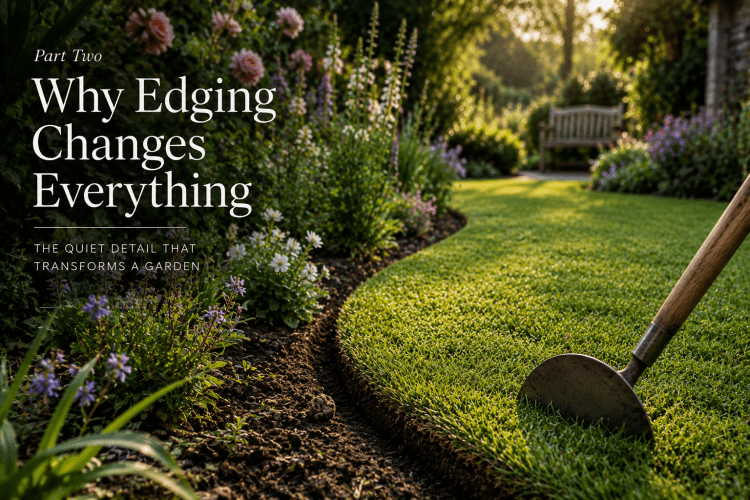
| Some gardening jobs attract admiration almost effortlessly. A rose in full bloom rarely goes unnoticed. A magnificent tree has a habit of stopping people in their tracks, and a border overflowing with colour will often earn an appreciative comment from anyone passing by. Then there are the quieter jobs. The ones that, if they are done well, hardly anyone mentions at all. Lawn edging sits firmly in that second group. I have lost count of the number of times I’ve spent the better part of an hour cutting crisp edges around a garden, only for the client to say, “The whole garden looks lovely.” They rarely point to the edge itself. They aren’t meant to. What they are really seeing is something far more subtle. Their eyes have become comfortable. That has always fascinated me. A narrow strip of soil separating grass from border shouldn’t carry so much influence, yet somehow it does. The plants haven’t changed. The lawn hasn’t become greener. The borders haven’t suddenly filled with more flowers. All that has happened is that one untidy line has become a deliberate one, and suddenly the entire garden appears calmer. It makes me wonder whether we notice order far more than we realise. Perhaps that is why untidy edges have such an unsettling effect. They rarely leap out at us in isolation. Instead, they quietly blur the boundary between one part of the garden and the next. Grass begins to wander into the border. Soil spills back onto the lawn. Plants appear to lose their shape, even though they are growing perfectly well. Nothing looks dramatically wrong, but everything feels just a little less cared for. Nature, of course, has no interest whatsoever in straight lines. Left entirely to itself, a lawn has no ambition to remain a lawn. Given enough time, it slowly begins a conversation with everything around it. Grass creeps into flowerbeds, self-seeded plants appear where nobody invited them, moss settles into the gaps and weeds quietly exploit every opportunity. None of this is malicious. It is simply what living landscapes do. Gardening, in many ways, is deciding which conversations to encourage and which ones to interrupt gently. That is why I have never thought of edging as simply cutting grass. It is closer to drawing a boundary than performing maintenance. It tells the eye where one space finishes and another begins. We often talk about creating structure in gardens through walls, hedges and paths, yet one of the strongest pieces of structure is often no more than a line a few centimetres wide. The curious thing is that people rarely notice the line itself. They notice how the garden makes them feel. Over the years, I have become convinced that many clients don’t actually want perfection. They want reassurance. They want to step outside and feel that somebody has quietly been looking after things. A crisp edge does exactly that. It whispers rather than shouts. It suggests that someone cared enough to finish the job properly. That final part matters. Finishing. There is a temptation in modern life to measure work by how much has been completed. Gardens don’t always work like that. Sometimes the difference between an average visit and an exceptional one is found in the last twenty minutes rather than the first three hours. Those final touches—the edging, the sweeping, the small adjustments that no one specifically asked for—often shape the lasting impression far more than the larger jobs that occupied most of the day. It reminds me a little of polishing a pair of shoes. Nobody admires polished shoes in isolation. They simply notice that someone looks well presented. The same is true of a neatly edged lawn. Very few visitors will crouch down and compliment the precision of the cut. They’ll simply think the whole garden feels cared for. There is another side to edging that receives far less attention. Edges are wonderful places to observe. They reveal where moisture is lingering after rain. They show which plants are beginning to lean into the lawn. They often expose ant activity, slug trails and the first signs of weeds establishing themselves before they become a larger problem. Even the colour of the soil tells its own story. Rich, damp earth looks very different from dry, dusty ground that is quietly asking for help. In that sense, edging becomes far more than a cosmetic exercise. It is one of the moments when a gardener slows down enough to notice the finer details. Walking carefully around the perimeter of a lawn brings you face to face with almost every border in the garden. You notice the self-seeded foxglove that has appeared in exactly the right place. You spot the young ash sapling that has arrived courtesy of the wind and probably shouldn’t stay. You find the tiny spider’s web glistening with morning dew between two stems that would have gone completely unnoticed had you hurried past. It is surprising how often wildlife benefits from this slower pace as well. A blackbird is usually the first to realise that the edging tool has come out. They know disturbed soil often reveals insects and worms, and before long they are following at a respectful distance, just close enough to take advantage without appearing rude about it. Robins are even less concerned with etiquette. Some seem perfectly happy to supervise the entire operation from just a few feet away, as though checking the work meets their approval. Moments like that have taught me that good gardening isn’t simply about making spaces look attractive. It is about understanding that we share them. That is one reason I have never chased perfect geometry for its own sake. There are gardens where razor-sharp edges suit the design beautifully. There are others where a softer, more relaxed line feels entirely appropriate. The trick is not producing the straightest edge possible. The trick is creating an edge that belongs to that particular garden. Gardening is full of these small decisions. They rarely appear in books because they don’t lend themselves to simple rules. No chart can tell you precisely how formal a lawn should feel, or exactly how much softness a cottage garden wants around its borders. Those decisions emerge through observation, familiarity and, if I’m honest, a little intuition developed over many years. Perhaps that is the hidden craft. Not the ability to cut a neat edge. Almost anyone can learn the technique. The craft lies in recognising when that edge has become part of the garden rather than simply a line around it. Once you begin to notice that, it becomes difficult to look at gardens in quite the same way again. The funny thing is that edging isn’t even the quietest job we do. There is another task that almost nobody notices until it hasn’t been done, yet it has an extraordinary ability to change the atmosphere of an entire garden. It happens right at the end of the visit, usually with a broom rather than a spade. And it deserves far more credit than it ever receives. |
| About our writing & imagery Most articles reflect our real gardening experience and reflection. Some use AI in drafting or research, but never for voice or authority. Featured images may show our photos, original AI-generated visuals, or, where stated, images credited to others. All content is shaped and edited by Earthly Comforts, expressing our own views. |

