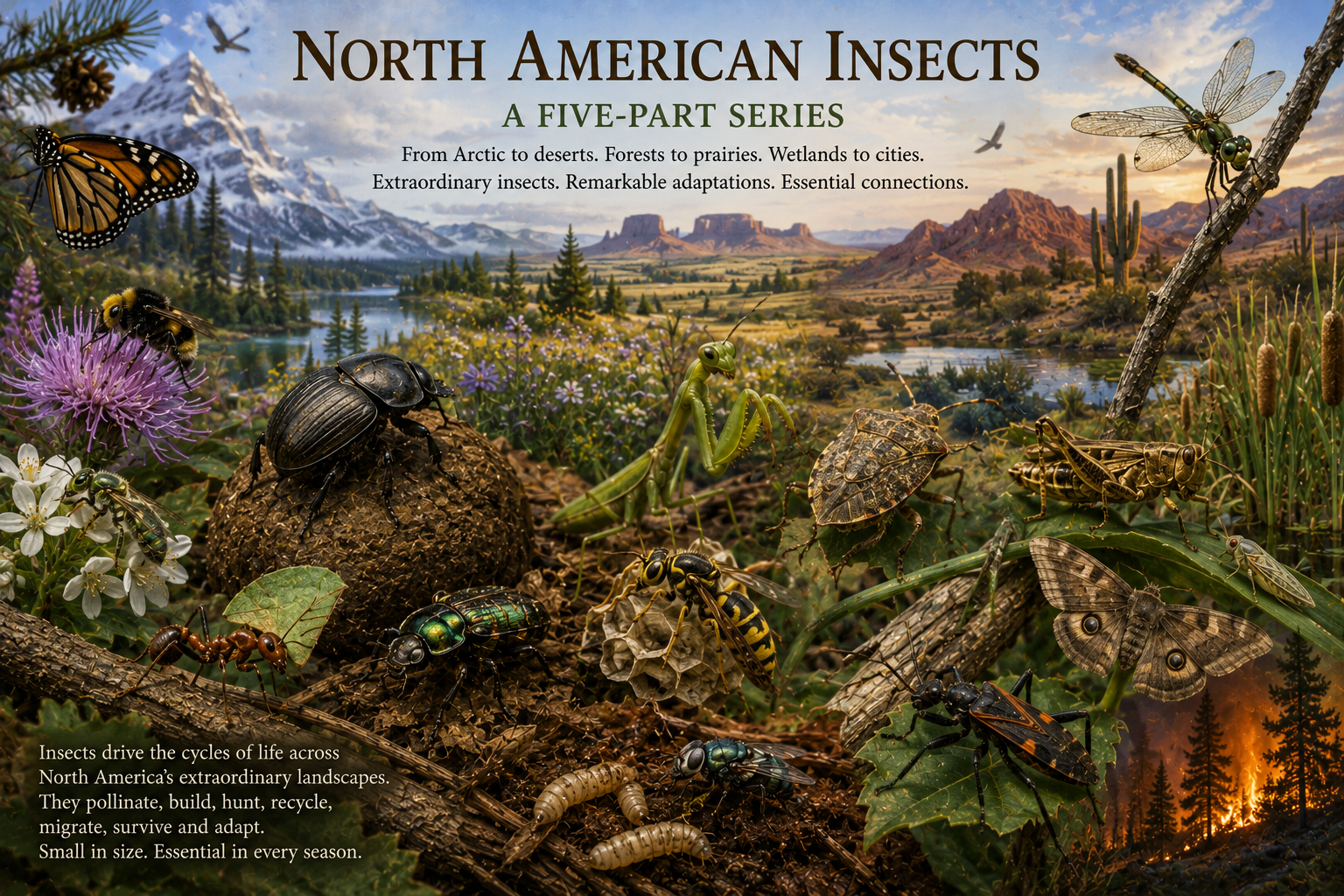
| A 5-Part Series |
| A curated exploration of North America’s most iconic, curious, and ecologically important insects |
| North America is a continent where insects have had to become remarkably adaptable. From the frozen ground of the far north to the deserts of the south-west, and from vast forests and open prairies to wetlands, mountains, farmland and increasingly urban landscapes, there is no single set of conditions that defines insect life here. The most striking feature is change. Winter can close down entire landscapes for months, while spring produces sudden abundance. Rain transforms dry ground, drought removes resources almost as quickly, and fire, storms and temperature extremes continually reshape habitats. For insects, survival often depends upon being able to respond at precisely the right moment. Some solve the problem collectively. Ants build protected systems beneath the soil, while bees and wasps connect plants and regulate other insect populations above it. Others move. Monarch butterflies cross extraordinary distances as successive generations follow the seasons, while painted ladies appear when conditions favour them and disappear again when those conditions change. Closer to the ground, beetles perform another kind of work. They hunt, recycle dung, dismantle dead wood and return nutrients to the soil. Grasshoppers, crickets and flies respond rapidly to periods of abundance, becoming food for the predators that follow them. Mantids, dragonflies and assassin bugs complete another part of the cycle, controlling prey through patience, speed or extraordinary precision. What interests me as a gardener is not simply the variety of insects, but the connections between them. A flower supports a pollinator; vegetation feeds a grasshopper; the grasshopper feeds a predator; fallen timber supports beetles; decomposition returns nutrients to the ground, and eventually another generation of plants begins. Gardens participate in these relationships too. However managed they may be, they remain pieces of a much larger landscape. A patch of bare soil, an old stem, a little dead wood, flowering plants or a modest pond can become part of an insect’s lifecycle. We do not have to recreate wilderness to make room for wildlife; sometimes we need to recognise what is already trying to live alongside us. Across these five episodes, we will look at North American insects not as a collection of curiosities, but as participants in systems built around movement, timing, abundance, decomposition and predation. The individual species may be small. The processes they maintain are anything but. |
| About our writing & imagery Most articles reflect our real gardening experience and reflection. Some use AI in drafting or research, but never for voice or authority. Featured images may show our photos, original AI-generated visuals, or, where stated, credited images shared by others. All content is shaped and edited by Earthly Comforts, expressing our own views. |

