| Alchemilla mollis The Plant That Teaches You to Slow Down |
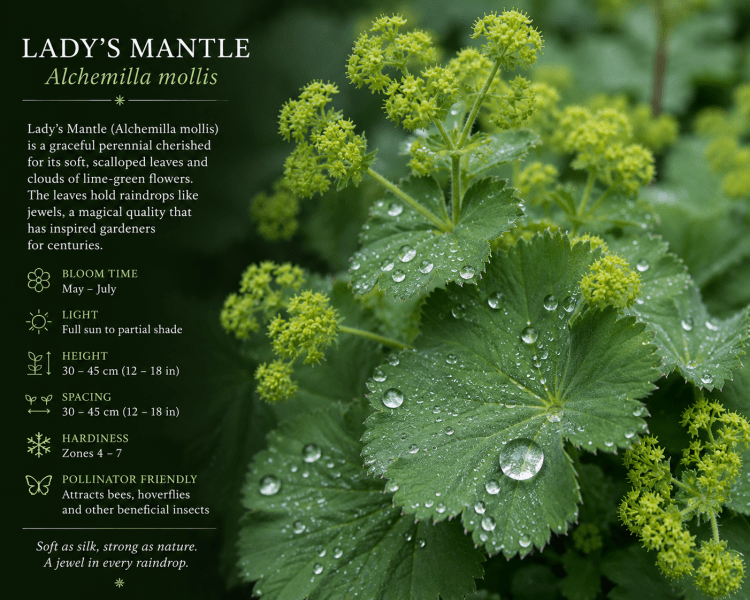
| There are mornings when a garden asks very little of you except that you notice it. As working gardeners, we rarely afford ourselves that luxury. The van needs unloading, tools need preparing, and somewhere there is almost certainly a lawn growing faster than we’d prefer. It is surprisingly easy to spend an entire day in gardens without really seeing them. We notice what needs cutting back, what has failed, what requires watering, what the client has mentioned and what we’ve promised to return to next week. Looking and observing are not always the same thing. It is usually the mornings after overnight rain that interrupt that routine. Before the sun has climbed high enough to dry everything, there is a brief period when every leaf seems to carry its own small world. Hostas cradle pools of water large enough for blackbirds to drink from, grasses bow beneath the extra weight, and spider webs suddenly become visible where, the day before, there appeared to be nothing at all. Somewhere amongst it all, almost without fail, my eye settles on a clump of Alchemilla mollis. If ever there were a plant that rewards those who are prepared to slow down, this is surely it. Nobody visits a garden specifically to admire Lady’s Mantle. It doesn’t possess the grandeur of a flowering rose, the theatrical confidence of a delphinium or the impossible colours of a dahlia. In many ways it is one of those dependable plants that quietly occupies the spaces between everything else. Ask a non-gardener to describe it, and they might struggle. Ask an experienced gardener, and you’ll often see a smile of recognition before they say a word. Its reputation rests not on spectacle but on character. The leaves are the first clue. Softly pleated, almost circular and covered in the finest layer of tiny hairs, they have evolved to hold water in a way that still feels faintly magical however many times you see it. Instead of soaking into the leaf or running away, droplets gather into near-perfect silver spheres that sit on the surface like polished glass. Children are often fascinated by them. Adults, if they happen to notice at all, usually pause for just a moment before carrying on with their day. Perhaps that’s enough. Gardening has an unfortunate habit of convincing us that every plant must justify itself through flowers. Garden centres encourage it. Plant labels encourage it. Television programmes encourage it. We measure success by colour, by months in bloom, by the size of the display and by how many compliments a border receives in June. Alchemilla mollis quietly refuses to compete on those terms. Its lime-green flowers are attractive without ever being dramatic, floating above the foliage like a soft mist rather than demanding centre stage. They do their job admirably, but they are not the reason the plant has remained in gardens for generations. In truth, I suspect its greatest contribution is one that rarely appears on a plant label. It softens. Hard edges become gentler where it spills across the front of a border. Paving appears less severe when leaves lean casually over the edge. The transition between one plant and the next becomes easier on the eye. Good gardens are rarely made from star performers alone. They rely just as much on those dependable companions that quietly connect everything, asking for very little recognition in return. That reliability extends beyond appearance. Once established, Alchemilla mollis is remarkably accommodating. It tolerates a surprising range of soils, copes with periods of dryness better than many people expect and responds cheerfully to being cut back after flowering if it begins to look tired. Even its habit of self-seeding, which some gardeners regard as an inconvenience, often proves rather endearing. I’ve lost count of the number of times I’ve found a seedling growing in exactly the right place. We like to imagine we designed every successful planting combination ourselves, but nature occasionally chuckles at our expense. A self-sown Alchemilla will sometimes appear precisely where another plant was beginning to leave an awkward gap, or where the border needed softening just a little more. Of course, not every seedling deserves to stay, but I’ve learned not to rush to remove them all. Now and then the garden demonstrates that it has rather good judgement of its own. There is a wider lesson hidden amongst those rain-soaked leaves. The longer I spend gardening professionally, the less impressed I become by plants that spend two glorious weeks demanding applause before fading into anonymity. Increasingly, I find myself appreciating those that get on with the job. They support their neighbours, provide structure, offer interest for longer than we often realise and quietly improve the whole composition without insisting on being the centre of attention. It strikes me that gardens, like people, depend rather more on quiet reliability than dazzling performance. Maybe that’s why Alchemilla mollis has never really gone out of fashion amongst gardeners who live with plants every day. It reminds us that beauty isn’t always loud, usefulness isn’t always obvious, and the finest moments in a garden are often the ones that arrive without announcement. The next time you find yourself walking through a garden after rain, don’t look for the biggest flowers first. Look instead for the plant that has turned a handful of raindrops into something that makes you pause, if only for a few seconds. Sometimes, that is all a garden was hoping you would do. |
| About our writing & imagery Most articles reflect our real gardening experience and reflection. Some use AI in drafting or research, but never for voice or authority. Featured images may show our photos, original AI-generated visuals, or, where stated, images credited to others. All content is shaped and edited by Earthly Comforts, expressing our own views. |

