
| Case File 02 When Myths Became Reality — Animals Once Thought Impossible |
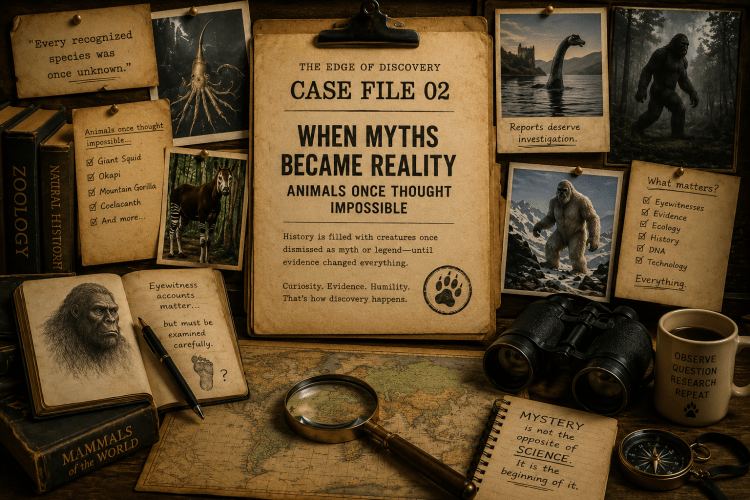
| For much of human history, the boundary between myth and reality has been remarkably thin. Sailors returned from distant voyages with tales of giant creatures rising from the depths, explorers described strange animals that nobody back home believed, and indigenous communities spoke confidently about species that science insisted could not exist. Time and again, these accounts were dismissed as exaggeration, misunderstanding or folklore. Occasionally, they were exactly that. Now and then, however, history delivered an unexpected twist. The creature in question turned out to be entirely real. One of the greatest mistakes we can make when discussing cryptozoology is assuming that history is neatly divided into fact and fiction. It is not. Instead, it is filled with observations waiting for evidence. Sometimes that evidence never appears. Sometimes it arrives centuries later. The purpose of this Case File is not to suggest that every cryptid will eventually be discovered. That would be an extraordinary claim requiring extraordinary evidence. Rather, it is to remind us that the history of zoology contains numerous occasions when accepted knowledge changed because someone was willing to investigate the improbable rather than dismiss it. Perhaps no animal illustrates this better than the giant squid. For generations, sailors described immense tentacled creatures capable of dragging ships beneath the waves. Those stories grew with every retelling until they became inseparable from legends of the Kraken. Scientists largely regarded such tales as products of fear, poor visibility and overactive imaginations. Yet fragments occasionally washed ashore—enormous suckers, strange beaks and lengths of tentacle unlike anything else known. Gradually the evidence accumulated. Dead specimens were recovered, then studied. Finally, in 2004, researchers photographed a living giant squid in its natural environment for the first time. What had once been dismissed as little more than maritime folklore was revealed to be one of the largest invertebrates on Earth. The monster had become an animal. The story of the okapi follows a very different path but reaches a similar destination. Long before European scientists had heard its name, the people of the Ituri Forest in what is now the Democratic Republic of Congo knew the animal well. To them it was neither mysterious nor mythical. It simply belonged to the forest. Western explorers, however, struggled to believe descriptions of an elusive creature with the body of a horse, the striped legs of a zebra and the long tongue of a giraffe. Such combinations sounded impossible. They were not. When specimens finally reached Europe in the early twentieth century, zoologists realised they were looking not at some bizarre horse, but at the giraffe’s closest living relative. The animal had existed all along. Only scientific recognition had been missing. A similar story unfolded with the mountain gorilla. Today it is one of the world’s most recognisable great apes, yet there was a time when reports of enormous man-like apes inhabiting the forests of central Africa were dismissed as fantasy. Local communities had lived alongside them for generations, but to many outsiders, they belonged more comfortably in legends than in zoology. It was only during the early twentieth century that the mountain gorilla became fully recognised by science, transforming from rumour into one of our closest living relatives. Perhaps the most astonishing rediscovery of all emerged not from a rainforest but from the sea. For decades, biology textbooks taught that the coelacanth had disappeared alongside the dinosaurs around sixty-six million years ago. It was an evolutionary relic known only from fossils. Then, in 1938, a South African museum curator named Marjorie Courtenay-Latimer examined the catch of a local fishing trawler and noticed an extraordinary blue fish unlike anything she had ever seen. Further investigation confirmed the impossible. The coelacanth had never become extinct. It had simply continued living beyond the reach of modern science. Enthusiastic cryptozoologists often use stories like these as proof that creatures such as Bigfoot or the Loch Ness Monster must also exist. That is a tempting conclusion, but the evidence does not support it. The rediscovery of one species does not validate every subsequent unexplained report. Science does not work by association. What these discoveries do demonstrate is something both simpler and far more important. They show that certainty should always remain open to revision. Every one of these animals teaches exactly the same lesson. They were never mythical creatures. They were real animals waiting for sufficient evidence. That distinction matters enormously. There is another lesson hidden within these stories that is too often overlooked. In every case, local people already knew the animal existed. European science did not discover the okapi. It discovered that the okapi existed. Those are two very different things. The same pattern repeats throughout natural history. Indigenous knowledge has frequently preserved accurate observations of wildlife long before those observations appeared in scientific journals. That does not mean every traditional story is literally true, but it reminds us that knowledge exists in many forms and deserves respectful consideration before dismissal. As I look back over my own life, this lesson resonates strongly. Long before I became interested in scientific papers or eyewitness databases, I had already encountered a world where extraordinary animals seemed perfectly ordinary. My childhood in Malaysia introduced me to stories of the Orang Mawas. At the same time, visits to Singapore’s Tiger Balm Gardens immersed me in folklore, mythology and creatures that blurred the boundaries between imagination and reality. Those experiences planted questions rather than answers. Years later, while working professionally with exotic mammals, I experienced another reminder that the known world is already astonishing enough. Standing beside a fully grown liger is difficult to describe until you have done it yourself. Photographs cannot convey the sheer scale of the animal. Its immense paws, muscular frame and unusual combination of lion and tiger characteristics make it appear almost fictional. If somebody had described such an animal to me before I had seen one, I might well have questioned whether it could really exist. Yet there it stood, only a few feet away, reminding me that nature often exceeds our expectations. My father understood something similar. He had always admired tigers, and years after his service with the Royal Australian Air Force in Malaysia, he had the opportunity to sit beside Tessa, a magnificent Siberian tigress at Hamerton Wildlife Park. Whenever I look at that family photograph, I do not see evidence for cryptozoology. I see something far more valuable. I see respect. Respect for an animal whose power, beauty and presence are impossible to appreciate fully until you are close enough to hear it breathe. That is the greatest lesson of all. The natural world does not need embellishment. Reality already possesses an extraordinary ability to surprise us. Cryptozoology sometimes forgets this. In the excitement of searching for unknown creatures, it is easy to overlook the astonishing animals we already know exist. Yet it is those very animals that should keep our minds open. Not open enough to believe every story unquestioningly, but open enough to recognise that history occasionally rewards curiosity. Every recognised species was once unknown. Every accepted discovery began with uncertainty. Most mysteries will eventually find ordinary explanations. A very small number may change the way we understand the natural world forever. The challenge—and the privilege—is learning to tell the difference. |
| From The Edge of Discovery Archive Archive Item 003 – Tessa |
| My father beside Tessa, the captive-bred Siberian tigress at Hamerton Wildlife Park. His lifelong admiration for tigers, together with stories from his years in Malaysia and Borneo, helped shape my own respect for remarkable wildlife. |

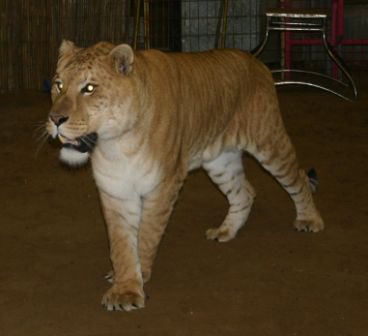
| From The Edge of Discovery Archive Archive Item 004 – The Liger |
| During my years working professionally with exotic mammals, I encountered a fully grown liger. Standing beside such an extraordinary hybrid is a reminder that reality is often more remarkable than imagination. |
| Case Assessment History reminds us that accepted knowledge is never truly finished. Animals such as the giant squid, okapi, mountain gorilla and coelacanth demonstrate that remarkable discoveries are possible, but they do not prove every cryptozoological claim. Their real value lies elsewhere. They teach us to approach mystery with curiosity, evidence and humility, recognising that the natural world still has the capacity to surprise us without abandoning the rigour needed to distinguish fact from fiction. |
| About our writing & imagery Most articles reflect our real gardening experience and reflection. Some use AI in drafting or research, but never for voice or authority. Featured images may show our photographs, original AI-generated artwork, or, where stated, credited images shared by others. All content is shaped and edited by Earthly Comforts, expressing our own views |


What a beautiful tigeress and the liger is very interesting. I had never seen a picture of one.
LikeLiked by 1 person
They are seriously impressive – both species. I had worked with tigers and lions for years with my livestock business. But the ligers are very different. A once in a lifetime experience.
LikeLiked by 1 person