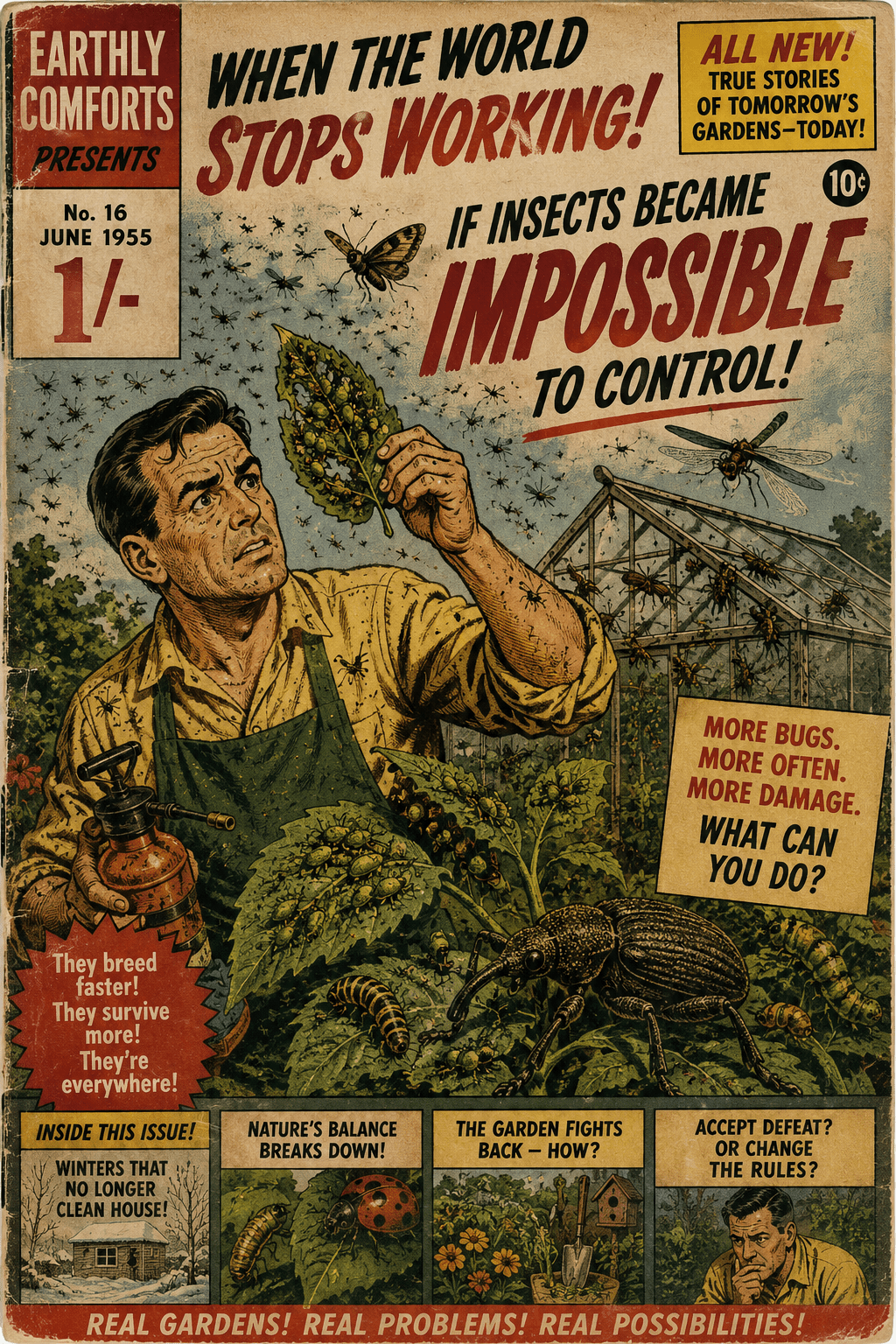
| There is a moment most gardeners recognise when you look at a plant and wonder how something so small has managed to cause quite so much trouble. Yesterday the rose looked perfectly respectable; today every tender shoot appears to have acquired its own aphid population. The cabbages were doing beautifully until the caterpillars discovered them, and something has been eating the hostas with such enthusiasm that you begin to suspect reservations are being taken. Gardening has always involved sharing the place with insects, although occasionally nobody seems to have explained to the insects quite how much sharing we had in mind. Most of the time, we muddle along together reasonably well. Some insects we actively encourage, others we tolerate, and a relatively small number cause us to reach for whatever method of persuasion seems appropriate. Experience eventually teaches you not to panic simply because something with six legs has appeared on a leaf. A healthy garden should contain insects. Bees, hoverflies, beetles, butterflies, moths, wasps and countless creatures we barely notice are part of the machinery that keeps the garden functioning. Even the ones we dislike usually have a place somewhere in the system. However, I confess that when vine weevil larvae are eating their way through the roots of a favourite plant, philosophical acceptance becomes considerably more difficult. But suppose the problem wasn’t that insects disappeared. We’ve already imagined that particular future, and it wasn’t terribly encouraging. Suppose instead they became extraordinarily successful. Not giant insects, not enormous beetles overturning wheelbarrows or houseflies carrying off the secateurs. Nothing quite so obligingly ridiculous. Imagine simply that the conditions around us gradually became better for certain insects than they were for us: longer warm periods, milder winters, changing rainfall and growing seasons stretching further at both ends. Some species might struggle, certainly, but others could find themselves enjoying circumstances so favourable that the garden began to feel less like somewhere they visited and rather more like somewhere they’d taken out a long lease. At first, we might be delighted. More butterflies dancing around the borders wouldn’t exactly suggest impending doom, and few gardeners would complain about seeing greater numbers of bees working the flowers. After years of hearing about insect decline, an apparently insect-rich summer might feel reassuring. We’d photograph them, count them and congratulate ourselves that perhaps nature was recovering after all. Then somebody would notice that the aphids seemed unusually numerous. The following week there would be rather more caterpillars than expected. Ant colonies would appear beneath paving we’d never previously known contained ants, and the greenhouse might suddenly support an impressive population of creatures we had absolutely no recollection of planting. The unsettling part wouldn’t be the arrival of anything particularly exotic. It would be the familiar insects behaving with unfamiliar success. Gardeners are accustomed to aphids appearing in spring, but we’re also accustomed to predators eventually finding them. Ladybirds arrive, hoverfly larvae begin feeding, birds take their share, and the numbers usually settle into something resembling a balance. But nature’s balances depend heavily on timing. If one species began reproducing earlier, survived winter more successfully, or squeezed another generation into a longer summer. At the same time, its predators continued to follow their old timetable, that balance could become surprisingly fragile. Nobody would need to mutate. Nobody would need to evolve a sinister plan. One side would have turned up for work three weeks earlier than everybody else. Professional gardeners would probably notice first, because one of the advantages of working across many gardens is that you begin seeing patterns. Aphids covering one client’s roses are aphids covering one client’s roses. Finding the same thing in ten gardens starts becoming interesting. By the twentieth, you might begin wondering whether something has changed. We’d hear the same remarks repeatedly: I’ve never seen so many of them, or we didn’t used to get these here. At first we’d reassure people, because most insect outbreaks really are temporary. Eventually, though, we might find ourselves saying the same reassuring words while privately wondering whether we still believed them. Garden centres, naturally, would rise magnificently to the occasion. Entire aisles would appear devoted to restoring order. There would be sprays, traps, sticky cards, barriers, biological controls and bottles containing quantities so small you’d assume the contents had been distilled from unicorn tears. Every problem would have a product and every product would have a photograph of an exceptionally healthy plant on the label. For a while, we’d probably buy them. Human beings are rather fond of solutions that come with instructions on the back. The trouble is that gardens are complicated places, and insects haven’t organised themselves into convenient groups labelled helpful and unhelpful. A caterpillar chewing a leaf might eventually become a butterfly we actively encourage. Wasps can become extremely unpopular around the patio while simultaneously hunting insects that damage plants. Ants may irritate us on the pavement while performing useful work elsewhere. Even aphids, which test the patience of almost every gardener at some point, support predators that we very much want to keep. The more aggressively we tried to remove everything causing inconvenience, the greater the risk that we’d also remove the creatures keeping something considerably worse under control. There would be a wonderful irony in that. In attempting to control insects, we might make insects harder to control. Eventually we’d have to change the question. Instead of asking, How do I kill this?, we’d begin asking, Why is there suddenly so much of it? That is a much more interesting gardening question. Perhaps the plant is stressed. Perhaps the conditions particularly favour one species. Perhaps we’ve created a garden offering enormous quantities of one food source and then wondered why the creature that eats it has moved in. Nature is very good at spotting opportunities, and a row of identical vegetables is, from an insect’s point of view, less a horticultural achievement than a conveniently organised restaurant. Our gardens might begin changing in response. Rather than trying to make them increasingly sterile, we could find ourselves making them more diverse. More flowers across longer periods would support predatory and pollinating insects. Ponds would attract a wider range of creatures. Shrubs and trees would provide places for birds, while some fallen leaves and less-disturbed corners would shelter beetles and other predators. The garden may become less tidy to become more resilient. There would still be limits, of course. Nobody needs to surrender the greenhouse to whitefly in the interests of ecological harmony, and watching an entire crop disappear beneath caterpillars is unlikely to awaken anyone’s inner philosopher. But we’d become more selective about the battles worth fighting. Winter would become part of the conversation too. Gardeners spend much of January complaining about cold, wet feet and wondering why anybody ever thought outdoor work was a sensible career, but winter performs jobs we rarely notice. Cold weather interrupts growth, alters life cycles and reduces the survival of some pests. If winters became consistently milder, certain insects wouldn’t need to become more aggressive to become troublesome; more of them might survive until spring. The starting line would move. By the time we’d traditionally begun watching for a problem, the problem might already be comfortably established and we’re wondering what had taken us so long. That is where this imagined future begins to feel slightly less imaginary. It doesn’t require every insect species to increase. It doesn’t require a plague descending from the sky. Ecological change is rarely so obligingly simple. Some insects could decline while others prosper. New species might gradually extend their range. Familiar ones could appear at different times or produce more generations when conditions allowed. What gardeners would experience wouldn’t necessarily be more insects in every sense. It would be a garden in which the old relationships had become less dependable. That could be the hardest part. Gardeners accumulate knowledge through repetition. We remember roughly when things happen because we’ve watched them happen year after year. We know when certain pests tend to appear, when birds begin nesting, when blossom should open and when winter usually brings the whole performance to a temporary halt. If those timings started drifting, we’d have to learn the garden again. Not completely, but enough to make experience feel less like a rulebook and more like a collection of useful suggestions. Perhaps, after a few difficult years, we’d stop talking about insect control altogether. We’d talk instead about insect management, tolerance and balance. We’d protect the plants that genuinely needed protecting and accept a little damage elsewhere. Netting might become more important than spraying. Resistant plants might replace those that repeatedly struggled. We might stop expecting every leaf to be perfect, because a garden containing nothing willing to eat a leaf is probably not the healthy garden we imagine it to be. There would still be mornings when all this ecological wisdom temporarily deserted us. You’d arrive at a garden to discover that something had eaten precisely the plant you were most pleased with, while leaving untouched the three plants beside it that you wouldn’t have minded losing. Nature has always possessed an exquisite sense of comic timing. You’d stand there examining the remains, mutter something about biodiversity that wasn’t entirely complimentary, and then get on with the day’s work. That, ultimately, is what gardeners do. If insects ever became impossible to control, I don’t think we’d lose our gardens. We’d change them. We’d become better observers, more cautious interveners and probably rather less convinced that neatness and health are the same thing. Some years we’d win; other years the aphids would. There would be plants we’d stop growing, techniques we’d abandon and new habits that eventually became so ordinary we’d wonder why we’d ever gardened differently. The insects wouldn’t have conquered anything. They wouldn’t need to. They’d have continued doing what insects have done for hundreds of millions of years: adapting, reproducing and taking advantage of whatever opportunities happened to appear. We, meanwhile, would have learned another of gardening’s recurring lessons. Control is a wonderfully comforting idea, right up until nature reminds us that it never actually agreed to it. And somewhere beneath a rose leaf, an aphid would carry on eating breakfast, blissfully unaware that it had become part of the apocalypse. |
| About our writing & imagery Most articles reflect our real gardening experience and reflection. Some use AI in drafting or research, but never for voice or authority. Featured images may show our photographs, original AI-generated artwork, or, where stated, credited images shared by others. All content is shaped and edited by Earthly Comforts, expressing our own views. |

