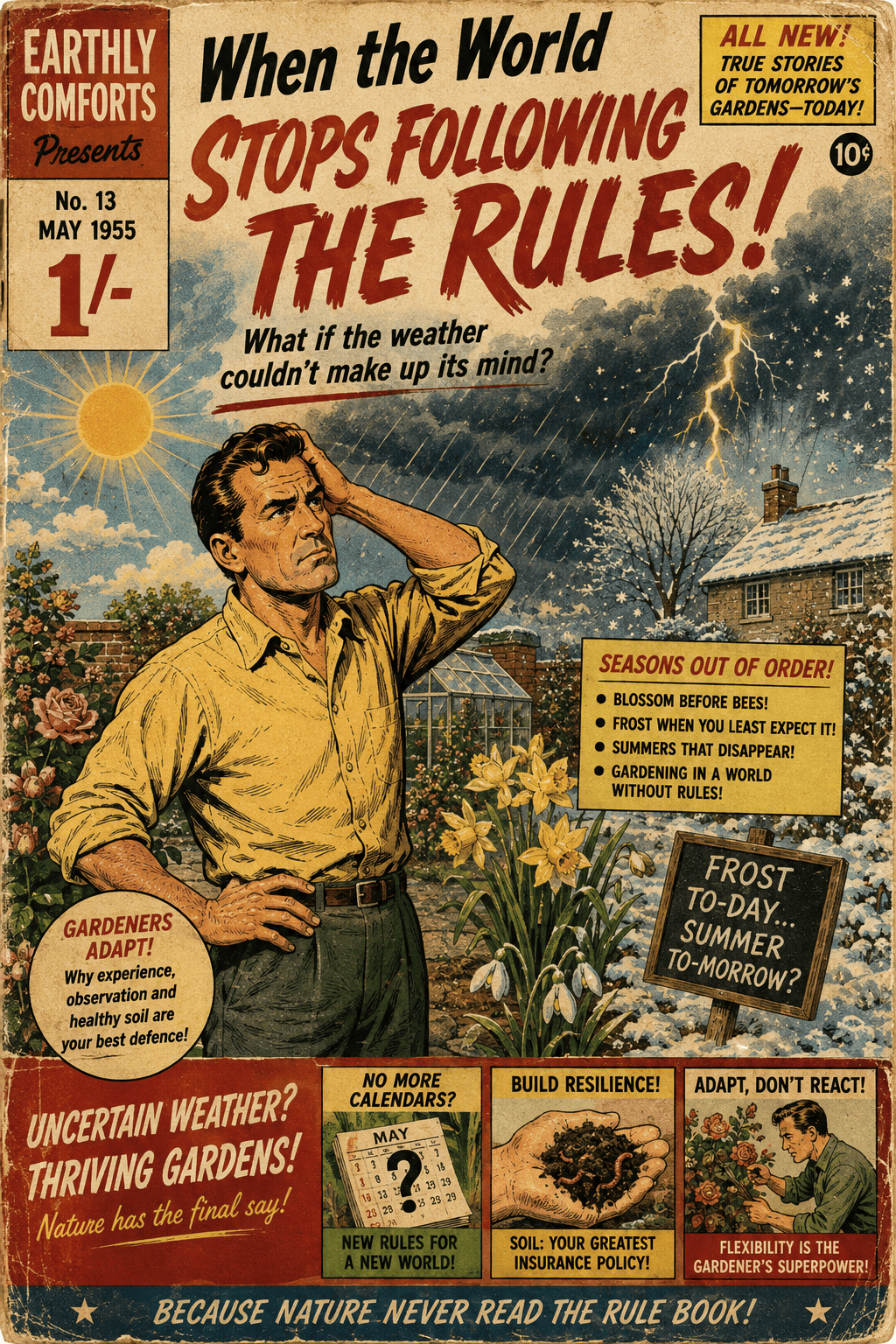
| One of the curious things about being a gardener is that you eventually stop looking at the calendar quite so often. Instead, you begin measuring the year by what is happening outside. The first daffodils announce that winter is beginning to loosen its grip. Hawthorn blossom quietly tells you spring has settled in properly. Roses suggest that summer has arrived, while the first falling leaves remind you that another season is preparing to take its place. After enough years, you develop an instinct for these things. You don’t consciously think about it; you know where the year ought to be. Or at least, that used to be true. Lately, I’ve found myself standing in gardens that seem to have misplaced the script. Roses are flowering long after I expected them to stop. Bulbs emerge during unusually mild spells, only to find themselves wondering why winter has suddenly remembered it still has another month to run. Fruit trees break into blossom with great enthusiasm before a late frost quietly undoes weeks of careful preparation. None of these things is entirely new. Gardeners have always accepted that nature enjoys the occasional surprise. What feels different is that the surprises themselves seem to be becoming rather more frequent. That thought stayed with me one morning after arriving at a client’s garden in early spring. The forecast had confidently promised a dry, bright day, yet I spent the first hour sheltering beneath the tailgate of the van. At the same time, a heavy shower wandered across the garden with absolutely no intention of appearing on anyone’s weather map. By lunchtime the sky had cleared, the sun was warm enough for shirt sleeves, and the birds were behaving as though summer had arrived. Two days later there was frost on the lawn. If I’d written that down as fiction twenty years ago, someone would probably have suggested I was overdoing it. Which made me wonder what might happen if the weather finally stopped pretending to follow the seasons altogether. Not if Britain became permanently hotter, colder or wetter. We already know how to imagine those futures. Instead, picture a world where the weather became… unreliable. Spring might arrive in February one year, then decide April looked more appealing the next. Summer could disappear for three weeks before returning in September as though nothing unusual had happened. Autumn might linger into January, while winter occasionally turned up in May, apologising politely for being delayed. The remarkable thing is that, at first, most people would laugh. After all, we already treat the weather as Britain’s favourite conversation starter. We joke about carrying sunglasses and waterproofs at the same time, about experiencing four seasons before lunchtime and about never trusting a forecast beyond tomorrow afternoon. Humour has always been one of our more effective coping mechanisms. Gardeners, however, would notice something else beneath the jokes. Plants don’t read calendars. They respond to temperature, moisture, daylight and timing. When those signals become confused, the plants themselves begin making decisions that seem equally confused. Seeds germinate too early. Blossom appears before the pollinators are ready. New growth emerges just in time to meet an unexpected frost. The individual events aren’t necessarily disastrous, but together they begin creating a garden that feels slightly out of rhythm with itself. I’ve often thought that a healthy garden resembles a well-rehearsed orchestra. The birds, insects, trees, flowers, and soil all seem to know roughly when their parts begin. Nobody is following a written score, yet somehow the performance usually comes together remarkably well. The weather has always acted as the conductor, quietly setting the pace without drawing attention to itself. Now imagine the conductor forgetting which page everyone has reached. The music wouldn’t stop. It becomes rather harder to dance to. Professional gardeners are among the first to notice the pattern because we spend our lives moving from one garden to another. One unusually early flowering shrub might be an interesting talking point. Twenty clients, all asking why their roses have flowered twice before August begins, feel rather more significant. You’d find yourself saying, “That’s odd,” several times a week until eventually you realised you’d almost stopped saying it altogether. The old gardening books would slowly become fascinating historical documents. Advice such as “prune in late March” or “plant after the last frost” would begin carrying invisible footnotes that read, “assuming there still is one.” Experience would become more valuable than rigid instructions because every season would demand its own decisions. Gardeners have always adjusted to local conditions; now we’d simply be adjusting a little more often. Of course, there would always be someone proudly insisting they’d planted their runner beans on the same day every year since 1984 and saw no reason to change now. There always is. Whether they harvested anything would become another matter entirely. The real change, I suspect, wouldn’t be in the weather itself but in the way we thought about gardens. We’d stop asking whether this was a “good” or “bad” year and begin accepting that there might no longer be such a thing as a typical one. Resilience would quietly replace perfection. Gardens filled with plants capable of coping with changing conditions would become more valuable than those relying upon everything happening at precisely the right moment. Healthy soil, rich in compost and alive with countless unseen organisms, would become our greatest insurance policy because resilient soil has an extraordinary ability to soften the effects of difficult seasons. Perhaps that’s the lesson nature has been trying to teach us all along. Gardening has never really been about controlling the weather. We’ve enjoyed a remarkably long period during which the weather has been reasonably cooperative. We came to mistake familiarity for certainty. We assumed spring would behave like spring because, for most of our lives, it usually had. The garden, however, has never made us any such promise. There is a quiet irony in all this. The more unpredictable the weather became, the more valuable gardeners themselves would become. Not because we possess any special powers, but because gardening has always required adaptation. Every experienced gardener already knows that plans change, plants surprise you, and nature rarely reads the same instruction manual twice. We’ve spent years learning to respond rather than react, adjusting our expectations to match the conditions in front of us rather than the ones we wished we had. Perhaps that’s why gardeners are often calmer than people expect. We’ve already accepted that certainty is something of an illusion. If the weather really did stop following the rules, I don’t imagine the world would end with dramatic headlines or apocalyptic scenes. Life would continue. Gardens would continue. We’d find ourselves paying a little closer attention, trusting observation more than habit and learning, once again, that nature has never been especially interested in our schedules. And perhaps, if I’m honest, that has always been one of the things I’ve liked most about gardening. When you think you’ve finally worked it all out, the garden smiles politely, changes the weather, and reminds you that you were only ever borrowing the rules in the first place. |
| About our writing & imagery Most articles reflect our real gardening experience and reflection. Some use AI in drafting or research, but never for voice or authority. Featured images may show our photographs, original AI-generated artwork, or, where stated, credited images shared by others. All content is shaped and edited by Earthly Comforts, expressing our own views. |

