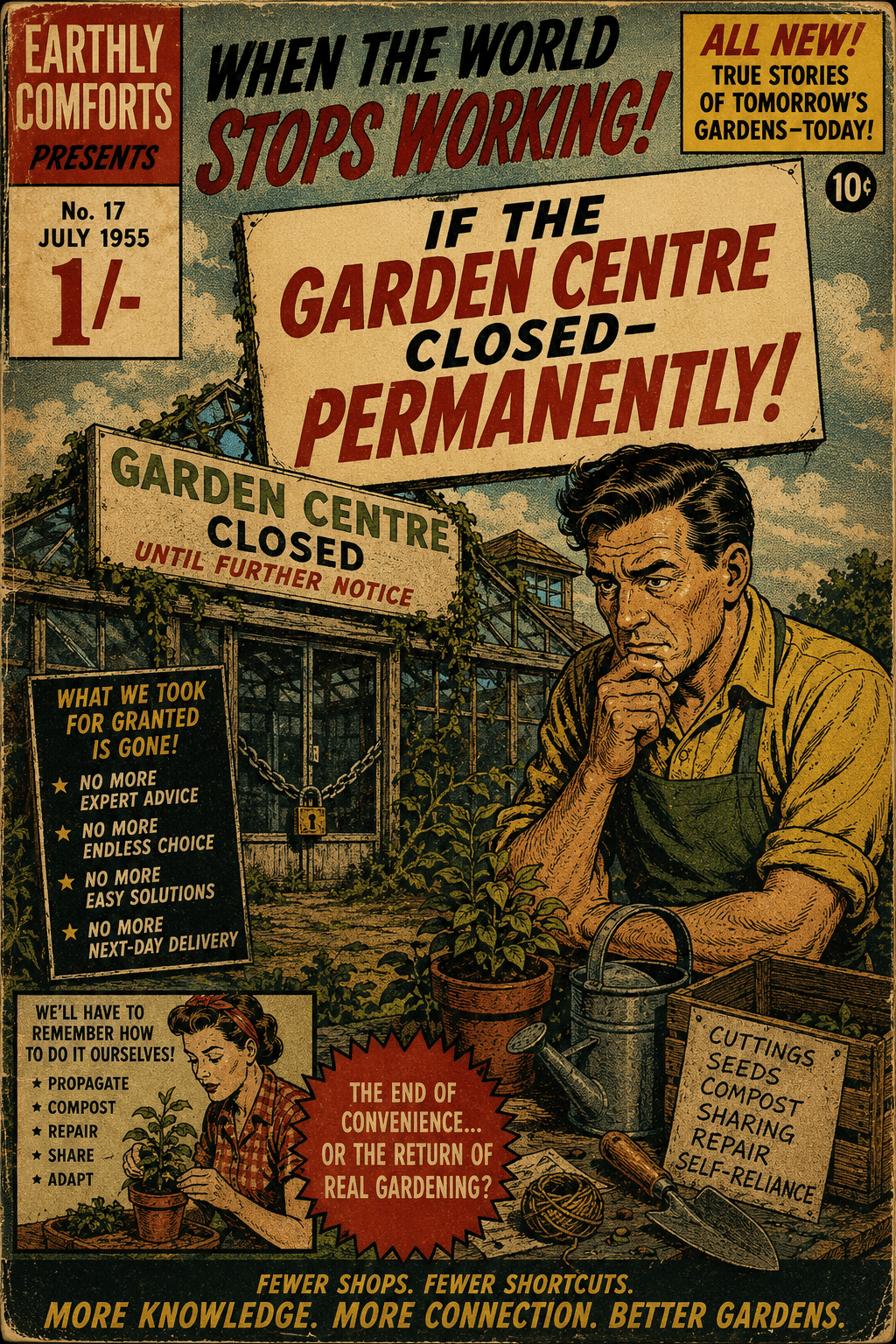
| There is something wonderfully reassuring about a garden centre. Whatever has gone wrong in the garden, there is a reasonable chance that somewhere inside that enormous building lies an object claiming to solve it. Plants looking hungry? There will be fertiliser. Slugs eating the hostas? An entire shelf awaits your retaliation. Need compost? Choose from twenty varieties, each apparently designed for a plant with increasingly particular requirements. And should you arrive without actually needing anything, the garden centre has developed a remarkable ability to ensure you leave with three plants, a bag of compost and something ornamental that hadn’t even entered your mind when you parked the car. We’ve become so accustomed to this abundance that it’s easy to forget how recent much of it is. Gardening existed perfectly well before enormous retail centres offered us pallet loads of compost, imported plants, plastic pots, lawn treatments, irrigation fittings, replacement tools and enough decorative gravel to alter the geology of a small county. Gardeners propagated plants, saved seed, swapped cuttings, made compost, repaired tools and generally used whatever happened to be available. None of this was considered particularly virtuous. It was simply gardening. We gradually replaced much of that self-reliance with convenience, and because convenience is extremely convenient, hardly anybody complained. So imagine arriving at the local garden centre one Saturday morning and finding the gates closed. There should be a handwritten notice at first. Closed temporarily due to supply difficulties. Nothing particularly alarming. We’d drive somewhere else, grumble about the wasted journey and carry on. A few weeks later the notice would change. Staff shortages. Rising costs. Deliveries unavailable. Perhaps another garden centre twenty miles away would still be trading, although its shelves were beginning to look suspiciously empty. Then one morning the temporary notice would disappear, and a rather more permanent board would take its place. The garden centre wasn’t reopening. At first, this would be an inconvenience rather than a crisis. Most gardeners have enough forgotten material in sheds and garages to maintain a medium-sized estate for several months. Half-used bags of compost would be excavated from behind lawnmowers. Plant pots would suddenly acquire value after years of being stacked in increasingly unstable towers. The mysterious collection of screws, fittings, hose connectors and pieces of wire that every gardener accumulates would finally justify its existence. Somewhere in Britain, a person who had refused to throw away a broken rake handle since 1997 would experience the finest moment of their life. Online suppliers would undoubtedly keep things going for a while, but our imaginary future isn’t really about one particular shop closing. Suppose the garden centre disappeared because the whole supply system behind it had become less reliable. Transport costs had risen. Some products were difficult to manufacture. Imported plants had become expensive or unavailable. Peat-free growing media depended upon materials being diverted elsewhere, while plastic pots, fertilisers and garden chemicals competed with other demands. Nothing had completely broken. It had simply become increasingly difficult to guarantee that the thing you wanted would be waiting for you whenever you decided you needed it. That would change gardening remarkably quickly. The first thing we’d rediscover would be propagation. A plant would no longer be something you automatically replaced when it died. If you liked it, you would probably make more while it was still healthy. Cuttings would regain an importance they’d never really lost, only temporarily surrendered to the convenience of buying another specimen. Dividing perennials would become less about controlling their size and more about creating useful stock. Seed heads that we’d routinely cut away might suddenly be worth collecting, drying and storing. Gardeners would begin looking at a mature plant and seeing not one plant but twenty possible ones. That would change how we valued gardens too. An old clump of hardy geranium wouldn’t seem quite so ordinary when you realised it could be divided repeatedly and establish itself almost anywhere. Plants that propagated easily, survived difficult conditions, and required little intervention would become more desirable than spectacular varieties that needed regular replacement. The fashionable plant that looked magnificent for six weeks but sulked whenever conditions weren’t perfect might find itself losing ground to something less glamorous that had survived in the same garden for thirty years without once requiring an emergency trip to the shops. There is a quiet irony there. For decades we’ve been encouraged to treat gardening as something partly dependent upon consumption. Every spring brings new plants, new products and new solutions. Yet some of the best gardens I’ve worked in contain plants that have been passed from one person to another for years. A cutting from a neighbour becomes a shrub—a divided perennial moves from one garden to another. Seeds are collected, bulbs multiply, and eventually nobody can remember where the original plant came from. Gardening has always contained its own supply chain. We became rather distracted by the one with a checkout. Compost would be the next interesting problem. Gardeners produce an astonishing quantity of material that can eventually return to the soil. Yet, enormous amounts of it have traditionally been removed from gardens while bags of something remarkably similar arrive through the front gate. If commercial compost became difficult to obtain, we’d become much more interested in what was leaving the property. Leaves would stop being rubbish and become next year’s leaf mould. Soft green material would be composted wherever practical. Woody prunings might be chipped, stacked or used differently rather than automatically disappearing into a waste stream. The garden would begin closing its own loops because there was no longer a lorry conveniently bringing replacements. Professional gardeners would feel that change particularly strongly. Waste has always been one of the less glamorous realities of the job. A vigorous garden produces enormous quantities of material, and the temptation is often to remove it simply because clients want everything looking tidy. But if resources became scarcer, the question would change from How quickly can we get rid of this? to Is there something useful we can do with it here? Not everything could stay, of course. Diseased material, invasive plants and sheer volume would still create practical limits. Yet perhaps we’d become rather less casual about exporting fertility from a garden and then purchasing it back in a brightly printed bag. Tools would acquire a different status as well. The secateurs that felt slightly rough but still worked would no longer be replaced because a shinier pair happened to be on offer. Handles would be changed, blades sharpened and machinery repaired for another season. Somewhere, people who actually knew how to mend things would suddenly become extraordinarily popular. The person who could put a new handle on a spade, sharpen a mower blade or persuade an elderly machine to survive another five years might find themselves regarded with the sort of admiration currently reserved for surgeons. There would still be commerce, naturally. Humans are far too inventive to stop selling things simply because the garden centre has vanished. Small nurseries might return. Local growers could begin supplying plants suited specifically to their area rather than enormous ranges transported across the country. Seed swaps and plant exchanges might become commonplace. Village fêtes would discover that the plant stall was suddenly the most strategically important table in the entire event. The woman down the road with forty-seven varieties of tomato would cease being regarded as eccentric and become a person of considerable influence. Gardeners would talk to each other more. That might be the strangest development of all. Instead of searching for a replacement plant online, we’d ask whether somebody locally had one. Instead of buying a product because a label promised to solve a problem, we might ask another gardener what they had done. Knowledge would start travelling alongside plants again. A cutting would arrive with instructions: Don’t put it there; it hates the wind, or My mother always cut this back after flowering. Some of that advice would be brilliant. Some would be complete nonsense. Gardening traditions have always contained generous quantities of both, and perhaps that is part of their charm. The gardens themselves might become more individual. One consequence of mass retail is that the same plants can appear everywhere. Walk through enough gardens, and you begin recognising the seasonal arrivals from garden centres because suddenly everybody owns one. Remove that common source and gardens would increasingly reflect what survived locally, what could be propagated and what neighbours happened to share. Kent gardens might gradually develop their own little communities of plants, moving from property to property, while elsewhere entirely different varieties became commonplace. We would probably lose things too, and it’s worth admitting that. Modern garden centres and nurseries provide access to an extraordinary range of plants and materials. Some specialist growers possess knowledge and collections that couldn’t simply be recreated by swapping cuttings over the fence. Gardening without those networks would be poorer in some respects. Certain plants would become difficult to find. Choice would narrow. Convenience would certainly disappear, and anyone who has discovered at four o’clock on a Friday afternoon that they desperately need another bag of compost would quickly learn not to romanticise self-sufficiency too enthusiastically. But perhaps we’d become better at distinguishing between need and want. A garden doesn’t actually require a constant stream of new objects. It needs soil, water, plants, time and somebody willing to pay attention. Much of everything else is useful, enjoyable, or convenient, but gardens themselves are remarkably capable of producing many of the resources needed to sustain themselves. Plants make plants. Leaves make soil. Seeds make possibilities. A broken branch can become habitat. Yesterday’s growth becomes tomorrow’s compost. The system is astonishingly regenerative when we allow it to be. That may be why this particular imagined collapse doesn’t seem especially apocalyptic to me. The garden centre closes, the shelves disappear, and for a few months everybody complains bitterly. Then something rather interesting happens. Gardeners begin remembering. We remember how to take cuttings. We remember that seeds can be saved. We remember that compost is something we can make rather than merely purchase. We remember that tools were once repaired, plants were exchanged and gardening knowledge travelled from one person to another without requiring a barcode. Eventually, somebody would open a little nursery at the edge of town. Nothing enormous. Just a few polytunnels, rows of locally grown plants, bags of compost made nearby and an older adult behind the counter who knew precisely which shrub would tolerate that awkward dry corner beside your fence. There wouldn’t be scented candles, garden furniture, Christmas decorations or a café serving cake on plates the size of paving slabs. You might actually have to go there to buy plants. And perhaps, after everything we’d learned, that wouldn’t seem quite such a disaster after all. |
| About our writing & imagery Most articles reflect our real gardening experience and reflection. Some use AI in drafting or research, but never for voice or authority. Featured images may show our photos, original AI-generated visuals, or, where stated, images credited to others. All content is shaped and edited by Earthly Comforts, expressing our own views. |

