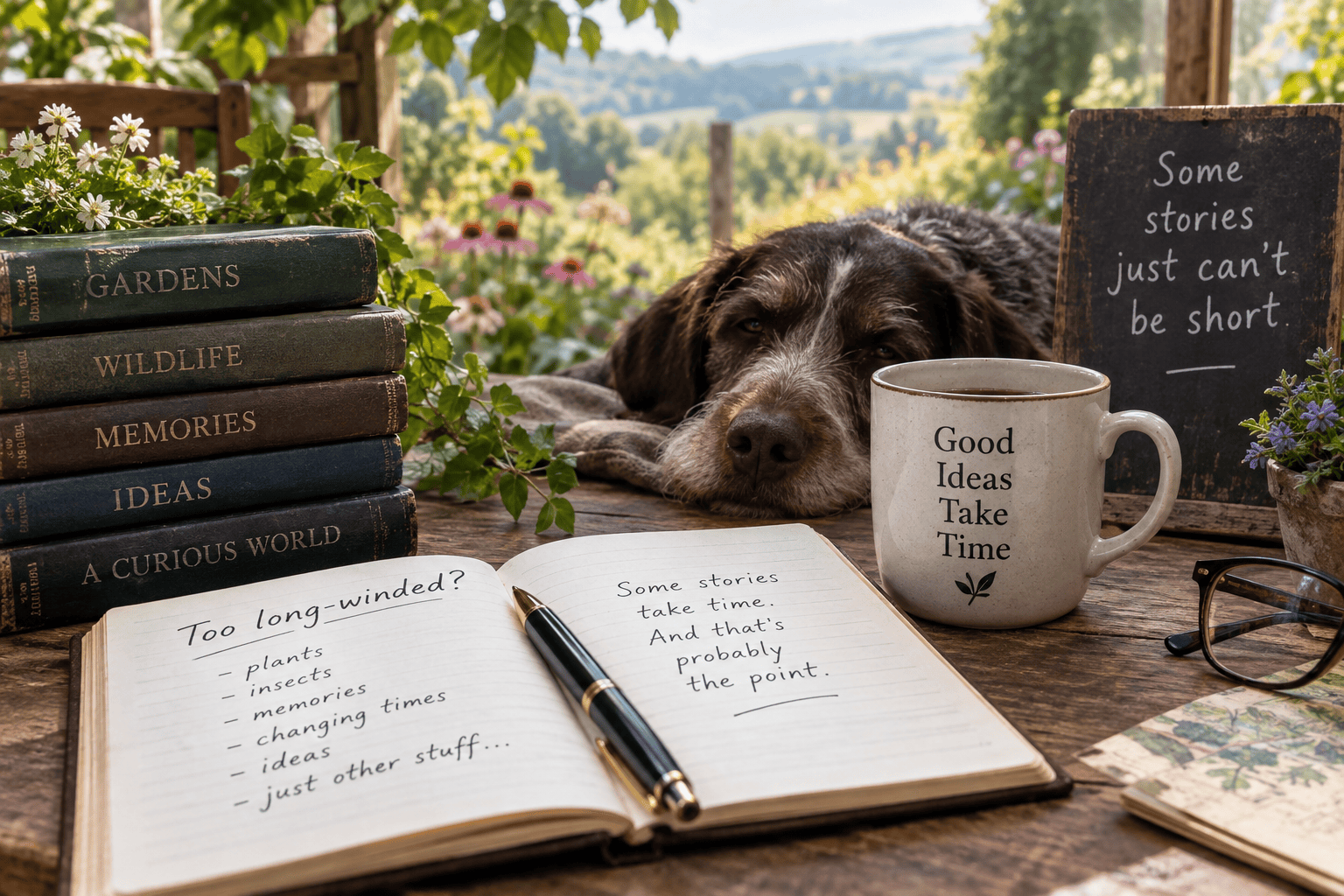
| A friend asked me recently whether I only write long-winded articles. It wasn’t entirely an accusation. At least, I don’t think it was. But it was one of those questions that hangs around afterwards because there is just enough truth in it to make you wonder. I do write long articles. Some of them are very long. Give me an insect, an odd plant, a changing climate, a childhood memory or the possibility of civilisation collapsing somewhere behind the garden shed, and there is a reasonable chance I will still be writing about it some considerable time later. I have never been particularly good at taking something interesting and reducing it to three paragraphs simply because three paragraphs would be quicker to read. But the question made me wonder whether long-form writing still has a place at all. We live in a world of increasingly short pieces of information. Headlines, snippets, reels, notifications and summaries compete for our attention. Even articles frequently begin by telling us how many minutes they will require of us, as though reading has become a contractual commitment that needs to be declared in advance. So my friend had a point. Or we may have become too frightened of length. As the old joke goes, it’s not the size that matters but what you do with it. |
| When Did Long Become Too Long? There was a period in blogging when long-form content became almost a formula. If you wanted an article to perform well in search engines, the prevailing advice was often to make it comprehensive. A simple question that could have been answered in 700 words became a 2,500-word guide containing everything anybody had ever thought about the subject. The result wasn’t necessarily better writing. Quite often it was simply more writing. There is an important difference between a long article and a padded one. A long article can take you somewhere. It can develop an argument, wander down an interesting side road, introduce something unexpected and eventually bring you back to where you started. A padded article merely takes longer to reach the end. I suspect that distinction matters far more than the number at the bottom of the page. If I am writing about when to prune a particular shrub, I don’t need to begin with the history of pruning in Mesopotamia and eventually arrive at the answer somewhere around paragraph twenty-seven. Sometimes the useful answer really is the short answer. But not everything I write is trying to answer a question. And that is where things become more interesting. A Blog Isn’t Necessarily a Manual For many years, blogs became increasingly associated with information. We searched for something, found an article, extracted the bit we needed and disappeared again. Gardening websites became particularly good at this. When do I sow this? Why are the leaves turning yellow? How do I prune that? Will this plant survive winter? There is nothing wrong with any of it. It is enormously useful. But I no longer really think of this Journal in quite those terms. About six weeks ago, I decided to change its direction. I didn’t particularly want the blog to remain an extension of the gardening business website. I wanted the two to become separate things: one a business and the other, for want of a more sophisticated description, just other stuff. A place where I could write about gardens, certainly, but also insects, wildlife, environmental change, memories, strange creatures, things I have seen, things I wonder about and occasionally things that haven’t happened at all. Once I made that decision, something else changed. I stopped feeling that every article needed to justify itself by being useful. Some things are worth reading simply because they are interesting. How Long Is Long? I don’t actually sit down and decide that an article will contain 1,742 words. Usually I start with an idea. Some ideas turn out to be quite small. You pick them up, turn them over, look underneath and discover that there isn’t much more to say. Trying to force another thousand words out of them doesn’t make them more substantial. It merely makes the reader increasingly aware that you should probably have stopped several paragraphs ago. Other subjects keep opening doors. A plant leads to a garden. The garden leads to a particular year. The year reminds me of something I saw when I was younger. That memory raises a question about what has changed since then. Suddenly the article isn’t really about the plant anymore. That is often how my longer pieces develop. The Within Living Memory articles are a good example. I could write a short piece saying that British summers appear to have become hotter, winters seem wetter, and the seasons don’t always behave quite as I remember them. It would be perfectly readable. But it wouldn’t really be the point. The interesting part is the distance between then and now. What I remember, what I may be remembering incorrectly, what the evidence tells us and what decades spent working outside and watching gardens actually reveal. That needs room. Likewise, if I am writing about insects, I don’t necessarily want to produce five facts followed by a photograph. I have been fascinated by them since childhood. Some remind me of Australia, others of Malaysia, others of creatures I encountered much later. There are stories attached to them. Remove those, and I may have produced something shorter, but I haven’t necessarily produced something better. The Problem May Not Be Length at All There is another possibility. Perhaps people don’t dislike long articles. Perhaps they dislike boring ones. Two thousand words can disappear surprisingly quickly when you’re enjoying them. Five hundred can feel interminable when you’re not. The same is true of books, films and conversations. Nobody leaves a genuinely fascinating conversation after eight minutes, as research suggests that eight minutes is the optimal engagement period. We stay because we want to know what comes next. That doesn’t give a writer permission to ramble indefinitely—quite the opposite. If I am asking somebody to spend ten or fifteen minutes reading something I have written, then I have a responsibility to make those minutes worthwhile. Long-form writing needs rhythm. It needs proper paragraphs rather than endless little statements sitting alone on the page pretending to be profound. It needs changes of pace. It needs somewhere to go. Most importantly, it needs something to say. Not Everything Needs the Same Sized Box One of the stranger habits of online publishing has been the desire to find the correct length for an article. Eight hundred words! Twelve hundred words!! Two thousand words!!! As though somewhere there is an ideal-sized container into which every human thought can conveniently be poured. I don’t think there is. Some of the pieces in this Journal may only need 600 or 700 words. A plant that deserves a second look doesn’t necessarily require a small book written about it. An observation from the garden might be finished before it reaches a thousand. Other subjects might comfortably pass 2,000 words. Occasionally, something may run considerably longer. I’m increasingly comfortable with that variation because a journal ought to vary. Pick up a newspaper or magazine, and you don’t expect every piece to occupy precisely the same amount of space. There are columns, observations, letters, features, investigations and essays. Some you consume in a couple of minutes. Others you settle down to read. Why shouldn’t an online journal work the same way? Writing for People Who Actually Want to Read There is a lot of discussion about our supposedly collapsing attention spans. Perhaps there is some truth in it. We are certainly surrounded by more things demanding our attention than at any previous point in my lifetime. But I don’t think people have lost the ability to read. They have become more selective about what deserves their time. That is rather different. Someone who has absolutely no interest in strange insects probably isn’t going to spend fifteen minutes reading several thousand words about them. I wouldn’t expect them to. Someone who shares that curiosity might happily do so. The answer isn’t necessarily to reduce everything until neither reader is particularly satisfied. It is to accept that not everything needs to be for everybody. That idea has become increasingly important to me as this Journal has developed. I’m not trying to build the biggest gardening website on the internet. I’m not trying to answer every possible gardening question. And I’m certainly not attempting to compete with the millions of pages already explaining how deep to plant a daffodil bulb. I’m building a body of work. Some of it practical. Some observational. Some personal. Some speculative. Some decidedly peculiar. If somebody discovers one article and then wanders into another, and perhaps eventually finds themselves reading something they hadn’t intended to read at all, then the Journal is doing exactly what I hoped it might do. So, Am I Long-Winded? Probably. At least occasionally. My friend wasn’t entirely wrong. There will undoubtedly be moments when I could have said something in 800 words and somehow arrived at 1,400. There will be sentences that could lose six words and paragraphs that survive perfectly well without their final line. That’s what editing is for. But I don’t want fear of being long-winded to become fear of taking my time. There are things worth lingering over. Some memories need context, arguments that need developing and stories that lose something when squeezed into the smallest possible space. There are also wonderfully simple subjects that can be dealt with quickly and left alone. I may need a different rule. Not keep it short. Not write long-form content. Simply: Write until the article has finished. Then stop. Which, considering the question that started all of this, is exactly where I should stop this one. |
| About our writing & imagery Most articles are grounded in our real gardening experience, observations and reflections. AI may assist with research, drafting and editing, but the experiences, opinions and editorial direction are our own. Featured images may include our photography, original AI-generated visuals or, where stated, images credited to others. All published content is reviewed and shaped by Earthly Comforts before publication. |

