| Part Four The Quiet Jobs That Make a Garden Feel Finished |
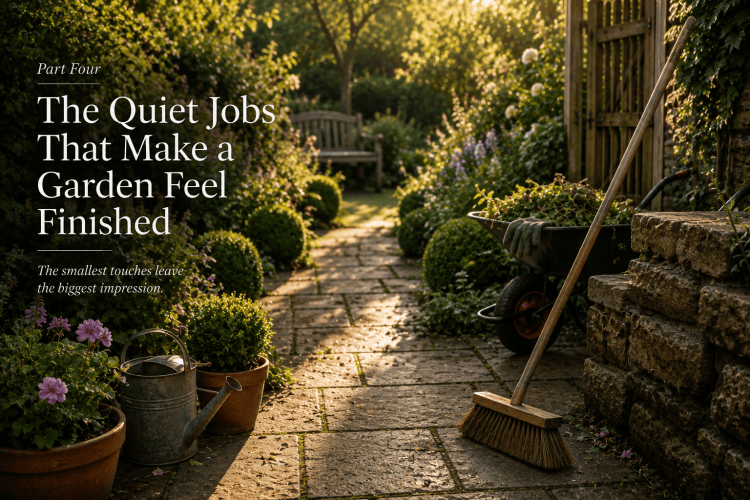
| There comes a point towards the end of almost every day’s gardening when the noisier jobs begin to fall silent. The mower has been put away. The hedge trimmer has stopped its familiar chatter. The last barrow of green waste has disappeared into the trailer, and the secateurs have finally found their way back into a pocket. To anyone looking out of the kitchen window, it might appear that the work is finished. Curiously, that is often when some of the most important work begins. I have always found it interesting that clients rarely remember how long it took to prune a shrub or mow a lawn. What they often remember is the feeling they have when they first step into the garden afterwards. They pause for a moment, look around and say something like, “It feels lovely.” That choice of word has always fascinated me. They don’t usually say the lawn is exactly twelve millimetres shorter or that the roses have been deadheaded particularly well. They talk about how the garden feels. It has taken me years to realise that the smallest jobs of all often create feeling. A broom, for example, is a remarkably underestimated gardening tool. Sweep a path properly and something curious happens. Dust disappears, of course, but so do all the tiny distractions that the eye had quietly been noticing without ever consciously acknowledging them. Fragments of leaves, loose soil, grass clippings, the odd twig that escaped the rake — individually they seem insignificant. Together they create a subtle sense of unfinished business. Remove them, and the garden seems to breathe out. I sometimes think sweeping has more in common with punctuation than cleaning. A full stop does not contain the meaning of a sentence, yet without it the sentence somehow feels incomplete. Sweeping performs much the same role in a garden. It tells the eye, almost subconsciously, that the work has reached its natural conclusion. The same can be said of putting things back where they belong. A watering can leaning against a wall. A flower pot left on its side. The hose stretched lazily across the lawn. None of these is particularly untidy in isolation, yet together they create a garden that still feels occupied by the work rather than ready to be enjoyed. The difference between a working garden and a finished garden is often measured in minutes rather than hours. Those final minutes matter. There is another quiet habit I have developed over the years. Before I leave, I nearly always walk back through the garden without carrying anything at all. No tools. No gloves. No wheelbarrow. Just a slow walk. It serves no obvious purpose, yet I suspect it has saved me from countless little oversights. A forgotten plant label catches my eye. A small pile of leaves hiding behind a pot. A chair that would look better turned slightly towards the evening sun. A branch that somehow escaped attention during pruning. None of these would justify another hour’s work, but each deserves another thirty seconds. Perhaps gardens appreciate being looked at one last time before we say goodbye. Wildlife also appreciates those quieter moments. The robin that vanished when the hedge trimmer started is often the first to return. Blackbirds emerge cautiously from beneath shrubs, hopeful that disturbed soil has revealed something worth investigating. Bees seem entirely unconcerned with whether the path has been swept, but they certainly notice that the noise has stopped. The garden begins settling back into itself. That is one of the loveliest moments in professional gardening. For a few minutes you stand almost unnoticed while life quietly resumes around you, as though the garden has accepted that today’s interruption is over. People often imagine gardening is all about activity. Digging. Cutting. Pruning. Lifting. Moving. There is certainly plenty of that. Yet some of the finest gardening I know consists of noticing rather than doing and straightening a bird bath by half an inch because it has gradually settled into the soil. Turning a pot slightly so its best side greets visitors arriving through the gate. Brushing stray compost from the rim of a terracotta container and removing one dead leaf from an otherwise healthy hosta because once you’ve seen it, you can’t quite pretend you haven’t. These are tiny decisions. Most will never be consciously noticed. And yet they somehow combine to produce an atmosphere that is immediately recognised. Clients sometimes apologise for noticing the “little things.”You probably think I’m fussy.” The truth is quite the opposite. The little things are exactly what I hope they’ll notice, even if they cannot explain why. A well-finished garden rarely announces itself. It simply feels comfortable. One common misconception about professional gardening is that speed is everything. Of course, efficiency matters. Nobody benefits from wasting time. But there is a difference between working quickly and hurrying. Hurrying often leaves behind loose ends, both literally and metaphorically. Efficiency, on the other hand, creates enough space to finish properly. That distinction has become increasingly important to me. The older I become, the more I believe that gardens remember how they were left. Leave tools scattered around and the work somehow lingers in the atmosphere. Leave the paths clean, the gates closed, the furniture settled back into place and the garden quietly returns to being itself. Perhaps that is why I have never regarded sweeping as merely tidying. It is a gesture of respect. Respect for the client.Respect for the garden. Respect for wildlife as it returns to its daily routines. And perhaps, if I’m honest, a little respect for the craft itself. It is often said that people judge a meal by its final mouthful. Are gardens judged by their final few minutes? Not the mowing. Not the pruning. Not the digging. But the quiet, almost invisible jobs that leave no obvious signature except a gentle sense that everything is exactly where it ought to be. The funny thing is that these quiet jobs are often mistaken for the easiest. In reality, they ask something rather different. They ask for patience. They ask for restraint. And above all, they ask for an understanding that gardening is never only about plants. It is also about people. Because the words “It just needs a tidy-up” are rarely about the garden alone. They are about how we hope the garden will make us feel. And that, perhaps more than anything else, is where the hidden craft truly begins. |
| About our writing & imagery Most articles reflect our real gardening experience and reflection. Some use AI in drafting or research, but never for voice or authority. Featured images may show our photos, original AI-generated visuals, or, where stated, images credited to others. All content is shaped and edited by Earthly Comforts, expressing our own views. |

