| Why a Good Broom Still Belongs in a Modern Gardener’s Toolkit |
| Some gardening jobs attract a lot of attention. Pruning roses properly, laying a lawn, sharpening a mower blade, improving soil or planting a border are all recognised as things that require a certain amount of knowledge and skill. Nobody talks very much about sweeping, perhaps because everybody assumes they can do it. You pick up a broom, push it backwards and forwards until whatever was on the path is somewhere else, and the job is done. Except, of course, it isn’t quite like that. I actually enjoy sweeping. I have done it for years, and the longer I have worked with brooms, the more convinced I have become that good sweeping is one of those quiet practical skills we are gradually forgetting. There is a considerable difference between somebody using a broom and somebody who has learned how to sweep. |
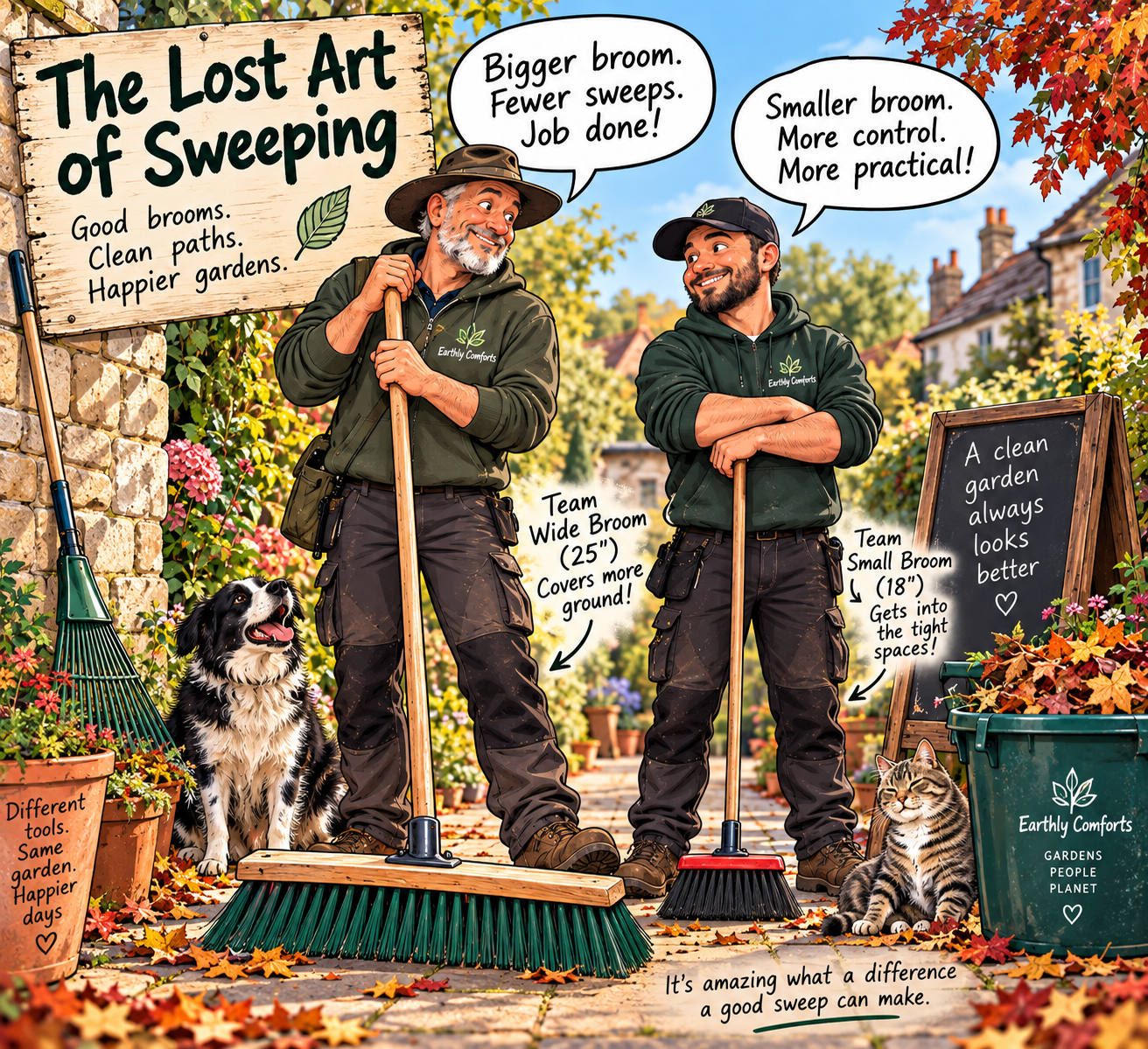
| The Great Broom Disagreement This subject came up because John and I disagree about brooms. John likes a relatively small garden broom, usually around an 18-inch head. His argument is perfectly reasonable: it is manageable, turns easily, gets into tighter spaces and doesn’t require you to wrestle a great slab of bristles around a garden. I prefer something nearer 25 inches. My argument is equally simple: if I am sweeping a reasonable expanse of path, patio, shed, garage floor or hardstanding, I want to cover some ground. A wider broom gathers material across a considerably greater area with every pass. John maintains that you cannot turn one of my big brooms on a sixpence. I maintain that I can. That isn’t because I possess some extraordinary broom-related ability; it is simply what happens when you have spent years using a larger broom and genuinely enjoy sweeping. You learn how the tool behaves. You don’t always sweep with the entire width of the head. You change the angle of the handle, pivot the broom, work with one end, pull rather than push, reverse to head to act as a scraper, make short strokes around an obstacle and then return to a broad stroke when the space opens again. Eventually you stop thinking about it, and perhaps that is where the lost art begins. There Is No Best Broom Despite my defence of the 25-inch broom, John isn’t wrong. The mistake would be deciding that either of us has discovered the perfect garden broom. Gardens aren’t uniform places. One minute you may be clearing a broad paved drive and the next you are between two raised beds. There are steps, gravel, old brick paths, modern paving, sheds, garages, narrow passages, lawns, borders and awkward corners. The right sweeping tool depends entirely upon the environment. We therefore use quite a collection: wide push brooms and smaller ones, hand brushes and dustpans, and I still like a traditional besom — the classic broom made from bundled twigs that inevitably makes people think of witches. John considers my fondness for them slightly feminine. I consider John sadly unenlightened. A besom remains an extremely useful garden tool because its flexible working end behaves quite differently from the rigid rectangular head of a modern push broom, particularly around uneven surfaces, edges and loose garden material. A Blower Isn’t a Replacement for a Broom We use blowers, including dedicated leaf blowers, especially as autumn arrives. People sometimes turn this into an argument between traditional hand tools and machinery, but I don’t see the point. They do different things. A blower can move debris from underneath shrubs, along edges and out of awkward places incredibly quickly. It can bring scattered material into an area where it can actually be dealt with, and during serious autumn leaf fall, powered equipment can save an enormous amount of labour. But that doesn’t make the broom obsolete. Sometimes six competent sweeps with a broom will finish something faster than getting a blower out. Other times, trying to clear thousands of autumn leaves manually to prove the superiority of traditional tools would be ridiculous. The skill isn’t necessarily in using one or the other; it is knowing when to change tools. When Leaves Really Begin to Fall Autumn changes sweeping completely. A few leaves scattered over a path are debris; a mature garden dropping thousands of leaves becomes a material-handling exercise. That is when our leaf collectors, leaf blowers and twin sweepers come into their own. Rather than endlessly moving individual leaves, the objective becomes gathering large volumes efficiently, concentrating them and getting them to wherever they need to go. Often, several tools are involved in the same job. A blower might release leaves caught around planting and move them onto an accessible area. A sweeper or collector can deal with the bulk. A broom then tidies the hard surfaces and edges, while a hand brush catches whatever remains in corners. It isn’t particularly glamorous gardening, but when it is done properly, you notice the result. The Walking Gardener’s Broom My situation is slightly different from John’s for another reason. John generally has access to our van; I’m often a walking gardener, and that changes how you think about tools. If you have a vehicle outside the client’s house, you can carry several different brooms, rakes, blowers and collectors and choose whatever suits the particular job. When you are walking through town carrying your equipment, every tool has to earn its journey. I will often have my wide broom and rake together, their handles resting over my right shoulder. If I need the Gorilla Tub, it can travel inside a green-waste bag, with the long handles arranged through the carrying handles so that everything moves together, while a shoulder bag carries the smaller things I need during the working day. It probably makes me look rather more like a gardener from another age than somebody running a modern gardening business, but it works. And if I am only taking one broom, I want the broom I know I can make do almost everything. John immediately reaches for his smaller broom; I reach for the wide one. Neither decision is really about the broom. It is about the person carrying it, where they are going and what they have learned to do with it. [Again, I laugh, we come back to my usual line! It’s not how big something is, but what you do with it when it’s in your hands that matters!] Sweeping the Surface, Not Just the Rubbish One of the pleasures of becoming familiar with a broom is discovering that different surfaces require different techniques. Smooth concrete doesn’t behave like old paving. Block paving has joints. Gravel edges steal leaves. Damp grass clippings stick stubbornly to hard surfaces. Fine dry soil behaves completely differently from wet soil. Twigs catch, wet autumn leaves become heavy and reluctant, and wind can either become your assistant or undo the previous ten minutes of work. So you adapt. Pressure changes, stroke length changes and the angle changes. Sometimes you push, and sometimes you pull. Sometimes you gather material into a long line before bringing it together; at other times you work gradually towards a single collection point. A good sweeper doesn’t simply attack the mess. You decide where you want it to finish before you start moving it, and that alone can save an extraordinary amount of unnecessary work. The Last Five Minutes Matter Another reason I think sweeping deserves a little more respect in professional gardening is that it’s often the last thing the client sees. We can spend several hours pruning, weeding, cutting, edging, and generally bringing a garden back into shape, but leave grass clippings scattered over the paving, bits of hedge beneath the gate, and soil across the path, and somehow the whole job looks unfinished. Sweep it properly and something changes. The edges become defined, the paving looks cleaner, the planting stands apart from the hard landscaping again, and the garden suddenly looks as though somebody has cared about the last five minutes just as much as the previous five hours. That matters to me. Perhaps It Isn’t Really About Brooms Modern gardening gives us an extraordinary selection of equipment, and I am certainly not going to surrender our blowers, leaf collectors or sweepers in pursuit of some romantic vision of gardening with nothing but wooden-handled tools. But I also don’t want to lose the skills those simple tools taught us. A broom doesn’t have a battery. It doesn’t make any noise. Almost nothing can go wrong with it. Pick it up, and it is immediately ready to work. More importantly, the better you become at using one, the more useful it becomes. Perhaps that is why I still enjoy sweeping. There is a rhythm to it: you read the surface, gather rather than chase, use the width when you have space and shorten everything when you haven’t. Eventually the broom becomes an extension of what you’re trying to do rather than something you’re merely pushing around. John can keep his 18-inch broom. I’ll keep my 25-inch. And I still say I can turn it on a sixpence. |
| Most articles are grounded in our real gardening experience, observations and reflections. AI may assist with research, drafting and editing, but the experiences, opinions and editorial direction are our own. Featured images may include our photography, original AI-generated visuals or, where stated, images credited to others. All published content is reviewed and shaped by Earthly Comforts before publication. |


Personally, I like smaller brooms, because they’re easy for me to handle. The leaf blowers that maintain the grounds in our complex blow leaves and dirt every where, and don’t collect it. No wonder we have allergies.
LikeLiked by 1 person
Hey Eugenia, I think the biggest problem with blowers is many people [like with bigger brooms] tend to not handle them correctly. My Suze is clueless when it comes to working with a blower [different to a leaf blower] and pushes things everywhere. But there is a skill to them as well, you have to think like a shepherd and ‘herd’ what you are blowing. 🙂
LikeLiked by 1 person
That makes sense, Rory. We mentioned it to the management, and they don’t care. Sigh…
LikeLiked by 1 person
My neighbors already think I’m eccentric for using an old-school besom. Though I draw the line at walking through town with two handles over my shoulder… you definitely deserve some kind of vintage gardener award for that!
LikeLike
Haha, yes l do get some strange looks walking through the town admittedly with a gorilla bucket on the end of two brooms or a rake, and my knee pads on.
LikeLiked by 1 person
😂 I absolutely loved this! There is something rather wonderful about two gardeners having a serious debate over 18 inches versus 25 inches of broom. And I have to admit, I completely understand why you prefer the 25-inch one after reading how you describe using it. There really is a skill to something as seemingly simple as sweeping, and I love the idea of the broom becoming an extension of what you’re doing rather than just something you’re pushing around.
And I have to say, I absolutely loved the image of you and John with the Border Collie and the cat! ❤️ It is such an adorable picture, and somehow it makes the whole 25-inch-versus-18-inch broom debate even more delightful. 😂 You all look like the official guardians of the Great Broom Controversy! 🤣🤣🤣
I also understand your point about blowers and why they are useful, although I have to confess that I absolutely hate the bloody things! 😂 I think it’s mostly the noise. But I can see one advantage to them: if there is a little spider or insect tucked away in a corner, blowing the leaves away is probably much gentler than going in there with a broom and potentially hurting the little creature. It’s rather like the wind moving through the garden — at least that’s how I see it. 🕷️🌿
And then you mentioned being able to “turn it on a sixpence” and my brain immediately produced an image of Fred Astaire dancing around the garden with a broom in the rain! 🤣🤣🤣 I have no idea why my mind works like this, but apparently it does.
So naturally, I have now decided that if I ever get my own Garden Butler, I shall be taking the 25-inch broom, putting on my pointy hat and practising my sixpence turns. 🧙♀️🧹😂
John can keep his 18-inch broom. I think I have officially joined your side! ❤️
LikeLike