
| Series One Episode Three The Garden Nobody Tended |
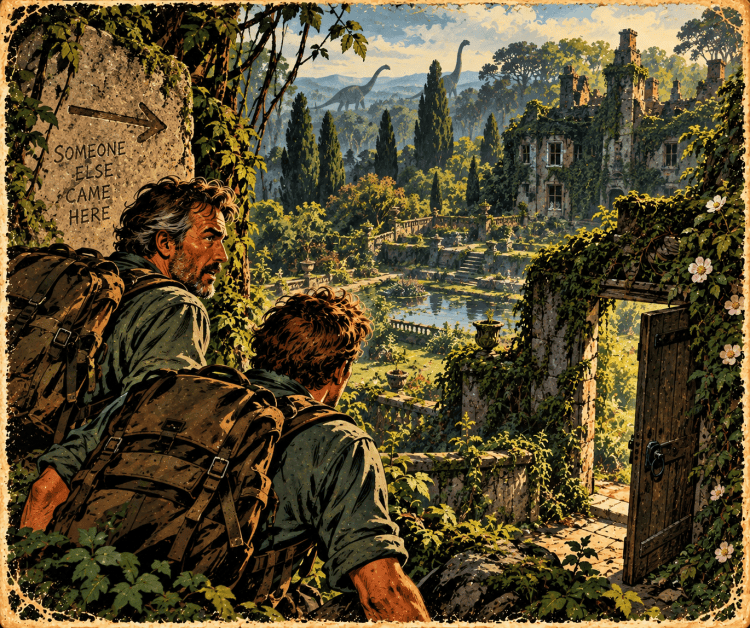
| Walking away from the only known route home felt completely wrong. Somewhere behind us, perhaps no more than a few hundred yards away, was an opening into a garden shed in Kent. Beyond that were our sorted piles of pots and rubbish, two unfinished mugs of tea and a client who presumably thought we’d become unusually quiet. Unfortunately, between us and all of that stood a large carnivorous dinosaur that showed no inclination to move elsewhere. John and I had therefore done something neither of us particularly wanted to do: turned our backs on the shed and walked deeper into a world that appeared to have misplaced humanity by several million years. We didn’t have a plan beyond putting some distance between ourselves and the animal. That bothered me because gardeners generally work with plans, even when they’re informal ones. You look at a job, decide where to start, work out what needs doing and adjust when reality inevitably disagrees with you. Here, reality had disagreed rather comprehensively. Our immediate priorities were much simpler: stay together, don’t get lost any more than we already were, conserve the water we’d brought with us and avoid anything large enough to regard two gardeners as an interesting change of diet. The stream gave us something useful to follow. Waterways lead somewhere, even if you don’t necessarily want to arrive there, and keeping it within sight meant we had at least one feature we could retrace. We moved upstream because that took us away from the area around the shed opening and because the vegetation appeared slightly more open in that direction. Neither of us suggested going downstream. There was no particular reason for this; sometimes two people make the same arbitrary decision, and it becomes a plan. For a while the landscape remained much as we’d already seen it: enormous ferns, cycads, conifer-like trees and unfamiliar plants growing through layers of their own dead material. The ground was uneven and occasionally treacherous, particularly where roots disappeared beneath leaf litter. We quickly stopped trying to maintain anything resembling a normal walking pace. A twisted ankle would have been inconvenient on a gardening job in Kent. Here it could become considerably more serious. The heat was beginning to matter as well. We were dressed for working outdoors in September, not for pushing through humid vegetation in whatever climate we’d landed in. John removed his outer layer and tied it to his rucksack, and I did the same. We drank, but not much. Between us we had enough water for an ordinary working day, which was no longer a useful measure of anything. The stream beside us contained plenty more, but clear water is not necessarily safe water, and neither of us fancied testing prehistoric gastrointestinal diseases simply because it looked inviting. “What happens when ours runs out?” John asked as we stopped beside the stream. “We find a way of making this safe.” “How?” I looked at the water. “I’ll let you know.” “Good plan.” It wasn’t, but at least we still had time to improve it. What surprised me most as we walked was how quickly the first dinosaur had stopped feeling like the strangest thing we’d seen. Once you’ve accepted that an animal which should have been extinct for millions of years has just eaten a plant in front of you, your definition of impossible becomes remarkably flexible. We saw other animals at a distance, although nothing came close enough for me to identify confidently. Once, something small and quick crossed the stream ahead of us on two legs and vanished before John properly saw it. Later we watched several larger animals moving among the trees on the opposite bank. They seemed to be feeding and showed no interest in us, so we returned the favour. The plants remained harder to ignore. Some looked broadly familiar because their descendants or relatives still existed in gardens, while others belonged to forms I’d only ever encountered in books or botanical displays. I kept wanting to stop and look more closely, which John tolerated for approximately the first hour. Eventually he pointed out that if I examined every interesting plant we passed, we might get home shortly before our client needed the shed replaced altogether. I reluctantly accepted the criticism. We stopped for lunch on a patch of higher ground overlooking the stream. It felt absurdly normal to sit on a fallen trunk and unwrap sandwiches while prehistoric vegetation stretched around us, but hunger remains surprisingly unimpressed by circumstances. We ate everything we’d brought for that day’s lunch rather than immediately attacking the snacks intended for later. There was no point starving ourselves while carrying food, but neither was there any sense pretending our supplies were unlimited. John looked at his sandwich, then at the forest. “Do you think anyone’s ever eaten cheese and pickle here before?” “Probably not.” “Historic moment.” “Prehistoric moment.” He gave me a look that suggested I’d deserved that considerably more than he had. We used the stop to examine what we actually had. The rucksacks were ordinary working bags rather than survival kits, but gardeners carry more useful things than you might expect. Folding saws and knives gave us cutting tools that didn’t depend on batteries. Secateurs were useful for smaller growth. Twine suddenly seemed considerably more valuable than it had that morning. We had gloves, basic antiseptic, insect spray and several miscellaneous items that had accumulated in pockets over time. My chewing gum contributed little to our immediate survival prospects but improved morale considerably. The phones were another matter. Neither had a signal, which wasn’t surprising. More interestingly, the location services had very little useful to say. Maps could show whatever had already been stored on the devices, but there was obviously no little blue dot politely informing us which prehistoric county we were standing in. We switched the phones off. Batteries were finite, and there was nothing useful they could do for us at that moment. After lunch we continued upstream. The ground gradually rose, and the vegetation began to change. The giant ferns became less dominant, and the trees stood farther apart, giving us occasional views across the surrounding landscape. From one higher point we could see an immense stretch of green extending towards distant hills. There were no roads, pylons, buildings, aircraft trails or cultivated fields. Nothing straight. Nothing divided. Nothing suggested that anybody had ever owned a single acre of it. John stood beside me, looking across the view. “Definitely not Kent.” “I wouldn’t rule it out.” He turned towards me. “Very early, Kent.” “Rory.” “Fine. Probably not Kent.” We were both laughing when a distant call rolled across the landscape. Several others answered from somewhere below. The humour disappeared rather quickly. Whatever else this place was, we needed to remember that we weren’t merely walking through an unusual botanical collection. We were small mammals in an ecosystem containing animals large enough to make the distinction between predator and herbivore extremely important. By late afternoon the question of where we were going had become unavoidable. Following the stream had kept us moving, but movement wasn’t the same as progress. We had no reason to think it would lead us towards another route home, and every step took us farther from the shed opening. Turning back remained possible in theory, but we’d have to retrace several hours of walking only to discover whether the dinosaur had finally left. If it hadn’t, we’d be exactly where we’d started, except more tired and with less water. John was the first to say what both of us were thinking. “We can’t just keep walking.” “I know.” “So what are we looking for?” “The way back.” “Yes, but what does that look like?” I didn’t have an answer. The shed opening had given us no clues. There had been no sign, path, mechanism or helpful instruction explaining how we’d arrived. We’d pulled out a box and discovered somewhere impossible behind it. For all we knew, there was only one opening, and it was currently being guarded by several tonnes of teeth. We decided to stop before darkness rather than allow circumstances to decide for us. Neither of us knew what night meant in this environment, but wandering around after dark seemed an excellent way to discover it badly. We found higher ground near the stream where several fallen trunks created a partly enclosed area, and spent the remaining daylight making it slightly less exposed. Our folding saws came into their own. They weren’t axes, and we had no intention of building a log cabin, but we could cut manageable branches and clear enough material to create a basic barrier around one side. It wasn’t much of a shelter. Calling it one was generous. We had no tarpaulin because the one we’d found in the shed had remained in the shed, and there was nothing in the rucksacks large enough to make a waterproof cover. Instead, we chose the driest ground we could find beneath dense overhead foliage, removed anything that was obviously uncomfortable, and used cut branches to make the area feel slightly less open. Whether that would deter anything larger than a determined beetle was questionable, but doing something was better than sitting around waiting for darkness. That was when John noticed the post. It stood perhaps ten yards beyond our makeshift camp, partly concealed by vegetation. At first I assumed it was a dead sapling because it was narrow, upright and weathered. Then John walked towards it and stopped. “Rory.” I joined him. It was wood. Not a tree. Not a broken branch wedged upright. A post. Someone had cut it square. We cleared vegetation from around the base. The timber was badly decayed and whatever had once been attached to it had disappeared, but there was no mistaking the marks. It had been shaped with tools. Near the top was a hole that might once have held a nail, peg or fixing. For most of the day we’d been looking at impossible things. Dinosaurs. Ancient plants. A landscape that couldn’t exist behind a garden shed. The wooden post was more disturbing than any of them. “People?” John said. “Somebody.” “When?” “No idea.” “Here?” “Apparently.” We searched the immediate area before the light disappeared. At first there was nothing else. Then I noticed a second piece of worked timber lying beneath vegetation several yards away. It was almost completely rotten, but one end had been cut cleanly. Nearby were stones arranged in a line too regular to feel natural. Not a wall exactly, more the remains of an edge or foundation. Whatever had been there was old. How old was impossible to judge. The obvious conclusion was that somebody else had reached this place before us. The less obvious conclusion was that they might have found a way out. That changed everything. We abandoned our original camping spot and searched farther while there was still enough light. The line of stones continued intermittently through the vegetation, disappearing beneath roots and reappearing several yards later. We followed it until it met something that made both of us stop. Steps. Only three were visible, made of large stone blocks and almost completely buried by soil and plants. They climbed a short bank and ended beneath dense vegetation. John started clearing it with his hands. I joined him. Behind the growth was another post. Then another. And between them, hidden beneath roots, moss and accumulated debris, was a narrow path. Not a prehistoric animal trail. A path made by somebody. We looked at one another. The light was going quickly, and following an unknown path into dense vegetation at dusk would have been idiotic even by the standards we’d established that day. We marked the spot as best we could and returned to our shelter. For the first time since we’d been forced away from the shed, however, we had something resembling a direction. That night was long. Neither of us slept properly. The forest changed after dark. Insects became louder, unfamiliar calls travelled astonishing distances and several times something moved near enough to make us sit up and reach for tools that would have been laughably inadequate against anything substantial. Nothing approached the shelter, although at one point a series of heavy footsteps passed somewhere beyond the stream and continued for several minutes. Morning arrived gradually through the canopy. We ate sparingly, drank and returned immediately to the path. In daylight it was easier to follow. Once we knew what to look for, traces appeared everywhere: an edging stone here, a piece of timber there, occasional sections of compacted ground where vegetation grew differently. Whoever had made it had done so a very long time ago, but the route persisted beneath everything that had tried to reclaim it. We followed. The path climbed away from the stream and through increasingly dense vegetation. Several times it vanished completely, and we had to search ahead until one of us found another straight edge or worked stone. Eventually, we reached a ridge where the ground dropped sharply on the other side. And there, below us, was something that should not have existed. Not another shed. A garden. At least, it had once been one. Even from above I could see the structure. Straight lines ran beneath the vegetation. Enormous trees stood where an avenue might once have been. Hedges had become sprawling walls of growth. A rectangular pond or pool lay almost completely hidden beneath plants. Beyond it, partly consumed by climbers and trees, stood the remains of a substantial house. John stared down at it. “That’s a garden.” “It was.” “Here?” “Apparently.” We descended cautiously. The difference became clearer with every step. After a day surrounded by vegetation from a world before gardens, familiar plants began to appear among the strange ones. Not neatly, and certainly not where any gardener would have put them now, but unmistakably. A climber had swallowed several trees and spread across the remains of a wall. Shrubs had layered themselves into enormous colonies. Trees that had probably once stood as individual specimens had seeded into the surrounding ground. Then I saw something I recognised immediately. A rose. It wasn’t flowering, and calling the tangled mass in front of us a rose bush would have been optimistic. Thick old stems sprawled through neighbouring vegetation, rooting where they touched the ground and sending new growth upwards through everything around them. John looked at it, then at me. “That’s not prehistoric.” “No.” “So we’re not where we were.” I looked back towards the ridge we’d crossed. The landscape behind us had changed so gradually that neither of us had noticed exactly when it happened. That was unsettling. We continued along what had once been a path. Beneath moss and soil were fragments of paving. The borders on either side had long since ceased being borders, but their original shapes remained faintly visible. I could pick out plants that had once been deliberately positioned: shrubs, climbers, ornamental trees and perennials surviving through persistence rather than care. Some had spread aggressively. Others existed as isolated remnants, somehow hanging on after whoever planted them had vanished. This was a garden nobody had tended for a very long time. Not years. Not decades. Longer. We reached the house by mid-morning. Much of the roof had collapsed, and trees grew through several rooms. Ivy covered whole sections of wall, although other climbers had joined it so completely that distinguishing architecture from vegetation was difficult. We didn’t go inside. The structure looked unstable, and neither of us fancied surviving dinosaurs only to be killed by falling masonry. Instead, we followed the remains of a terrace around the outside. That was where we found the rucksack. At least, what remained of one. It lay beneath an overhang where part of the wall had protected it from the worst of the weather. The fabric had rotted almost completely, and the straps fell apart when John touched them, but buckles and metal fittings remained. Nearby was a rusted folding knife, a corroded metal bottle and something that looked remarkably like the remains of a torch. None of them belonged in a garden that had been abandoned for centuries. John crouched beside the objects. “Someone else came through.” It was difficult to find another explanation. I searched the ground carefully and noticed marks scratched into a stone at the base of the wall. Most had weathered away, but one remained clear enough to recognise. An arrow. It pointed along the terrace. We followed it. More arrows appeared at irregular intervals, sometimes scratched into stone and once cut into the remains of a timber post. Whoever had made them had been deliberately leaving a trail. The terrace narrowed, passed behind the ruined house and descended through what must once have been another part of the garden. At the bottom stood an old brick wall. Set into it was a wooden door. Not magical. Not glowing. Not surrounded by anything that announced its importance. It looked like an ordinary garden door that had survived far longer than the wall around it had any right to. John and I stopped several yards away. Neither of us approached immediately. We had learned at least that much. “Think that’s how they left?” John asked. “Possibly.” “Think it goes home?” “No idea.” “Think we should open it?” I looked back at the ruined garden, the ancient path and the remains of somebody else’s rucksack. Whoever had left the arrows had wanted someone to find this door. Whether that was reassuring depended very much on what had happened to them afterwards. We walked towards it. The timber was weathered but surprisingly solid. There was an old iron latch on our side, worn smooth in exactly the way the back of the shed had not been. I put my hand against the wood. Cool. John stood beside me with his rucksack over one shoulder. “Ready?” “No.” “Good.” This time neither of us laughed. I lifted the latch and pulled. The door opened. On the other side was a garden. For one wonderful second it looked completely ordinary. Then I noticed what was growing in it. |
| About our writing & imagery Most articles reflect our real gardening experience and reflection. Some use AI in drafting or research, but never for voice or authority. Featured images may show our photos, original AI-generated visuals, or, where stated, images credited to others. All content is shaped and edited by Earthly Comforts, expressing our own views. |


Oh wow, what a journey of discovery.
LikeLike