| Part One |
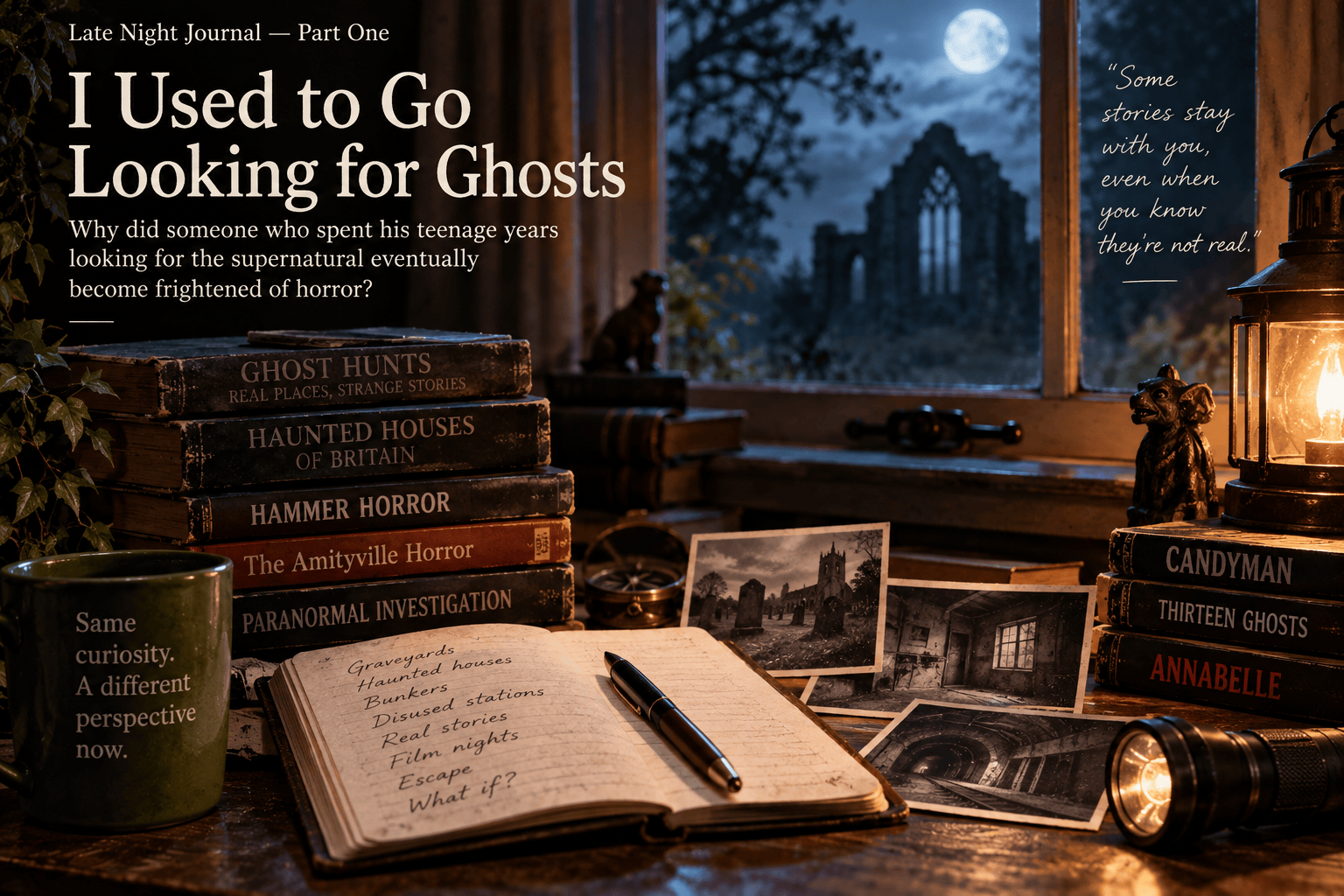
| Why did someone who spent his teenage years looking for the supernatural eventually become frightened of horror? Suze and I have recently been watching ghost stories together, which is slightly odd because she doesn’t particularly like them. We watched The Haunting of Bly Manor and then The Haunting of Hill House, which I originally saw in 2020 and remember as making me distinctly uncomfortable—this time it didn’t. In fact, we both thoroughly enjoyed it, perhaps because I found myself looking beyond the ghosts and noticing what the story was really about. Hill House is certainly supernatural, but underneath it is something much more ordinary and, in many ways, much sadder. It is about a broken family, childhood, grief, addiction, guilt and memory, and about the different ways people carry the same events through their lives. The house may be haunted, but so are the people who once lived there. That started me wondering why ghost stories frighten us at all, and more particularly why my own relationship with horror changed so dramatically, because there was a time when frightening me with a ghost story was actually rather difficult. |
| I Wasn’t Avoiding Ghosts. I Was Looking for Them. I started reading horror books around twelve, and by fourteen I was watching the old Hammer Horror films, usually alone. Dracula, vampires, haunted castles and things wandering around in the darkness were entertainment, and I don’t remember a book genuinely frightening me. I believed in ghosts when I was young, although “believed” probably needs some qualification. More than anything, I was curious. I didn’t simply want somebody to tell me that ghosts existed; I wanted to go and have a look. It began fairly innocently with graveyards after dark and ghost stories around Scout campfires. Night hikes also gave us chances to frighten other Scouts with scares borrowed from films like The Shining, which I suspect we found considerably funnier than whoever happened to be walking ahead of us. Eventually a few friends and I went into a closed house in Woking after dark where murders were said to have occurred. They found the place unsettling; I found it fascinating. We saw strange circular lights in rooms with us and experienced what seemed to be sudden temperature drops. I couldn’t explain them, but instead of wanting to leave, I wanted to understand what was happening. I later joined a club, and casual teenage ghost hunting gradually became something closer to paranormal investigation. Between about sixteen and nineteen, I visited supposedly haunted houses and museums, wartime bunkers, disused railway stations and other places with reputations for unexplained activity. Plenty of strange things happened, but experience also taught me that apparently paranormal events often become considerably less paranormal when properly investigated. Old, poorly maintained buildings creak, move, produce draughts, and create strange noises. Temperature changes can have perfectly ordinary environmental explanations, darkness distorts perception, and frightened people begin interpreting ambiguous sights and sounds according to what they expect to find. Sometimes people make things up. There was also another potential hazard in abandoned buildings that had nothing whatsoever to do with ghosts: occasionally, you discovered squatters inside. Despite all this, I don’t remember being particularly frightened on these investigations. My parents knew what I was doing and apparently concluded that I was possessed, although not by anything supernatural. They thought I was possessed by madness. When the Haunted House Was an Escape Looking back, there was another reason this strange hobby mattered to me. Home life when I was young could be very difficult. My father, who is no longer with us, could be an aggressive bully, and books, horror films, ghost stories and eventually paranormal investigation became one of the worlds into which I could escape. I don’t want to manufacture a convenient psychological explanation decades afterwards and claim that everything I did was because of my father. Human beings aren’t that simple, and my fascination with the supernatural was quite genuine. I enjoyed investigating things I couldn’t explain right away. Nevertheless, the irony is difficult to miss now. I deliberately walked through graveyards after dark and entered buildings where people assured me terrible things had happened, yet I rarely felt frightened. Whatever might have been waiting in those dark buildings, I already knew that real people could be considerably more frightening. That’s interesting when you consider the whole idea of the haunted house. Almost every haunted-house story begins with an assumption that home is where we should be safe. Horror turns that upside down by putting the danger inside. Locking the door no longer works because whatever threatens you is already on your side of it. My own experience complicates that idea slightly because a house isn’t automatically safe simply because somebody calls it home. Sometimes leaving the ordinary house and walking into the supposedly haunted one can feel more like an escape. Then, One Morning, Something Changed For decades afterwards, horror remained something I could watch without much difficulty. Then, in 2015, something happened that still seems slightly bizarre. At about half past ten one bright, sunny morning, with Suze reading in another room, I decided to watch Annabelle. There was no darkness, thunderstorm or lonely old house to create an atmosphere, yet something in the first few moments spooked me. I can’t provide a dramatic explanation because I don’t really have one. I remember the reaction. For perhaps the first time in my life, a horror film genuinely frightened me, and afterwards something seemed to change. It wasn’t that I suddenly became convinced that ghosts or demons were hiding around the house; I stopped wanting supernatural horror in my imagination. Even reading a ghost story became something I didn’t particularly want to do. My reaction was essentially: I don’t want this in my head. That still feels strange to me because I spent decades moving toward the supernatural rather than away from it. How does someone go from actively looking for ghosts to not even wanting to read about them? Watching Bly Manor and Hill House recently made me think about that again, particularly because neither frightened me very much. Perhaps part of the answer is that what frightens us in horror isn’t necessarily the ghost itself. Perhaps the Frightening Bit Isn’t the Ghost Films are remarkably good at frightening us before anything frightening happens. Think of Halloween. Much of the tension doesn’t come from Michael Myers doing anything; it comes from waiting for him to do something. Music begins, the camera lingers on a doorway, and somebody walks through an apparently empty room. Our eyes may tell us nothing is there, while the soundtrack tells another part of the brain something is wrong. Then the music stops, and sometimes the silence is worse. Eventually something appears with a sudden burst of sound, and we jump. We remember being frightened by whatever appeared on screen, but the film has spent the previous minute preparing our bodies for that reaction. Remove the soundtrack from many horror sequences, and they become considerably less frightening and, occasionally, faintly ridiculous. Another sort of horror, however, seems particularly effective on me. It is the kind that doesn’t remain safely contained within the television. Whatever You Do, Don’t Say It Five Times Candyman is a perfect example because the film itself didn’t particularly frighten me. What stayed with me was the mirror ritual: say Candyman five times while looking into a mirror and he appears. Obviously this is nonsense. Candyman is fictional, and repeating a word can’t make a supernatural murderer materialise in the bathroom. I understood that when I watched the film and understand it perfectly well today. I am now sixty-three. I spent part of my youth investigating supposedly haunted buildings and learned how easily apparently paranormal experiences can be explained in ordinary terms. I don’t believe in ghosts as figures wandering around under sheets, and although I accept that there are things we cannot immediately explain, unexplained does not automatically mean supernatural. Would I therefore stand in front of the bathroom mirror tonight and say Candyman five times? Absolutely not. I don’t care how illogical it is; I ain’t saying it. That may tell us more about horror than pretending otherwise would. The rational part of my brain knows exactly what would happen after the fifth repetition: nothing. Another part of my brain apparently sees absolutely no reason why this particular hypothesis needs testing. The film has attached an imaginary consequence to an ordinary action and, decades later, the association remains. It isn’t really belief. I think it is psychological, but the result is the same: a little piece of the horror film escaped from the screen and came home with me. The Things We Cannot See Thirteen Ghosts frightened me for a different but perhaps related reason. It wasn’t simply the appearance of the ghosts that bothered me; it was the idea that they could be standing there without you being able to see them. Under certain circumstances, special glasses let the characters see what was actually sharing the room with them. Remove the glasses, and apparently there was nothing there, except that there was. That idea removes one of our most basic ways of assessing danger. If I can see something threatening, at least I know where it is. If I can’t see it, my imagination has an enormous space to fill. Perhaps that is one reason darkness works so effectively in ghost stories. Darkness doesn’t have to contain anything frightening; it merely prevents us from being completely certain that it doesn’t. When the House Really Existed My relationship with The Amityville Horror was different again because the story entered my life through reality before cinema. I vaguely remember my parents discussing the DeFeo murders while we were living in Australia. I would have been around ten. Years later I read the book before watching the films, and what I remember most wasn’t straightforward fear but fascination. Amityville occupies an uncomfortable territory between what unquestionably happened and what was later claimed to have happened. Six members of the DeFeo family really were murdered inside that house in 1974. The extraordinary supernatural experiences later attributed to the property are another matter and have been disputed ever since. Yet once you know that the murders and the house were real, the boundary between reality and the subsequent horror story becomes slightly thinner. Something terrible genuinely happened there, and then somebody tells you that something else happened afterwards. It leaves just enough room for that wonderfully troublesome question: what if? The Boy Who Looked for Ghosts I find myself in a peculiar position today. I don’t believe in ghosts in the traditional sense, and if anything, ghost hunting taught me to become more sceptical. Buildings, weather, suggestion, expectation and human behaviour can create remarkably convincing experiences. At the same time, I don’t think we understand everything, and some experiences are hard to explain right away. That doesn’t make them supernatural; it simply means we don’t yet have an explanation. That may be why watching Bly Manor and Hill House with Suze interested me. This time I wasn’t concentrating particularly on whether the ghosts were frightening. I was thinking about what they represented. Hill House isn’t ultimately just about a haunted building. It is about a family that leaves a house but discovers that physically leaving somewhere and escaping what happened there are very different things. Memory, grief, childhood and family can haunt people just as effectively as anything supernatural. When I was young, I went looking for ghosts. Now I’m much more interested in why human beings create them, why we believe in them, what they represent and why something we know perfectly well isn’t real can still make the hairs rise on the back of our necks. Thinking about Amityville then led me somewhere else. I started remembering The Entity, possession stories, poltergeists and the paranormal cases that seemed to be everywhere when I was growing up. An extraordinary number appeared to cluster around one particular period: the 1970s. It left me wondering whether more strange things really seemed to be happening then, whether people were more willing to believe they were happening, or whether that decade created almost perfect conditions for a haunted-house story to become something millions of people thought might actually be true. That is where I’m going next. |
| Part Two: Why Did the 1970s Seem So Haunted? |
| About our writing & imagery Most articles are grounded in our real gardening experience, observations and reflections. AI may assist with research, drafting and editing, but the experiences, opinions and editorial direction are our own. Featured images may include our photography, original AI-generated visuals or, where stated, images credited to others. All published content is reviewed and shaped by Earthly Comforts before publication. |

