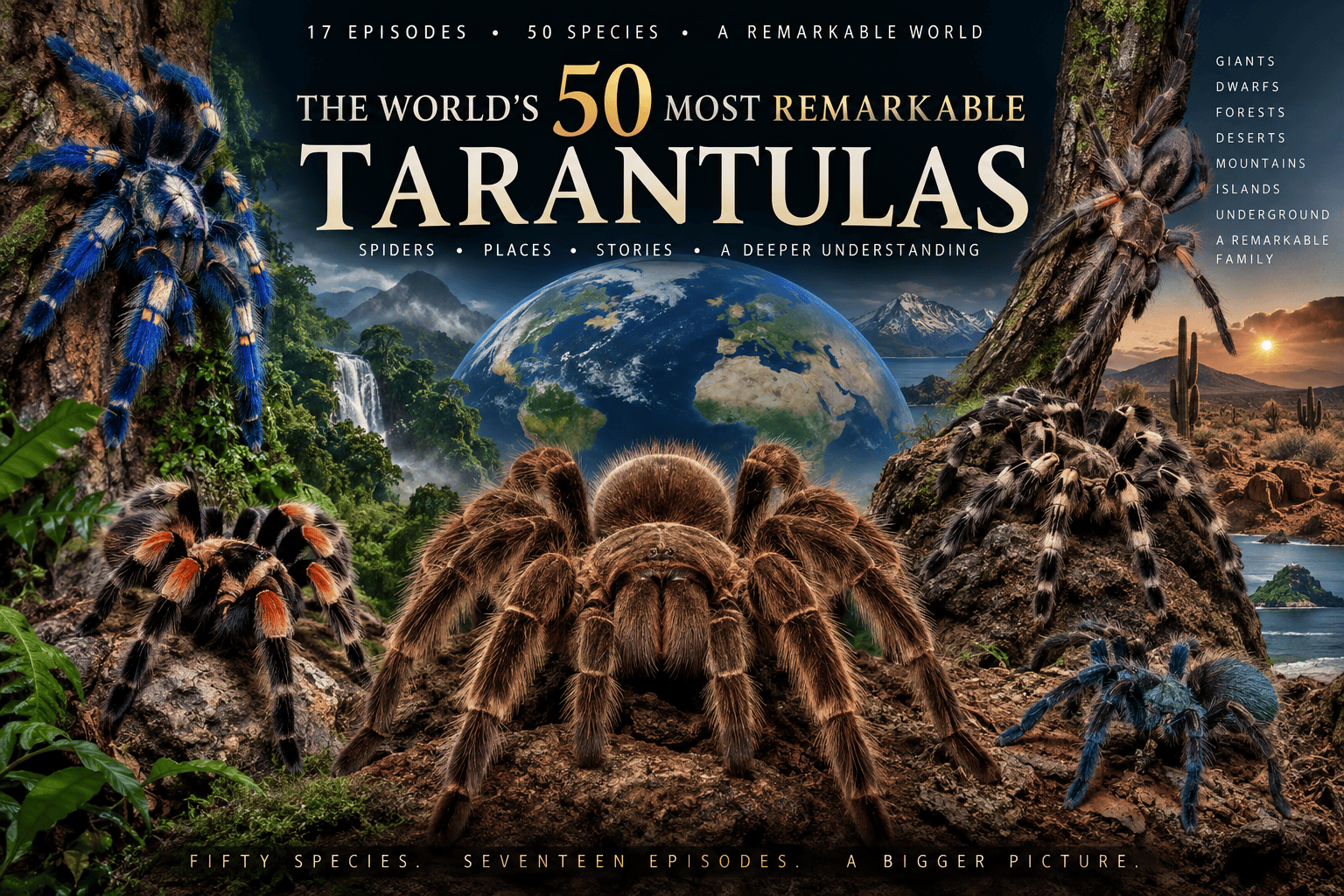

| Introduction Fifty Spiders and a Rather Different List |
| Many years ago back in 2009, when I was working professionally in the exotic livestock trade, an importer approached me with an unusual request. He wanted me to compile a list of the top fifty tarantulas from around the world. At the time, it made perfect sense. Tarantulas had become established within the exotic-animal world, and there was an extraordinary variety appearing in collections. Some were enormous, some brilliantly coloured, some notoriously defensive and others remarkable simply because very few people had encountered anything quite like them before. Putting together fifty of the most interesting seemed an intriguing exercise. I have occasionally thought about that list since. Not necessarily about which species occupied which position, or whether I would make the same choices today, but about how differently I would approach the question now. Because what exactly makes a tarantula remarkable? The biggest? The brightest? The rarest? The one with the longest legs, the most impressive threat display or the reputation most likely to make somebody take a rapid step backwards? Perhaps. But those are only tiny parts of a much larger story. So, many years after that original exercise, I have decided to do it again. Except this time, the list will be rather different. |
| Beyond the Hairy Spider For somebody with little interest in spiders, a tarantula can easily become a single mental image: a very large, very hairy, vaguely alarming spider. Look a little closer, and that image begins to fall apart. Tarantulas occur across an extraordinary range of landscapes. Some spend much of their lives underground, occupying burrows that provide carefully controlled refuges from the world above. Others live largely on the surface. Some have taken to trees and developed a very different way of moving through their environment. They occur in tropical forests, dry scrublands, grasslands, mountains and landscapes where surviving at all requires a remarkable degree of adaptation. Their appearances are equally varied. There are sombre brown animals that almost disappear against soil and bark, species decorated with brilliant blues, oranges and reds, immensely heavy-bodied ground dwellers and far more lightly built arboreal species. And then there is behaviour. One species may retreat rapidly when disturbed. Another may stand its ground. Some rely on concealment, others on speed, threat displays, or specialised defensive hairs. Their hunting strategies, burrows, reproductive behaviour and responses to their surroundings all tell slightly different versions of the same evolutionary story. There really isn’t one thing called the tarantula. There are hundreds of species belonging to the family Theraphosidae, and together they represent an extraordinary experiment in how a large spider can make a living. So Why Fifty? This isn’t going to be a countdown. There is no scientifically defensible way of declaring one species the forty-seventh most remarkable tarantula on Earth and another the third. “Remarkable” isn’t a biological measurement, and trying to pretend otherwise would miss the point. Instead, these fifty are a collection. Some will be here because of their size. Others because of their colour, habitat, behaviour or evolutionary history. Some have extraordinary geographical ranges; others exist in remarkably restricted areas. A few will be familiar even to people with only a passing interest in tarantulas, while others may be animals most readers have never encountered before. There will inevitably be some spectacular species. It would be rather perverse to write about the world’s remarkable tarantulas while deliberately avoiding spectacular tarantulas. But spectacle alone won’t earn a place. The challenge is to find fifty animals that, taken together, show just how diverse this family really is. That also means travelling considerably further than the familiar image of giant South American spiders. Africa, Asia and the Americas have produced very different evolutionary answers to similar problems: finding food, avoiding predators, reproducing and surviving environmental extremes. And somewhere among those differences lies the real reason for this series. Animals, Not Monsters Large spiders have an unusual relationship with human beings. For some people, simply seeing a photograph of one is uncomfortable. Others find them irresistible. Throughout my years working with exotic animals, I repeatedly saw both reactions. A creature could produce fascination in one person and an almost instinctive desire to leave the room in another. Tarantulas have consequently acquired considerable mythology. They have been described as aggressive, vicious and deadly. Their sizes are frequently exaggerated. Exceptional measurements become ordinary measurements after being repeated often enough, and dramatic stories about bites can travel considerably further than the more complicated biological reality. This series isn’t intended to rehabilitate tarantulas or persuade anybody that they should love spiders. Nor are we going to turn them into monsters. We are simply going to treat them as animals. That means looking properly at venom when it matters, defensive behaviour when it is interesting, and those formidable fangs without pretending they exist specifically to terrify human beings. It also means recognising that an animal capable of frightening us may itself rely primarily upon hiding, retreating or remaining completely unseen. There is something rather wonderful about discovering that an animal’s reputation and its actual biology are not necessarily the same thing. A World That Has Changed There is another reason revisiting my old Top 50 idea interests me. The world surrounding these animals has changed. Our understanding of tarantula taxonomy continues to develop. Familiar species have been moved between genera, once commonplace names have changed, and scientific work continues to reveal relationships that weren’t understood when many of these animals first became familiar within the exotic-animal world. Our understanding of wildlife trade has changed too. Some tarantulas occupy restricted habitats. Some face pressure from habitat destruction or collection. International trade has brought remarkable animals to the attention of people thousands of miles from their natural ranges. Still, it has also raised difficult questions about where animals come from and what happens when rarity itself becomes commercially desirable. Those questions belong in this story as well. My original list was created within the world of exotic livestock. This one belongs to natural history. That distinction matters. The Journey to Fifty Rather than trying to squeeze five or six animals into every article, we are going to slow things down. Most episodes will introduce just three tarantulas. That gives us time to do something more interesting than record a name, a country and a leg span. Each animal deserves enough room for us to understand why it is here. Sometimes that will take us underground into a burrow, sometimes into a rainforest canopy. We may find ourselves tracing the history of a scientific name, examining an extraordinary adaptation, or discovering that something repeated about a species for years isn’t quite as straightforward as it first appeared. Three animals also allow each episode to take us somewhere different. A giant terrestrial tarantula might share an episode with an arboreal specialist and a secretive burrower from the other side of the world. By the end, we will have met all fifty. |
| The Series at a Glance — Our Fifty Tarantulas Episode 1 — Where Better to Begin? Theraphosa blondi — Goliath birdeater Poecilotheria metallica — Gooty sapphire ornamental Monocentropus balfouri — Socotra Island blue baboon Episode 2 — Giants and Heavyweights Theraphosa apophysis — Pinkfoot goliath Lasiodora parahybana — Brazilian salmon pink birdeater Pamphobeteus antinous — Bolivian blue-leg Episode 3 — Mexico’s Remarkable Tarantulas Brachypelma hamorii — Mexican red-knee Brachypelma boehmei — Mexican fireleg Brachypelma emilia — Mexican red-leg Episode 4 — The American Deserts Aphonopelma chalcodes — Arizona blonde Aphonopelma hentzi — Texas brown Aphonopelma johnnycashi — Johnny Cash tarantula Episode 5 — Life Above the Ground Avicularia avicularia — Pinktoe tarantula Caribena versicolor — Antilles pinktoe Ybyrapora diversipes — Amazon sapphire pinktoe Episode 6 — South American Colour Chromatopelma cyaneopubescens — Greenbottle blue Acanthoscurria geniculata — Brazilian white-knee Nhandu tripepii — Brazilian giant blonde Episode 7 — The Ornamental Tarantulas Poecilotheria regalis — Indian ornamental Poecilotheria rufilata — Red slate ornamental Poecilotheria ornata — Fringed ornamental Episode 8 — Underground Asia Cyriopagopus lividus — Cobalt blue Cyriopagopus minax — Thailand black Chilobrachys fimbriatus — Indian violet Episode 9 — African Specialists Heteroscodra maculata — Togo starburst baboon Pterinochilus murinus — Orange baboon tarantula Stromatopelma calceatum — Featherleg baboon Episode 10 — Beauty Beneath the Surface Harpactira pulchripes — Golden blue-legged baboon Harpactira marksi — Marks baboon spider Ceratogyrus darlingi — Rear-horned baboon Episode 11 — The Americas Underground Tliltocatl albopilosus — Curlyhair tarantula Tliltocatl vagans — Mexican red-rump Davus pentaloris — Guatemalan tiger rump Episode 12 — South American Survivors Grammostola pulchra — Brazilian black Grammostola rosea — Chilean rose Grammostola pulchripes — Chaco golden knee Episode 13 — Speed in the Trees Psalmopoeus irminia — Venezuelan suntiger Psalmopoeus cambridgei — Trinidad chevron Tapinauchenius violaceus — Purple tree spider Episode 14 — Tarantulas That Don’t Look Ordinary Ephebopus murinus — Skeleton tarantula Ephebopus cyanognathus — Blue-fang skeleton tarantula Xenesthis immanis — Colombian lesser black Episode 15 — Islands and Isolation Phormictopus cancerides — Hispaniolan giant Phormictopus auratus — Cuban bronze Cyrtopholis portoricae — Puerto Rican tarantula Episode 16 — Three More Ways to Be Remarkable Cyriocosmus elegans — Trinidad dwarf tiger Dolichothele diamantinensis — Brazilian blue dwarf beauty Neoholothele incei — Trinidad olive Episode 17 — The Final Two Megaphobema robustum — Colombian giant red-leg Theraphosa stirmi — Burgundy goliath birdeater |
| And then — Final Reflections The numbers mark our progress through the series. They are not rankings. Look at the fifty together, and the reason for making the series longer becomes clearer. There are giants and dwarfs, burrowers and tree dwellers, animals of rainforest and semi-arid country, extraordinary blues and oranges alongside species whose more subdued appearance is every bit as successful an adaptation. Some have become famous. Others remain comparatively obscure. Some occur across substantial areas, while the future of others is inseparable from remarkably restricted habitats. Fifty species. Fifty different variations on the business of being a tarantula. |
| What Might Fifty Tarantulas Tell Us? As we work our way through them, some larger questions will inevitably arise. How did tarantulas become so successful? Why did some remain tied to the ground while others moved into trees? Why do some spend so much of their existence underground? Why did different defensive strategies evolve? Why did some become enormous? How ancient is their lineage? And perhaps most intriguingly, why does an animal that spends much of its existence trying not to attract attention command quite so much attention from us? I suspect that last question may tell us almost as much about ourselves as it does about spiders. But ultimately, this series comes back to three qualities that have fascinated me about insects, spiders and other invertebrates for much of my life: diversity, resilience and adaptability. Fifty tarantulas should give us plenty of all three. And somewhere among them may be a species capable of changing the mind of somebody who previously thought that a tarantula was simply a very large hairy spider. So, let’s begin. Next: The World’s 50 Most Remarkable Tarantulas — Episode One |
| About our writing & imagery Most articles reflect our real gardening experience and reflection. Some use AI in drafting or research, but never for voice or authority. Featured images may show our photos, original AI-generated visuals, or, where stated, images credited to others. All content is shaped and edited by Earthly Comforts, expressing our own views. |

