| Episode 4 The Swallow: When Summer Returns on Wings |
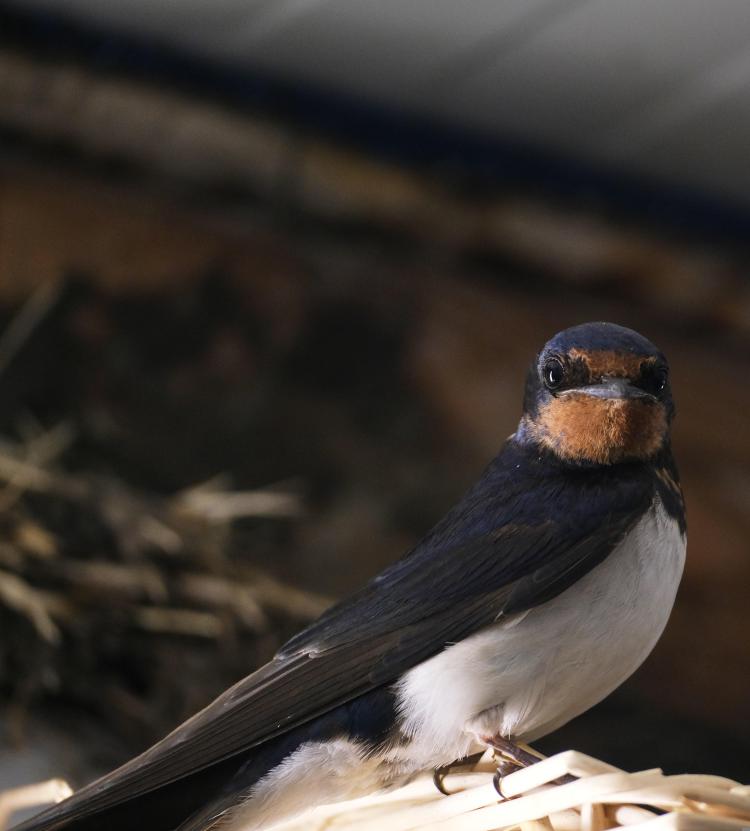
| There comes a point in spring when working outside stops feeling like something you have to endure and starts becoming something you actually want to prolong. The ground has warmed, coats have gradually been abandoned, and suddenly there is enough daylight at the end of the working day to notice the countryside rather than drive home through it. Gardens begin accelerating too. Lawns that barely needed attention a few weeks earlier are growing almost. At the same time, you watch them, clients rediscover plants they had forgotten they owned, and weeds begin their annual campaign to show they have considerably more enthusiasm than the gardener. Somewhere amongst all this activity, usually without ceremony, a familiar dark shape cuts across the sky. It turns sharply, drops towards the ground and climbs again, and the deeply forked tail tells you what you have just seen. The Swallows are back. Some birds we mark on calendars; others return and change a place’s feeling. The Barn Owl belongs to dusk, the Cuckoo announces spring from somewhere beyond our sight, and the Skylark fills open fields with song. The Swallow (Hirundo rustica) seems to bring movement itself. Once you begin noticing them, they are rarely still. They sweep across fields, skim over water, circle farm buildings and twist through the air with a confidence that makes our own attempts at moving efficiently around a garden look rather cumbersome. For much of the time, they feed, taking flying insects directly from the air, and what looks like exuberant aerobatics is actually a working day every bit as purposeful as our own. What makes their return extraordinary is how easily we become accustomed to it. These small birds have arrived after travelling thousands of miles from their African wintering grounds, crossing landscapes, weather systems and formidable geographical barriers before eventually returning to Britain. Some will return to the same general area they occupied previously, and suddenly the barn, stable, shed, or outbuilding that sat quietly through winter has its summer occupants again. We tend to say that Swallows “come back” as though they had merely spent a wet weekend somewhere warmer. The reality is one of the natural world’s great journeys, undertaken by a bird weighing little more than a handful of garden soil. Living Alongside Us The relationship between Swallows and people is unusually intimate. They are not merely birds of wilderness or distant nature reserves. For centuries they have taken advantage of the structures we create, particularly barns, stables and other open buildings where ledges and beams provide suitable nesting sites. Their mud nests can look slightly precarious to human eyes, attached beneath beams or tucked against rafters, but generations of Swallows have successfully raised young in precisely these places. There is something rather pleasing about a wild bird choosing to raise a family inside a building built for an entirely different purpose. It is also a useful reminder that wildlife habitat does not always have to look wild. A hole beneath an eave, an open barn doorway, an old wall, a hedge or even a slightly neglected corner may be every bit as important as the things deliberately installed under the label of “wildlife friendly”. We gardeners, can sometimes become rather enthusiastic about buying solutions to problems that nature previously solved with cracks, gaps, mud, dead wood and untidy vegetation. Swallows, however, need more than a place to build a nest. They need food, and that means insects. Watching them hunt makes the connection wonderfully obvious. On warm days they may feed high above fields, while in cooler or damp conditions they often fly much lower as insect activity changes. They can skim astonishingly close to grass or water, making abrupt turns that seem physically impossible until another Swallow performs the same manoeuvre behind it. A healthy population of aerial insects is therefore not background scenery to a Swallow’s life. It is the pantry. That matters because insects are one of those groups of animals we tend to appreciate selectively. Butterflies are welcome, bees receive considerable attention, and dragonflies are admired. Midges, flies and many moths receive rather less enthusiastic publicity. Yet an ecosystem cannot be assembled around the creatures we happen to find attractive. The flying insects above a meadow, pond or garden are part of a much larger food web supporting birds, bats and countless other animals. If we want skies containing Swallows, we also need landscapes capable of producing an enormous number of insects. The Garden Beneath the Swallows An ordinary garden is unlikely to determine whether Swallows survive in Britain, and I think we should be careful not to pretend that every wildlife problem can be solved within a suburban boundary. But gardens collectively occupy a considerable amount of land, and how we manage them shapes the wider landscape. A pond produces insect life. Flowering plants provide resources for pollinators. Longer grass supports a different community from closely mown turf. Trees and hedges provide shelter, while avoiding unnecessary insecticides prevents us from removing creatures that may later become somebody else’s dinner. One of the more useful things gardening teaches is that visible damage is not automatically a problem. A few chewed leaves do not mean a plant is being destroyed. A cloud of tiny flies above a lawn does not mean the garden has failed. A moth caterpillar occupying a plant may be doing exactly what that plant has helped it to do for thousands of years. Intervention is sometimes necessary, particularly when plants are genuinely threatened, or pests become overwhelming, but the assumption that every insect needs controlling is worth challenging. Sometimes the most wildlife-friendly response is simply deciding that nothing needs doing. That is harder than it sounds. Gardeners are employed to do things. We prune, cut, weed, mow, edge, clear, divide and improve. Standing in front of something and deciding that the best course of action is to leave it alone can feel suspiciously like avoiding work. Yet thoughtful gardening is as much about knowing when to stop as knowing when to start. If a patch of longer grass supports insects, if fallen leaves quietly decompose beneath shrubs, or if an old shed has become useful to nesting birds, tidiness may not always be the highest priority. The Swallow makes these relationships particularly visible because its feeding behaviour happens above our heads. We can watch insects become birds almost in real time. The connection between land and sky suddenly becomes obvious. A Summer Visitor That Must Leave There is something bittersweet about a bird whose presence is tied so strongly to summer. By late summer, Swallows begin gathering together, sometimes lining wires and rooftops in groups that seem to grow almost by the day. Young birds join adults, feeding continues intensely, and gradually the restless behaviour begins to feel like preparation. They are getting ready to leave. Migration is one of those natural phenomena that becomes stranger, not more ordinary, the closer you look. Young swallows preparing for their first southward journey have never made it before. No motorway sign points toward Africa, and no helpful map is tucked beneath a wing. They possess a combination of inherited behaviour, environmental cues and navigational abilities that will carry them across enormous distances. Weather may push them off course. Food availability will affect their progress. Some will not survive the journey. Those that do may eventually return to Britain the following spring and begin the cycle again. For centuries, people struggled to understand where Swallows went. Their sudden disappearance encouraged theories that now seem wonderfully improbable, including the belief that they might spend winter hibernating in mud beneath ponds. It is easy to smile at that from our modern position, but perhaps we should be slightly more sympathetic. Imagine living in a world without ringing studies, satellite tracking or an understanding of long-distance migration. A bird is everywhere in August and completely absent in December. Something has happened to it; the difficulty is working out what. Today we know far more about migration, but knowing the route doesn’t make the journey any less remarkable. If anything, it makes it more so. When the Sky Becomes Quieter Like many familiar birds, Swallows can create an illusion of security. When several sweep over a field, it is hard to imagine anything could be wrong. Familiarity encourages us to assume permanence. The same happens with House Sparrows, Starlings, bees and butterflies. Creatures that remain visible seem abundant because we keep seeing them, even when the wider picture may be changing. Swallow numbers can fluctuate considerably from year to year because their lives depend on conditions across a vast geographical area. A poor breeding season in Britain matters, but so can drought, weather and habitat conditions encountered elsewhere on their migratory route or wintering grounds. Changes in farming and insect abundance here can influence them too. A bird crossing continents forces us to abandon the comforting idea that wildlife conservation can be contained neatly within national borders. Something more subtle is also happening in our own landscape. Old farm buildings are converted or sealed. Access points disappear. Muddy puddles used for nest-building are tidied away. Insect-rich pasture changes. None of these individual alterations necessarily looks catastrophic. That is often how environmental change works: not through one dramatic event but through thousands of small modifications, each perfectly understandable when considered alone. Gardens can change in much the same way. One hedge becomes a fence because it is easier to maintain. One lawn becomes artificial grass because mowing is inconvenient. A pond is filled because children are visiting. An old tree comes down because it drops leaves. A flower bed becomes paving because somebody wants another seating area. Every decision may have a perfectly reasonable explanation, yet eventually the landscape contains fewer of the small opportunities wildlife once used. This is not an argument for freezing gardens or countryside in time. Landscapes have always changed, and people need to live and work within them. It is simply an argument for noticing what disappears when we change them. The Bird That Makes Us Look Up Perhaps that is ultimately what I like most about Swallows. They make us look upwards. Gardening naturally directs our attention towards the ground. We notice soil condition, emerging shoots, weeds, roots and the small disasters that have occurred since our previous visit. We spend an extraordinary amount of time looking down. A Swallow slicing through the air interrupts that concentration for a moment and reminds us that the garden does not end at the top of the hedge. An entire aerial landscape lies above it. Insects rise from the vegetation. Swallows hunt them. Bats will take over later. Birds cross between territories, weather systems arrive, seeds travel on the wind, and somewhere far above our heads, migrating birds may be passing without us ever knowing they are there. The patch of ground we call a garden is connected vertically and horizontally to the wider natural world. That is one reason the first Swallow of spring still matters. It is not simply another species returning to Britain. It marks the reopening of a seasonal relationship between our landscape and places thousands of miles away. The bird crossing a Kent field may have spent part of our winter beneath an African sky, yet here it is again, chasing insects above a paddock as though the intervening continent hardly existed. Then, sometime towards the end of summer, you realise you haven’t seen one for a while. There is rarely a farewell. One day the wires are busy with birds and another day they are empty. The garden continues, autumn approaches, and our attention shifts to leaves, shortening days, and the jobs that need doing before winter. But somewhere to the south, the Swallows are travelling. And next spring, if all goes well, the sky will suddenly have them in it again. Watching For… Swallows begin returning to Britain during spring and remain with us through summer into early autumn. Look for them over open fields, pasture, wetlands, ponds and farmland, particularly around barns, stables and other buildings where they may nest. Their deeply forked tail is one of the easiest features to recognise, particularly when compared with the shorter-tailed House Martin, and their fluid, low-level hunting flight is distinctive once familiar. Perhaps the best way to watch them is not to pursue them at all. Find somewhere insects are abundant, stop for a few minutes and allow the Swallows to come to you. Before long you may discover that the apparently empty air above a field is actually one of the busiest parts of the landscape. |
| About our writing & imagery Most articles reflect our real gardening experience and reflection. Some use AI in drafting or research, but never for voice or authority. Featured images may show our photos, original AI-generated visuals, or, where stated, credited images shared by others. All content is shaped and edited by Earthly Comforts, expressing our own views. |

