
| Series One Episode Six The Garden at the End of the Path |
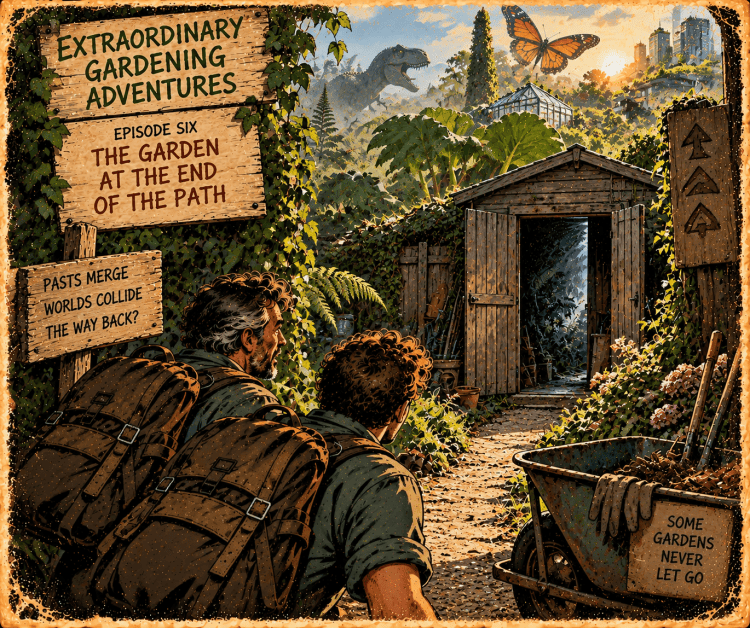
| We followed the sound of the lawnmower because, after everything else we’d encountered, it was probably the most reassuring noise imaginable. Dinosaurs had made noises. Giant insects had made noises. Whatever machinery existed in 2189 had made noises I didn’t understand. A lawnmower, however, belonged to our world. More specifically, it belonged to our working day. As John and I walked away from the greenhouse and beneath trees whose leaves had finally returned to sensible proportions, I began to believe we might actually be getting somewhere. The smell of freshly cut grass strengthened that impression. Anyone who works in gardens knows it immediately, and for the first time since we’d fallen through the back of the client’s shed, the landscape around us felt completely familiar. There were oaks and field maples, brambles pushing through the edge of a hedge, nettles in a patch of richer soil and ivy climbing an old trunk. Nothing towered above us that shouldn’t have done, nothing appeared to belong millions of years in the past and, most encouragingly, there were no slugs large enough to require right of way. John noticed it too. “Kent?” “It looks like Kent.” “You said that about the future.” “That was Kent.” “You know what I mean.” I did. The temperature felt right for September, and the light had that slightly softer quality that begins creeping into late summer afternoons. Even the soil exposed along the edge of the path looked ordinary. I crouched to examine it, which earned the predictable question from John about whether we really had time to start checking soil again. I told him that after everything we’d been through, ordinary soil deserved some appreciation. The path ahead was narrow but maintained, with signs of recent foot traffic and occasional tyre marks from a wheelbarrow or mower. We followed it through a belt of trees until the vegetation opened and found ourselves looking across a lawn. It wasn’t spectacular. In fact, it was almost aggressively normal: a modest stretch of grass, a few mature trees, herbaceous borders and an old brick wall running along one side. A mower stood abandoned halfway across the lawn. Nobody was using it. The engine was running. John and I remained beneath the trees for several moments. The mower was an ordinary petrol machine, the sort we’d both used countless times. A strip of freshly cut grass ran behind it, ending exactly where the machine had stopped. No gardener was nearby, no abandoned jacket, no fuel can, and no obvious explanation for why somebody had apparently walked away from a running mower. “That’s not good,” John said. “No.” “You were happy about the mower five minutes ago.” “I’ve changed my mind.” We approached cautiously, and John switched it off. The sudden silence was surprisingly uncomfortable. Birds were singing in the surrounding trees and insects moved through the borders, but there was no sound of people. I looked at the mower more closely. It wasn’t new, but neither was it old enough to belong anywhere except approximately our own time—even the damp grass packed beneath the deck. The garden beyond it became stranger only when we began paying attention. At first everything looked ordinary, but plants from the places we’d already visited were mixed through the borders. A cycad grew beside a modern rose. Several enormous fern fronds emerged behind a group of perfectly normal hostas. At the same time, silver-leaved drought plants like those we’d seen in 2189 occupied a sunny bed beside an old-fashioned hydrangea. None of it should have grown together under the same conditions, yet everything appeared healthy. John stopped beside one border. “That wasn’t here when we walked in.” I looked back. “What?” “The big fern.” I was fairly certain it had been, although I couldn’t remember seeing it. Before we could decide, a butterfly passed between us and settled on a flower. It was normal-sized. A second followed, considerably larger, perhaps twice what it should have been, and disappeared over the wall. The worlds were beginning to mix. We continued towards the far end of the lawn, where a gravel path disappeared between tall hedges. The closer we got, the more fragments appeared. A length of paving identical to the terrace in the abandoned garden crossed the gravel for no apparent reason. One of the water channels we’d seen in 2189 ran beneath a rose bed and vanished into the lawn. Beside the path stood a weathered wooden post, cut square and pierced near the top. I recognised it immediately. It was like the first post we’d found beside our shelter in the prehistoric world. John ran his hand over the timber. “Same one?” “I don’t know.” “How many rotten posts do you need before it stops being coincidence?” That was a fair question. The path narrowed between the hedges and began descending. We could no longer see the lawn behind us, but every few yards something familiar appeared from somewhere it didn’t belong. A giant dandelion grew beside ordinary grass. Farther on, a rusted metal bottle lay beneath a hedge, remarkably similar to the one we’d found beside the decayed rucksack. We left it where it was. By now I was beginning to suspect that objects weren’t simply repeating. The boundaries between the places we’d travelled through seemed to be collapsing. Then we found one of the arrows. It had been scratched into a flat stone beside the path and pointed forward. The mark was weathered but unmistakable, made in the same crude manner as the arrows we’d followed through the abandoned garden. John crouched beside it and looked ahead. “Whoever had that rucksack came this way.” “Or somewhere like this.” “That’s not reassuring.” “No.” “But we’re following it.” “Yes.” “Of course we are.” The truth was that we had little alternative. Behind us were giant plants, future Kent and eventually a prehistoric world with an inaccessible shed opening. Ahead was a maintained path, a sequence of clues left by somebody who appeared to have travelled through the same impossible places, and the first landscape we’d encountered that resembled our own time. It wasn’t much of a plan, but our standards for plans had declined considerably. We walked for perhaps twenty minutes, although judging time had become increasingly difficult. The path seemed longer than the landscape around it could accommodate, something that would once have troubled me considerably more. After clearing a twelve-by-eight shed whose interior had quietly gained several feet, my expectations of distance had become flexible. Eventually, the hedges ended, and the path entered an orchard. Apples hung from the trees, normal-sized and reassuringly ordinary. Several had fallen onto the grass and were beginning to rot. John picked one up, examined it and asked whether I was going to tell him not to eat it. I considered the question. We’d eaten most of our food, our water was holding up, and the apple looked exactly like an apple. More importantly, insects had already been feeding on several fallen fruits without apparently turning into anything enormous. We shared one. It tasted like an apple. That simple fact affected me more than I expected. For the first time since leaving the shed, we’d eaten something that hadn’t come out of our rucksacks. John ate another while I checked the trees for anything unusual. There wasn’t. They needed pruning, but I decided mentioning that would probably test his patience unnecessarily. At the far end of the orchard stood a small gate. Beyond it, the path continued across what looked like an ordinary meadow. The arrow symbol was scratched into one of the gateposts, and beneath it someone had carved several words. DON’T FOLLOW THE GARDENS. FOLLOW WHAT REPEATS. We read it several times. “That would have been useful earlier,” John said. It was the first actual message we’d found, rather than simply an arrow. Whoever had left it knew the places changed and apparently understood enough to recognise a pattern. I thought about what had repeated: worked wooden posts, paths, doors, the arrows themselves, fragments of structures and, increasingly, plants and objects from other worlds. Then there was the smell of cut grass. It had been with us since leaving the giant garden. John was already thinking the same thing. “The mower?” “Maybe.” “That’s not exactly repeating.” “No, but grass is.” He looked across the meadow. “There’s quite a lot of it.” He had a point. We went through the gate. The meadow should have been straightforward to cross. The path ran visibly towards a group of trees perhaps a quarter of a mile away, yet the farther we walked, the less certain the surroundings became. For several yards, enormous grasses appeared among the ordinary ones, then vanished when I looked back. A dragonfly passed overhead with a wingspan that belonged somewhere much earlier in Earth’s history. Beyond it, for a moment, I could have sworn I saw the outline of the ruined house from the abandoned garden standing among the trees. John saw something too. “Did you—” “Yes.” “House?” “Yes.” “Gone now.” “Yes.” Neither of us stopped. The path was doing something. Or perhaps the places around it were. The garden worlds we’d travelled through no longer seemed separate. They were overlapping, fragments sliding across one another like badly aligned sheets of tracing paper. A cycad appeared beside the path, followed several yards later by one of the drought-tolerant planting beds from 2189. We passed a giant rhubarb leaf growing inexplicably from an ordinary hedgerow, and somewhere in the distance came a deep animal call I recognised from our first day. We walked faster. The trees ahead finally drew closer. Beneath them the path became gravel, and the smell of cut grass strengthened until it was almost exactly what you’d expect on an ordinary gardening job. There was another sound too: not a mower this time, but metal against stone. Clink. A pause. Clink. John stopped. “Secateurs?” “No.” We listened. Clink. It sounded like somebody working. We followed the path around the trees and found a wheelbarrow. Our wheelbarrow. At least, it looked like one of ours. Mud was dried around the wheel, a pair of gloves rested inside it, and several cut branches lay across the tray. Beside it stood two black garden-waste bags, partially filled. John stared at them. “We didn’t bring a wheelbarrow.” “No.” “Or those.” “No.” He picked up the gloves. “These are mine.” That changed the mood immediately. John’s gloves had been in his rucksack earlier. He checked. They were still there. He held one pair while looking at the identical pair in his bag. Whatever was happening here wasn’t simply mixing places. It was repeating objects as well. The path continued beyond the wheelbarrow towards a high wooden fence. I could see a roof beyond it, partly hidden by trees. Not a house roof. A shed. Neither of us spoke as we approached. From this angle, nothing remarkable. Felt roof. Timber walls. Double doors. Approximately twelve by eight. Our client’s shed. The path ended at a gate in the fence. Beyond it lay the garden we’d left, or something so close to it that distinguishing the two was impossible. I could see the patio where we’d had our mugs, the piles we’d sorted during the clearance and the client’s house beyond. John reached for the gate. I caught his arm. Something was wrong. The piles. We’d left them near the shed while clearing it, but one of the stacks contained objects I didn’t remember sorting. A rusted bottle lay beside the pots. A piece of worked timber rested across the rubbish pile. Growing from behind the shed was a single enormous fern. John saw them too. “This isn’t it.” “It’s close.” “How close do you need?” I looked at the shed. The doors were open. Inside, the shelving and clutter looked exactly as we’d left them. At the back was the gap behind the boxes where I’d fallen through. For a moment I could see only darkness beyond it. Then something moved. A huge fern frond passed across the opening. We were looking through the shed into the prehistoric world. John stepped back from the gate. “So which side are we on?” I had absolutely no idea. The carved message came back to me: Don’t follow the gardens. Follow what repeats. I looked around again. The shed repeated. The objects repeated. The paths repeated. But there was something else that had been present almost from the beginning, something so ordinary we’d stopped noticing it. The rucksacks. Ours were still on our backs. The decayed traveller had carried one. Another had appeared among the clues. They were objects people carried through the worlds, not objects belonging to the worlds themselves. Then I noticed an arrow scratched into the gatepost. It didn’t point towards the shed. It pointed along the fence. We followed it. The path there was barely visible, squeezed between the fence and a hedge. It curved behind the shed, where no path existed in the client’s real garden, and ended at a narrow gap between two panels. Beyond it came voices. Not strangers from 2189. A woman’s voice. Our client’s voice. “Rory? John?” John looked at me. This time neither of us moved immediately. We’d learned that much. She called again. Then came another sound, faint but unmistakable. The clink of our mugs being placed on the patio table. I looked through the gap. All I could see was ordinary September light and the corner of a familiar garden. John adjusted his rucksack. “Do you think that’s actually home?” I thought about dinosaurs, abandoned gardens, future Kent, giant slugs and every impossible route that had looked promising until we’d stepped through it. “No idea.” He nodded. “Good. Just checking.” We squeezed through the gap. And somewhere behind us, the path disappeared. |
| About our writing & imagery Most articles reflect our real gardening experience and reflection. Some use AI in drafting or research, but never for voice or authority. Featured images may show our photos, original AI-generated visuals, or, where stated, images credited to others. All content is shaped and edited by Earthly Comforts, expressing our own views. |


Fascinating tale, and so beautifully written, Rory.
LikeLiked by 1 person
Glad you enjoyed it Eugenia.
LikeLiked by 1 person
😊
LikeLiked by 1 person