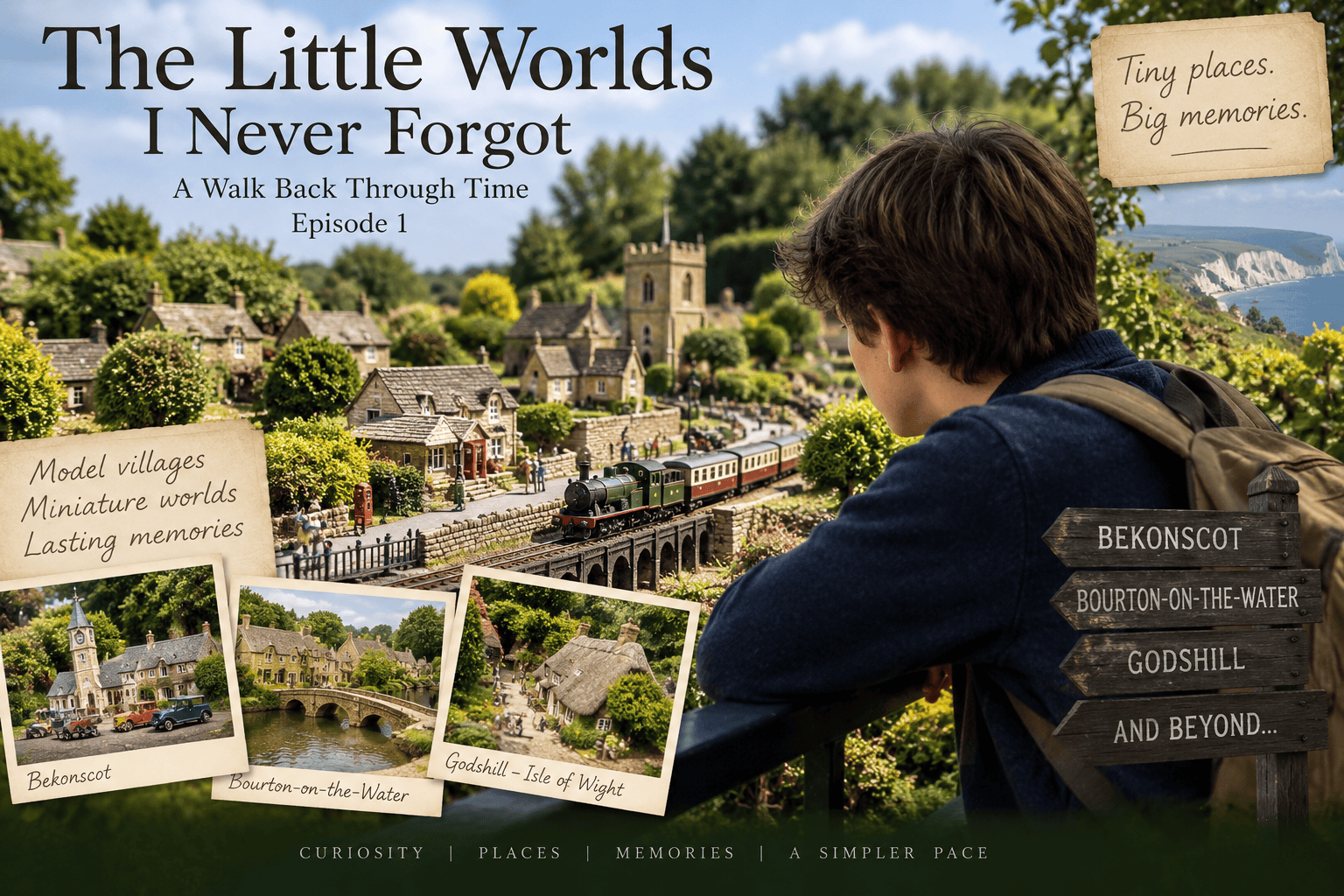
| A Walk Back Through Time Episode 1 |
| It is strange what opens a door into the past. Suze and I were recently talking about taking a holiday on the Isle of Wight, somewhere we once knew rather well because we lived there for a time. Inevitably, the conversation turned to places we might visit if we went back. Blackgang Chine came into my mind, and from there, for reasons that probably make perfect sense to the peculiar filing system of memory, I suddenly thought of Godshill. Not simply Godshill itself, but the model village. And just like that, something I had barely thought about for years came flooding back. Very few people who know me would associate me with model villages. It isn’t something I have talked about much, and I doubt many people realise just how fascinated I once was by them. Yet during my teenage years, particularly through the 1980s and into the years that followed, I loved them. If there was a model village somewhere we were visiting, I wanted to see it. I don’t know whether model villages really were more prominent then, or whether they seemed that way because I was looking for them. Memory can be deceptive about these things. Britain certainly had a wonderful assortment of slightly eccentric attractions in those days: miniature railways, boating lakes, museums, castles, wildlife parks, pleasure gardens and, tucked among them, these extraordinary little worlds. Something about walking through the entrance of a model village immediately captured me. You weren’t simply looking at models. You were looking down upon an entire world. Houses with tiny windows and gardens, churches, shops, railway stations, and roads disappeared between buildings. Little people waited on platforms or stood outside pubs. Cars remained permanently halfway through journeys they would never complete. Somewhere a train might emerge from a tunnel, cross a bridge and disappear again behind a miniature hillside. And I wanted to look at everything. That was part of the appeal. Model villages rewarded curiosity. The longer you looked, the more you discovered. Something amusing might be hidden around the back of a building. A tiny scene that was almost invisible from the main path suddenly appeared when you changed your angle. You began following roads to discover where the modeller had decided they should go. Nothing demanded your attention. You had to give it. One model village I remember visiting was Beaconsfield in Buckinghamshire. I think I was about fifteen at the time, although after all these years I wouldn’t swear to the exact age. What has remained with me isn’t a precise itinerary of the day but the feeling of the place: the buildings, the landscape and the extraordinary amount of detail contained within this miniature world. Then there was Bourton-on-the-Water, where the idea becomes wonderfully peculiar because the model village represents the village in which you are actually standing. Somewhere within that miniature Bourton is another model village, and within that another still. As a teenager fascinated by miniature worlds, that sort of thing was irresistible. I also remember Godshill on the Isle of Wight, which is where this entire train of thought began again all these years later. Suze and I lived on the island for a period, and at the time we had Scrappy, our dog. Anyone who has travelled with a dog will know that holidays and days out begin to take on a slightly different shape. You don’t simply decide where you want to go; you also consider where the dog can go. Consequently, there were places we didn’t visit, or didn’t revisit, even though we were living remarkably close to them. That may be partly why the thought of returning to the island now has stirred so much up. I would be going back to somewhere familiar, but as a visitor again. And suddenly I wonder whether I would experience Godshill Model Village differently today. I almost certainly would. Because I appreciate another part of model villages far more now than I probably did when I was fifteen. The gardening. A convincing outdoor miniature landscape has a problem that the buildings do not: plants refuse to understand scale. A miniature house stays miniature. A tree does not. Creating the illusion therefore requires an extraordinary understanding of proportion, growth and texture. Small-leaved plants can become trees. Ground-cover plants can become fields and woodland floors. Tiny hedges must remain tiny hedges. Everything grows, changes with the seasons and occasionally decides that it would rather occupy considerably more of the model village than its creator intended. As a working gardener, I can appreciate that now in a way the teenage version of me probably couldn’t. That is another reason these places have stayed somewhere in my imagination. A model village isn’t really static. It is a constructed world being slowly invaded by the real one. Rain falls on it. Moss grows. Leaves drop. Frost arrives. Plants get bigger. Things weather and fade. Somebody has to keep persuading this tiny world to remain the size it is supposed to be. My fascination with miniatures had another side, too. Many years ago, I played tabletop wargames. Again, that is something relatively few people know about me. But looking back, the connection seems obvious. Tabletop wargaming gave me landscapes in miniature: buildings, terrain, figures and entire scenes arranged across a table. The subject was different, but the fascination with scale was much the same. There is something extraordinarily satisfying about seeing a whole landscape at once. In the real world we exist inside the landscape. We see the road immediately ahead, the house opposite, the tree above us. In miniature, suddenly we can see how everything connects. The road passes the church, crosses the railway, winds around the hill and reaches the village on the other side. You can comprehend the world. Perhaps that sounds rather grand for something involving tiny houses and miniature trains, but it is part of their peculiar magic. And there was imagination involved too. As a child or teenager, I don’t think you see the little figure standing beside the railway station. Somewhere in your mind you wonder where he is going. The cottage isn’t simply a model; somebody lives there. The little road disappearing behind the hill must lead somewhere. The modeller provides the world. Your imagination quietly supplies the rest. I wonder if we are as willing to do that now. That isn’t an argument that everything was better in the 1980s. It wasn’t. Nor do I think children today are incapable of imagination because they have screens and technology. Every generation finds its own worlds to explore. But model villages require something increasingly unusual from us. They require us to stop. You cannot really rush around a good model village and understand why somebody spent countless hours creating it. The pleasure is in noticing. You look through the little windows. You wait for the train. You discover the joke hidden behind the shop. You notice that somebody has put washing on a miniature washing line even though most visitors will walk straight past it. Someone thought that detail mattered. And so do I. The little details always matter. That may be what came back to me when Suze mentioned the Isle of Wight. Not just the memory of Godshill, but the feeling tied to all those places. I hadn’t lost my fascination with model villages. I had stopped thinking about it. Some passions disappear as we grow older. New interests replace others and eventually seem to belong to somebody we used to be. But a few apparently do neither. They become quiet. They sit somewhere at the back of the mind for decades until an unexpected conversation finds them again. For me, it took the possibility of an Isle of Wight holiday. Blackgang Chine led me to Godshill. Godshill led me back to model villages. Model villages took me to Bekonscot, Bourton-on-the-Water and other miniature landscapes I remember wandering around many years ago. And before long I was fifteen again, looking down upon tiny houses, miniature railways and little roads disappearing into another world. If Suze and I do return to the island, I should go back. I suspect I would spend considerably more time looking at the planting than I once did. But model villages weren’t my only fascination when I was younger. Another type of place can guarantee I would want to stop. We would see them from the road, find them marked on maps, or discover their names while visiting somewhere new. Some were magnificent and almost complete; others consisted of little more than ruined walls standing in a field. Unlike my miniature villages, these places weren’t tiny. They were enormous, ancient and mysterious. Castles. That may be the curious contrast. Model villages made me look down into another world. Castles made me look up. But that is another walk back through time. |
| About our writing & imagery Most articles reflect our real gardening experience and reflection. Some use AI in drafting or research, but never for voice or authority. Featured images may show our photos, original AI-generated visuals, or, where stated, images credited to others. All content is shaped and edited by Earthly Comforts, expressing our own views. |


I loved this post. I have always been fascinated by the miniature world. For me it was dolls houses and model railways as a child. Later I discovered model villages. I like to see the details the modeller has created. The church with a full wedding party outside, the man hanging from his roof because his ladder fell down, children at a miniature fun fair. As an adult I also appreciate the work that goes into making tiny clothes and accessories.
LikeLiked by 1 person
Hey 🙂 It’s funny, when l was writing this l thought of you, and how you would ‘get’ the whole miniaturization’ concept like l do.
LikeLike
I am a fan of castles too, although we don’t have any in Australia, of course.
LikeLiked by 1 person
Well, there are and then there are not castles in Oz. Not in the true European sense. More to the tune of eccentric houses built in the same vein as castles. But sadly not castles at all.
LikeLiked by 2 people