| When a useful insight becomes a label |
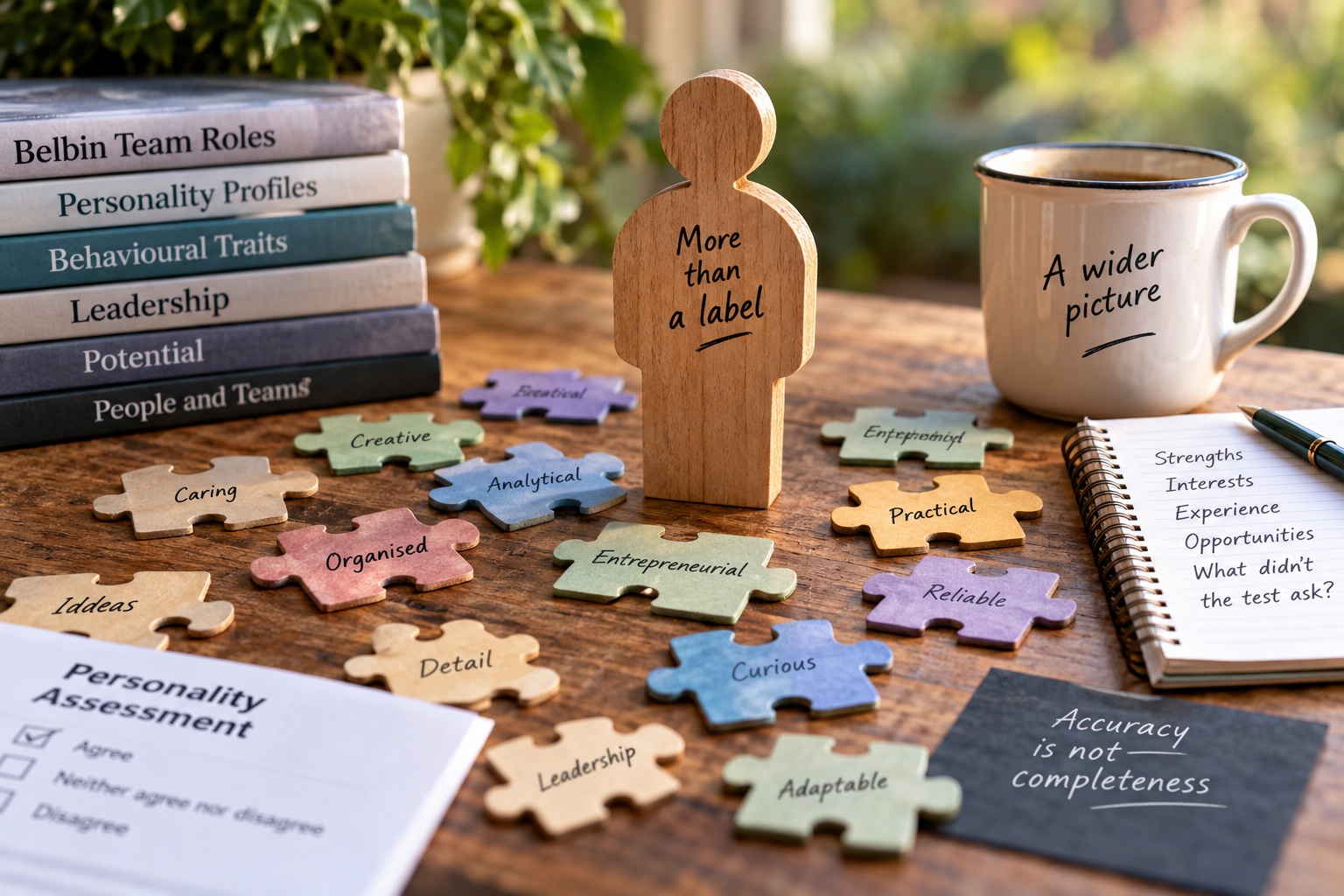
| Years ago, when I worked as a retail manager, management courses seemed to be everywhere. This was in the late 1980s and early 1990s, when businesses became fascinated with understanding what made their employees tick. We took courses on leadership, communication, motivation and, inevitably, personality and team behaviour. One name I remember particularly well was Meredith Belbin. You completed questionnaires, considered various scenarios, and eventually discovered which of the famous Belbin Team Roles supposedly best represented how you operated. Were you the Plant, generating ideas? The Shaper, pushing things forward? The Implementer, turning ideas into action? The Completer Finisher, making sure everything was actually done properly? At the time, these things were enormously popular. Managers loved them because they appeared to make the complicated business of understanding people rather more manageable. Put everyone through an assessment, identify their strengths and preferred behaviours, and suddenly the mysterious workings of a team seemed a little easier to explain. Then life moved on. I left retail management behind and, over the following thirty-odd years, largely stopped paying attention to personality tests. Until recently. Someone suggested that I take one of the modern versions. The terminology had changed, the presentation was slicker, and the categories were different, but I immediately recognised the basic idea. Answer a series of questions and the system would tell me something about the way I think, work and approach opportunities. My own result was a mixture, which didn’t particularly surprise me. What interested me far more was what happened when somebody else I know took the same assessment. She was identified very strongly with one particular profile: the analytical, organised and systematic type. Someone who knew her was delighted by the result and believed the test had described her remarkably accurately. And in one respect, perhaps it had. She is highly organised and extremely capable administratively. She notices details, keeps track of things, works methodically and can impose order on situations that would leave other people wondering where to begin. The assessment may have found X, Y and Z perfectly well. But a question occurred to me: what about A, B and C? The Good I don’t think personality and workplace-behaviour assessments are inherently useless, far from it. Used sensibly, they can make us think about ourselves in ways we might not otherwise have considered. They can identify preferences, highlight strengths, and give teams a common language for discussing why different people approach the same problem differently. You might even have one of those slightly unnerving moments when you read the result and think, Good grief, that does sound like me. If an assessment helps somebody recognise that they enjoy generating ideas but struggle with completing them, that might be useful. If another person realises they are naturally drawn to detail and structure, that might help explain why certain jobs satisfy them, and others exhaust them. Used that way, the test starts a conversation rather than delivering a verdict. The problem isn’t necessarily what the test discovers. The problem is what we subsequently do with the discovery. The Bad Somewhere along the way, “You display these characteristics” can quietly become “This is what you are.” That’s a much bigger statement. A person who scores highly for analytical and administrative characteristics becomes the administrator. Someone who demonstrates imagination becomes the creative one. Another person becomes the leader, while somebody else becomes the people person. Before long, we’ve taken an extraordinarily complicated human being and put them into a convenient box. Human beings aren’t that tidy. Someone can be meticulous about their accounts and gloriously disorganised in their garden shed. They can be cautious with money and adventurous when travelling. They can dislike brainstorming meetings yet be extraordinarily inventive when confronted with a practical problem. Creativity itself isn’t confined to painting pictures, designing things or producing wild new ideas. Finding a better administrative system, spotting a flaw in a business process or working out an ingenious solution to a practical problem can all require creativity. We also learn and change. Someone who has spent twenty years working in administration is likely to have become rather good at administration. Someone who has managed people for years will probably have developed behaviours they didn’t possess when they first became a manager. Confidence changes us, experience changes us, and responsibility changes us. Circumstances matter too. The person we encounter at work isn’t necessarily the same person their family sees at home, nor the same person who appears when they pursue something they genuinely love. So when a questionnaire identifies a strong characteristic, perhaps the sensible conclusion is, “That’s interesting. We’ve discovered something this person appears to be good at.” That is very different from saying, “Excellent. We’ve discovered what this person is.” The Ugly The ugly part begins when the label starts determining what someone supposedly cannot be. If somebody is classified as analytical, we assume they aren’t creative. If they’re an administrator, perhaps we decide they aren’t entrepreneurial. If they’re a quiet thinker, perhaps we don’t consider them leadership material. The assessment has stopped identifying strengths and started drawing boundaries. More troublingly, if the person hearing these judgements respects the individual making them, they may start believing the boundaries themselves. Perhaps I’m not creative. Perhaps I’m not someone who could run a business. Perhaps ideas aren’t really my thing. A test meant to help someone understand their strengths has now begun defining their limitations, and that should concern us. Being an excellent administrator shows someone has administrative ability. It isn’t evidence that they lack imagination, commercial judgement, leadership, initiative or entrepreneurial instinct. Indeed, some of those supposedly contradictory characteristics can complement each other beautifully. An entrepreneur who understands systems, margins, paperwork, organisation and cash flow may have considerable advantages over the great visionary who has a hundred ideas before breakfast but cannot remember whether anyone has paid the invoices. Why should creativity and organisation be opposites anyway? That assumption may tell us more about the limits of our categories than about people. Where Was the Defence? The more I thought about this, the more personality testing reminded me of a court case. Imagine the prosecution calls a witness and the barrister asks a carefully constructed series of questions about X, Y and Z. The questions are excellent, the witness’s answers are clear and, by the end of the examination, X, Y and Z have been established very convincingly. Then comes the defence. But suppose the defence barrister isn’t very good. Perhaps the questions about A, B and C are poorly worded. Perhaps the barrister barely investigates them. Perhaps those questions aren’t asked at all. The jury has now heard excellent evidence about X, Y and Z and almost nothing about A, B and C. The jury could reasonably conclude that there is strong evidence for X, Y and Z. What it cannot reasonably conclude is that A, B and C therefore don’t exist. They weren’t properly investigated. To me, that illustrates a fundamental limitation of personality testing: a questionnaire can only discover what its questions allow it to discover. If I devised fifty excellent questions about horticulture, I might become very good at determining someone’s gardening knowledge. But if I asked nothing meaningful about mathematics, I couldn’t reasonably conclude from my results that the person had no mathematical ability. I hadn’t tested it. The same principle applies when we attempt to measure something as complicated as a human being. If creativity, entrepreneurial instinct, resilience or practical ingenuity haven’t been adequately explored, their absence from the result doesn’t necessarily tell us very much. Accuracy Is Not Completeness This is the most important distinction of all: a personality test can be accurate without being complete. Those aren’t the same thing. It could correctly identify every characteristic it reports and still overlook numerous others because its questions, categories or underlying model weren’t designed to reveal them. Think of photographing a house. I can take an extraordinarily detailed photograph of the front. Every window, brick, gutter and door can be reproduced perfectly. The photograph can be completely accurate, but I haven’t photographed the back. I haven’t shown you the rooms, the garden, or what’s in the attic. Nothing in the photograph needs to be wrong for the picture to be incomplete. The mistake occurs when somebody looks at that one accurate photograph and believes they’ve now seen the entire house. That is why saying “this test described you remarkably accurately” doesn’t settle the matter. Perhaps it did. The more interesting question is whether it described everything relevant about you, and that is a much more difficult claim to establish. Thirty-Five Years Later This may be why, after all these years, I find myself less impressed by personality classifications than I once was. Back in management during the late eighties and early nineties, these models seemed exciting. They offered managers a framework for understanding why teams behaved as they did, and they can still be valuable. What thirty-five years of watching people has taught me, however, is something questionnaires struggle to capture: people surprise you. The quiet employee finds their voice. The administrator has the brilliant idea. The apparently confident manager struggles with something nobody expected. Someone who never regarded themselves as entrepreneurial suddenly spots an opportunity, takes a chance and builds something. Sometimes other people underestimate us; more dangerously, sometimes we accept their assessment and begin underestimating ourselves. So by all means take the personality test. Read the result, smile when it gets something uncannily right and think about what it might teach you. But when it tells you that you’re a Plant, a Shaper, a Steel, a Dynamo, a colour, a letter or whatever terminology the latest system happens to use, remember what you’re actually looking at. You’re looking at the answers to the questions somebody chose to ask. Perhaps the most interesting response therefore isn’t “Is that really me?” It might be: “Yes, I recognise that part of myself. Now tell me — what didn’t you ask?” Because the greatest danger isn’t that these tests tell us something about ourselves, it’s that we start believing they’ve told us everything. |
| About our writing & imagery Most articles are grounded in our real gardening experience, observations and reflections. AI may assist with research, drafting and editing, but the experiences, opinions and editorial direction are our own. Featured images may include our photography, original AI-generated visuals or, where stated, images credited to others. All published content is reviewed and shaped by Earthly Comforts before publication. |


Oh, I really enjoyed this one because I’ve always been rather skeptical about personality tests for exactly the reason you describe.
I don’t necessarily think they’re useless. Sometimes they can point out something about ourselves that we hadn’t really noticed, and that’s interesting. But I think the problem starts when we move from “this is something I recognize in myself” to “this is what I am.”
People are far too complicated for that. We can be organised in one part of our lives and hopelessly chaotic in another. We can be analytical and creative. We can be quiet and still have plenty to say. We can be cautious about one thing and take a ridiculous chance on something completely different. 😂
And, of course, we change.
I particularly liked your distinction between accuracy and completeness. Your photograph analogy really brought that home for me. You can take a perfectly accurate photograph of the front of a house, but that doesn’t mean you’ve seen the whole house. You haven’t seen the back garden, the kitchen, the attic or what is happening behind the front door.
As a photographer, that analogy really resonated with me. 😂📷
And I think the same thing applies to people. A test might accurately show you one part of somebody, but if the questions never really explored another part, how can we conclude that part doesn’t exist?
The part that worries me most is exactly what you describe under “The Ugly” — when the label starts telling somebody what they can’t be.
Someone gets told they’re analytical, so perhaps they aren’t creative. Someone is described as an administrator, so perhaps they aren’t entrepreneurial. Someone is quiet, so perhaps they aren’t leadership material.
And eventually the person might start believing it themselves.
That seems such a shame because people surprise us. We surprise ourselves. Sometimes we discover abilities in ourselves simply because life puts us in a situation where we have to use them.
So yes, I’ll happily take the test, read the result and see whether it makes me laugh because they’ve actually got something right. 😂 But I’m definitely not going to let a questionnaire tell me that it has finished describing me.
And I absolutely loved your final question:
“What didn’t you ask?”
Perhaps that is the question we should be asking much more often.
Because I think you’re right — the danger isn’t necessarily that the test tells us something untrue. It’s that we start believing it has told us everything. 😊
LikeLiked by 1 person
That’s is it precisely – my partner Suzanne, was asked to take the test by her boss, it came back with she is a Steel as in administrative only and not creative’ It knocked her a lot, l would tell her repeatedly that these tests are only designed to see parts of us. They are not designed to see all of us. However the damage was done, her boss insisted all she was good at was non creative admin and so she believed it.
LikeLiked by 1 person
I have to admit, the story about Suzanne really made me sad. ❤️ I think this is exactly why I dislike labelling people. There is such a difference between saying that someone has certain traits and telling them, or making them believe, that this is all they are.
People are far too complicated to fit neatly into a box. We can be organised and creative, practical and imaginative, quiet and curious, and so many other things at the same time. And we can discover completely new parts of ourselves as we go through life.
What saddens me most is that she eventually started believing that she wasn’t creative because someone else had effectively told her that she wasn’t. That is such a powerful thing to do to another person, even if it wasn’t intended that way.
I think we should be very careful about the labels we put on people. A description might capture one little part of someone, but it can never capture the whole person.
Perhaps that’s why I like your question so much: **“What didn’t you ask?”** There is always more to a person than what fits inside the frame. ❤️
LikeLike