| Episode 2 “Ground Cover for Sun — Plants That Knit a Border Together.” |
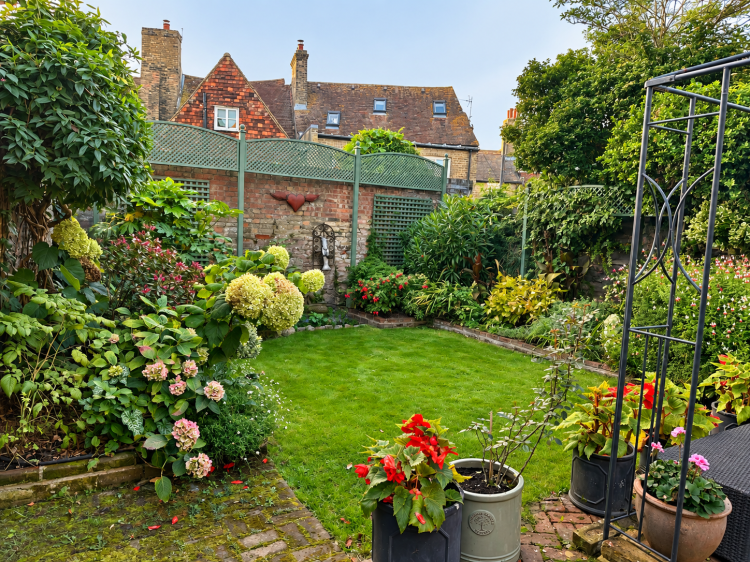
| Ground cover does not have to mean a flat carpet. Here, lower planting fills the spaces beneath and between larger shrubs and perennials, helping the borders knit together while allowing each plant to retain its own character. |
| At some point in developing a sunny border, it stops looking like a collection of plants and starts looking like a garden. The shrubs have grown enough to give the border structure, the larger perennials are beginning to establish themselves, and perhaps ornamental grasses are providing the height and movement we originally wanted. Yet beneath all of this, considerable amounts of soil can still show between individual plants. Everything may be perfectly healthy and growing exactly where it was planted, but somehow the border has not quite joined together. Each plant still seems to occupy its own little island, surrounded by earth, and those spaces require almost as much attention as the plants themselves. We weed them, mulch them, watch them dry out in hot weather, and then weed them again when something inevitably discovers the vacant ground. This is where ground cover can change not only the appearance of a sunny border, but also how it functions. In a sunny position we have an enormous choice of plants capable of occupying this lower layer. However, that abundance can make choosing them rather more complicated than it first appears. A plant described as suitable for ground cover might form a restrained clump, creep gently outwards, root as it travels, scatter seedlings several feet away or eventually attempt to occupy half the border. All of those plants may technically cover the ground, but they are not doing the same thing, and that distinction becomes increasingly important as a garden matures. For me, the most useful sunny ground cover is rarely the plant that covers the greatest distance in the shortest time. It is usually the plant that gradually knits the planting together without making everything else disappear. We want something confident enough to fill the spaces we give it, but not so determined that every neighbouring plant eventually becomes an obstacle to overcome. Sun is not one growing condition. We tend to talk about a sunny border as though the description tells us everything we need to know, when in reality two sunny borders can present completely different growing conditions. A south-facing bed against a brick wall can become extraordinarily hot and dry during summer. At the same time, an open border on heavier soil may remain surprisingly moisture-retentive beneath the surface despite receiving just as much sunlight. Add wind exposure, competition from mature shrubs, reflected heat from paving, and the difference between morning and afternoon sun, and the simple instruction to choose a plant “for full sun” becomes much less useful. Ground-cover plants experience these variations particularly strongly because they live close to the soil surface, exactly where heat, evaporation and competition from surrounding roots can be most noticeable. Another complication becomes apparent only over time. A low-growing plant placed in an open, newly planted border may spend its first few years receiving uninterrupted sunshine, only to find itself in quite substantial shade once the shrubs and taller perennials around it mature. That is why I prefer to start with the ground and the developing garden rather than a list of supposedly suitable plants. Is the soil dry or moisture-retentive? Does it drain freely after heavy rain? Are we planting amongst established shrubs whose roots already occupy much of the available soil? Will the ground-cover plant remain in open sunshine or eventually find itself beneath something much larger? Most importantly, how much territory do we actually want it to occupy? Once we start thinking about those questions, choosing the right plant becomes considerably easier. The plants that quietly join things together Hardy geraniums are a good example of why ground cover is better understood as a behaviour than as a particular type or height of plant. Not every geranium makes useful ground cover, and different species and cultivars can behave remarkably differently, but the right one can perform the job beautifully. Geranium macrorrhizum, for example, can develop into broad, leafy colonies and is particularly useful where something robust is required. Its aromatic foliage creates a substantial layer over the soil, and it will tolerate conditions that defeat many more delicate plants. Other hardy geraniums form looser mounds, spreading gradually while still allowing neighbouring plants to emerge alongside them. In a mixed border this can be more useful than creating a completely uniform carpet because the objective is not necessarily to hide every centimetre of earth beneath one species. It is to remove that sense that every plant has been placed separately into its own patch of soil. This is when a border begins to take on the slightly blurred boundaries I particularly like. One plant finishes somewhere around the point another begins, but it is not always obvious exactly where. Leaves intermingle, taller perennials emerge through lower foliage and spring bulbs can push upwards before disappearing again as the season progresses. Alchemilla mollis can produce this effect wonderfully in the right situation. Its soft, rounded foliage fills awkward spaces and can disguise the hard visual boundary between soil, paths and larger plants. After rain, of course, those leaves perform their familiar trick of holding droplets of water, which is probably the moment when most people notice the plant. Yet from a gardener’s point of view, some of its most useful work is far less spectacular: it occupies space that would otherwise remain open. Alchemilla also illustrates why we need to think about what happens after a plant becomes established. It can seed itself freely when conditions suit it, and sometimes that is precisely what makes it so useful. Seedlings appear in small gaps, along edges and between neighbouring plants, and gradually the border develops a continuity that would have been difficult to design plant by plant. In another garden, or even another part of the same garden, the same behaviour can become irritating because seedlings repeatedly appear where they are not wanted. The plant has not suddenly become good in one situation and bad in another. Its behaviour is essentially the same; what has changed is whether that behaviour is useful to us. That distinction will become particularly important later in this series when we meet some of the plants I think of as the beautiful bullies. When the ground really does bake At the hotter and drier end of a sunny garden, the character of useful ground cover changes considerably. A narrow border beside paving, a gravel garden, or a bed against a warm wall can be unforgiving during a dry summer, particularly when the soil is shallow or naturally free-draining. This is where creeping thymes can become particularly useful. Their low growth lets them occupy edges and work amongst stones without overwhelming them. At the same time, their preference for free-draining conditions means they suit heat and dryness far better than many of the softer plants we might use elsewhere. When they flower, they also become remarkably busy places for insects, adding another purpose to a plant that might otherwise be seen as something used to cover exposed soil. Lower-growing sedums offer another approach. Their fleshy leaves let them tolerate conditions where maintaining lush, moisture-dependent ground cover would be an unnecessary battle. This points to a broader principle that applies far beyond these particular plants: ground cover should suit the conditions rather than requiring us to alter those conditions to keep it alive constantly. If a border becomes dry every summer, choosing a moisture-loving plant and repeatedly watering it simply because we like its appearance makes little sense when there are plants naturally adapted to that environment. The same is true of poor soil. Some plants used for sunny ground cover actually become less attractive when given rich soil and excessive feeding because their growth becomes softer, taller, and less compact. What was supposed to creep or mound neatly across the ground begins reaching upwards instead. Sometimes the apparently difficult patch of the garden is giving us a fairly good indication of what ought to grow there. Ground cover does not have to hug the soil. One misconception worth abandoning is that a ground-cover plant must remain only a few centimetres high. In a substantial border, something twenty, thirty or even forty centimetres tall may form the lowest meaningful layer, and what matters is not its height in isolation but its relationship with everything growing around it. A tiny mat of thyme beneath a large hydrangea might disappear visually. In contrast, a spreading geranium, Nepeta or Alchemilla could have enough presence to connect the shrub to the planting around it. This becomes increasingly obvious as gardens mature. The larger the structural plants become, the more generous the lower planting can afford to be, while tiny individual plants dotted around their bases can begin to look rather lost. The objective is not necessarily to see every ground-cover plant clearly. Quite often its success lies in making everything above it look better. A rose rising directly from cultivated soil is unmistakably a rose planted in a bed; the same rose emerging from a loose mixture of lower foliage can feel as though it belongs to a larger planting community. The eye stops travelling from specimen to specimen and begins reading the whole border as one composition. That is partly an aesthetic effect, but it also has practical consequences: the more of the soil surface that useful vegetation occupies, the fewer completely open spaces remain for unwanted vegetation to exploit. We are effectively deciding what gets to occupy the ground rather than repeatedly clearing it and waiting to see what arrives next. Competition is part of the bargain. However, there is a danger in treating this idea too simplistically: every plant we add to a border is another competitor. Ground cover does not merely protect soil and inconvenience weeds; its roots require water and nutrients, its foliage intercepts light and, as it expands, it occupies physical space. Around a mature shrub with a well-established root system, competition may be relatively insignificant. Around a newly planted shrub or young perennial, it can matter considerably. Something vigorous planted immediately against a new plant can compete for exactly the resources that plant needs while establishing itself, which is why mulch is sometimes a much better temporary answer than living ground cover. This gradual development is something we often forget when looking at photographs of mature gardens. We see plants flowing into one another and imagine that the border was planted at that density from the beginning, when frequently it was not. Structural plants were given space to establish, the open ground was weeded and mulched, and the lower layer gradually expanded as the garden matured. There is nothing wrong with leaving deliberate space around young plants provided we understand that this space needs managing while the border develops. The mistake is not having bare soil in year one. The mistake is assuming the same bare soil should still be there in year ten. Gardens need time to grow into themselves, and good ground-cover planting should be part of that process rather than something imposed upon the border all at once. The edges often tell the story. One place where I notice the effect of ground cover most strongly is along the front of a border. A hard line of exposed soil running beside paving, gravel or lawn can make otherwise attractive planting look strangely disconnected from the rest of the garden. Let a suitable plant soften that boundary, and the effect can change almost immediately. Nepeta leaning slightly towards a path, thyme creeping between stones, Alchemilla spilling gently over an edge or a hardy geranium gradually obscuring the precise point where the planting finishes can make the border feel considerably more settled. We have not altered the shrubs or changed the principal planting at all; we have dealt with the line beneath them. There is obviously a practical limit. A plant that repeatedly flops halfway across a path stops being attractive and becomes something we have to step over, while ground cover constantly invading a lawn creates another maintenance job. This is where observation becomes more useful than the dimensions printed on a plant label. Plants rarely read their labels. A stated spread of sixty centimetres does not mean a plant reaches sixty centimetres and politely stops. It indicates what an established specimen may do under expected conditions, but soil, rainfall, competition, exposure, and time all influence what happens next. Eventually the gardener learns the real dimensions by watching the plant, and sometimes by cutting it back after discovering that our sixty-centimetre plant has rather different ideas. Flowers are almost a bonus. It is easy to choose ground-cover plants for their flowers because flowers catch our attention at the nursery or in photographs. Yet for this particular layer of the garden I think foliage is often more important. Flowers may last several weeks, while leaves can do their job for six, eight, or even twelve months. Leaf shape, density, colour and persistence therefore deserve just as much thought as flowering time. The rounded softness of Alchemilla looks very different from thyme; geranium foliage creates another texture; and silver or grey-green leaves can completely alter the character of a hot, dry part of the garden. Mixing those forms and textures is one way to prevent ground-cover planting from becoming a featureless carpet. This lower layer also offers quieter wildlife value. Flowers from thyme, Nepeta, hardy geraniums and many other suitable plants can provide nectar and pollen, but the vegetation itself matters too. Dense foliage creates shelter close to the soil surface, catches fallen organic material and provides a more complex environment than a repeatedly cleared patch of earth. Small invertebrates do not experience a border as we do from several feet above it. At their scale, the difference between bare soil and a dense layer of stems, leaves, shade and accumulated plant material is enormous. It is another reminder that some of the most important activity in a garden occurs in the part we are least inclined to look at closely. Knowing when enough is enough Perhaps the most important skill with sunny ground cover is recognising when the plants have achieved what we originally wanted. Once the gaps begin disappearing, management changes. Instead of encouraging a plant to spread, we may begin restricting it. A geranium encroaching upon a weaker neighbour gets reduced, an edge is trimmed back from the path, Alchemilla seedlings appearing somewhere inconvenient are removed. At the same time, a thyme that has wandered beautifully into a patch of gravel may be allowed to continue because it looks better there than anything we could deliberately have designed. That is not evidence that the planting scheme has failed. In many ways, that ongoing editing is the planting scheme. A living border is never finished the way a paved path is; plants grow, compete, seed, retreat, intermingle, and occasionally surprise us, while the gardener decides which changes to encourage and which need correcting. We began this series with bare soil and the idea that nature rarely regards it as finished. In a sunny border, we can decide what occupies those spaces before something else decides for us, and the answer doesn’t have to be a single ground-cover species repeated from one end of the bed to the other. Some of the most convincing borders are held together by several plants performing slightly different versions of the same job: creeping along an edge, forming a mound between shrubs, slipping beneath a rose, occupying a dry corner or eventually meeting another plant somewhere in between. Individually, none of them necessarily becomes the star of the border, and that is precisely the point. Their job isn’t always to demand our attention, but to connect the plants that do. Once that lower layer begins to establish, something subtle happens. We notice the bare soil less, the boundaries between individual plants become softer, and the border starts to feel older and more settled than it really is. We may still admire the rose, hydrangea or ornamental grass first, but what allows those plants to belong together may be happening much closer to the ground. And once again, the plants we notice least may be the plants holding the garden together. |
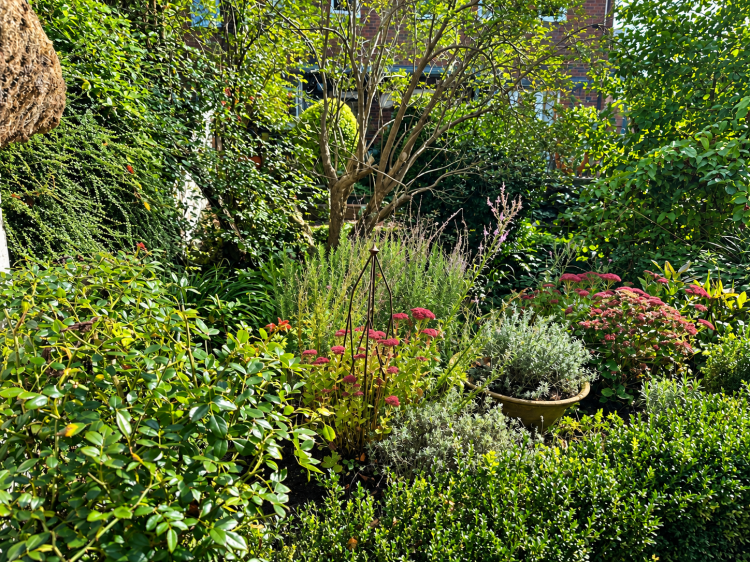
| A sunlit border built in layers, where shrubs, perennials and lower-growing plants overlap naturally, occupying the ground and creating the sense of a garden that has gradually knitted itself together. |
| About our writing & imagery Most articles reflect our real gardening experience and reflection. Some use AI in drafting or research, but never for voice or authority. Featured images may show our photographs, original AI-generated artwork, or, where stated, credited images shared by others. All content is shaped and edited by Earthly Comforts, expressing our own views. |

