| A 5-Part Series |
| A curated exploration of North America’s most iconic, curious, and ecologically important insects |
| Part Four Grasshoppers, Flies & Roaches: Abundance and Control |
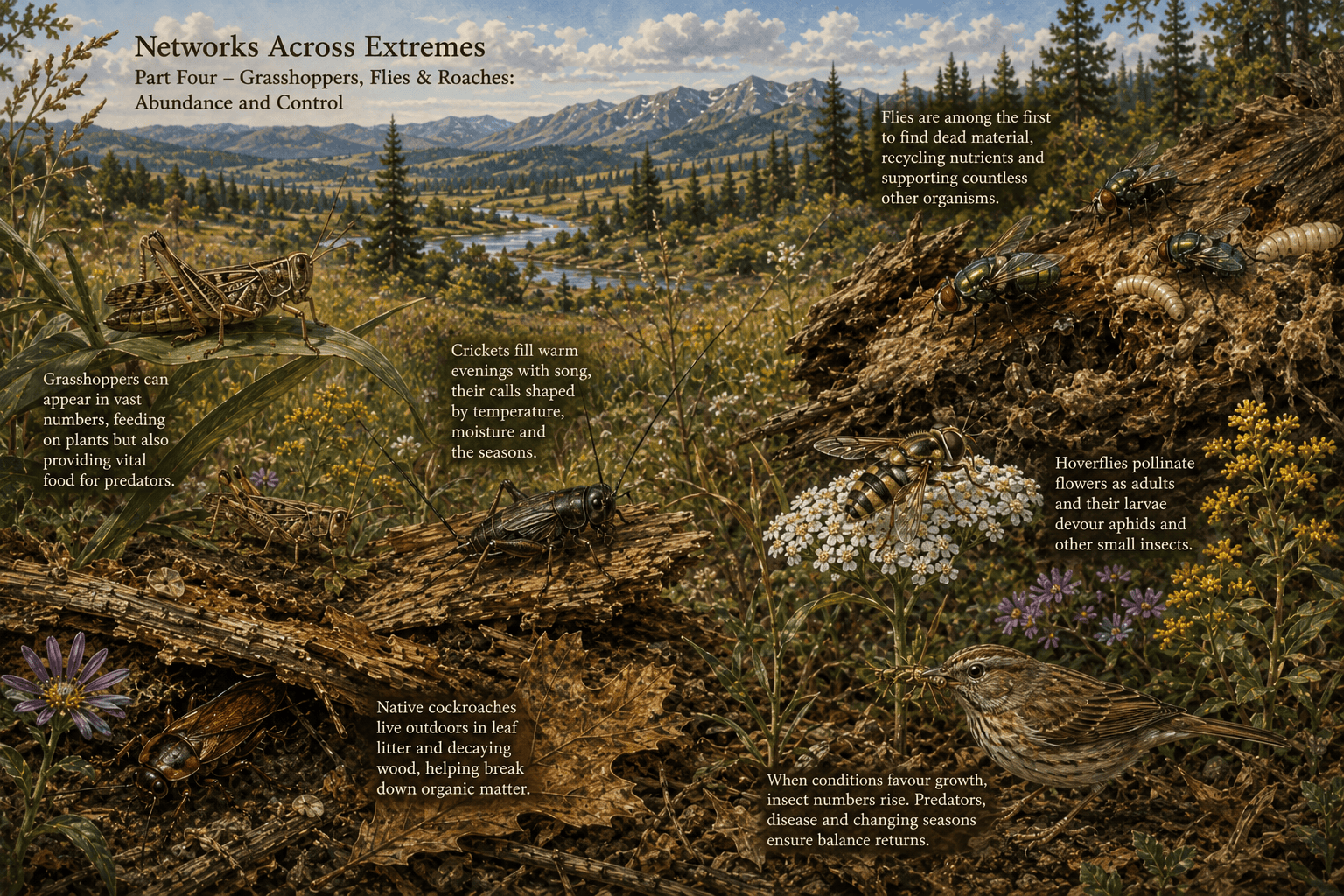
| North America has a habit of producing insects in numbers that can appear almost impossible. A prairie that seemed relatively quiet one week may suddenly be alive with grasshoppers. Warm evenings become filled with the sound of crickets, while a change in weather can bring flies, midges and other insects into view almost overnight. We tend to interpret these moments as explosions, as though something has gone wrong. Sometimes, of course, insect numbers genuinely do become problematic, particularly where agriculture has concentrated enormous quantities of suitable food into one place. But abundance itself is not necessarily evidence of imbalance. In many North American landscapes, rapid population growth followed by equally rapid decline is part of the ecosystem’s normal rhythm. Rainfall produces vegetation. Vegetation supports herbivores. Herbivores support predators. Heat accelerates development, while drought, cold, disease and predation eventually reduce numbers again. The landscape expands and contracts biologically in response to conditions. Grasshoppers, crickets, flies, hoverflies and native cockroaches occupy very different roles within this cycle, but they share one important characteristic. When conditions become favourable, they can respond remarkably quickly. Grasshoppers and the rhythm of the prairie Few insects are more closely associated with North America’s grasslands than grasshoppers. They are particularly well suited to open habitats, where grasses and herbaceous plants provide both food and shelter. Their populations can fluctuate considerably from one year to another. Rainfall influences plant growth, temperature affects development, and the success of previous generations determines how many insects are present when conditions return to favourable levels. A sequence of good seasons can produce substantial numbers. For agriculture, this can become a genuine concern. Large grasshopper populations can consume considerable quantities of vegetation, and where crops or grazing land are involved, the economic consequences can be serious. Ecologically, however, grasshoppers are not simply consumers removing plants from the system. They are themselves a major food resource. Birds, mammals, reptiles, spiders and predatory insects feed upon them. Their abundance transfers enormous quantities of energy from vegetation into the wider food web. When grasshopper numbers rise, predators benefit too. This relationship is easy to forget because gardeners naturally notice what has been eaten. A chewed leaf provides visible evidence; the bird that later eats the grasshopper responsible may leave none. People also tend to assume that every outbreak requires immediate intervention. In some situations, it does, particularly when crops or vulnerable plants suffer substantial damage. In natural landscapes, however, populations frequently self-regulate through changes in weather, disease, food availability, and predation. The difficult part is knowing when abundance is temporary and when genuine intervention is justified. That judgement is as relevant in a garden as it is on a prairie. Crickets and a landscape measured in sound Crickets announce themselves differently. We may never see the insect producing the sound, yet warm evenings across much of North America can be filled with their calls. The effect is so familiar that cricket song is often treated as little more than summer background noise. It is actually information. Male crickets call primarily to attract females, and their activity is strongly influenced by temperature. As conditions warm, calling often increases. Different species have their own patterns, creating a shifting acoustic landscape through the season. Moisture, vegetation and habitat structure also influence which crickets are present. A meadow, a woodland edge, and a suburban garden may each support different communities. This makes sound another way of observing ecological change. Gardeners are accustomed to reading plants. Wilting leaves tell us the ground is dry. New shoots indicate growth. Fungal problems may reveal prolonged dampness. Insects provide similar clues, but some of them do so acoustically. A garden that becomes suddenly quiet can sometimes tell us as much as one that becomes noisy. Crickets also play an important role in food webs. Depending on the species, they consume plant material, fungi, and organic debris and become prey for birds, small mammals, reptiles, amphibians, spiders, and other insects. The familiar summer chorus is therefore produced by creatures sitting squarely in the middle of a much larger system. Flies doing the work nobody celebrates Few insect groups have suffered more from their association with human waste than flies. When you mention flies, most people think of bins, kitchens, carrion, or something unpleasant that needs removing. These associations are not entirely unfair. Certain species readily exploit human environments and can transmit pathogens as they move between contaminated material and food. But judging all flies by these encounters is rather like judging all birds by pigeons around a railway station. The group is extraordinarily diverse. Blowflies and many related species carry out some of the fastest decomposition in the landscape. When an animal dies, flies can locate the remains remarkably quickly. They lay eggs, larvae develop, and organic material begins converting into living tissue that other animals can eat. It is not a pleasant process by human standards, but ecosystems cannot afford sentimentality about decomposition. Dead organisms contain nutrients. Those nutrients must return to circulation. Without decomposers, the landscape would gradually accumulate material that remained biologically unavailable. Flies help prevent this. Their larvae feed birds and other predators, while adults themselves become food for spiders, dragonflies, amphibians and countless other animals. What looks unpleasant at close range may be essential when viewed at the scale of an ecosystem. Hoverflies doing two jobs at once Hoverflies offer a useful challenge to our instinctive reactions to insects. Many resemble bees or wasps, with yellow and dark markings that can make people keep their distance. Yet hoverflies cannot sting and are generally harmless. The resemblance itself provides protection. A predator that has learned to avoid a wasp may hesitate before attacking something that looks similar. Their ecological usefulness extends well beyond disguise. Adult hoverflies visit flowers for nectar and pollen, making them important pollinators. Their ability to move rapidly between flowers can make them particularly noticeable on sunny days, hovering almost motionless before suddenly darting away. The larvae of many species lead completely different lives. Some are predators of aphids and other small insects, meaning that the same species can contribute to pollination as an adult and natural pest regulation during its larval stage. For gardeners, that combination is hard to beat. Yet hoverflies are sometimes killed simply because they are mistaken for wasps. Appearance has once again shaped our judgement before we consider behaviour. Learning to recognise the difference does not require becoming an entomologist. Watching the insect often provides clues. Hoverflies have their characteristic stationary flight and generally lack the purposeful searching behaviour of a hunting wasp. A little observation can prevent a useful garden visitor being treated as an enemy. Cockroaches away from houses Cockroaches face an even greater reputation problem. The word itself immediately suggests indoor infestations, contaminated food and difficult attempts at eradication. A handful of species have adapted extremely well to human buildings, and those species have effectively become representatives for the entire group. Most cockroaches are nothing of the sort. North America has native species that live outdoors in woodlands, in leaf litter, beneath bark, and among decaying vegetation. Far from invading kitchens, they spend their lives helping process organic material. Their role resembles that of many other decomposers. Leaves and plant debris contain nutrients that cannot remain locked within dead material indefinitely. Cockroaches fragment and consume some of this matter, assisting microorganisms and other organisms involved in decomposition. In woodland systems, this is ordinary ecological housekeeping. The distinction between indoor pest species and outdoor native cockroaches matters because our instinctive response is often based entirely on the name. A cockroach beneath a rotting log in a forest is not evidence of an infestation. It is where the insect belongs. Something is revealing about this. Humans are remarkably good at allowing a few troublesome relatives to ruin the reputation of an entire family. Insects suffer from it constantly. Abundance does not always mean imbalance. The insects in this episode share something else: their numbers can be deceptive. A sudden increase in grasshoppers may result from favourable weather rather than ecological collapse. Large numbers of flies may indicate that a temporary food source has become available. Hoverflies may gather where aphids are abundant, while crickets respond visibly — or rather audibly — to warmth. We tend to prefer wildlife in modest quantities. One butterfly is delightful. Hundreds of caterpillars are less enthusiastically received. A hoverfly on a flower is welcome, while a cloud of insects tends to produce concern. Nature does not operate according to our preferred densities. Population changes are often responses to resources. When food becomes plentiful, the organisms capable of exploiting it increase in number. Predators then respond, disease spreads more readily through dense populations and eventually resources decline. The result is correction. That correction does not always happen quickly enough for our purposes. A farmer cannot necessarily wait for predators to reduce grasshopper numbers after a crop has already been destroyed. Nor should a gardener ignore a rapidly developing problem simply because nature may eventually resolve it. Ecological understanding does not require abandoning practical management. It simply allows us to distinguish between genuine damage and the discomfort of seeing more insects than we expected. A garden is allowed to fluctuate. Gardening encourages consistency. We water to compensate for dry weather, feed plants when soil becomes depleted, and prune growth to maintain shape. Much of our work involves smoothing out natural variation. Wildlife does not always cooperate. A warm spring may produce extraordinary aphid numbers. The following year they may barely be noticed. Hoverflies arrive in response. Wasps hunt when prey is plentiful. Grasshoppers increase and decline. Flies appear when decomposition provides an opportunity. A biologically active garden should not look identical from year to year. This can be difficult to accept because stability feels reassuring. Yet a landscape in which populations rise and fall is not necessarily unstable. Fluctuation may be evidence that organisms are responding normally to changing conditions. The important question is not whether numbers change. It is whether the relationships that can bring them back into balance still exist. Predators need habitat. Decomposers need organic material. Pollinators require flowers. Insects that spend part of their life cycle in soil need places where the soil remains relatively undisturbed. Remove too many parts of the system and natural correction becomes harder. Abundance and control Grasshoppers, crickets, flies, hoverflies and cockroaches are unlikely to compete successfully with butterflies in a popularity contest. Some are tolerated, others misunderstood, and a few can spark an immediate desire to reach for something to remove them. Yet together they perform work that landscapes cannot easily do without. Grasshoppers convert vegetation into food for predators. Crickets contribute to decomposition and food webs, translating temperature and season into sound. Flies rapidly return dead material to circulation. Hoverflies move between pollination and predation, while native cockroaches continue breaking down plant debris where few people ever see them. Their numbers rise when conditions favour them and fall when those conditions change. Sometimes the rise is inconvenient. Occasionally it is destructive. Often it is simply temporary. These pulses of abundance have always shaped North America’s landscapes. Rain comes; vegetation responds; insects multiply. Predators follow. Heat intensifies, food disappears, or winter arrives, and numbers fall again. Control doesn’t necessarily mean preventing abundance. In a functioning ecosystem, control often comes afterwards. And much of the time, it arrives without us doing anything at all. |
| About our writing & imagery Most articles reflect our real gardening experience and reflection. Some use AI in drafting or research, but never for voice or authority. Featured images may show our photos, original AI-generated visuals, or, where stated, images credited to others. All content is shaped and edited by Earthly Comforts, expressing our own views. |

