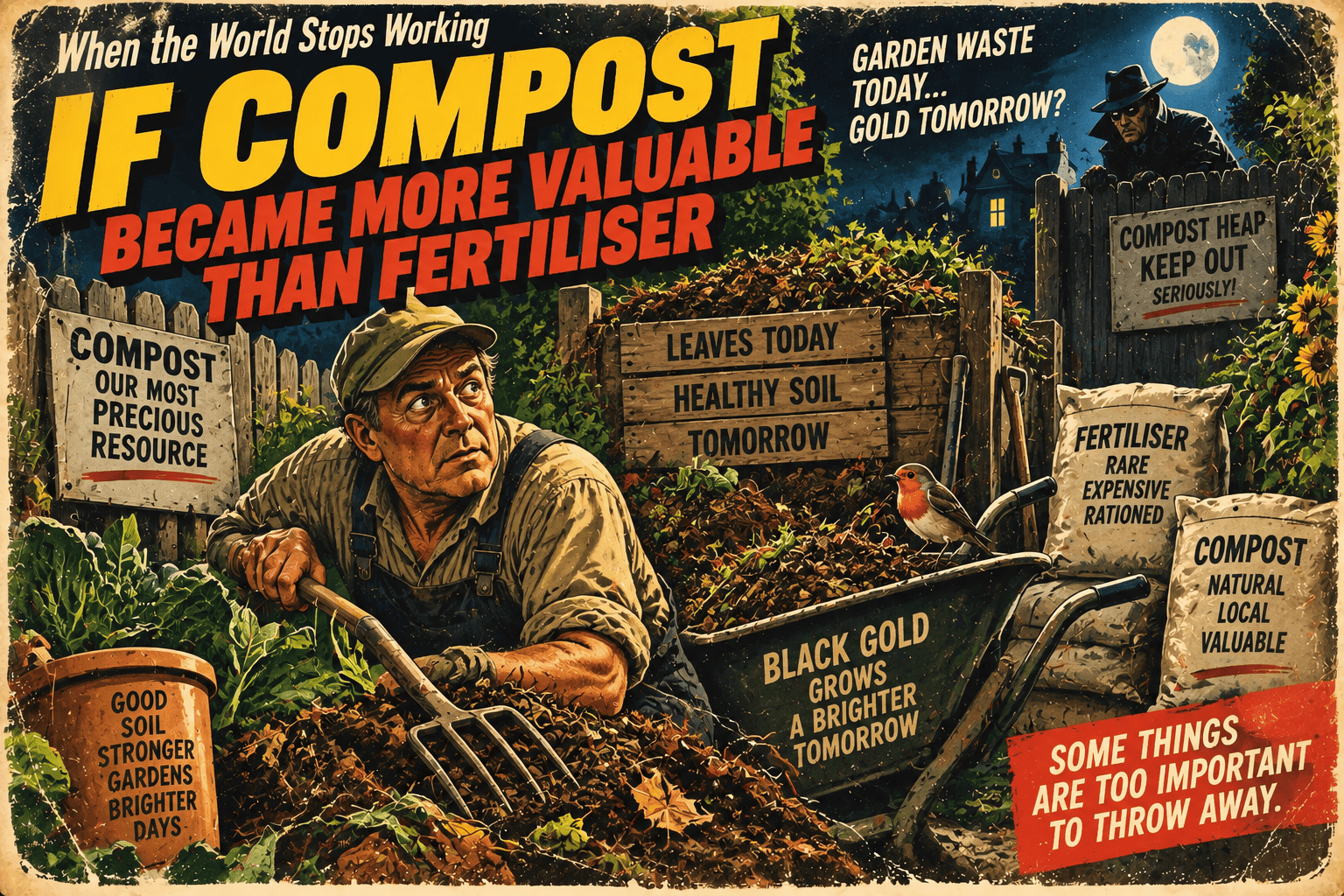
| Compost has something wonderfully unglamorous about it. It sits at the bottom of gardens in heaps, bins and bays, quietly turning things nobody wanted into something gardeners eventually fight over. Grass clippings, leaves, hedge trimmings, old annuals and the remains of last year’s vegetable plants go in one end. If we’ve got the mixture reasonably right and are prepared to wait, something dark, crumbly and useful eventually comes out of the other. Nobody normally guards it. Nobody insures it. I’ve never arrived at a client’s garden to find the compost heap chained to the wall. But suppose we did. Suppose that, over a relatively short period, manufactured fertilisers became expensive, difficult to obtain or simply unreliable in supply. Not completely unavailable, because that would make this too easy. They would still exist, sitting on garden-centre shelves in smaller bags with increasingly alarming prices. Farmers and commercial growers would get priority. Gardeners would still be able to buy some, but enough uncertainty would develop that people began looking much more seriously at what they could produce themselves. Suddenly the heap at the bottom of the garden would look rather different. The first mistake is probably assuming that compost and fertiliser are interchangeable. They aren’t. Fertilisers primarily supply plant nutrients, often in concentrated, predictable forms. Compost contains nutrients, but its greater value lies in what it does to soil: adding organic matter, improving structure, improving moisture retention, supporting soil organisms, and gradually returning material to the ground from which much of it originally came. In other words, a bag of fertiliser can feed a plant. Good compost helps maintain the place the plant lives. We sometimes forget the distinction because modern gardening makes it remarkably easy to buy solutions. A plant looks hungry, so we buy feed. A border needs improving, so we buy soil conditioner. A container needs filling, so bags of growing medium arrive in the boot of the car. Something has finished flowering, so we cut it down, put the resulting material into a green-waste bin and pay somebody to take it somewhere else. Then we buy something in a bag to put back onto the garden. From a sufficient distance, the arrangement looks slightly peculiar. If fertiliser became difficult or expensive, gardeners would probably begin by rationing it. Roses get fed; perhaps the hedge doesn’t. Vegetables get priority over ornamental shrubs. Containers receive attention because their roots have access to a limited volume of growing medium. Established plants growing perfectly well in decent soil are left to get on with it. That alone might teach us something, but eventually people would start taking compost more seriously. Not the neglected heap containing three years of grass clippings compressed into something resembling peat from another geological era, but proper compost: material deliberately collected, mixed, managed and allowed to decompose until it could be returned to the soil. At that point, garden waste would stop looking quite so much like waste. Leaves would become valuable. Grass clippings would become useful rather than irritating. Soft hedge trimmings, spent plants and suitable prunings would become ingredients. Cardboard would be saved. People who had previously regarded autumn leaves as something that needed removing immediately might begin eyeing the neighbour’s leaf pile with an interest bordering on acquisitive. I can imagine conversations changing very quickly. A client might ask whether we were taking the leaves away, then pause before asking where exactly they were going. The moment people started wondering who owned the contents of a green-waste bag, we’d know compost had acquired a market value. Garden centres would notice too. The area currently devoted to shelves of feeds and fertilisers might begin sharing space with compost thermometers, shredders, aerators, wormeries, leaf-mould cages and increasingly elaborate composting systems. Manufacturers would discover that a wooden box with ventilation holes could command an astonishing price if the words SOIL REGENERATION SYSTEM were printed on the side. There would inevitably be apps. Somebody would develop a subscription service that told you when to turn your compost heap, while somebody else sold a sensor that told your phone the middle of the heap was warm. People who had successfully made compost for forty years using a fork and occasional guesswork would watch all this with quiet amusement. Professional gardeners would find themselves in a particularly interesting position because we generate organic material constantly. Every working day produces it. Lawns create clippings, hedges create trimmings, borders produce weeds and spent growth, and autumn creates leaves in quantities that make you wonder whether trees have been saving them up personally for your arrival. Traditionally, much of that material is treated as something that has to be removed from the job. The client’s garden becomes tidy; the material goes into a vehicle and is taken elsewhere. But if compost became genuinely valuable, the economics would reverse. The question would no longer be, How do we get rid of this? It would become, Why are we giving this away? That would change garden design and maintenance. Space for composting would stop being the slightly embarrassing corner hidden behind the shed and become part of the working garden. Larger gardens might have several bays: one for filling, one for decomposing, and one for finishing. Leaves could be stored separately for leaf mould, woody material could be chipped, and some suitable prunings could remain as habitat. Material would still occasionally need removing, but far more could stay on site and eventually return to the soil. The tidy garden might have to make room for the productive garden. There would, inevitably, be problems because composting isn’t magic. Mix the wrong materials, neglect it completely, or expect everything to disappear in six weeks, and disappointment follows. A heap consisting almost entirely of grass clippings can become wet, compacted and unpleasant, while too much dry woody material can leave decomposition crawling along. Diseased material requires thought, persistent weeds need sensible handling, and some things don’t belong in an ordinary garden compost heap. Above all, compost takes time, and that may be its most inconvenient characteristic in a world accustomed to buying immediate solutions. You cannot order mature compost from your own heap tomorrow if you started it this afternoon. Biological processes depend on temperature, moisture, oxygen, particle size, and the organisms doing the work. We can manage those conditions, but we cannot bully decomposition into respecting next-day delivery. That would force gardeners to plan further ahead. The leaves falling this autumn might improve beds next year or the year after. Today’s hedge trimmings could eventually become part of tomorrow’s soil. Instead of seeing gardening as a sequence of individual jobs, we’d begin seeing material moving around a cycle: a plant grows, it is cut, the material decomposes, it returns to the soil, and eventually another plant grows. None of this is revolutionary. Nature has been operating roughly this system for much longer than garden centres have existed. Forests don’t normally receive deliveries of granular fertiliser. Leaves fall, organisms break them down, nutrients cycle and organic matter accumulates and changes. It is far more complicated than that simple description suggests. Still, the fundamental principle remains: healthy natural systems are extraordinarily good at reusing material, and gardens can do some of the same. Not perfectly, of course. We remove crops, export nutrients in harvested food, grow plants in unnatural densities and ask soils to perform in ways that natural ecosystems often don’t. There would still be circumstances where additional nutrients were necessary, and commercial agriculture certainly couldn’t simply replace modern fertilisers with whatever happened to be in the compost bin behind the farmhouse. But our imaginary shortage would probably make gardeners much more interested in soil itself, and that might be the biggest change of all. For years, gardening has often concentrated on plants above ground because that is the part we can see. We discuss flowers, foliage, pruning, pests, and varieties, while beneath our boots sits the system on which almost all of it depends. Soil structure, fungi, bacteria, invertebrates, organic matter, moisture and air rarely make glamorous photographs. Yet, a garden with functioning soil has an enormous advantage over one continually relying upon external inputs. If compost became expensive enough to steal, we’d probably start treating soil as capital. We wouldn’t strip organic matter away unnecessarily; mulching would become normal rather than an optional improvement, people would think more carefully about compaction, and worms would finally acquire the public-relations department they have long deserved. And then there would be the allotments. Allotment compost heaps are already capable of producing territorial behaviour, so in our imagined future they would become strategic reserves. Every plot holder would know exactly which bay belonged to whom, and wheelbarrows of finished compost would move around with the solemnity of bullion transfers. There would be rumours. Arthur on Plot 17 has three bags of leaf mould. Not ordinary leaf mould either. Two-year-old. Somebody has seen it. Nobody would leave that unattended. Councils might eventually realise that the enormous quantities of green material collected from households represented something rather useful. Municipal composting would expand, landscapers and tree surgeons would find greater demand for chipped material, and farms might become more closely connected with local organic-waste streams. The distinction between waste management and soil management would begin to blur. Once something becomes valuable, of course, somebody eventually tries to sell a premium version of it, so there would undoubtedly be artisan compost: small-batch, locally sourced, and probably with a waiting list. You could buy compost described as having notes of mature leaf mould with a woody finish, while somewhere a gardener stood beside a heap they’d made themselves for nothing and wondered what had happened to the world. Beneath the comedy, though, would sit a serious change in attitude. We would have stopped seeing fertility primarily as something delivered in a bag. The best gardens would be those that retained more of their own resources. Leaves wouldn’t automatically leave the property, grass clippings wouldn’t necessarily leave, prunings might be chipped and returned, and composting systems would become larger and more organised because the material coming out of them had a recognised value. Even clients might begin asking a different question. Instead of, “Can you take all that away?” we might increasingly hear, “Can we use any of that here?” For a gardener, that would be quite a shift. And this is another of those When the World Stops Working scenarios where the imaginary future isn’t entirely imaginary. Fertiliser prices can fluctuate, supply chains can be disrupted, and soil degradation is a genuine concern in many parts of the world. Gardeners are already encouraged to compost, mulch, recycle organic material and think more carefully about soil health. None of that means fertiliser is about to disappear or that your compost heap requires security lighting, but it does suggest that the stuff we routinely call waste may be rather more valuable than it looks. Perhaps one day the most useful part of a garden won’t be the greenhouse, shed or immaculate lawn. It will be three rather ordinary-looking bays at the bottom of the plot: one filling, one working and one ready. John and I would probably still arrive at gardens and be asked to take green waste away, and we’d load the van as usual, although perhaps with rather more enthusiasm than before. Eventually a client might notice and ask, “Rory, what happens to all this?” I’d tell them it became compost. “Is it worth anything?” they’d ask. I’d hesitate. John would look at me. I’d look at the bags. “Not really.” Some things clients don’t necessarily need to know. |
| About our writing & imagery Most articles are grounded in our real gardening experience, observations and reflections. AI may assist with research, drafting and editing, but the experiences, opinions and editorial direction are our own. Featured images may include our photography, original AI-generated visuals or, where stated, images credited to others. All published content is reviewed and shaped by Earthly Comforts before publication. |


Oh, that compost of yours sounds amazing!
The only compost we have here consists mostly of leaves and grass clippings under the avocado and litchi trees and in the plant beds. I leave them there for the bugs, spiders and especially the gorgeous shongololos we have here. Big, beautiful ones! We love seeing them!
You’ve described the difference between fertiliser and compost so well. And yes, if I had to buy fertiliser, there wouldn’t be any in my garden because I’m just a pensioner, and I don’t have a beautifully manicured garden with roses and the like.
Mostly, I have hydrangeas and ivy along the side of the house but I am a wild type of gardener and if I could have a garden inside the home, I would have loved that as well. 🤣 And well, the rest consists of a few spekboom plants, some dwarf aloes, four o’clocks, which many people here consider invasive, but I absolutely love their gorgeous, colourful flowers — sometimes in different colours, too! I also have some vinca flowers. I’ve even planted a few butternut seeds from the butternut Rambo gets in his breakfast and dinner, and they’ve started sprouting in a pot. It’s such fun watching them grow! And that’s about it. LOL!
If I had a home of my own, I’d definitely have a compost heap in the garden and tend to it. And yes, compost takes time and needs to be maintained properly.
I do have to disagree with you on one thing, though. Fungi make excellent photographic subjects, as do the invertebrates living among them. I always go gaga over a little mushroom that has sprouted in the grass! LOL! As a photographer yourself, you’d know just how beautiful moss can look in close-up photographs. Nature is so amazing and beautiful!
Loved what you said: “Even clients might begin asking a different question. Instead of, “Can you take all that away?” we might increasingly hear, “Can we use any of that here?” For a gardener, that would be quite a shift.” Now, wouldn’t that be wonderful to hear?
And yes, some things clients don’t necessarily need to know. You don’t have to give away all your secrets, do you? 😉
LikeLike