| Episode 2 El Niño, La Niña, and the Great Pacific Seesaw |
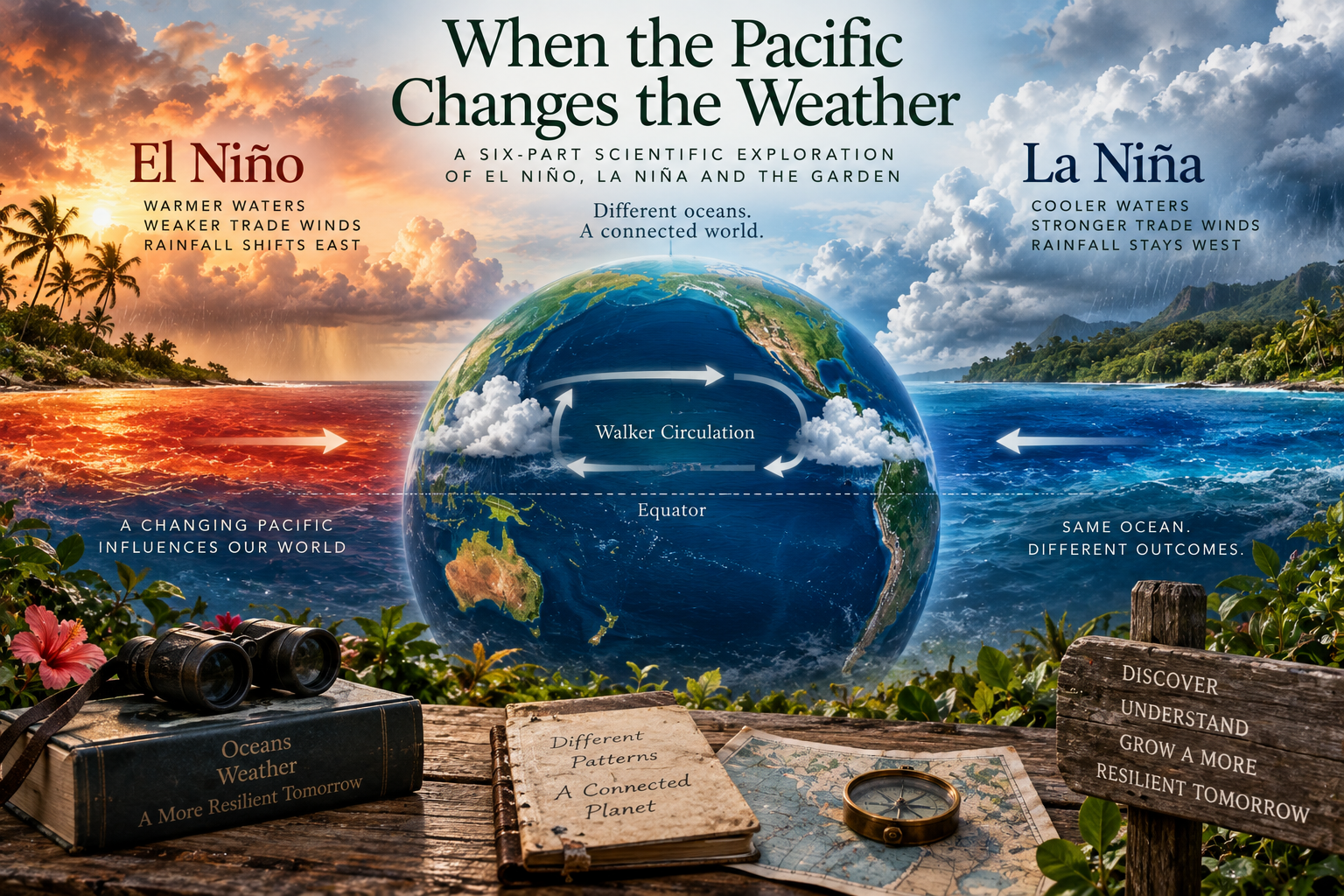
| In the first episode, we watched something remarkable happen in the tropical Pacific. Trade winds weakened, warm surface water spread eastwards, cold-water upwelling was reduced, and the atmosphere began responding to the changing ocean beneath it. That was El Niño, but it’s only part of a much larger system. Sometimes the Pacific moves in the opposite direction. The trade winds strengthen, more warm surface water is driven towards Indonesia and the western Pacific, and parts of the central and eastern equatorial Pacific become cooler than usual. This is La Niña. Between these two states are periods known as ENSO-neutral, when neither El Niño nor La Niña is established. Together they form the El Niño–Southern Oscillation, usually shortened to ENSO. It is one of the most important sources of natural year-to-year variability in the global climate, but it isn’t a regular cycle ticking away in the background. To understand why, we need to look at both the atmosphere and the ocean. The atmosphere above the Pacific Under normal conditions, easterly trade winds blow across the tropical Pacific, pushing warm surface water westwards. The western tropical Pacific consequently contains a huge reservoir of warm water, while colder water rises toward the surface in the east. The atmosphere responds to that contrast. Warm water heats and moistens the air above it, encouraging air to rise over the western Pacific. As it rises, water vapour condenses, producing extensive cloud and tropical rainfall. High in the atmosphere, air moves eastwards before eventually descending over the cooler eastern Pacific. Near the surface, the trade winds complete this enormous atmospheric circulation by flowing back towards the west. This broad circulation is known as the Walker circulation. Although the real atmosphere is considerably more complicated than any simple diagram suggests, it gives us a useful picture of what is happening. During El Niño, this normal arrangement weakens. The trade winds weaken, warm water spreads farther east, and tropical rainfall shifts with it. During La Niña, the opposite occurs: the trade winds strengthen, the temperature difference across the Pacific increases, and the Walker circulation generally intensifies. This is why neither El Niño nor La Niña can properly be described as warm or cold water. The ocean changes the atmosphere, and the atmosphere changes the ocean. ENSO is a coupled system in which the two continually interact. The Southern Oscillation The atmospheric part of this relationship explains the other half of the name El Niño–Southern Oscillation. Scientists discovered that atmospheric pressure across the tropical Pacific behaves rather like a vast seesaw. When pressure shifts toward one side of the Pacific, it tends to shift in the opposite direction toward the other. Historically, scientists have monitored this relationship using atmospheric pressure measurements from places including Tahiti in the central Pacific and Darwin in northern Australia. Comparing pressure between these widely separated locations indicates what the tropical atmosphere is doing. This pressure relationship became known as the Southern Oscillation. Eventually scientists realised that it was intimately connected with the changing ocean temperatures already associated with El Niño. The two pieces belonged together. Sea temperatures, atmospheric pressure, trade winds, rainfall and ocean circulation were all parts of the same enormous system. The great Pacific seesaw Calling ENSO a seesaw is helpful, but only up to a point. A playground seesaw moves predictably backwards and forwards. The Pacific does not. El Niño doesn’t arrive every other year and neatly hand over to La Niña. Events differ in strength, duration and geographical pattern. Neutral conditions may persist between them, while occasionally the same phase can continue or return across successive years. ENSO events tend to recur irregularly on a timescale of roughly two to seven years, but this is not a timetable. No Pacific calendar tells us when the next El Niño or La Niña must arrive. That irregularity is part of what makes ENSO so interesting. It oscillates, but it does not behave like a clock. There is also a natural question here. If an El Niño begins reinforcing itself — weaker trade winds allowing warmer water eastwards, which in turn alters the atmosphere and can weaken the normal circulation further — why doesn’t it simply continue indefinitely? The answer lies partly beneath the surface. An ocean with a memory ENSO involves far more than the temperature of the top few centimetres of the Pacific. Enormous quantities of heat and water are being redistributed through the upper ocean, while changes in the thermocline move across the basin. As an El Niño develops, the conditions that helped create and sustain it gradually alter the ocean itself. Eventually, the processes supporting the event weaken. The Pacific may return towards neutral conditions or, in some cases, continue far enough in the opposite direction for La Niña to develop. La Niña is also self-limiting. It also changes the distribution of water and heat within the Pacific until the conditions that maintain it eventually weaken. This doesn’t mean one phase must automatically produce the other. Sometimes neutral conditions intervene and persist. Sometimes La Niña lasts longer than expected. The Pacific has tendencies, not appointments. What happens beneath the surface matters because the ocean can retain and transport heat for long periods. Changes in the depth of the thermocline and the amount of warm water below the surface can provide scientists with clues about how ENSO may develop months later. In that sense, the ocean has a kind of physical memory. Satellites can tell us a great deal about the surface, but buoys, floats and other instruments measuring conditions beneath it reveal another part of the story. Neutral doesn’t mean quiet It is easy to imagine ENSO as a contest between El Niño and La Niña, but much of the time the tropical Pacific is in neither state. These periods are described as ENSO-neutral. Neutral does not mean that the world’s weather becomes neutral as well. Floods, droughts, heatwaves, cold spells and severe storms can all occur when there is neither an El Niño nor a La Niña. This distinction matters because ENSO is only one influence in an enormously complicated climate system. It can shift probabilities, sometimes quite substantially, but it does not control everything happening in the atmosphere. There is another complication too. No two El Niño events are identical, and neither are two La Niñas. One may be relatively weak and short-lived while another becomes much stronger. The largest temperature changes may occur in different parts of the Pacific, and an event’s timing can also affect its influence elsewhere. Scientists therefore need to know considerably more than whether the Pacific is “in El Niño”. Strength, location, timing and interaction with other parts of the climate system all matter. When the Pacific reaches beyond the Pacific This brings us back to why any of this should interest somebody standing in a British garden. Changing the distribution of warm water across an ocean as large as the Pacific also changes where enormous quantities of heat and moisture enter the atmosphere. That affects where tropical air rises, where rain falls, how atmospheric pressure is distributed and how winds circulate. Those disturbances can then influence atmospheric circulation far beyond the tropical Pacific. These long-distance relationships are known as teleconnections. In some parts of the world the connection with ENSO is comparatively strong and well understood. In others it is weaker, changes with the season or competes with other powerful influences on the atmosphere. Britain falls very firmly into that more complicated category. It would be wonderfully convenient if El Niño meant one kind of British winter and La Niña another. Gardeners could check the state of the Pacific, prepare accordingly and regard the problem as solved. But between the tropical Pacific and a garden in Kent lies the atmosphere of an entire planet. The Atlantic matters. The jet stream matters. Atmospheric pressure patterns over the North Atlantic matter. The time of year matters, and other large-scale climate patterns matter too. Sometimes these influences may reinforce the effects associated with ENSO. At other times they can weaken or overwhelm them. That is why El Niño and La Niña are best understood as influences on probability rather than instructions to the weather. We have now travelled from changing ocean temperatures to trade winds, atmospheric pressure and the Walker circulation. We have seen how the ocean and atmosphere interact, and why a disturbance beginning in the tropical Pacific can eventually reach much farther afield. |
| Now we can ask the question that matters most. If El Niño and La Niña can influence weather thousands of miles from the Pacific, what do they actually mean for Britain? Not what a dramatic winter headline says they mean, and not what happened during one memorable El Niño twenty or thirty years ago. What does the scientific evidence actually tell us? That is where we go next. Episode 3: What Does El Niño Actually Mean for Britain? |
| About our writing & imagery Most articles are grounded in our real gardening experience, observations and reflections. AI may assist with research, drafting and editing, but the experiences, opinions and editorial direction are our own. Featured images may include our photography, original AI-generated visuals or, where stated, images credited to others. All published content is reviewed and shaped by Earthly Comforts before publication. |


Another fascinating read, Rory! 🌍❤️ I must admit, I’m becoming really interested in El Niño and La Niña, and I love how you explain these things in a way that makes them easier to understand. The idea that changes in the Pacific Ocean can influence weather so far away is amazing! I also found the part about the ocean having a kind of memory particularly interesting. There’s so much happening around us that we don’t even think about in our everyday lives. I’m looking forward to learning more in the next episode. Thank you for another wonderful and educational read! 🌊🌿❤️
LikeLiked by 1 person
Thank you also 🙂
LikeLiked by 1 person