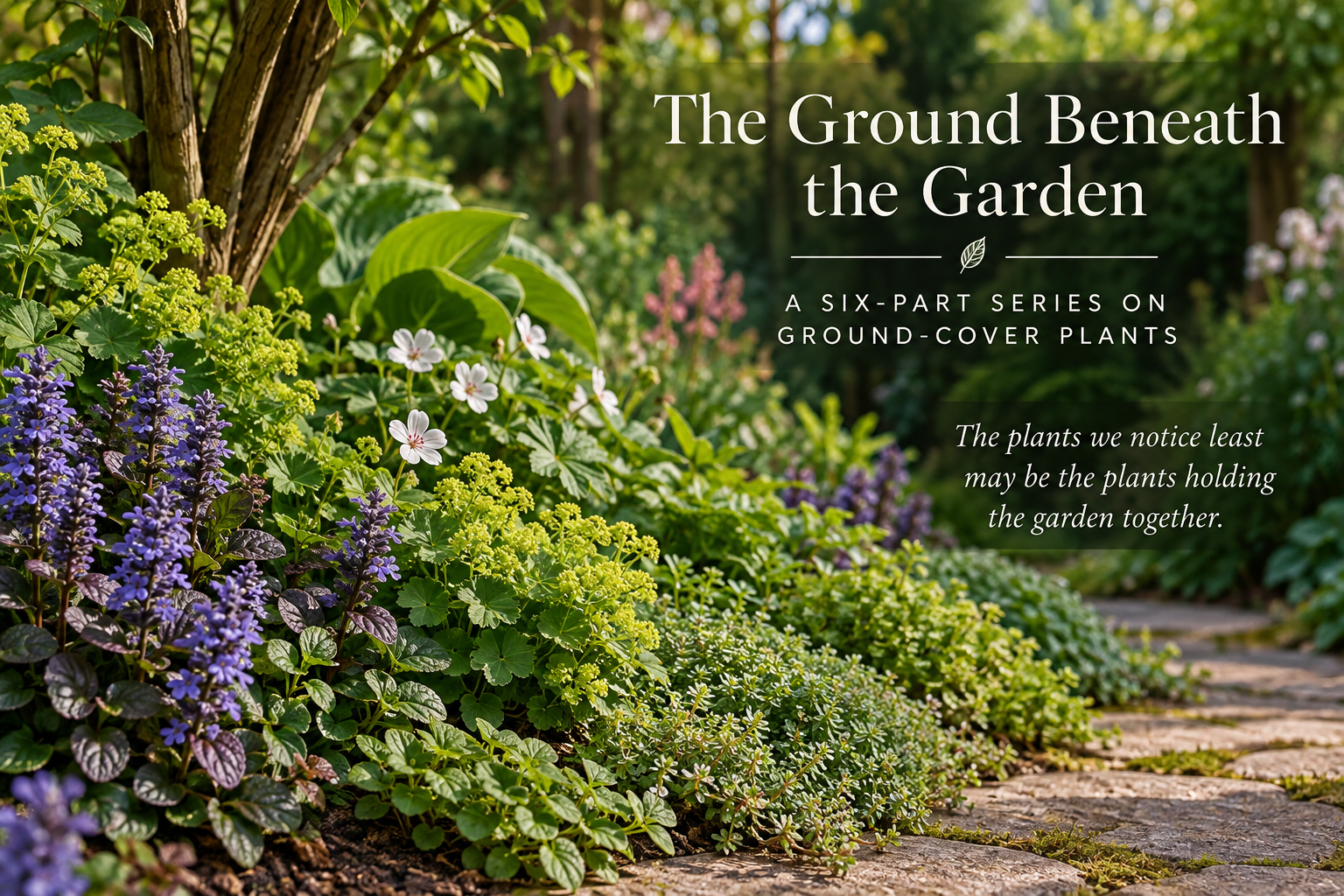
| Episode 3 “Ground Cover for Shade — Where Some of the Best Plants Live.” |
| Some parts of a garden seem determined to resist our best efforts. The ground beneath an established tree, the narrow border along a north-facing wall, or that awkward corner where the sun barely reaches for much of the year. We plant something, watch it struggle, replace it with something supposedly more suitable, and occasionally wonder whether the simplest solution is to abandon planting altogether. Yet some of the most interesting and rewarding ground-cover plants are perfectly at home here. They belong to a different world from the sun-loving plants we explored in the previous episode. Shade has an unfortunate reputation amongst gardeners. Gardeners often treat it as a problem to be solved rather than a growing condition to be understood. Garden centres do little to discourage this perception, with their displays of flowering plants basking in sunshine while the shade-tolerant selections occupy a quieter corner. We naturally gravitate towards colour, and a plant covered in flowers will generally attract more immediate attention than one whose principal appeal lies in the shape, texture or arrangement of its leaves. But spend enough time working in established gardens and you begin to appreciate that shaded planting can possess a richness and subtlety that a sunny border sometimes struggles to achieve. There is something particularly satisfying about finding a plant that thrives where almost everything else has failed. Not merely surviving, with a few reluctant leaves and the occasional flower, but actually making itself comfortable, spreading gradually and occupying the ground as though it had been waiting for the opportunity all along. This is where shade-loving ground cover becomes so valuable. It lets us turn what might otherwise be an awkward, repeatedly weeded, or sparsely planted area into a living part of the garden. Understanding the shade Before choosing anything, however, we need to understand what we mean by shade. It is one of those gardening descriptions that sounds straightforward until you look at the conditions more closely. A border shaded by a building is not necessarily comparable to the ground beneath a mature beech tree, even if both receive very little direct sunlight. One may remain reasonably moist year-round, while the other can become surprisingly dry because the tree’s roots take up much of the available water. A position beneath deciduous trees may receive considerable light in early spring before the leaves emerge. In contrast, the north side of a tall evergreen hedge can remain shaded year-round. These differences matter enormously. Plants that thrive in cool, moist woodland conditions may struggle badly in the dry shade beneath established shrubs, while others are remarkably tolerant of root competition and intermittent drought. The amount of light reaching the ground also changes throughout the seasons. Beneath deciduous trees, spring bulbs and early-flowering perennials can make use of the brighter months before the canopy closes. At the same time, plants adapted to deeper shade take over much of the visual work later in the year. It is a natural arrangement that gardens can borrow from. However, a mature tree’s roots and canopy make establishing new plantings much harder than a photograph of a beautiful woodland garden might suggest. One of the most useful habits a gardener can develop is to stop looking at a difficult patch of ground simply in terms of what will not grow there. Instead, look at what is already succeeding. Is the soil covered with moss? Are ferns appearing naturally? Does ivy seem perfectly content while everything else struggles? Do spring bulbs flourish before disappearing beneath the summer canopy? These observations tell us something about the conditions, even if they do not provide every answer. A garden often gives us clues about what it can support, as long as we pay attention. The quiet confidence of Epimedium If one group of plants deserves more recognition for its contribution to shaded gardens, it is Epimedium. They may not be the first plants people notice, especially when they are not in flower, but their ability to create attractive, relatively low-maintenance foliage beneath shrubs and trees makes them enormously useful. Their leaves can be heart-shaped, pointed or divided into several leaflets, often emerging with bronze, copper or reddish colouring before maturing into shades of green. Some retain their foliage through winter, while others are deciduous, and the flowers, which appear in spring, can be wonderfully delicate. What I particularly like about Epimedium is that it offers an alternative to the rather unimaginative idea that shaded ground must be covered with ivy or nothing at all. Different species and cultivars vary considerably in their vigour, but many gradually form attractive colonies without the relentless expansion associated with some of the more aggressive ground-cover plants. Epimedium × perralchicum ‘Frohnleiten’, for example, is well known for establishing in relatively dry shade, producing attractive foliage and yellow spring flowers. It can form substantial patches over time, although even this relatively tolerant plant benefits from careful establishment and sufficient moisture while its roots develop. This offers a useful lesson in patience. A plant that eventually performs well in dry shade may still require watering during its first growing seasons. We sometimes confuse drought tolerance with an ability to establish without water, and the two are not the same. Beneath mature trees, the upper soil can dry surprisingly quickly, particularly in summer, and young plants with limited root systems compete with established roots that may extend far beyond the tree’s visible canopy. Once Epimedium has settled into a suitable position, it can become a remarkably dependable presence, but it needs the chance to reach that stage. When useful plants become too successful Another familiar plant for shaded ground is Vinca, commonly known as periwinkle. Its glossy evergreen leaves and blue, violet or occasionally white flowers make it attractive, while its ability to spread across the soil can be genuinely useful in difficult situations. Yet Vinca is also an excellent example of why you should choose ground-cover plants for their behaviour rather than simply their appearance. Vinca minor generally forms a lower, finer-textured cover than the more vigorous Vinca major, although both can spread well beyond their original planting positions when conditions suit them. In a large area beneath established shrubs, where the goal is to occupy ground that would otherwise require regular attention, this spreading habit may be exactly what you want. In a small mixed border containing delicate woodland perennials, it can become considerably less welcome. Stems travel across the surface, root where conditions allow, and gradually create an increasingly interconnected planting. You can remove unwanted growth, but it is not always the quick, straightforward task we imagined when the original plants went into the ground. The same caution applies to ivy. Hedera helix is a perfectly reasonable ground-cover choice in some situations, particularly in difficult shaded areas where little else will establish. Its evergreen foliage provides cover year-round, and mature flowering ivy can be an important late-season resource for insects. But ivy does not necessarily remain a polite, low-growing carpet. Given the opportunity, it can climb walls, shrubs and trees, and managing it may become an ongoing responsibility. It is neither universally desirable nor universally undesirable. As with so many useful garden plants, the question is whether its natural behaviour suits the place we have chosen for it. In the next episode, we will explore the distinction between a plant that occupies the ground and one that eventually dominates it more fully. For now, it is enough to recognise that shade tolerance and good behaviour are not automatically found together. Where foliage becomes the main attraction One pleasure of shaded planting is that flowers become less central to the composition. They are certainly welcome, and some woodland plants produce wonderful seasonal displays, but foliage often carries the garden for much longer. Instead of selecting plants primarily for flower colour, we begin noticing leaf shape, texture, density, and how different shades of green interact. Pachysandra terminalis is a familiar evergreen groundcover for shade, forming colonies of glossy leaves that can create a fairly uniform appearance beneath shrubs. It generally performs best where the soil retains some moisture and is not excessively dry, and its spreading habit suits some situations better than others. Asarum europaeum, the European wild ginger, offers something quite different. Its rounded, glossy leaves sit close to the ground, creating a rich, dark-green texture that can look particularly attractive beneath taller woodland plants. It is relatively slow to establish and prefers humus-rich soil that does not dry out excessively, but where conditions suit it, the effect can be beautiful. Then there are the many forms of Lamium maculatum, whose silver-marked foliage can brighten a shaded spot. These often spread faster than some more restrained woodland plants, and their flowers can provide nectar for visiting insects. In a moderately shaded border, a suitable Lamium can soften the ground beneath larger planting and introduce contrast amongst darker foliage. Yet some varieties can become rather enthusiastic, particularly where soil and moisture are favourable, so once again we need to consider how much freedom we are prepared to give them. The more time we spend looking at shaded borders, the more obvious it becomes that green is not simply green. There are blue-greens, yellow-greens, deep glossy greens and soft, almost translucent spring greens. Some leaves catch the smallest amount of light, while others absorb it; broad leaves create calm areas of texture, and finely divided foliage gives the planting movement. Ground cover is particularly important in bringing these differences together because it forms the visual foundation beneath everything else. Learning from the woodland floor It is tempting to imagine that planting beneath trees means recreating a woodland floor, but the comparison needs a little care. Natural woodland soils develop over long periods through the accumulation and decomposition of leaves, twigs, and other organic material. Fungi, bacteria, earthworms, and countless other organisms contribute to nutrient cycling, while the vegetation above and below ground has adapted to the conditions over many generations. A domestic garden beneath a mature ornamental tree may share some of these characteristics. Still, it may also contain compacted soil, buried building materials, depleted organic matter or roots concentrated in a relatively small area. That is why preparation matters, although you should approach preparation beneath trees gently. Repeated digging and cultivation can damage the very roots we are trying to plant amongst, and adding large quantities of soil over existing tree roots can create further problems. Often the better approach is to work with the soil as it is, improve the surface gradually with suitable organic mulch and establish smaller plants carefully in the spaces available. Smaller specimens can sometimes settle more successfully than large pot-grown plants because they require less disturbance during planting and can develop their roots among those already present. Leaf litter is another feature worth reconsidering. We are often inclined to clear every fallen leaf from a border because it looks untidy, but a modest layer of decomposing leaves can contribute organic matter, shelter soil organisms and help protect the soil surface. This does not mean allowing thick, wet accumulations to smother small evergreen plants or delicate crowns. It means recognising that a shaded border does not always benefit from being kept as clinically clean as a freshly swept path. In a woodland-style planting, some of what we traditionally remove may actually help the garden function. A garden that changes with the seasons Shade also lets us work with the changing seasons in ways that aren’t always possible in open, sunny borders. Beneath deciduous trees, spring creates a brief period when light reaches the ground before the canopy develops. Snowdrops, cyclamen, wood anemones, and other suitable woodland plants can take advantage of this opportunity, producing flowers and foliage before many surrounding plants have fully awakened. Some then retreat underground as the season progresses, leaving space for later foliage to occupy the scene. This seasonal overlap is one of the most attractive aspects of woodland planting, although it requires thought when choosing ground cover. A very dense evergreen carpet may make it difficult for some smaller plants to establish or emerge successfully. At the same time, a more open or deciduous lower layer can allow spring bulbs and woodland perennials greater freedom. The best arrangement is not necessarily the one that keeps every patch of ground permanently hidden beneath foliage. Sometimes it is the one that allows different plants to occupy the same space at different times of year. There is also something appealing about the changing character of a shaded border. In spring, the ground may be bright with fresh foliage and small flowers. By summer, taller plants and shrubs create a cooler, enclosed atmosphere, while autumn brings fallen leaves, changing colours and a gradual return to the structure beneath. Even winter can be interesting when evergreen ground cover, ferns and the shapes of woody plants remain visible. A shaded garden need not be a place where little happens. It can be a place where change is quieter and rewards closer observation. The quieter garden None of this means that planting ground cover in shade will eliminate maintenance. Weeds will still appear, particularly while the plants are establishing, and some perennial weeds can grow through dense foliage. Brambles, bindweed and other persistent plants do not suddenly surrender because we have introduced Epimedium or Pachysandra. In fact, letting them become entangled among established ground cover can make removal considerably more difficult. Some ground-cover plants may also need thinning or dividing; others may need their edges controlled, and vigorous spreaders can gradually crowd out smaller neighbours. The goal isn’t to create a part of the garden that never needs attention, but to replace repeated struggles with bare soil and unwanted growth with a planting that settles and becomes more manageable over time. I think this is particularly important in gardens where shaded areas have been neglected because they seem too difficult. It is easy to focus our efforts on sunny borders, where flowering plants respond readily, and the results are immediately obvious. Shaded corners become places to store a pot, leave a pile of leaves, or tolerate a patch of struggling vegetation. Yet with suitable planting and a little patience, those areas can become some of the most attractive parts of the garden, offering contrast to the brighter, more colourful spaces elsewhere. Perhaps the greatest change required when gardening in shade is not horticultural at all, but one of expectation. We are so accustomed to judging gardens by the abundance of their flowers that we can overlook the beauty of foliage, texture and subtle differences in height. A shaded border may never provide the brilliant colour of a sunny summer display. Still, it can offer something equally rewarding: a sense of depth, calm and permanence, with plants occupying the ground in a way that feels remarkably natural. The most successful shaded planting often looks as though it has gradually found its own arrangement. Epimedium spreads beneath a shrub, ferns rise through the lower foliage, spring bulbs appear between established plants, and a few carefully chosen evergreens maintain the structure when everything else retreats. No single plant demands attention, yet the whole area works because each occupies a place suited to its needs and behaviour. The next time you walk through a garden, particularly one with mature trees or established shrubs, it is worth looking beneath them rather than immediately towards the flowers. Notice what is growing there, how the leaves overlap, where the soil remains exposed and which plants seem genuinely comfortable in their surroundings. You may find that some of the most successful planting is happening in places you would normally walk straight past. The plants we notice least may be the ones holding the garden together, and nowhere is that more apparent than in the quieter world beneath the shade. |
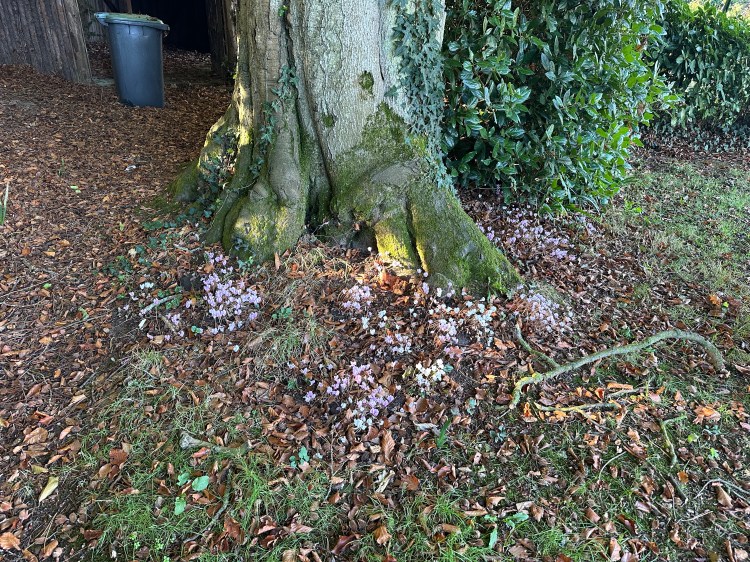
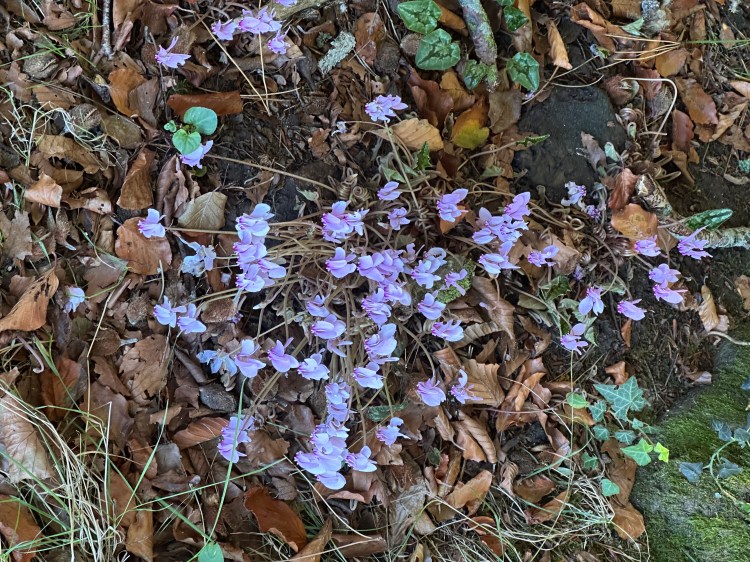
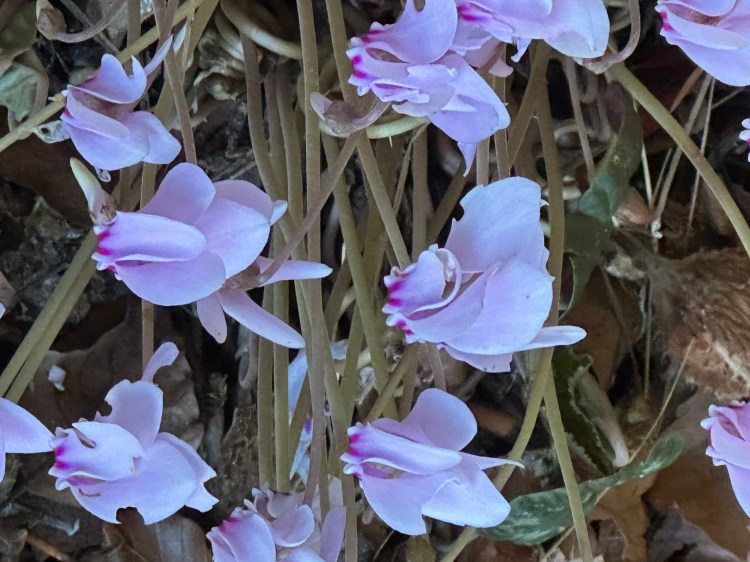
| Beneath a mature tree, ivy-leaved cyclamen flowers amongst exposed roots and fallen leaves, demonstrating how seasonal planting can make use of ground that other garden plants might find difficult. |
| Most articles are grounded in our real gardening experience, observations and reflections. AI may assist with research, drafting and editing, but the experiences, opinions and editorial direction are our own. Featured images may include our photography, original AI-generated visuals or, where stated, images credited to others. Earthly Comforts reviews and shapes all published content before publication. |


Another wonderful and interesting post, Rory! 🌿❤️ I love how clearly you explain everything and the useful tips you share along the way. Your photographs are beautiful too!
I have Vincas as well and would definitely not mind the ground cover ones like yours. It must be a sight to behold!🌸 Ours is Catharanthus roseus, or Madagascar periwinkle (here’s a link). I have mine growing in pots, and instead of spreading out as ground cover, it grows long and trails over the sides. I love those gorgeous little pink and purple flowers, and every now and then I get a white one as well. They’re such cheerful little flowers!
I also enjoyed your reminder to look at what is already growing happily in a difficult spot instead of concentrating only on what won’t grow there. There’s always something new to learn from your garden posts, and I thoroughly enjoy reading them.
I must admit that I love leaf litter too! 🌿 I like leaving some here and there under my trees and in the few flower beds I have, where most of my plants are hydrangeas. I have the big mophead varieties in purple and white, and I like knowing that the fallen leaves provide shelter for little garden creatures while helping to keep the soil cool and moist. There’s something lovely about letting nature do its thing instead of tidying every little corner away. ❤️🕷️🐸
Thank you for sharing your knowledge and beautiful photographs with us! ❤️🌸
LikeLiked by 1 person
I love mopheads! This summer they all grew to enormous sizes! Leaf litter is incredibly beneficial to insects too.
LikeLiked by 1 person