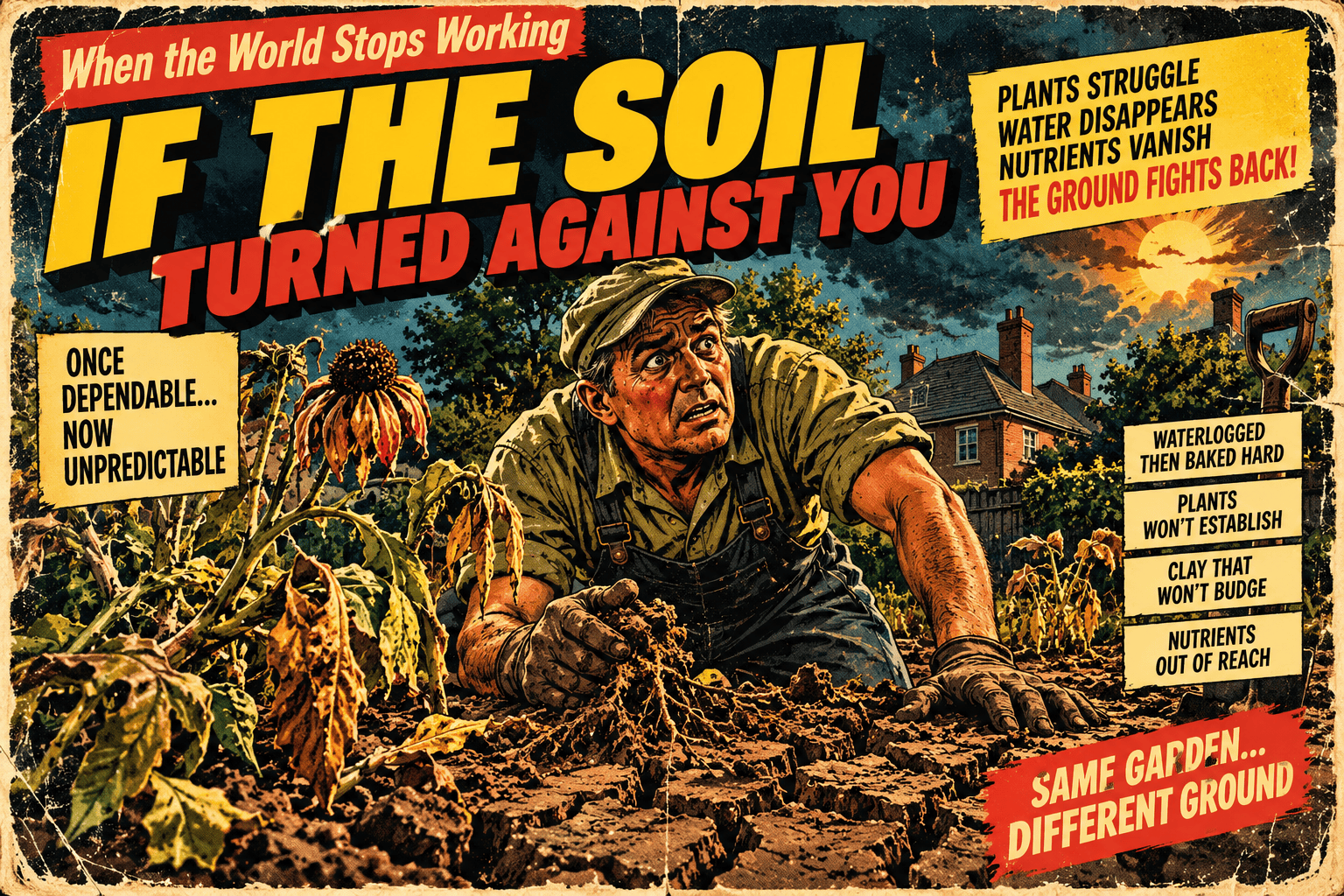
| Gardening tends to treat soil as the dependable part. Plants come and go, weather changes, pests arrive, trees fall, and gardeners change their minds with remarkable regularity, but the soil remains beneath everything. We improve it, dig it, mulch it, compact it, walk across it, plant into it and occasionally complain about it. Still, we fundamentally assume it will keep doing what soil has always done. Put a reasonably suitable plant into reasonably suitable ground, give it enough water and care, and it has a fair chance of growing. Soil is quite literally the foundation of almost everything we do in a garden, yet because it is always there, we can become remarkably good at taking it for granted. But what if that assumption stopped being reliable? Not because the soil suddenly became alive or developed some malevolent intention towards gardeners. No rumbling flowerbeds or lawns swallowing people whole; this isn’t one of our spoof episodes. Imagine instead something much more plausible and, in some ways, considerably more worrying. The soil gradually becomes harder to garden. Plants that once thrived begin to struggle, water behaves differently, nutrients become less readily available, and the structure deteriorates. Some areas remain waterlogged while others dry almost immediately, and each year gardeners find themselves working harder to achieve what used to happen almost by itself. At first, I doubt we’d blame the soil. We’d blame the plants. A shrub starts looking unhappy, so perhaps it needs feeding. The lawn becomes thin, so we reseed it. A perennial that has grown perfectly well for years suddenly deteriorates, so perhaps it has reached the end of its life. Newly planted specimens struggle to establish, and we wonder whether the nursery stock wasn’t particularly good. One or two failures mean very little in gardening because plants die, and anyone who has gardened for long enough eventually develops a fairly philosophical relationship with that fact. It would be the repetition of those failures, rather than any single dramatic event, that eventually made us wonder whether something more fundamental was changing. You’d begin noticing the same problems appearing in different gardens. Heavy soils would remain wet for longer after winter rain and then bake hard during prolonged dry spells. Lighter soils would lose moisture almost as quickly as it arrived. Beds that had previously been relatively easy to cultivate would become increasingly difficult to work, while plants might show signs of stress despite apparently receiving everything they needed. Roots could remain shallow or fail to establish properly. The garden above ground would gradually be telling us that something beneath it wasn’t working as well as it once did. For professional gardeners, soil is one of those things we encounter constantly without necessarily stopping to think about it. You notice it through the spade. Some ground opens beautifully, some comes up in heavy lumps, and some contains so much flint that digging a planting hole feels less like horticulture and more like archaeology. In one garden you can push a fork into the ground almost effortlessly; in another you begin wondering whether somebody buried a patio beneath the border. After working regularly in the same gardens, you also learn where the wet patches are, which borders dry first, where roots establish easily, and where every planting job will involve considerably more effort than it appeared to require when you first looked at it. Soil can also change remarkably quickly when treated badly. Repeated traffic over wet ground can compact it, heavy machinery can compress layers beneath the surface, and organic matter can decline when material is continually removed and very little returned. Bare ground can erode, intensive cultivation can damage structure, poor drainage can deprive roots of oxygen, and prolonged drought can leave some soils extremely hard and difficult to rewet. None of these requires the soil to turn against us; we can create many of the problems ourselves. Now imagine several of those pressures arriving together. Winters become persistently wetter, summers bring longer dry periods, and rain increasingly arrives in heavy bursts rather than the useful gentle spells gardeners would prefer. The soil spends part of the year saturated and another part desperately short of moisture. Gardeners keep walking over it, machinery keeps crossing it, and every autumn enormous quantities of organic material are collected, bagged, and removed because we’ve spent decades treating dead vegetation as untidy. Nothing catastrophic needs to happen on any particular day. The ground becomes a little less forgiving each year until eventually we realise that the conditions we once regarded as normal are becoming increasingly difficult to recreate. The first casualty might be our planting habits. We are accustomed to choosing a plant because we like it, then trying to make the garden accommodate it. Wrong soil? Improve it. Too dry? Water it. Too hungry? Feed it. Too exposed? Protect it. Modern horticulture gives us an extraordinary ability to create temporary conditions for plants that might otherwise have little reason to be growing where we’ve put them. If soil became less forgiving, that luxury would diminish, and plant selection would become much more local. Instead of asking primarily what somebody wanted to grow, we’d increasingly ask what their particular ground could support. Two gardens half a mile apart might require completely different planting because one sits on free-draining soil while the other holds water throughout winter. The familiar phrase right plant, right place would stop sounding like useful gardening advice and start becoming an economic necessity. We’d also become much more reluctant to disturb established plants that were doing well. A mature shrub happily occupying difficult ground would become valuable precisely because it had already solved the problem of living there. The modern tendency to remove perfectly healthy plants simply because somebody wants a different colour scheme might become considerably less attractive when replacing them carried no guarantee of success. Lawns would probably reveal the problem very quickly. Grass survives an extraordinary amount of abuse, which is one reason we use it, but lawns still depend upon functioning soil. Compaction restricts roots and drainage, waterlogging damages grass, drought stresses it, and weakened turf leaves opportunities for weeds, moss and disease. We could continue treating the symptoms with feed, seed and increasingly determined maintenance, but eventually we’d have to ask whether maintaining the same type of lawn in the same place still made sense. Some areas repeatedly failing under changed conditions might become planting, meadow, gravel, mulch or something else entirely, not because lawns had suddenly become undesirable, but because gardens would have to adapt to their ground rather than continually forcing the ground to maintain the garden we’d decided ought to exist. Vegetable growers would have less freedom to compromise. Ornamental gardeners can tolerate a disappointing flowering season; somebody relying upon a plot to produce food cannot simply admire the interesting foliage and try again next year. Productive soils would therefore receive enormous attention. Compost, manure, mulches, green manures and crop rotations would become more important, while protecting soil from unnecessary compaction and erosion would become routine. And suddenly the material we discussed in the previous episode — compost — becomes rather important again. That isn’t accidental, because one interesting thing about this series is that the systems keep joining together. If fertiliser becomes difficult to obtain, compost matters more. If soil deteriorates, organic matter matters more. If water becomes difficult to find, soil that can hold moisture becomes more valuable. If weather becomes unpredictable, healthy soil can help plants tolerate at least some of those fluctuations. A garden isn’t really a collection of separate problems; it is a connected system. We often talk about improving soil as though we’re adding something to an inert material, but healthy soil is extraordinarily complex. Mineral particles sit alongside organic matter, water and air. Roots move through it, fungi extend through it, bacteria occupy it and worms, insects, and countless other organisms live within it, breaking material down and influencing structure and nutrient cycling. Much of this happens completely unnoticed while we’re concentrating on the hydrangeas. If that biological and physical system deteriorated, pouring more fertiliser onto the surface wouldn’t necessarily repair it. We might produce temporary growth while doing very little to address the underlying problem, and gardeners would gradually have to become soil managers rather than simply plant managers. That could represent one of the biggest changes horticulture has undergone. We’d stop digging simply because digging is what gardeners traditionally do and instead ask whether disturbing that particular ground was actually necessary. Sometimes cultivation would be useful; sometimes leaving the soil alone would be better. We’d cover bare ground more often, mulching would become routine, and fallen leaves would increasingly stay somewhere in the garden rather than automatically being exported from it. Paths and access routes would matter more because keeping repeated foot traffic off productive soil helps reduce compaction, and even the humble plank might take on new significance. Anyone who has worked on wet clay knows the value of spreading your weight rather than repeatedly stamping along the same narrow strip. Water management would change alongside it. Instead of treating rain as something that either falls or doesn’t, gardens would increasingly be designed to make better use of what arrived. Soil would be protected from erosion during heavy downpours, organic matter would help retain moisture, and rain gardens or planted depressions could hold water temporarily rather than sending everything immediately towards drains. Hard surfaces might become more permeable, while planting itself could be arranged around the natural movement of water through a site. The irony would be difficult to miss: for years we would have regarded the garden as something sitting on top of the soil, only to discover that the garden was largely a consequence of what was happening within it. There would inevitably be commercial opportunities. Soil testing would become more common, laboratories would offer increasingly detailed analyses, and garden centres would sell conditioners, inoculants, biological additives and products promising to restore exhausted ground. Some would undoubtedly be useful, while others would probably feature impressive labels, complicated diagrams, and far more optimism than evidence. There are always miracle cures. A gardener would still have to do the less glamorous things: add appropriate organic matter, avoid unnecessary compaction, choose suitable plants, manage water sensibly and allow time for improvement. Soil does not normally transform overnight simply because something expensive has been sprinkled over it. Professional gardeners might also spend more time explaining why they weren’t doing something. Imagine arriving after several days of heavy rain to find the borders saturated. The client quite reasonably points out that the border needs weeding and you’re standing there with gardening tools, so why aren’t you getting on with it? The answer might be that walking all over the bed today would do more harm than leaving the weeds until next week. That conversation already happens, but in our imagined future it would happen much more often. Sometimes the best thing a gardener can do for soil is stay off it, even when that looks suspiciously like refusing to garden. Perhaps gardens themselves would consequently become less uniform. Areas with naturally wet ground would embrace plants that tolerate moisture, while dry gardens would increasingly use plants that can cope with drought. Heavy soils would no longer be endlessly amended to imitate lighter ones, and free-draining soils wouldn’t be expected to behave like moisture-retentive loam. Instead of every garden aspiring towards roughly the same horticultural ideal, local geology would begin showing through again. I rather like that part of the idea, although obviously not the degraded soil that got us there. Something is appealing about gardeners becoming intimately familiar with the ground beneath their particular patch. You would know where water sat after winter rain, which corner dried first, where worms were abundant, where roots struggled and which plants genuinely belonged there. Soil would stop being merely the brown material underneath the interesting bits and become something we observed as closely as the plants growing from it. That brings us back to the slightly dramatic title of this article, because the soil would never really have turned against us. Soil doesn’t hold grudges. It doesn’t know we’ve compacted it, stripped organic matter from it or expected it to support plants for decades while continually removing material. It simply responds to physical, chemical and biological conditions, and if those conditions deteriorate, the soil changes. What feels like betrayal from our point of view is really a consequence. That is perhaps what makes this What If? rather less comfortable than giant insects, rebellious vegetables or homicidal garden gnomes. We don’t need to invent anything supernatural. Soil degradation, erosion, compaction, declining organic matter, drought and waterlogging already exist. The exact problems vary enormously between places and soil types, and no sensible gardener should assume every patch of ground is heading towards disaster. Still, the principle holds: soil is not infinitely resilient. We can exhaust it, but equally importantly, we can improve it. That second possibility matters because soil can recover when organic material returns, damaging pressures are reduced, and biological processes are allowed to rebuild. Gardens have an enormous advantage here because they are relatively small. We can observe them closely and change what we plant, where we walk, how we manage water and what organic material we return. We don’t necessarily have to wait for national policy or some enormous technological solution before improving the few hundred square metres outside the back door. A great deal of sensible soil care is remarkably ordinary, which may be why it receives less attention than it deserves. Perhaps that would ultimately be the lesson of the whole crisis. The most valuable thing in a garden wouldn’t be the specimen tree, expensive greenhouse, immaculate lawn or latest piece of battery equipment; it would be the ground supporting all of them. One morning John and I would arrive at a garden after several days of rain. The borders would need weeding, a shrub would need moving, and there would be plenty we could theoretically do. I’d put a boot onto the edge of the bed and feel the soil give beneath it. “No,” I’d say. John would look at the border and ask if it was too wet. “Far too wet.” We’d find something else to do. The client might wonder why two gardeners had decided not to garden, but sometimes looking after the garden means knowing when to leave the bloody soil alone. |
| About our writing & imagery Most articles are grounded in our real gardening experience, observations and reflections. AI may assist with research, drafting and editing, but the experiences, opinions and editorial direction are our own. Featured images may include our photography, original AI-generated visuals or, where stated, images credited to others. Earthly Comforts reviews and shapes all published content before publication. |

