| Where memory meets evidence |
| Episode VII The Australia I Remember Memory, climate and a changing continent |
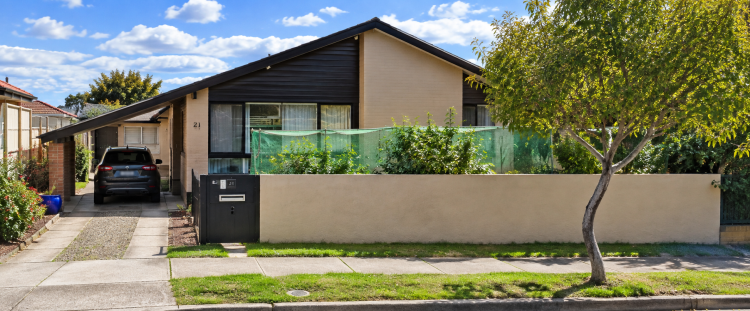
| Modern photograph of 21 Serpentine Road |
| The photograph above shows the house where I lived as a child in Springvale South, Victoria. It is an ordinary Australian suburban house of its period, and remarkably, when I look at the same house today, parts of it have changed rather less than I might have expected. The large front window is still recognisable. More than half a century has passed, but there it is. |
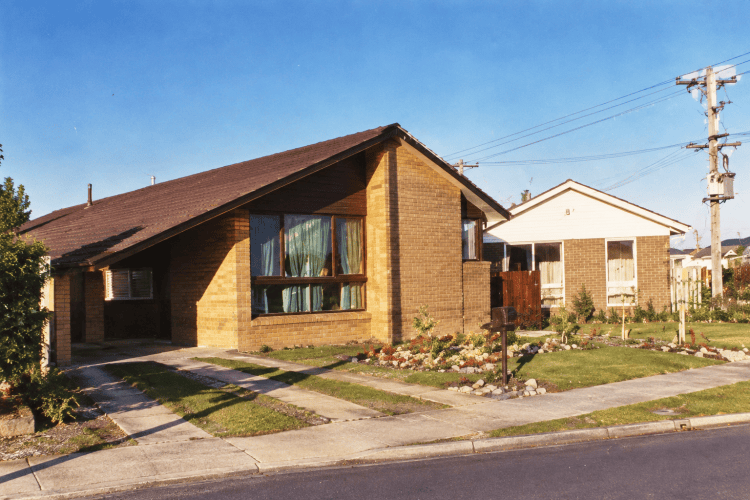
| 21 Serpentine Road 1973 |
| I also have photographs taken when we actually lived there. They take me back inside the house: orange furniture, blue-green curtains, brick walls and the everyday clutter of family life. These are not photographs anybody took to document Australia in the 1970s. Nobody was thinking about environmental history or climate change. They are simply family photographs, and perhaps that makes them more useful. They captured things nobody realised might one day become evidence. |
| Looking through those photographs while preparing this article has already corrected something I remembered wrongly. I had remembered bushland directly opposite our house. It was a very clear memory. I could picture walking out of the house and seeing Australian bush on the other side. Then I found a photograph taken outside the house. There, unmistakably, were houses opposite us. The bush was real. My childhood adventures in it were real. But I had moved it. It was further down towards the cul-de-sac, close enough to be part of our everyday world but not exactly where sixty-three-year-old me had placed it. Somewhere during the intervening fifty years, memory had shortened the distance between our front door and the bush. I rather like discovering that. Earlier in this series I wrote about the relationship between memory and evidence. I argued that memory should be respected without automatically being treated as proof. Now my own family album has caught me doing exactly what memory sometimes does. The broad memory was right; one geographical detail was wrong. The photographs did not destroy the memory. They sharpened it. That seems a particularly appropriate place from which to revisit the Australia I remember. |
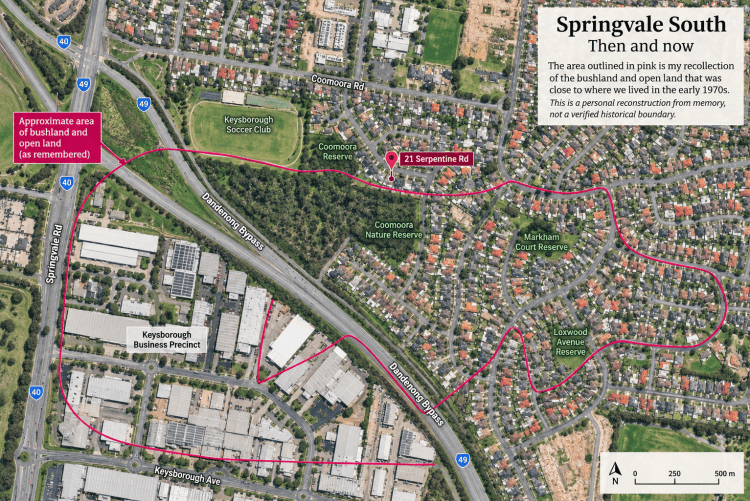
| Modern satellite of Springvale South with the area shown as marked as being the original bushland as it was when mobs of up to 200 kangaroos could be seen. The bounary is a rough estimate, but it wasn’t back then a built up area like today. |
| I first went to Australia in 1965, when I was about two, and consequently remember very little from those earliest years. One of my first genuine childhood memories is not of wildlife at all. It is of walking out of a shop with a large green plastic train that apparently hadn’t been paid for. My mother later told me how much I loved the noise it made. It is an appropriately unreliable beginning for an article about memory: I remember the train rather better than I remember arriving in Australia. Australia was then interrupted by Malaya, where we lived from 1967 until 1971. By the time we returned to Australia, I had spent several formative childhood years with tropical jungle close at hand. Malaysia had insects, primates, birds and the dense sounds and smells of tropical vegetation. Australia was different, but it certainly did not seem empty by comparison. It had its own noise, its own heat and its own wildness. The Australia I remember was big, busy in places, but far less populated than the Australia I encounter through photographs, maps and reports today. Suburbia existed, obviously. Our family photographs prove that readily enough. But its edges often seemed much closer to wild country. Housing developments met bushland. Roads passed through enormous spaces. The natural world did not seem like somewhere we had to make a special journey to visit. At Springvale South, we went “walkabout” as a family. I don’t mean that in any formal Australian cultural sense; it was simply our family’s way of going off walking and exploring. Bushland meant eucalyptus, wattles and that extraordinary mixture of botanical smells that Australia produces. Wet bush had one smell and dry bush another. Even now I think that particular mixture of vegetation, warmth, soil and eucalyptus could probably transport me backwards more effectively than a photograph. |
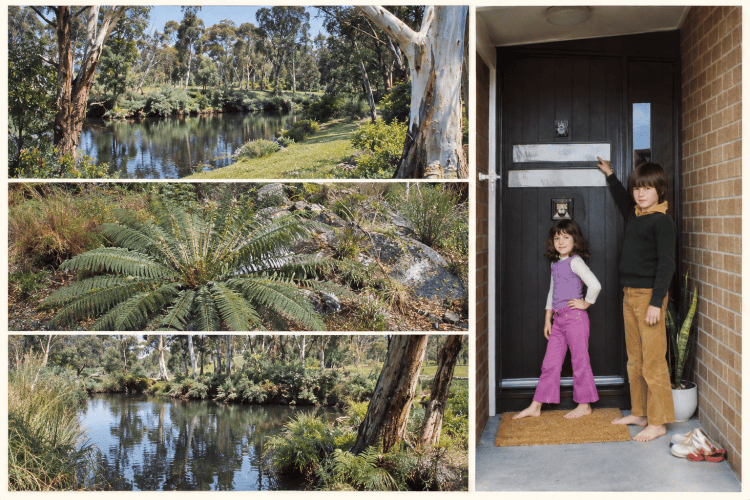
| Australian bush/water/fern landscape and the front door of 21 Serpentine Road |
| Wildlife belonged to that world. Kookaburras, magpies, cockatoos, and parakeets; kangaroos and wallabies; possums, wombats, and bats; frogs, snakes, spiders, and ants. There were bull ants, caterpillars and witchetty grubs. Koalas and platypuses belonged to the Australia I understood as a child too, although obviously none of these animals wandered past our front door. That distinction matters. Childhood compresses geography just as easily as it compressed the distance between our house and the bush. Kangaroos are a particularly good example. To somebody growing up in Britain, seeing a kangaroo may sound like an event. To an Australian child, they could be part of the country’s wildlife. Among our old family photographs are pictures of kangaroos. They sit in the album alongside pictures of houses, family members and ordinary outings. Nobody appears to have regarded wildlife as belonging to a separate category called “nature”. It was simply part of Australia. |
| Perhaps that explains something about me that only became obvious much later. If you gave me one ordinary day of my Australian childhood back, I would go insect hunting. Not sightseeing. Not searching for some famous Australian landmark. I would want to be a boy again, looking for insects. I was fascinated by them. I kept ant farms and bug farms. Cicadas were part of Australia’s soundtrack, just as they had been part of my tropical childhood. There were beetles, caterpillars and those formidable bull ants. Large wasps hunting spiders fascinated me. I don’t remember carrying much fear of Australian wildlife. That doesn’t mean some of it wasn’t potentially dangerous; Australia plainly contains animals deserving considerable respect. But as a child, I had little reason to regard wildlife as something I should automatically recoil from. I wanted to look at it. That curiosity never really left me. It followed me into adult life, eventually into working with exotic livestock, and much later into gardening. Looking back, I find it difficult to separate the adult who stops working in a garden because he has noticed an insect from the child who disappeared into the Australian bush looking for one. The weather was equally ordinary. Australia was hot. Malaysia had been hot too, but it was a different kind of heat in my memory. Malaysian heat was sticky. Australian heat seemed drier. By the time we returned from Malaya, heat was simply heat and hot was hot. I do not remember spending my childhood analysing it. Nor do I remember frost where we lived. That is not the same as claiming Victoria did not experience frost. It did, and does. I am describing the weather that entered my childhood memory. This distinction has become increasingly important to me as I write this series. Personal experience can be completely genuine without being universally representative. The seasons existed. I remember summer, autumn, winter and spring, but not as replicas of British seasons. We wore jumpers when it became cooler, although in my memory they were not the great heavy layers I later associated with British cold. When I returned to Britain in 1977, the contrast seemed much clearer. Spring was spring, summer summer, autumn autumn and winter winter. At least that is how the thirteen-year-old arriving from Australia experienced it. There is a temptation here that I need to resist. My memory tells me that the Australia of my childhood was warm. Part of me even remembers those seasons as warmer than descriptions of Australian winters sometimes make them sound today. But when memory meets the measurements, something interesting happens. Australia has not become colder since my childhood—quite the opposite. The Bureau of Meteorology reports that Australia’s average climate has warmed by about 1.5°C since national records began in 1910, with most of that warming occurring since 1950. Every decade since 1950 has been warmer than the preceding decades, and extreme heat events have become more frequent. (Bureau of Meteorology) So my childhood memory of a warm Australia and the scientific evidence of a warming Australia are not contradictory. They are answering different questions. I remember how the climate felt to one child living in particular places during particular years. The instruments tell us what happened across a continent over many decades. Rainfall demonstrates the same problem even more clearly. I remember the Australia of my childhood as relatively dry, but Australia is enormous. Even talking about “Australian rainfall” can disguise tremendous regional differences. Modern observations show declining cool-season rainfall across parts of southern Australia while parts of the north have experienced increases. The south-east, which includes Victoria, has experienced a significant decline in cool-season rainfall in recent decades. (Bureau of Meteorology) In other words, neither my childhood nor a national average can describe Australia on its own. One of my more disturbing Australian memories involves fire. I remember travelling through a major bushfire in New South Wales. My memories come as flashes rather than a continuous film: flames, dead kangaroos beside the road, my mother frightened and shouting while my father drove. I think this happened around 1972 because of how old I remember my younger sister being, but I cannot independently date the event from memory. I have not found enough evidence to identify the particular fire confidently. So I will leave the date uncertain. The experience belongs to my memory; the precise date belongs to evidence I do not yet have. Bushfire, of course, was not invented by modern climate change. Fire has been part of Australian landscapes for millennia, including through Aboriginal land management and natural fire regimes. What has changed is the background climate in which contemporary fires occur. The Bureau of Meteorology reports an increase in extreme fire weather and a longer fire season across large parts of Australia since the 1950s. (Bureau of Meteorology) That does not allow me to attribute a fire I remember from childhood to climate change. It does allow us to recognise that the fire environment of modern Australia is changing. The landscape has changed too, and my photographs become particularly interesting here. Springvale South was already developing when we lived there. The family album shows new houses, building plots and streets under construction. This wasn’t an untouched wilderness subsequently replaced overnight by suburbia. It was an expanding suburban edge with remnants of bushland close by. |
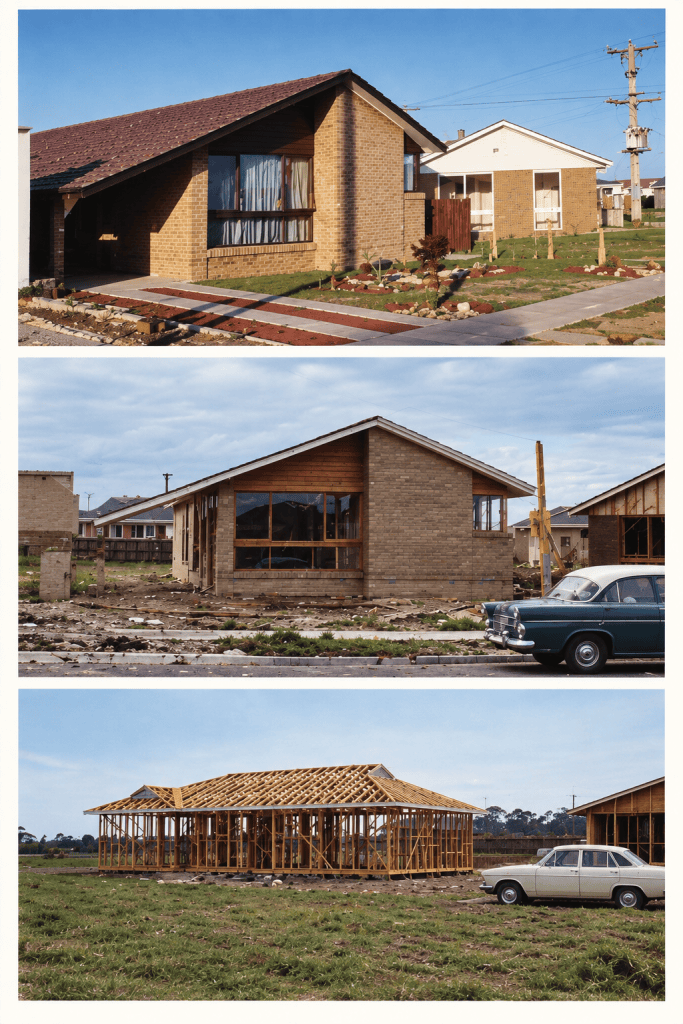
| These images were taken during the estate build of Serpentine Road, it was built on reclaimed bushland. |
| That distinction makes my memories more believable, not less. We were living where two landscapes met. Some remnants of the older vegetation survive. Greater Dandenong Council describes the nearby Alex Wilkie Nature Reserve as one of the last remaining examples of the heathland vegetation that once covered the wider Springvale South sandbelt, now surrounded by suburban housing. Interestingly, plans to preserve that particular piece of habitat were already being discussed in 1969, during my childhood era. (Greater Dandenong Council) That surviving fragment tells its own story. What I remember as “the bush” belonged to a much larger ecological landscape, portions of which survived while suburbia expanded around them. Perhaps children are unusually good at living along such boundaries because they don’t think in terms of land use. A patch of scrub isn’t an ecological remnant. A drainage ditch isn’t infrastructure. A vacant block isn’t awaiting development. They are simply places containing things. And I was interested in the things. Ants under stones. Caterpillars on leaves. Beetles. Spiders. Frogs. Whatever could be caught, watched, investigated and occasionally brought home, presumably to varying degrees of parental enthusiasm. Looking at the photographs now, I can see something else I could not possibly have recognised then. I was growing up in a changing landscape while assuming, as children naturally do, that the world around me was permanent. I think many of us did. One thing I took for granted was that Australian weather would continue being Australian weather. The bush would remain the bush. Wildlife would remain abundant. Seasons would repeat themselves. Adults might build another house or road, but the larger natural world seemed far too enormous to be fundamentally altered by us. Australia is, after all, a very big country. But size does not make a landscape immune to change. That does not mean the Australia of my childhood was some ecological paradise. Nor should my memories of the 1960s and 1970s be turned into nostalgia for a supposedly perfect past. Enormous environmental pressures were already at work: expanding cities and habitat loss. Our own photographs of houses under construction show that expansion is happening around us. The photographs have also taught me something more personal. Before looking through them, I was confident that the bush stood directly opposite number 21. It didn’t. That small correction may be one of the most important discoveries I have made while writing Within Living Memory, because it demonstrates exactly why I began this series. Memory is not worthless because it makes mistakes. Nor should it be accepted unquestioningly just because the person remembering is certain. Memory gives us somewhere to begin. Evidence gives us something to test it against. Sometimes the evidence says: yes, broadly, that is what happened. Sometimes it says: not quite. And sometimes, wonderfully, it says: you remembered the bush correctly, Rory. You just put it on the wrong side of the road. There is something rather reassuring about that. At sixty-three, I can look at a satellite image of Springvale South and see roads, houses and development surrounding remnants of the landscape I remember. I can look at the modern photograph of number 21 and recognise the house. Then I can open an old family album and step through the front door again. The orange chairs are there. The curtains are there. My family is there. And somewhere further down the road, the bush is there. If I could return to that world for a single ordinary day, I know what I would do. I would not spend it comparing temperatures or measuring rainfall. I wouldn’t stand outside the house trying to calculate how much Springvale South would eventually change. I would go looking for insects. Perhaps that is what the Australia I remember ultimately means to me. It isn’t a claim about what the whole continent was like in the 1960s and 1970s. Australia was too large, too ecologically varied and too complicated for one child’s experience ever to represent it. It is simply the Australia that I knew. Hot, noisy, spacious, suburban in one direction and wild in another; eucalyptus and wattle, kookaburras and kangaroos, bull ants and cicadas, family walkabouts and childhood expeditions into whatever patch of bush happened to be within reach. The scientific record tells me that Australia has warmed since then. Maps tell me that suburbia has expanded. Photographs have already corrected one of my own memories. None of those things diminishes the childhood I remember. They put it into context. And perhaps that is the difference between saying Australia was like this and saying the Australia I remember was like this. One attempts to describe a continent. The other describes a life. And the Australia I remember is very different from the Australia I read about today. |
| About our writing & imagery Most articles are grounded in our real gardening experience, observations and reflections. AI may assist with research, drafting and editing, but the experiences, opinions and editorial direction are our own. Featured images may include our photography, original AI-generated visuals or, where stated, images credited to others. All published content is reviewed and shaped by Earthly Comforts before publication. |

