| Episode 2 Charlotte’s Property Dispute! |
| Author’s Note The Other Side of the Flowerbed is an original work of humorous fiction. All characters, personalities, dialogue and events are fictional. Any similarity in character names to those appearing in existing literary works or other fictional creations is coincidental and does not imply any connection with, or endorsement by, their respective creators or rights holders. © 2026 Rory Matier. All rights reserved. |
| Story inspired by Sonel of The Creative Soul |
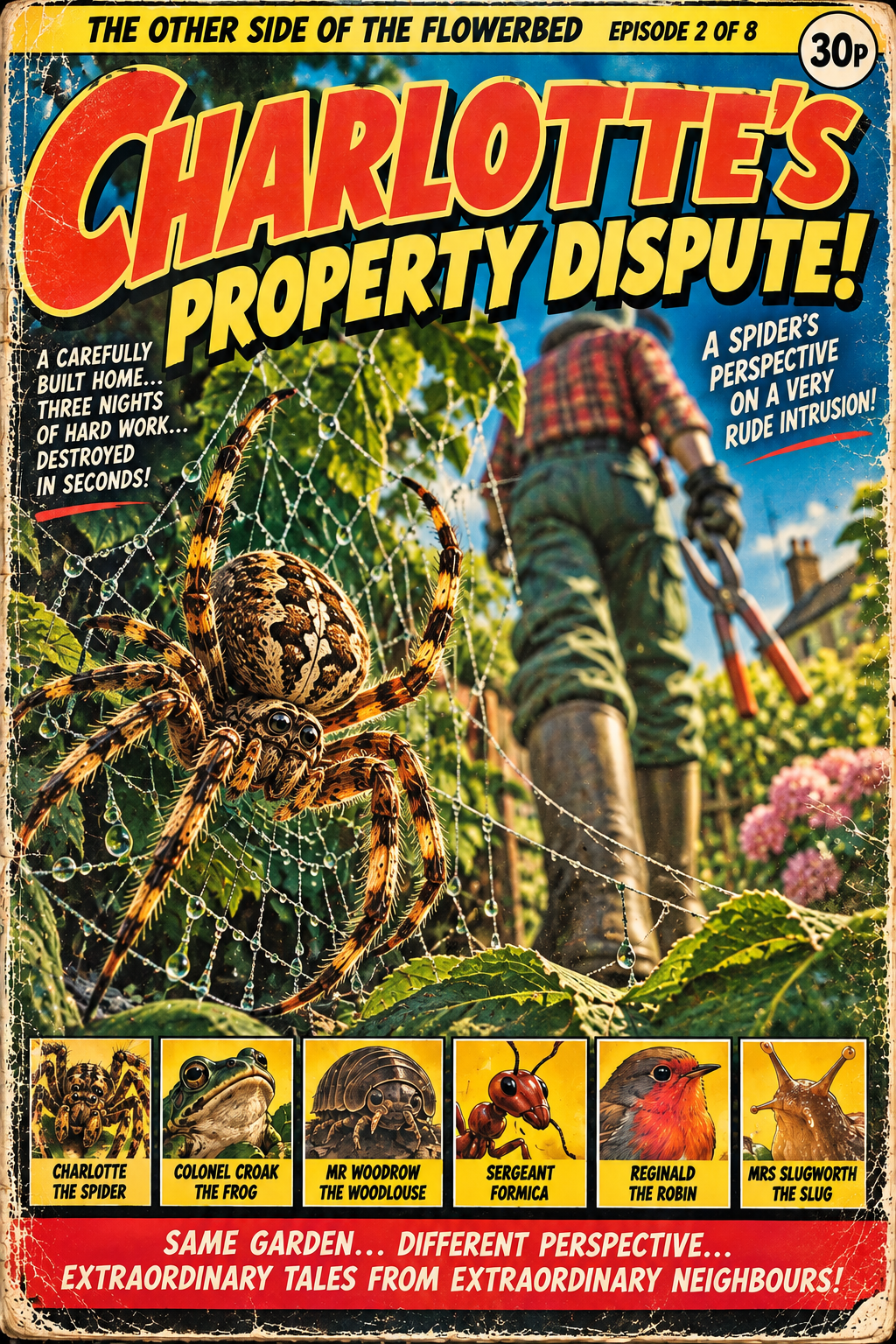
| Charlotte had always considered herself a reasonable spider. She understood that living in a garden involved certain unavoidable inconveniences, particularly when one’s home was suspended between two shrubs frequented by creatures with little regard for private property. Rain was an occupational hazard, wind could be troublesome, and moths were notoriously incapable of distinguishing between an open flight path and somebody’s carefully constructed residence. She had learned to accept these difficulties. What she could not accept, however, was the enormous two-legged creature that appeared with alarming regularity and rearranged the entire neighbourhood without so much as a polite enquiry. Her latest web was, by any reasonable assessment, a masterpiece. Suspended between the outer branches of a lavender bush and a neighbouring shrub, it sat in a spot that offered excellent opportunities to catch passing insects while remaining reasonably sheltered from the prevailing wind. The supporting framework had been constructed with considerable attention to detail, and the circular arrangement of silk strands demonstrated the sort of precision that Charlotte believed was sadly lacking in modern garden architecture. She had spent much of the previous night repairing damage caused by an exceptionally clumsy moth, and the finished structure was now performing exactly as intended. Unfortunately, the Giant had arrived. Charlotte watched him from the centre of her web, where she had been enjoying a perfectly satisfactory morning, and studied his movements with growing suspicion. He had already deposited a collection of tools beside the border and was now examining the shrubs with an expression she recognised only too well. It was the same expression he wore whenever he decided that something perfectly acceptable required improvement. Charlotte had observed this behaviour many times and concluded that humans suffered from a peculiar inability to leave things alone. The Giant stepped closer, bent down and began removing several dead stems from the lavender. Charlotte felt the vibrations travel through the branches supporting her home and immediately adopted the defensive posture of an architect whose building had just been approached by an unsupervised demolition contractor. “Careful,” she muttered, watching the enormous fingers move through the foliage. “Those are load-bearing branches, you great lumbering idiot.” Naturally, the Giant paid no attention. He could not hear Charlotte, and even if he could, he would probably have struggled to understand why a spider might consider removing dead lavender stems a matter requiring formal consultation. From his perspective, the plant needed tidying, and the work would take only a few minutes. From Charlotte’s perspective, an unidentified authority had entered her property, interfered with the foundations and appeared to be considering further alterations. She hurried along one of the supporting strands to inspect the disturbance. The web remained intact, although the movement had loosened a connection near the western edge. Charlotte repaired it immediately, muttering darkly about artistry, planning regulations and the general decline in respect for established residents. She was halfway through tightening the replacement strand when a familiar voice called from beneath the hostas. “Trouble, is it?” Colonel Croak had emerged far enough from his shelter to observe the Giant’s activities, although not so far that he might be accused of taking unnecessary risks. He regarded Charlotte’s position with professional concern. Elevated structures, in his opinion, were exceptionally vulnerable during an offensive, particularly when their occupants insisted upon remaining visible to the enemy. “Trouble?” Charlotte repeated indignantly. “He’s interfering with my eastern supports. I’ve spent three nights getting the tension right, and now he’s blundering about as though the whole place belongs to him.” The Colonel considered this complaint entirely justified, though he cared less about the architectural implications than about the strategic significance of the Giant’s movements. He had been predicting another incursion for some time, largely because the same creature appeared at regular intervals, and he regarded each return as further evidence of a sustained campaign against the garden’s inhabitants. “I warned everyone,” he replied gravely. “Every time he comes, it’s the same. First the reconnaissance, then the equipment, then the destruction. You should have established an alternative position weeks ago.” Charlotte regarded him with irritation. “And where, precisely, would you suggest I build it? Beneath a hosta with you? Some of us require a little height to conduct our business.” The Colonel declined to answer. He had never particularly approved of spiders, whose preference for suspended accommodation struck him as unnecessarily adventurous, but he respected Charlotte’s determination to defend her territory. He withdrew beneath his leaf, promising to maintain surveillance and report any significant developments. Charlotte suspected this meant he intended to sit in the shade and complain, which was more or less what he did on most mornings. For several minutes, matters appeared to improve. The Giant moved away from the lavender and began clearing a small patch of weeds near the lawn. Charlotte returned to the centre of her web, inspected the repaired connection and congratulated herself on having survived another close encounter with human incompetence. A small fly became entangled near the upper edge, providing a welcome distraction, and she began to think the morning might yet prove profitable. Then the Giant returned with the secateurs. Charlotte recognised the instrument immediately. It was a dreadful contraption consisting of two enormous metal jaws that snapped together with a sharp, unpleasant sound. She had witnessed its effects upon vegetation before, and although she understood very little about human intentions, she knew that branches tended to become considerably shorter after encountering it. The Giant examined the neighbouring shrub, selected an overlong stem and reached forward. Charlotte felt the first warning tremor as his hand brushed the foliage. She moved quickly towards the outer framework, intending to retreat into the shrub if necessary. Still, before she could reach safety, the secateurs closed around a branch that supported one of her principal anchor lines. There was a sharp metallic click. The branch moved. And Charlotte’s magnificent web, which moments earlier had represented the pinnacle of spider engineering, collapsed sideways into a shapeless tangle of silk. For several seconds she could do nothing but cling to a surviving strand while the remains of her home swung gently beneath her. The central spiral had folded in on itself, the outer framework hung at an impossible angle, and the unfortunate fly she had been preparing to eat had disappeared somewhere into the wreckage. Charlotte stared at the devastation with the stunned disbelief of someone who had returned from a pleasant afternoon stroll to find her house demolished to make room for a car park. “Oh, you absolute—” She stopped herself. Charlotte considered strong language beneath her dignity, though sometimes dignity required considerable effort. The Giant, unaware that he had just destroyed an important piece of local infrastructure, dropped the severed branch into his waste container and continued pruning. He was quite pleased with the progress. The shrub was beginning to look tidier, the lavender had been cleared of dead material, and there was still plenty of time to attend to the remaining border. Charlotte, meanwhile, had concluded that the situation required immediate intervention. She climbed into the neighbouring foliage and surveyed the damage from a safer position. Several supporting strands remained attached, but the structure itself was beyond repair. It would have to be dismantled and rebuilt, an undertaking that would require considerable time and energy. Worse still, the Giant was showing every indication of continuing his activities in the immediate vicinity. “This is outrageous,” she declared to nobody in particular. “Absolutely outrageous. There ought to be a law.” A small beetle passing along a nearby stem paused to examine the wreckage. “What happened?” “Compulsory demolition,” Charlotte replied bitterly. The beetle looked towards the Giant, then back at the tangled silk. “Didn’t you know he was coming?” “Of course I knew he was coming. He always comes. That doesn’t mean I should have to abandon my home every time he feels like cutting something.” The beetle considered this argument before suggesting that Charlotte might construct her next web somewhere less exposed. Charlotte regarded him with the expression of a professional architect being offered structural advice by somebody whose principal accommodation consisted of hiding beneath a stone. “Thank you,” she said coldly. “I’ll give that suggestion precisely the consideration it deserves.” By now, word of the incident had begun spreading through the garden. The collapse of Charlotte’s web was reported to Colonel Croak as the destruction of an elevated observation post. At the same time, a passing ant informed Sergeant Formica that a major transport structure had failed near the eastern border. By the time the news reached Mr Woodrow beneath his flowerpot, it had become an account of an entire residential development being flattened without planning permission. Mr Woodrow was appalled. “Without consultation?” he demanded, addressing several members of the Under-Pot Residents’ Association. “Without notification? Without even a preliminary meeting?” One of the younger woodlice pointed out that the Giant had never attended an association meeting and was unlikely to start now. Mr Woodrow considered this a particularly poor excuse for administrative negligence and announced his intention to draft a formal complaint. Nobody asked how he proposed to deliver it, largely because they were accustomed to his complaints remaining beneath the flowerpot until eventually forgotten. Charlotte, having completed her assessment of the damage, decided to seek an explanation from the only creature in the garden who appeared to enjoy the Giant’s company. Reginald was perched on a low branch overlooking a freshly disturbed patch of soil. He had already secured two small worms and was watching the gardener with the keen interest of someone attending a particularly promising buffet. When Charlotte approached, he greeted her cheerfully and enquired whether she was having a pleasant morning. “A pleasant morning?” Charlotte repeated. “My home has been destroyed, my breakfast has vanished, and that enormous menace is still wandering about with a pair of metal jaws. Does that sound pleasant to you?” Reginald tilted his head and considered the matter. He was not entirely unsympathetic, but his own experiences of the Giant had been overwhelmingly positive, and he found it difficult to understand why the other residents insisted upon interpreting every gardening activity as an act of aggression. “Well, he does tend to move things about,” he admitted. “But he’s generally quite helpful. Look at all this lovely soil he’s turned over.” Charlotte examined the disturbed earth with disgust. “I don’t live in the soil, Reginald. I live in a carefully engineered suspended structure. Or rather, I did until your enormous friend decided it was surplus to requirements.” Reginald swallowed a worm and suggested that she might rebuild once the Giant had finished. This, he explained, was the advantage of dealing with humans. They were terribly disruptive while present, but they eventually went away, leaving behind all sorts of interesting opportunities. Charlotte found this observation profoundly irritating, partly because it was delivered with such infuriating cheerfulness and partly because she suspected it might contain a grain of truth. She returned to the damaged shrub and began considering alternative locations. The original position had been excellent for catching insects, but the supporting branches were now shorter, and the Giant had removed several convenient attachment points. A nearby gap between two stems offered a possible replacement site, although it would require a slightly smaller web and a different arrangement of supporting threads. Charlotte disliked compromise. She preferred to regard each construction as an improvement upon the last, and the suggestion that she might be forced to build something smaller merely because a human had decided to tidy a shrub offended her professional pride. Nevertheless, she began work. Spiders are remarkable builders, capable of producing different kinds of silk for structural support, attachment and prey capture. Charlotte, although unaware of the scientific terminology, understood these distinctions perfectly well. She began by laying a new bridge line, testing its strength before adding the main framework. From there, she could construct the radial supports and, eventually, the spiral arrangement that would form the web’s working surface. It was painstaking work, made considerably harder by the need to keep one eye on the Giant, who continued moving about the border with an alarming disregard for the emotional wellbeing of its residents. After a while, Charlotte realised she was being watched. Private Derek had wandered away from the ant colony and was standing on a nearby stem, apparently fascinated by the construction process. He had been sent to investigate a possible food source but had become distracted by the sight of a spider apparently knitting in mid-air. “What’s that you’re making?” he asked. “A web.” “What’s it for?” “Catching food.” Derek considered this with considerable interest. “Couldn’t you just go and fetch it?” Charlotte paused, turned toward him, and examined the small ant with weary disbelief. She explained, with as much patience as she could manage, that her species used a different method of obtaining food and that the structure’s entire purpose was to intercept flying insects without the inconvenience of chasing them about the garden. Derek nodded thoughtfully. “Seems a lot of work.” “Yes,” Charlotte replied. “It is.” “Sergeant says we should always take the most efficient route.” “Does he?” “Yes. Although I keep getting lost.” Charlotte decided that further discussion would serve no useful purpose and returned to her construction. Derek watched for another minute before wandering away in the wrong direction, apparently satisfied that he had learned something useful about engineering. The morning progressed, and the Giant gradually moved farther along the border. Charlotte continued working, slowly establishing the framework of her replacement web. It was not as grand as the original, but the new position offered reasonable shelter, and the altered arrangement of branches might actually provide better protection from heavy rain. She was reluctant to admit this, even to herself. Colonel Croak eventually emerged from beneath his hosta to inspect the damage. He listened while Charlotte described the demolition in considerable detail, occasionally interrupting to offer observations about the tactical disadvantages of exposed positions. When she showed him the beginnings of her replacement structure, he examined it with the solemn expression of a military officer inspecting a newly constructed defensive installation. “Better concealed,” he observed. “Smaller target. Less vulnerable to attack.” “It’s a web, Colonel, not a fortress.” “Same principles.” Charlotte chose not to argue. The Colonel was plainly enjoying himself, and she had neither the time nor the inclination to explain the differences between catching flies and repelling an invading army. By the time the Giant began collecting his tools, Charlotte had completed the principal framework of her new home. The delicate spiral would require further attention, but the structure was already functional, and she had even caught a small gnat near one of the outer strands. It was hardly sufficient compensation for the morning’s disruption, but it represented a promising beginning. The Giant paused beside the shrub and examined his work. He had removed several overgrown stems, cleared away dead material and opened up the planting sufficiently to allow more light and air into the border. From his perspective, the result was a considerable improvement. “That’s better,” he remarked nodding his head. Charlotte watched him from her new position and felt a fresh surge of indignation. “Better?” she repeated quietly, understanding the nodding motion. “You’ve destroyed a perfectly respectable residence, displaced its owner, interrupted a profitable business and forced an emergency reconstruction, and you dare to stand there looking pleased with yourself?” The Giant straightened, collected his waste container and moved away. Charlotte remained silent for a moment, considering the extraordinary injustice. Then she inspected her new web, tested one of the supporting strands and reluctantly acknowledged that the altered position was proving rather effective. The air currents were favourable, the shelter was better than she had expected, and another small fly was already approaching from the direction of the lavender. Perhaps, she thought, the location had certain advantages after all. She would never admit it publicly, of course. There were principles to consider, and allowing the Giant to believe that his interference had produced a beneficial result would set a dangerous precedent. From beneath the hosta, Colonel Croak called out to ask whether she intended to lodge a formal protest. “Absolutely,” Charlotte replied. “I’ve already decided to establish a residents’ committee.” The Colonel regarded this proposal with interest. He had long advocated greater cooperation between the garden’s inhabitants, particularly on matters of security, and the possibility of an organised body capable of resisting human interference appealed to him enormously. “Excellent idea,” he declared. “We shall require a chairman, a defence strategy and a proper chain of command.” Charlotte examined the Colonel, then glanced towards the flowerpot beneath which Mr Woodrow was almost certainly conducting another meeting. On reflection, perhaps a committee was not such a good idea. She returned to the centre of her new web and settled down to await her next meal, privately resolving to construct an even more impressive structure once the garden had returned to normal. After all, she had nearly an entire week before the Giant came back. And this time, she intended to be ready. |
| To be continued in Episode 3 — Colonel Croak and the Great Offensive! |
| About our writing & imagery Most articles are grounded in our real gardening experience, observations and reflections. AI may assist with research, drafting and editing, but the experiences, opinions and editorial direction are our own. Featured images may include our photography, original AI-generated visuals or, where stated, images credited to others. All published content is reviewed and shaped by Earthly Comforts before publication. |