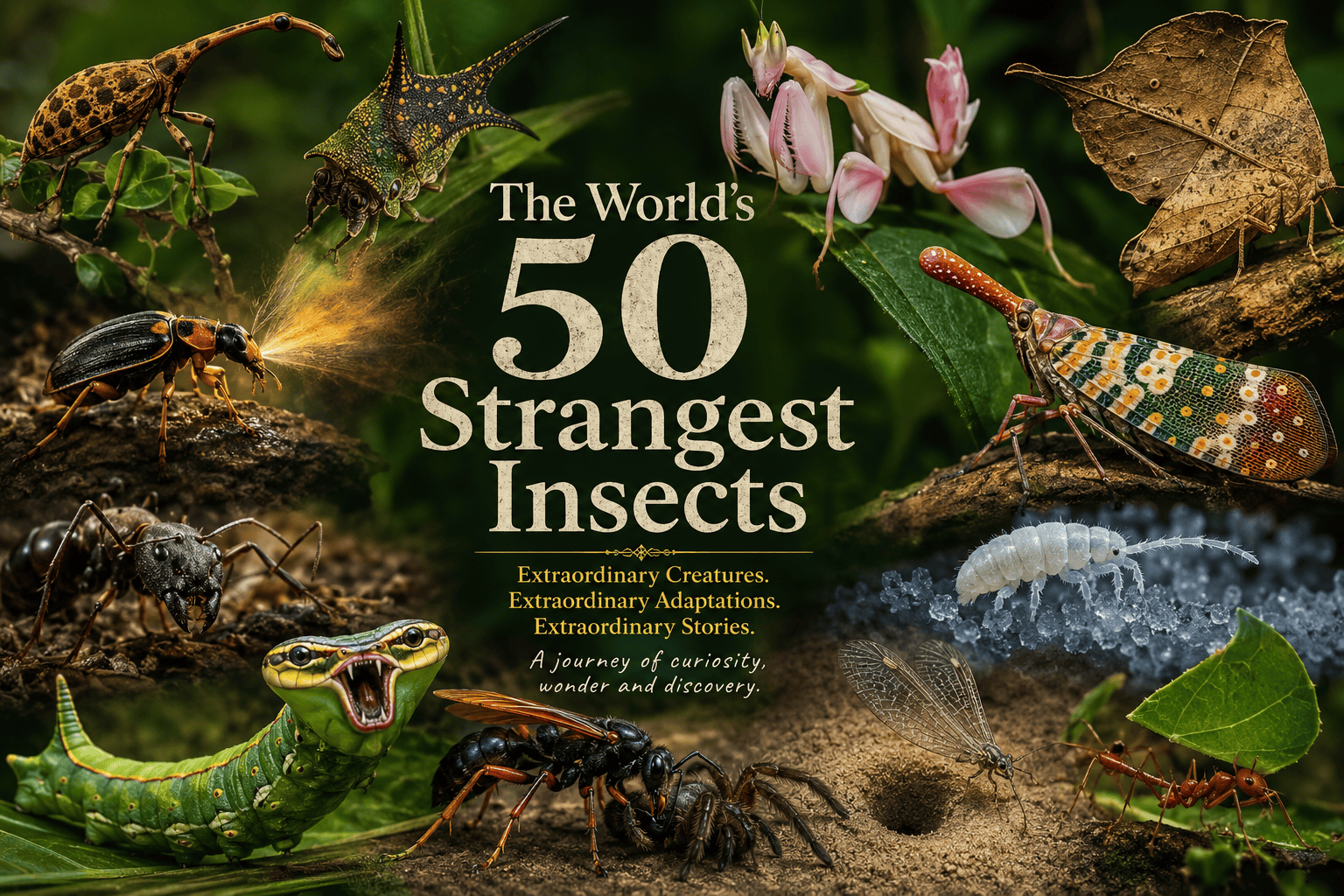
| Episode 1 — Masters of Disguise |
| Some things you remember from childhood because they were unusual, and others that probably seemed ordinary at the time but only became unusual when you looked back years later. Leaf insects fall into the second category for me. We lived in Malaysia between 1968 and 1971, when I was still very young, and I remember leaf and stick insects in the garden, along with mantises and the considerable collection of other creatures that came with living somewhere tropical. They were there. I don’t remember standing in the garden contemplating several hundred million years of insect evolution. I was a small boy interested in bugs. What seems much stranger now is what I was actually looking at. A leaf insect doesn’t merely happen to be green. A good one can have a broad, flattened body, legs expanded into leaf-like shapes and markings that interrupt the otherwise healthy green with areas resembling damage, discolouration or decay. Put one amongst real foliage, and the problem isn’t simply that it is difficult to see. Your brain can look directly at an insect and still tell you you are looking at vegetation. That distinction takes us to a useful place for the first episode of this series. Camouflage is often described as though the object were to become invisible. Nature has produced rather more imaginative possibilities than that. An insect can blend into a background, resemble an object a predator has no reason to investigate, or exploit another animal’s expectations so successfully that the deceived animal actually approaches it. Our first five insects all play with perception. They don’t all do it in quite the way we might expect. |
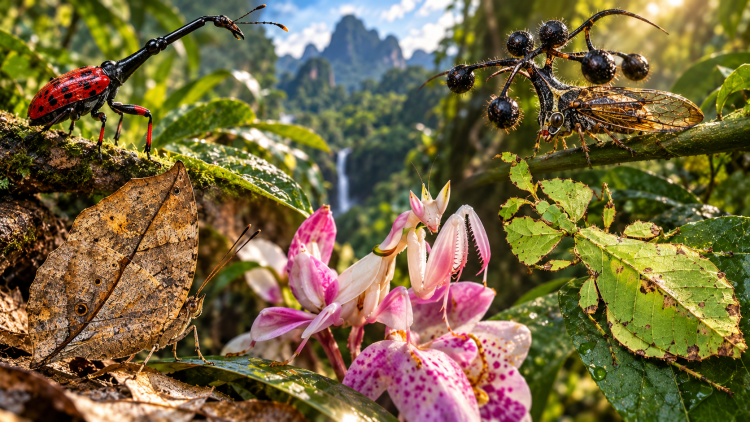
| 1. The giraffe weevil — Trachelophorus giraffa Madagascar has an unfortunate habit of making the rest of the natural world look conservative by comparison. Its long isolation has produced an extraordinary fauna, and among the insects found there is a small red-and-black weevil with a neck that seems to belong to something considerably larger. The giraffe weevil is one of those animals whose common name needs little explanation. In the male, in particular, the head sits at the end of an elongated neck, producing a shape quite unlike the compact outline we normally associate with a weevil. Females have much shorter necks. Once you see the male, however, it is difficult to look anywhere else. This is where we need to be careful with the word strange. An elongated structure may look ridiculous to us while being perfectly serviceable to the animal carrying it. Male giraffe weevils use their greatly extended necks in contests with other males, while the female’s shorter neck is associated with the rather different business of preparing leaves for reproduction. She cuts and manipulates a leaf, deposits an egg and creates a rolled structure around it. What initially looks like an insect assembled with the wrong proportions begins to make rather more biological sense. Sexual differences like this remind us that evolution does not necessarily produce one ideal version of a species. Males and females can face different pressures. A feature that improves a male’s success in competition need not be equally advantageous to a female, and over generations the two sexes can consequently end up looking markedly different. Another reason I wanted the giraffe weevil near the beginning of our fifty. It is very easy to turn unusual insects into a parade of visual curiosities. Photograph the long-necked male, add an excitable caption underneath it, and the job is apparently done. Except that the photograph is the least interesting part. The interesting part is that the neck has a life attached to it: competition, reproduction, leaf manipulation and the peculiar circumstances of an animal that evolved in Madagascar. Once you consider those things, the neck stops being a novelty. It becomes part of the animal’s way of making another giraffe weevil. That will happen often in this series. |
| 2. The Brazilian treehopper — Bocydium globulare If the giraffe weevil looks as though one body part has been stretched, Bocydium globulare looks as though something has been added. Above its body rises an extraordinary arrangement of stalks and rounded structures. The effect is difficult to describe without making the insect sound invented. Several dark spheres appear to hover above it, attached to a complicated framework arising from the thorax. People have inevitably compared it with all sorts of human machinery, although I suspect the treehopper manages perfectly well without knowing what any of it is. The structure is real. The imaginative explanations surrounding it are considerably less secure. Bocydium globulare belongs to the treehopper family Membracidae, a group in which the pronotum — broadly, a plate associated with the first part of the thorax — has diversified into a wonderful range of projections, crests, spines and helmet-like structures. Some treehoppers resemble thorns or other plant structures remarkably well. In others, the shape is so elaborate that determining precisely what advantage it provides becomes much harder. That uncertainty matters. We could look at Bocydium and produce an attractive evolutionary story about mimicry or predator confusion, but an attractive explanation isn’t automatically demonstrated. Defensive and mimetic functions have been proposed for treehoppers’ remarkable structures more generally. Still, the precise function of the globular arrangement in Bocydium should not be presented as settled simply because we would like an answer. Sometimes not knowing yet is the more interesting answer. Treehoppers themselves are relatives of cicadas and leafhoppers and feed on plant fluids. Their small size makes the extravagance above Bocydium all the more peculiar. This is not a great lumbering tropical insect carrying an enormous display. The insect itself is tiny. There could be one sitting on vegetation surprisingly close to your face, and the first difficulty would still be noticing it. That creates an odd reversal. Enlarged photographs have made Bocydium globulare recognisable amongst people interested in unusual insects, but those photographs also alter our perception of it. We encounter the extraordinary structure at many times the size at which the insect actually carries it. Macro photography has opened a world that was always present but wasn’t always available to the unaided human eye. Some insects haven’t become stranger. We have become much better at seeing how strange they always were. |
| 3. The dead-leaf butterfly — Kallima A dead leaf on the forest floor is not especially interesting. That, of course, is precisely the point. Butterflies of the Asian genus Kallima, commonly called oakleaf or dead-leaf butterflies, possess one of the classic examples of masquerade. With the wings closed, the visible undersides can reproduce the impression of a dry leaf with extraordinary conviction. A dark line runs through the wings like a midrib. Other markings resemble veins. The colours include browns and irregular patches suggestive of the staining, blemishes and imperfections of a leaf that has finished being useful to a tree. Then the butterfly opens its wings, and much of the illusion disappears. The upper surfaces can reveal strong colours quite unlike the dull object we thought we were looking at. It is rather like watching a dead leaf suddenly open a brightly coloured coat. What particularly interests me about Kallima is that it lets us distinguish between two ideas we often bundle together under the word camouflage. An animal can be difficult to detect because it matches its background. Masquerade goes a little further. The predator may see the animal and classify it as something else: in this case, an object that isn’t food and therefore isn’t worth investigating. Experimental work with oakleaf butterflies has provided evidence supporting exactly that effect. The resemblance is not merely about becoming difficult to see. A predator familiar with dead leaves can be slower to recognise the butterfly as potential prey. The evolutionary history is equally interesting because the finished disguise looks almost too complete. It is tempting to imagine that half a leaf would be useless. If an ancestral butterfly only vaguely resembled a leaf, why wouldn’t a predator eat it before evolution had the opportunity to finish the job? Evolution doesn’t work by drawing the finished design first. Research comparing Kallima with related butterflies shows how leaf-like appearance can develop by modifying wing-pattern elements already present. The familiar-looking veins of the false leaf did not have to arrive as a complete package. Existing pattern components could change, shift and combine across generations, producing increasingly convincing intermediate forms. That makes the butterfly more interesting to me, not less. The disguise isn’t evidence of nature somehow knowing what a dead leaf ought to look like. It is an example of what can happen when small variations affect whether an animal gets noticed, recognised and eaten, repeated across generations for a very long time. A predator doesn’t need to admire the result. It merely needs to make a mistake. |
| 4. The orchid mantis — Hymenopus coronatus Mantises were amongst the insects I remember seeing in the garden in Malaysia. I can’t claim that the ones I saw as a boy were orchid mantises; childhood memory is not a specimen label, and I have no intention of upgrading a recollection into a species identification more than half a century later. But mantises themselves were familiar enough, and even as insects go, there is something particularly purposeful about them. The orchid mantis takes that familiar mantis shape and does something rather unexpected with it. Hymenopus coronatus, found in Southeast Asia, has pinkish and white forms and expanded lobes on its legs that contribute to a flower-like appearance. The obvious explanation is that it resembles an orchid so that it can hide amongst orchid flowers and ambush pollinating insects. The obvious explanation isn’t quite right. Research on the shape and colour of orchid mantises has found little reason to think they precisely mimic one particular orchid. Instead, their appearance seems to fall within the broader visual territory occupied by flowers. Rather than copying a particular blossom, the mantis can provide a more general flower-like signal. And it does something still more interesting than hiding. Experiments have shown that pollinating insects can actually be attracted towards orchid mantises. That changes our interpretation completely. The mantis isn’t necessarily disappearing into a floral background, waiting for an unfortunate insect to pass by. Its appearance can participate in the deception, exploiting the sensory expectations of insects looking for flowers. There is a lovely complication here. Camouflage usually makes us think about not being seen. The orchid mantis can benefit from being seen by the very animal it intends to eat. That is aggressive deception rather than simple concealment. It also illustrates why studying an animal’s appearance through human eyes can lead us astray. We see an orchid mantis and think orchid. A pollinating insect has a different visual system and a different reason for looking at flowers. The biologically important question isn’t whether the mantis convinces us. It is whether the signals it presents are sufficient to influence its prey’s behaviour. Evidence even suggests that the surroundings matter. A flower-like predator among real flowers may compete with those flowers for attention. In some cases, being away from flowers may make the mantis’s deceptive signal particularly conspicuous. So the animal popularly celebrated as the supreme example of hiding in a flower may be doing something subtler. It can resemble a flower well enough to bring food to itself. Nature occasionally has a dry sense of humour. A pollinating insect goes looking for lunch and discovers that lunch was looking for it. |
| 5. The giant Malaysian leaf insect — Pulchriphyllium giganteum And so we return to a leaf. This one takes me back towards the garden memories with which we began. I remember large leaf and stick insects in Malaysia, although again I won’t pretend I can now identify which species I saw between 1968 and 1971. There are numerous phasmids in the region, and fifty-odd years is quite long enough for certainty to become imagination if you let it. What I can say is that the basic trick was already familiar to me as a child: sometimes the leaf you were looking at wasn’t a leaf. Pulchriphyllium giganteum, the giant Malaysian leaf insect, demonstrates how far that trick can go. Older literature and collections may refer to it as Phyllium giganteum, but its currently accepted placement is Pulchriphyllium giganteum. Even the name reminds us that taxonomy isn’t a permanent filing cabinet. It changes as scientists gain better evidence about relationships between organisms. The female has the broad, flattened form we associate with the most convincing leaf insects. The abdomen resembles a leaf blade, and the legs carry expansions that break up the unmistakably insect-like appearance of six articulated limbs. Green dominates, but individuals can carry brownish markings that make the resemblance less like an immaculate plastic leaf and more like something that has actually spent time growing outdoors. That imperfection is important. Real leaves are seldom perfect. They are bitten, browned, stained, curled, scarred and shaded. A uniformly bright green insect could actually stand out amongst them. What looks like damage to us can become part of the disguise. Leaf insects belong to the order Phasmatodea alongside stick insects, and their masquerade extends beyond simply having the right outline. Behaviour can contribute as well. Phasmids are well known for rocking or swaying movements, often interpreted as helping to maintain the impression of vegetation moving in the air. As with so many apparently obvious adaptations, however, it is worth resisting the temptation to assign one universal explanation to every movement made by every species. Sexual differences add another layer. In many leaf insects, males are slimmer and better able to fly, while females are broader and more leaf-like. That reflects different demands on the two sexes rather than one version being somehow more highly evolved than the other. Even the eggs continue the visual uncertainty. Phasmid eggs can resemble seeds or other small pieces of plant material and may be dropped away from the female rather than carefully placed in anything we would recognise as a nest. The insect that spends its adult life looking remarkably like vegetation can begin the next generation looking remarkably unlike an insect egg. By this point, disguise is too simple a word. The leaf insect’s whole presence in the environment has become difficult to separate visually from the plants amongst which it lives. |
| Being Seen Without Being Recognised Our first five insects haven’t really given us five versions of the same trick. The giraffe weevil barely belongs under disguise at all, and that helps because it keeps the episode from becoming too tidy. Its exaggerated anatomy introduces the danger of assuming that anything unusual-looking must be camouflage. Bocydium globulare goes further still: we can see an extraordinary structure without yet being able to explain exactly why that particular structure exists confidently. Kallima gives us masquerade in a much clearer form. We can see the butterfly but mistake it for something irrelevant. The orchid mantis turns deception around, making resemblance potentially attractive to prey. The Malaysian leaf insect then brings us back to the more familiar business of disappearing amongst vegetation, but does so with a degree of commitment that makes simply calling it green camouflage seem rather inadequate. There is something else connecting them. None of these insects knows what it looks like to us. The dead-leaf butterfly hasn’t studied a leaf and attempted to reproduce its veins. The orchid mantis didn’t decide that flowers attracted convenient meals. The leaf insect doesn’t inspect itself each morning to see whether today’s brown patch looks sufficiently convincing. Variation, inheritance, ecology and the consequences of being eaten or reproducing successfully have done their work without foresight. We arrive afterwards and call the result strange. I find myself thinking back to those Malaysian gardens. At six or seven years old, I knew that a leaf insect looked like a leaf because that was the obvious and rather wonderful thing about it. Decades later, the more interesting question is how an insect lineage can become so thoroughly integrated into the visual clutter of vegetation that another animal’s perception becomes part of its survival strategy. That may be what has changed since the bug farms and childhood collecting. I still enjoy the fact that something looks extraordinary. I want to know why. And after our first five insects, we have already discovered that sometimes science has a good answer, sometimes the familiar answer turns out to be slightly wrong, and sometimes the responsible answer remains that we don’t yet know. That seems a good place to begin a journey through fifty of them. Next time, disguise gives way to something rather less subtle. We will meet insects whose defence can involve chemical reactions, protective shields, the remains of previous victims and, in one particularly committed ant, the destruction of its own body. |
| Explore Further The science behind unusual insects is often considerably more interesting than the headline attached to them. These resources are here for readers who would like to explore some of the research and natural history behind the five insects in this episode. They are not intended as an exhaustive bibliography. 1. Giraffe weevil — Trachelophorus giraffa The Madagascar giraffe weevil belongs to the leaf-rolling weevils. Females construct rolled-leaf shelters associated with reproduction, while the greatly elongated neck of the male is one of the species’ most conspicuous differences between the sexes. Explore further: Wildlife Madagascar — Madagascar Giraffe-Necked Weevil Smithsonian — Giraffe Weevil natural-history overview 2. Brazilian treehopper — Bocydium globulare Treehoppers are famous for their remarkably diverse pronota — the enlarged and sometimes extraordinarily elaborate structures above their bodies. Bocydium globulare provides one of the most spectacular examples, but the precise adaptive function of its globular structure should not be treated as settled simply because several plausible explanations have been suggested. Explore further: University of Connecticut — Treehopper natural-history resources and Bocydium globulare 3. Dead-leaf butterfly — Kallima Kallima gives us two particularly interesting areas of research. One examines whether predators really can mistake these butterflies for dead leaves; another investigates how such an apparently elaborate leaf pattern could evolve gradually from existing butterfly wing-pattern elements. Explore further: Scientific Reports / PubMed Central — empirical evidence for dead-leaf masquerade in Kallima butterflies BMC Evolutionary Biology / PubMed — gradual evolution of leaf mimicry in Kallima wing patterns Cell — The evolution and diversification of oakleaf butterflies 4. Orchid mantis — Hymenopus coronatus The familiar explanation that an orchid mantis simply hides amongst orchids turns out to be much too simple. Experimental research found that the mantis can attract wild pollinators and that its appearance is better understood as a generalised flower-like stimulus than as a precise imitation of one particular flower species. Explore further: The American Naturalist — Pollinator Deception in the Orchid Mantis Current Zoology / Oxford Academic — Does the orchid mantis resemble a model species? Ethology / Wiley — The Roles of Colour and Shape in Pollinator Deception 5. Giant Malaysian leaf insect — Pulchriphyllium giganteum Taxonomy changes as relationships between insects are reassessed. The specialist Phasmida Species File records the currently accepted name Pulchriphyllium giganteum, along with its older nomenclature, specimen information, distribution and extensive scientific references. Explore further: Phasmida Species File — Pulchriphyllium giganteum A note about our resources Scientific understanding does not stand still. Names change, new experiments test familiar explanations and sometimes the most attractive story turns out not to be the best-supported one. Throughout The World’s 50 Strangest Insects, these companion resources will concentrate particularly on the claims worth investigating further: unusual behaviour, evolutionary explanations, changing taxonomy and those occasions when the popular version of an insect’s story is rather neater than the evidence. Where the evidence is strong, we’ll follow it. Where scientists genuinely don’t yet have the answer, we’ll leave the question open. That uncertainty is part of the story too. |
| About our writing & imagery Most articles reflect our real gardening experience and reflection. Some use AI in drafting or research, but never for voice or authority. Featured images may show our photos, original AI-generated visuals or, where stated, credited images shared by others. All content is shaped and edited by Earthly Comforts, expressing our own views. |


Rory, you need to put a warning on your blog: “May cause uncontrollable wildlife photography cravings.” 🤣🪲🌿
I so enjoyed reading about these five gorgeous insects and can’t wait for the next series. It’s always such a treat to land here and be taken into this amazing world!
What I particularly love is how you don’t just show us these extraordinary little creatures, but make us curious about them. There’s always something new to discover, and I find myself looking at nature with even more questions than before.
That combination of beautiful images, fascinating facts and genuine curiosity makes these posts such a pleasure to read.
Thank you for sharing your wonderful discoveries with us. Now, if you’ll excuse me, I have a growing photography wish list to attend to! 🤣📸❤️
LikeLiked by 1 person
🙂
LikeLiked by 1 person