
| Case File 06 The Big Cats of Lincolnshire — Encounters from My Own Field Notes Part 2 |
| Four locations, several unexpected encounters, three dead sheep, and one autumn evening when something followed my dogs’ movements through a Lincolnshire hedgerow. These are my recollections of events that convinced me Britain’s big-cat mystery deserves to be taken seriously. |
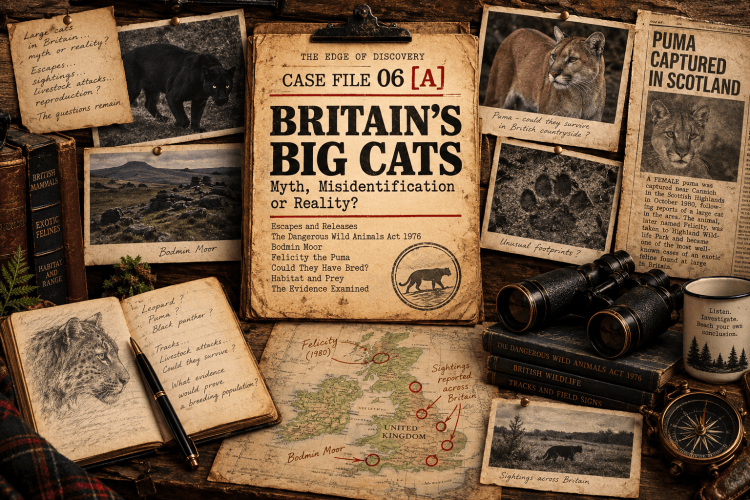
| There is a considerable difference between reading about an unusual animal encounter and finding yourself standing in front of an animal that, according to conventional wisdom, should not be there. When we investigate the world’s more mysterious creatures, we frequently find ourselves examining somebody else’s observations, photographs, footprints or recollections. We weigh the available evidence, consider alternative explanations and attempt to reach a sensible conclusion. It is a perfectly reasonable approach, although it becomes rather more complicated when the person describing the encounter happens to be yourself. In Part One of this investigation, we explored the history of Britain’s alien big cats, the possible consequences of the Dangerous Wild Animals Act 1976, the capture of Felicity the puma in Scotland, and the continuing debate over whether exotic felines could survive in the British countryside. We considered the availability of prey, the difficulties of establishing breeding populations and the considerable gap between an eyewitness report and scientifically verifiable evidence. This time, however, we leave the national mystery behind and travel to Lincolnshire, where I spent several years living and working. There, I had several encounters with animals I identified as large exotic felines, including black cats and one particularly memorable sandy-coloured individual. I also became involved in examining the aftermath of an unusual incident involving three dead sheep, an experience that raised questions I have never been able to answer conclusively. I should establish something at the outset. I am not asking readers to accept these accounts simply because I have experience with exotic animals. Nor am I presenting my recollections as scientific proof of a breeding population of large cats in Britain. I can describe what I saw, explain why I reached certain conclusions and identify the details that made these incidents memorable. Beyond that, readers must decide for themselves how much weight to give the evidence. And that is precisely how an investigation should work. A Background That Changes How You Look at Animals Between 1993 and 2010, I worked within the exotic livestock trade, primarily as a broker dealing with mammals. My work brought me into contact with importers, quarantine facilities, private animal collections, wildlife parks and zoological establishments. Over those years, I encountered an extraordinary variety of animals, including numerous feline species ranging from relatively small wild cats to cheetahs, leopards, lions and tigers. I should clarify that I did not keep large cats at my own brokerage premises. The feline species I dealt with were housed at appropriate collections and facilities. However, that distinction did not always prevent local rumours suggesting that I had an assortment of exotic predators hidden away somewhere. Anyone familiar with small communities will understand how a perfectly ordinary fact can acquire a remarkably imaginative life of its own. [I did hold assorted mammal collections of my own between the years of 2005 – 2009, but the largest at that time was North American Porcupines] Working around exotic mammals does not turn somebody into an infallible wildlife expert. It does, however, provide familiarity with characteristics that are not always obvious in photographs or television programmes. Animals have distinctive ways of carrying themselves, distributing their weight, turning their heads and moving through their surroundings. Their proportions become more familiar when you observe them repeatedly up close. A puma, for example, looks very different from a domestic cat. Its muscular shoulders, elongated body, substantial limbs and long tail combine to create a silhouette that is difficult to forget once you have become accustomed to it. Leopards have distinctive proportions and movement, and although melanistic individuals may appear uniformly black at a distance, their underlying anatomy remains that of a leopard. That familiarity influenced how I interpreted my encounters in Lincolnshire. It did not eliminate the possibility of error. Still, it meant that when I described an animal as resembling a puma or a leopard, I was comparing it with creatures I had encountered before rather than relying entirely upon illustrations or popular descriptions. With that background established, we can begin with a late-summer evening in 2003. Market Deeping, 2003 — A Black Cat in the Headlights It was approximately eleven o’clock at night when my then-wife and I were driving towards Peterborough after visiting her parents. We were travelling in a Mini along Lincoln Road, the B1524, having left Market Deeping behind us. We were roughly two miles outside the town and approaching the junction with Mill Road on our right. The countryside was dark, and the car’s headlights provided the principal illumination of the road ahead. As we approached the junction, a large black animal appeared in front of us. My wife braked, bringing the Mini to a halt, and for a brief period the animal remained visible in the headlights. What struck me immediately was its feline appearance and substantial size. This was not simply a dark shape glimpsed at the edge of a field. We had an unobstructed view of an animal standing on the road, sufficiently close for its proportions and movement to register clearly. It paused, looked toward the vehicle, then moved away, running down Mill Road. I identified it as a large black feline, matching what people commonly describe as a black panther. That description refers to its appearance, not a confirmed species identification. I could not establish whether it was a melanistic leopard or another animal, and there was no photograph or physical evidence to settle the question. However, two of us were in the car, and we both witnessed the encounter. One difficulty with unexpected sightings is that events unfold much faster than we can document them. Today, with mobile phones readily available, it is tempting to imagine that everyone should be able to photograph anything unusual they encounter. In practice, by the time you have recognised something unexpected, processed what you are seeing and thought about recording it, the opportunity may already have passed. In our case, the entire incident was over before photography became a consideration. The animal had disappeared down Mill Road, and we were left with the extraordinary experience of seeing something neither of us expected on a Lincolnshire road. It was not to be my last encounter with a large black cat. Baston, 2005 — Another Unexpected Crossing At another point during my years in Lincolnshire, I was walking my dogs along Main Street in Baston when a large black feline crossed the road. This was a different setting from the Market Deeping encounter. I was on foot rather than sitting inside a vehicle, and my dogs were with me. Their reaction was immediate, drawing attention to the animal as it moved across the road. Again, I observed an animal whose apparent size and proportions did not match what I would expect from an ordinary domestic cat. It was black, moved in a distinctly feline manner and disappeared before I had any opportunity to investigate further. I cannot offer a precise measurement of its size, and I would be reluctant to manufacture one now. The animal was not standing beside a ruler or a conveniently placed object of known dimensions, and estimates made years after a brief encounter are not necessarily reliable. What I can say is that I recognised a substantial feline, and the encounter was unusual enough to remain firmly in my memory. Of course, my dogs’ reaction does not establish the species involved. Dogs may respond to unfamiliar animals, scents or movements for any number of reasons. Their behaviour was part of the encounter, but it was not independent confirmation that we had seen an exotic cat. Nevertheless, when considered alongside the Market Deeping sighting, it gave me another reason to wonder whether large felines were moving through this part of Lincolnshire. Gedney Hill, 2011 — Dark Shapes Across the Fields While I was living in a caravan at Gedney Hill, I repeatedly observed large black feline shapes moving through the fields at a distance of around 500 feet. These observations differed from the two road encounters because the animals were considerably farther away. The fields provided open views, but distance introduces uncertainties that can be difficult to resolve without optical equipment, photographs or reliable measurements. What I remember is seeing dark animals whose movement and general appearance suggested large cats. These were not all single, fleeting glimpses of something disappearing immediately into cover. I had opportunities to observe movement across the landscape, and the impressions were sufficiently consistent to reinforce my belief that unusual felines were present in the area. Even so, I would not place these observations in quite the same evidential category as the close encounter near Market Deeping. Distance matters. A familiar animal can appear unfamiliar when viewed against an open landscape, and judging size without a reliable reference point is notoriously difficult. I have no wish to strengthen an account artificially by removing its limitations. The Gedney Hill observations contributed to my overall impression of large cats in the area, but they did not produce photographs, measurements or independently verified species identifications. By this stage, I had encountered what I believed to be large black felines in several different locations. Yet a sandy-coloured animal, seen during an autumn evening on Dunsby Drove, would become perhaps the most memorable of all. Dunsby Drove, 2008 — An Autumn Evening With Wolfie and Dora The encounter occurred mid-October in 2008. It was approximately six o’clock in the evening, shortly before the clocks changed, and the daylight was beginning to fade. There was still enough light to see along the lane, although the hedgerows and surrounding fields were gradually darkening. I was walking two of my dogs, Wolfie and Dora, along Dunsby Drove. They were both substantial animals, Wolfhound–Labrador crosses with considerable height and strength. Wolfie was the stockier of the two, while Dora was leaner but equally tall. Anyone who has walked two large, enthusiastic dogs along a narrow country lane will appreciate that they can take up far more of your attention than two small terriers. Hedgerows bordered the lane, with fields beyond. As we walked, both dogs noticed something moving through the hedge on our right. They began barking, their attention firmly fixed on whatever was travelling alongside us. At first, I could not see what was responsible. The vegetation concealed the source of the movement, but the dogs’ behaviour made it clear something had caught their attention. I continued walking, aware of movement in the hedgerow and that both dogs were responding to it. Then I noticed something curious. When I stopped walking, the movement in the hedge appeared to stop as well. When I resumed, the movement continued. This happened sufficiently clearly for me to recognise a pattern. However, I cannot say whether the animal was deliberately following us, travelling in the same direction or simply responding to our presence. It is tempting, particularly when recalling an unusual encounter, to interpret such behaviour as stalking. But stalking implies an intention that I could not establish. All I knew was that something was moving through the vegetation alongside the lane, and its movement appeared to correspond with ours. The dogs continued to bark. Then the animal emerged. |
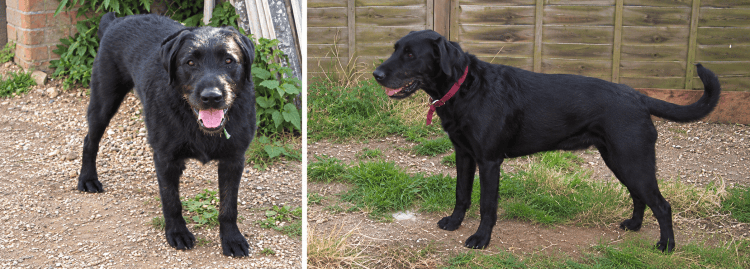
| Wolfie and Dora – Wolfhound/Gundog Labrador crosses not a small variety of dog. |
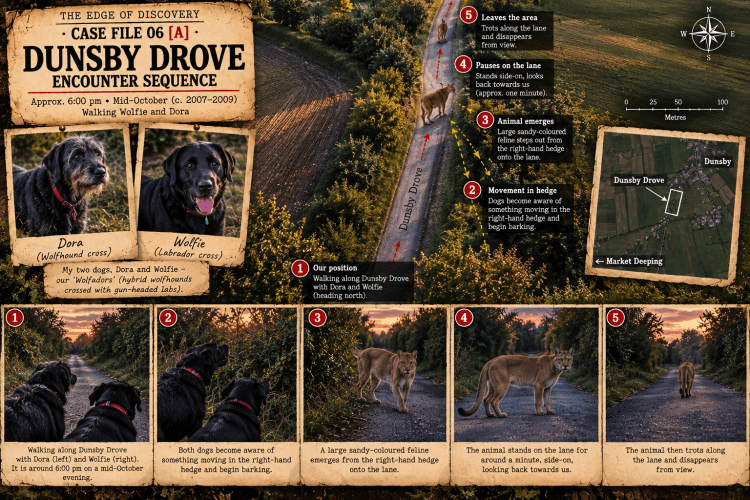
| The Puma on the Lane A large sandy-coloured feline stepped out onto Dunsby Drove, bringing the source of the disturbance into view. My immediate identification was a puma. The animal had the general proportions and appearance I associated with that species: a substantial, muscular body, a relatively small head in proportion to its frame, and the long-tailed silhouette characteristic of a large feline. Its sandy colouring was entirely consistent with a puma, and I could see enough of the animal to form a confident impression. It was not merely a flash of movement disappearing into the distance. The cat remained visible on the lane for what I recall as approximately a minute, although I recognise that estimating the duration of an unexpected encounter years later is imprecise. Its position was particularly memorable. The animal stood side-on, with its left flank towards me. Its hindquarters faced the field from which it had emerged, while its head faced the field on the opposite side of the lane. It looked back towards us as it stood there. I had the distinct impression of a powerful, composed animal that was assessing its surroundings rather than reacting in panic. In terms of apparent size, it was comparable to my dogs, though that shouldn’t be taken as a precise shoulder-height measurement. Wolfie and Dora were unusually large dogs, and my comparison was a visual impression formed during the encounter. What surprised me almost as much as the cat’s appearance was the dogs’ behaviour. They had been vocal and alert while something moved through the hedge, yet once the animal stood visibly on the lane, neither attempted the sort of direct challenge I might have expected. I cannot explain why. Perhaps they were uncertain, perhaps the animal’s presence inhibited them, or perhaps other behavioural factors I could not recognise were at play. Whatever the reason, I was grateful. My principal concern was not for my own safety. Having worked around exotic mammals, I did not regard the mere presence of a puma as a reason to panic. I was, however, very conscious that two large dogs confronting a powerful wild feline could create a dangerous situation for all three animals. A dog might chase an unfamiliar cat, and a cornered or threatened feline could respond with considerable force. Even if the cat’s instinct were to escape, an encounter involving two substantial dogs could deteriorate quickly. Fortunately, nothing like that happened. After standing on the lane and looking back towards us, the animal moved away at a trot. It did not charge, threaten or attempt to approach us. It simply continued along the road and disappeared from view. I was left standing with Wolfie and Dora, having witnessed something I had certainly not expected to encounter during an ordinary evening walk. What Did the Animal Want? This is one of the questions I have considered most often since that evening. Was the animal following us? Was it interested in the dogs? Had we disturbed it while it was travelling through the hedgerow? Or were we moving along parallel routes until it chose to emerge onto the lane? I do not know. The fact that its movement appeared to stop when I stopped is interesting, but it does not establish predatory behaviour. Large felines can be cautious and observant, and an animal moving through cover might pause whenever a nearby disturbance becomes stationary. Equally, it may have been attempting to avoid us rather than approach. It is also worth remembering that a puma would have little reason to regard two substantial dogs accompanied by a person as straightforward prey. Such an encounter would involve uncertainty and potential danger for the cat itself. I have sometimes wondered whether it was simply assessing us before deciding how best to continue its journey. That interpretation fits the composed manner in which it stood on the lane and subsequently trotted away, but it remains an interpretation rather than something I could verify. The incident is memorable because of the combination of circumstances: the dogs’ initial reaction, the movement through the hedge, the apparent correspondence between that movement and our own, and the eventual appearance of an animal I recognised as a puma. Taken individually, some of those details might have ordinary explanations. Taken together, they created an encounter that has remained remarkably vivid in my memory. I did not obtain a photograph. At the time, I was handling two large dogs and concentrating on the animal in front of me. Retrieving a camera or telephone was neither practical nor top of mind. That absence of photographic evidence limits what the account can establish, and I accept that limitation. Nevertheless, it does not change what I remember seeing. Returning to the Scene Years later, I used modern satellite imagery and street-level views to identify the approximate positions involved in the Dunsby encounter. I marked where I had been standing and where the animal emerged, using the images to illustrate the relationship between the lane, hedgerow and surrounding fields. These annotated images are useful as visual aids, but they should not be confused with contemporary evidence from the evening itself. Hedgerows change, agricultural boundaries can be altered, and vegetation grows or disappears over time. A modern image cannot necessarily reproduce the precise appearance of a Lincolnshire lane in 2008. What it can do is help readers understand the geography of my recollection. The photographs of Wolfie and Dora serve a similar purpose. They show the dogs involved in the encounter and provide context for my comparison of their size with the animal’s. They are photographs of my dogs, not photographs of the puma, and should be understood accordingly. I think such distinctions matter. Investigations of unusual animals tend to present every associated photograph or map as though it constitutes evidence of the creature itself. In reality, supporting material can be valuable without proving the central claim. A picture of a lane tells us where an encounter reportedly occurred. A photograph of the dogs tells us something about their build and proportions. Neither establishes that a puma was present. That question ultimately rests upon the eyewitness account, and whatever independent evidence might eventually emerge. Market Deeping, Around 2006 — Three Dead Ewes Of all my experiences involving Britain’s possible big cats, one of the most disturbing did not involve seeing a living animal at all. Around 2006, I was contacted following an incident on a farm near Market Deeping. Three adult ewes had been found dead after a single night, and the circumstances were sufficiently unusual for questions to be raised about whether an exotic predator might have been responsible. The initial enquiries had reached an animal sanctuary. Farmers had contacted the sanctuary to ask whether it might have lost a large exotic animal, but the sanctuary had no such escape to report. Because of my background in exotic livestock, I was subsequently asked to examine the situation. I arrived at the farm before the authorities attended. They were notified afterwards, but I made my initial observations before any formal examination, as far as I was aware. The farm lay near woodland on the outskirts of Market Deeping. What I encountered there was not a straightforward livestock casualty scene, and several details immediately attracted my attention. Three adult ewes had been killed during the same night. At least one had suffered extensive injuries, including severe damage to the head and areas where flesh was missing. There were apparent large bite wounds, clotted blood and scattered wool, although the visible blood distribution seemed surprisingly limited in relation to the injuries. The most striking detail concerned one of the carcasses. It was lodged in the fork of a tree, approximately nine to twelve feet above the ground. I remember examining the animal’s position and considering what kind of predator could have placed or moved a sheep there. The sight was unusual enough to leave a lasting impression, especially since we were dealing with an adult ewe rather than a small rabbit or bird. The tree also had marks that looked like scratches. I considered whether a large feline might have made them, but I could not establish when they were created. They may have predated the incident entirely, and it would be misleading to claim that they were necessarily connected with the dead sheep. The surrounding ground contained impressions in mud that I did not believe resembled ordinary dog tracks. However, I did not obtain an independently verified identification of those marks, and I would not present them now as confirmed feline footprints. It was a disturbing scene, and one that demanded careful consideration. The Leopard Hypothesis My initial suspicion was that a large feline might have been involved, with a leopard being one possibility. That conclusion was influenced partly by the carcass found in the tree. Leopards are powerful climbers, and their behaviour of carrying prey into trees is well documented in parts of their natural range. They may do so to protect a kill from competitors or scavengers, and their strength can be remarkable. A leopard’s ability to climb with substantial prey therefore provided a possible explanation for one of the most unusual features of the scene. But a possible explanation is not a confirmed cause. I did not witness the attack, and I could not establish how the ewe came to be lodged in the tree. It would be unwise to assume that a leopard was responsible simply because leopards are known to move carcasses into elevated positions. Other possibilities required consideration. Domestic dogs can inflict severe injuries on sheep and may kill multiple animals during a single incident. Post-mortem scavenging can alter the appearance of wounds, and injuries that appear distinctive to an observer may require veterinary or forensic examination before their origin can be determined reliably. The limited visible blood, the damage to the head and the apparent bite wounds were all features I found interesting, but none could independently identify the animal responsible. Nor could I establish whether the three sheep had been killed by one predator, several animals or some other combination of circumstances. I left the farm believing that a large feline was a serious possibility. I left without proof that a leopard had killed the sheep. That distinction remains as important today as it was then. Why the Sheep Incident Still Troubles Me The incident has remained with me because it involved physical circumstances rather than a fleeting sighting. There were dead animals, visible injuries, marks on the ground and an unusually positioned carcass. Unlike an encounter that ends when an animal disappears into a hedge, this was a scene that could be examined. Yet even here, the evidence did not produce a definitive answer. I sometimes wonder what might have been established if the incident had undergone a thorough modern forensic investigation. Carefully collected biological samples, detailed photographs, veterinary examinations, wound measurements, and properly documented tracks might have helped distinguish between competing explanations. DNA analysis, in particular, could potentially have identified biological material from an attacking animal. However, such testing would have depended upon the quality of the samples and the circumstances of collection. None of that can be reconstructed reliably now. The event occurred many years ago, and my recollections are not a substitute for a contemporary forensic record. I have also wondered whether unusual animal reports were sometimes played down because of concerns about public alarm. That was an impression I formed during my years around exotic animals, rather than something I can demonstrate as an established policy in relation to this incident. It would therefore be wrong to interpret the absence of a public conclusion as evidence of an official cover-up. What remains is an unresolved livestock incident that I personally examined and found sufficiently unusual to suspect the possible involvement of a large feline. And sometimes unresolved is the most accurate conclusion available. Could These Encounters Have Been Connected? Looking back across the Lincolnshire incidents, it is tempting to search for a common explanation. There was the large black feline near Market Deeping in 2003, the animal that crossed Main Street in Baston, the dark shapes observed around Gedney Hill, the sheep deaths near Market Deeping and the sandy-coloured cat on Dunsby Drove. The locations were all within a broader region of eastern England, and the countryside offered agricultural fields, drainage channels, hedgerows, woodland patches and other routes through which animals might move. But geographical proximity does not establish a biological connection. The encounters occurred over several years, and the animals were not all described in the same way. A black feline and a sandy-coloured puma would not ordinarily be assumed to belong to the same species, let alone the same breeding population. It would also be unreasonable to assume that the animal I encountered near Market Deeping in 2003 was necessarily connected with the sheep deaths several years later. We have no way to identify an individual animal from either incident, and the passage of time makes such speculation particularly uncertain. One possibility is that more than one exotic feline was present in the region at different times. Another is that some observations were mistaken while others involved genuine escaped animals. It is also possible that unrelated incidents have become associated in my memory because they concern the same unusual subject. The temptation to connect the dots is understandable. Human beings are naturally inclined to recognise patterns, particularly when events are memorable or unexpected. But an investigator must be willing to acknowledge that not every dot necessarily belongs to the same picture. What Would Convince a Sceptic? If I were examining somebody else’s account of these incidents, I would want to know much the same things that a sceptical reader is likely to ask me. Was the animal observed clearly? Could its size be established? Were there independent witnesses? Were photographs taken? Could tracks or biological samples be examined? Were alternative explanations considered? The Market Deeping road encounter involved two witnesses and a comparatively clear view, but no photographic or physical evidence. The Baston sighting involved a brief observation and my dogs’ reactions, but again no independent identification. The Gedney Hill observations were more distant and therefore more uncertain. The Dunsby encounter provided the most sustained view of an animal I identified as a puma, supported by a detailed recollection of its position, behaviour and appearance. Nevertheless, it remains an eyewitness account rather than a scientifically confirmed record. The sheep incident involved physical remains and unusual circumstances, but no conclusive forensic determination of the predator responsible. A sceptic would therefore be entirely justified in saying that these accounts do not prove the existence of a wild breeding population of large cats in Lincolnshire. I would agree. Where I would disagree is with the suggestion that the absence of conclusive proof means every encounter must automatically have been an ordinary domestic cat, a dog or a product of imagination. The evidence does not justify certainty in either direction. The Difference Between Knowing and Proving Perhaps the most difficult aspect of recounting these experiences is explaining the difference between personal conviction and independently demonstrable fact. I remain convinced that the animal I encountered on Dunsby Drove was a puma. My identification was based upon what I saw and my previous familiarity with exotic felines. I was close enough to observe its appearance and behaviour, and it remained visible long enough for me to form a clear impression. That conviction matters to me, but it is not the same as proof another investigator can examine and verify. Likewise, I remain suspicious that a large feline may have been involved in the Market Deeping sheep deaths. The circumstances were unusual, and the elevated carcass particularly attracted my attention. Yet I cannot identify the predator responsible with certainty, and I would be doing the investigation a disservice if I pretended otherwise. Discussions of cryptozoology tend to treat uncertainty as a weakness. People sometimes feel obliged to declare themselves either complete believers or complete sceptics, as though the only acceptable positions lie at opposite ends of an argument. I have never found that especially helpful. We can accept that a witness may have encountered something unusual while also recognising that the available evidence is insufficient to establish precisely what it was. We can consider an exotic predator as a possibility without ignoring more familiar explanations. We can remain curious without abandoning the standards by which we assess claims. That, to my mind, is where worthwhile investigation begins. An Ordinary Lane, an Extraordinary Memory Of all these encounters, I return most often to Dunsby Drove. Perhaps it is because the scene was so ordinary. There was no expedition, no organised search for mysterious animals and no expectation that anything unusual would happen. I was walking Wolfie and Dora along a quiet Lincolnshire lane as the autumn daylight faded. The dogs became interested in something moving through the hedge, and I became interested because they were interested. Then a large sandy-coloured feline emerged onto the road, stood for a while looking back towards us and eventually trotted away. That was all. There was no dramatic confrontation, no attempt to pursue the animal and no extraordinary event beyond the appearance of a creature I believed to be a puma in a place where I had no reason to expect one. And perhaps that is precisely why the encounter has remained so vivid. It was an interruption to an ordinary evening, an unexpected glimpse of an animal whose presence challenged the familiar picture of the countryside around me. I cannot take readers back to that lane and show them the animal. I cannot produce a photograph that was never taken or biological evidence that was never collected. I can only describe the experience as accurately as memory allows, acknowledge its limitations and explain why it mattered. For some readers, that will be insufficient. For others, it may be an intriguing addition to the wider collection of British big-cat reports. Both responses are reasonable. |
| Case Assessment |
| STATUS: MULTIPLE PERSONAL ENCOUNTERS — EXOTIC FELINE IDENTIFICATIONS UNVERIFIED The Lincolnshire accounts comprise several observations of animals I identified as large exotic felines, including a close encounter with a sandy-coloured animal resembling a puma. My professional experience with exotic mammals informed those identifications, but none of the encounters produced photographs, biological samples or other independently verifiable evidence establishing the animals’ species. The Market Deeping livestock incident involved three dead adult ewes and unusual physical circumstances, including one carcass found lodged high in a tree. A large feline was among the possible explanations I considered, but the cause of the deaths was not conclusively established. Taken together, these experiences explain why I consider the presence of individual exotic felines in the British countryside entirely plausible. They do not demonstrate that a breeding population existed in Lincolnshire, nor do they establish a connection between the different incidents. The encounters remain personally convincing but scientifically unresolved. |
| Companion Box — Reading the Evidence |
| Eyewitness observations: Personal testimony can provide useful information about an animal’s appearance and behaviour, particularly when a witness has relevant experience. However, memory, distance, lighting and expectations can affect identification. Animal behaviour: The apparent movement of an animal alongside a person or dogs does not, by itself, establish stalking or predatory intent. Caution, curiosity, territorial movement or coincidence may offer alternative explanations. Livestock injuries: Unusual wounds or carcass positions require veterinary and forensic investigation before responsibility can reliably be assigned to a particular predator. Domestic dogs, scavenging and environmental circumstances must also be considered. Historical photographs and maps: Images created or annotated years after an event can help illustrate a witness’s recollections, but they should not be presented as contemporary proof of the encounter. What would strengthen the case? Clear photographs with reliable scale, independently verified genetic samples, properly documented tracks or other physical evidence would be valuable. Repeated records of identifiable animals and offspring would be necessary to establish a breeding population. |
| Closing the File — For Now Across the two parts of Case File 06, we have travelled from Britain’s historical predators and private exotic animal collections to the capture of a real puma in Scotland, the enduring legend of the Beast of Bodmin Moor and a series of personal encounters in Lincolnshire. The evidence establishes that exotic large cats have occasionally been present outside captivity in Britain. Their ability to survive for a time is entirely plausible, and the countryside contains resources that some species could exploit. Whether self-sustaining populations have existed across multiple generations remains a separate question requiring much stronger evidence. My own experiences have given me reasons to believe that large felines have moved through parts of Lincolnshire. They have also reminded me how difficult it can be to turn a convincing personal observation into something another person can independently verify. That difficulty lies at the heart of Britain’s big-cat mystery. Somewhere between an ordinary domestic cat mistaken for something extraordinary and a genuinely escaped exotic predator lies a collection of encounters that deserve careful examination rather than dismissal or exaggeration. And if another walker should one evening find a large, unfamiliar feline standing on a quiet country lane, I hope they will have the opportunity to observe it safely, record what they can and contribute something useful to the investigation. Because an extraordinary animal does not necessarily need to be unknown to science. Sometimes it is enough for it to appear somewhere science does not expect to find it. Listen. Investigate. Reach your own conclusion. Case File 06 — Closed, pending further evidence. |
| About Our Writing & Imagery Most articles are grounded in our real gardening experience, observations and reflections. AI may assist with research, drafting and editing, but the experiences, opinions and editorial direction are our own. Featured images may include our photography, original AI-generated visuals or, where stated, images credited to others. All published content is reviewed and shaped by Earthly Comforts before publication. |


Rory, what a fascinating read! You investigated, observed, considered the evidence and left room for uncertainty, which I really respect. 😊
However, I do have a few questions about the continuity of this wildlife series! 😂 What happened to the dogs when the caravan entered the story? I can understand that they replaced your ‘then-wife’ 🤣 And then suddenly, in 2008, Wolfie and Dora reappeared as though nothing had happened! I think we need a separate episode explaining this. 🤣🤣🤣
But that puma? Oh, my goodness! You were standing there assessing the situation while I was mentally halfway down the road, carrying two Labradors under my arms and wondering whether my Canon could run faster than I could! 😂😂😂
I love wildlife, but I think I’ll stick to photographing spiders and snakes. At least with those, I can usually remain in the same postcode! 🤣🤣🤣
And those poor ewes in the tree certainly give us something to think about.
Thank you for sharing your experiences, Rory. It was genuinely fascinating to read, and you’ve given me plenty to think about. Although, judging by the speed at which my imagination ran away with me (gosh, it was like watching an action movie! 🤣), I suspect my Canon and I are still fleeing that puma! I investigated the same evidence and concluded that a snake or spider is perfectly acceptable, provided it doesn’t have four enormous paws and the ability to turn me into the fastest woman on the South Coast. 😂❤️🤣🤣🤣📸❤️
LikeLiked by 1 person
Thank you for such a wonderful comment!
I must admit, you’ve raised a very good point about the continuity. Somewhere between the then-wife, the caravan and the reappearance of Wolfie and Dora, several chapters of my life appear to have gone missing! Perhaps we need to open another case file: The Mysterious Disappearance and Reappearance of Rory’s Companions. Although I suspect that investigation could become considerably more complicated than the big-cat sightings!
As for the puma, I can assure you that I wasn’t quite as fearless as the story might suggest. My main concern was what would happen if two enormous, enthusiastic Wolfadors decided to investigate a rather large feline that probably wouldn’t appreciate their curiosity!
I did laugh at the image of you sprinting down the road with two Labradors and your Canon. I suspect you’d have broken several land-speed records!
Thank you again for reading, for your lovely words and for taking the time to share your thoughts. It’s wonderful to know the story brought the encounters to life, even if your imagination is still somewhere on Dunsby Drove, running for its life!
LikeLiked by 1 person
🤣🤣🤣 Rory, I see we now have a second investigation running alongside the big-cat sightings! I shall need a notebook, a magnifying glass, and several strong cups of coffee to get to the bottom of the missing companions. The continuity department clearly has its work cut out!
As for the puma, I think you were perfectly sensible to consider what might happen if two enthusiastic Wolfadors decided to introduce themselves. Dogs aren’t always the best judges of when a friendly greeting might be a terrible idea! Now put my little lion in the mix! Can you just imagine? 😂
I laughed all over again at your mental picture of me sprinting down Dunsby Drove. My Canon was way ahead of me at that time!** 🤣🤣🤣
There I was, running after my own camera, shouting, *”WAIT FOR ME! I’M THE PHOTOGRAPHER!”* while my Canon Rebel disappeared into the distance. 🤣🤣🤣
That wretched camera had already reached the scene, adjusted its settings, focused on the puma and taken three excellent shots before I’d even caught up! 📸💨
The two Labradors were probably introducing themselves to the wildlife, the puma was reconsidering its life choices, and I was somewhere behind them all, desperately trying to catch up with my own equipment.
And after all that, imagine discovering that the Canon had already submitted the photographs to Pixabay and Pexels while I was still gasping for air! 😂😂😂
Nature photography: 10/10. Personal dignity: currently under review.
Thank you for another wonderful story, Rory. 🙏 I really enjoyed reading it. Please do keep those case files coming — although next time, could you warn me if the camera is going to make a run for it? 🤣❤️
LikeLiked by 1 person
There are 30 case files in the series: 7 Have been written, 6 are already published and one is sitting in post scheduling – but you can see what is planning to be written over the coming months – https://earthlycomforts.uk/blog-post-archive/
LikeLiked by 1 person
Thanks for the link to the archives, Rory, but I’ve already found that quite a while ago and am still wondering whether I should start with the A’s first or just start with the Assorted series. 🤣
But can you imagine your WordPress notifications?
“Oh, lovely, Sonel has commented again!” ❤️
Five minutes later…
“Oh, she’s found another one.” 😂
An hour later…
“She’s in the 2024 archives now. Should I put the kettle on, or will I ever get back to my gardening?” 🤣🤣🤣🌿
When I do start going through your archives, though, I’ll mostly leave likes or write a comment when I have something useful to say. I really don’t want to become your second full-time job as far as commenting is concerned. 🤣🤣🤣
But I must say, if you keep writing interesting things and I keep finding them, that’s hardly my fault, is it? You wrote the bait, I took the bait, and then my Canon-wielding imagination took over. HAHAHAHA! 🤣📸❤️
LikeLiked by 1 person
Hahaha 🙂
LikeLiked by 1 person
🤣🤣🤣🤣
LikeLiked by 1 person