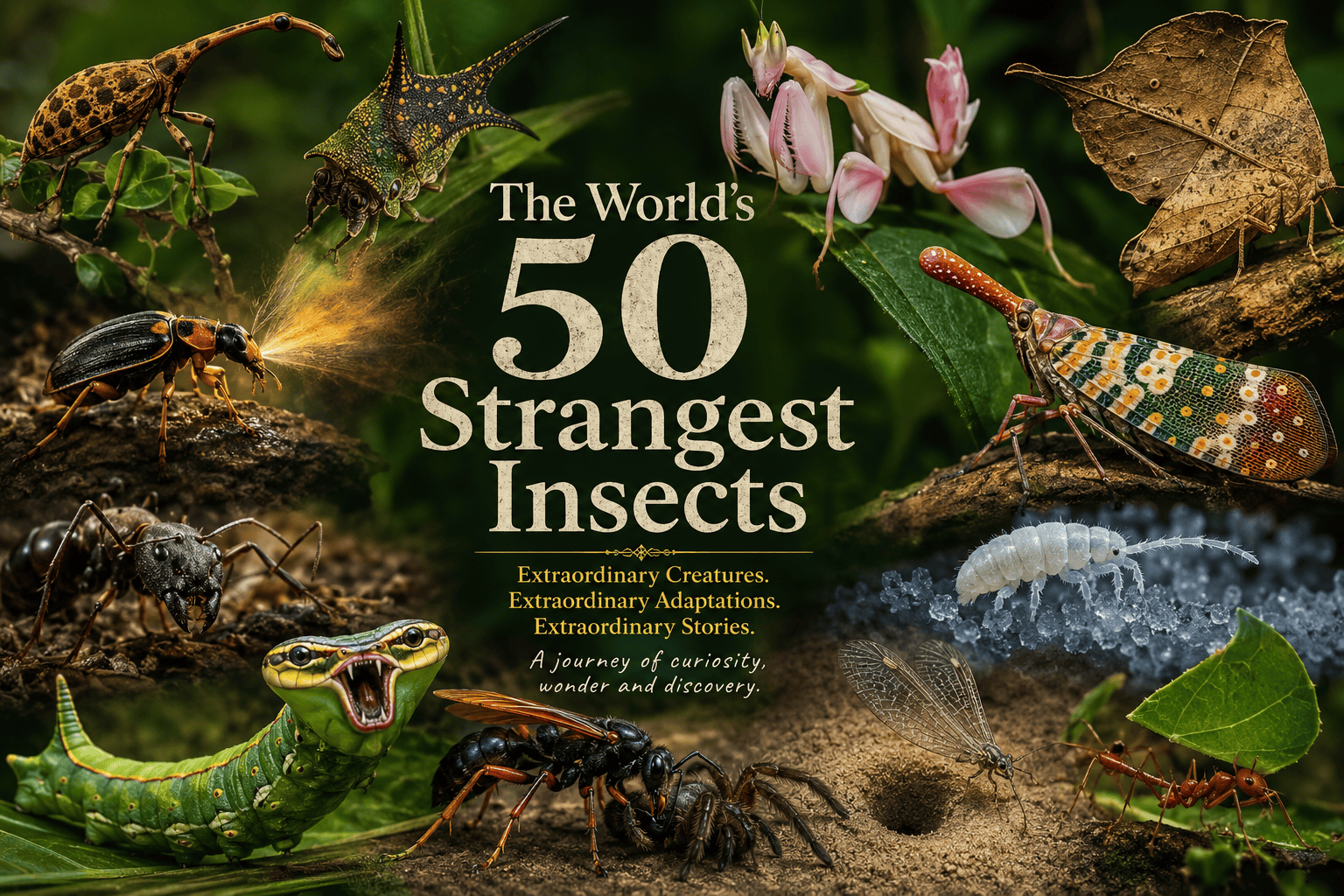
| Episode 2 — Defence by Extraordinary Means |
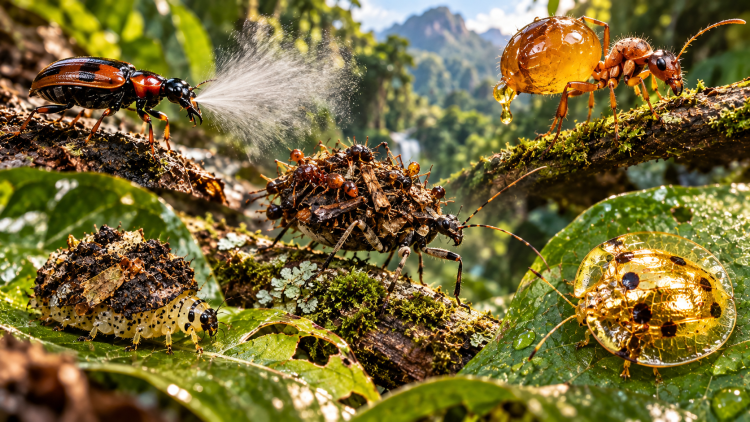
| Being a small animal in a world full of hungry mouths has disadvantages. Birds, amphibians, reptiles, spiders, and countless other creatures depend on insects for food, and the insects themselves are often just as eager to eat one another. Much of the natural world seems to operate on the understanding that anything small enough to swallow is worth investigating. Yet insects have been dealing with predators for hundreds of millions of years, and they have developed an extraordinary collection of ways to avoid becoming somebody else’s dinner. Some rely on speed or camouflage, others on unpleasant tastes, hard outer coverings or chemical substances that make a predator reconsider its choice of meal. Having spent much of my life looking at insects, from childhood collections in Australia to the creatures I encounter whilst gardening today, I am still surprised by the ingenuity of some of these arrangements. A small beetle running across the ground may carry a remarkably sophisticated chemical defence, while an apparently defenceless larva might hide beneath a protective covering made from its own waste. Our first episode explored insects whose appearance can deceive other animals. This time we look at five whose methods of defence are more direct, although appearances still play an important role. 6. The bombardier beetle — Brachinus and relatives The bombardier beetle is one of those insects whose reputation sounds suspiciously exaggerated until you investigate the science behind it. A small ground beetle that can produce a hot chemical spray and direct it toward an attacker seems almost too elaborate to be believable, yet the essential mechanism is well established. Bombardier beetles occur in several related groups, including the genus Brachinus. Many are relatively unremarkable in appearance, with reddish heads and thoraxes contrasting with darker wing cases. They spend much of their time amongst stones, vegetation and leaf litter, hunting small invertebrates. Nothing about their appearance immediately suggests the chemistry taking place inside their abdomens. Their defensive system involves specialised glands and a reaction chamber near the rear of the body. They store hydroquinones and hydrogen peroxide in a reservoir and, when needed, release them into a chamber containing enzymes that rapidly promote a chemical reaction. Heat and pressure build, producing a hot, irritating spray containing benzoquinones, which the beetle expels through an opening near the abdominal tip. The temperature within the reaction chamber can approach the boiling point of water. In some bombardier beetles, the discharge is released as a remarkably rapid series of pulses rather than one continuous stream. The beetle can also direct its abdomen towards a threat, allowing the spray to reach an attacker approaching from different directions. What interests me is not simply the chemical reaction, impressive though it is, but the control involved. The beetle must store the substances, regulate their release and contain the reaction without damaging itself. The chamber’s specialised structure and associated valves allow the defensive spray to be produced on demand rather than continuously. The question remains whether such a defence would be effective against a determined predator. Experiments have shown that bombardier beetles can survive being swallowed by certain amphibians, which then regurgitate them after the beetles release their chemical spray. It is an extraordinary outcome for an insect that might otherwise have disappeared without much ceremony. We sometimes describe the arrangement as a miniature chemical weapon, although that comparison can distract from what is actually happening. The beetle has not invented anything in the human sense. Its defensive system results from evolutionary changes that have produced an effective way to discourage predators. And, as any gardener who has encountered the unpleasant secretions of certain insects will appreciate, a predator doesn’t necessarily need to be seriously injured to decide that a particular meal is best avoided. 7. The exploding ant — Colobopsis explodens Ants have fascinated me since childhood. In Australia I remember bull ants particularly well, and I used to keep ant farms and other small insect collections under my bed. I wanted to see what they did, how they moved and how their colonies operated. I doubt the arrangement would have impressed everybody, but it kept me occupied. The exploding ants of Southeast Asia take social insect defence in a direction I certainly wouldn’t have anticipated as a boy. Colobopsis explodens, formally described in 2018, belongs to a group of ants whose workers can rupture their own bodies during certain defensive encounters. Scientists have known about the behaviour for many years, but the taxonomy of these unusual ants has proved complicated, with several related species displaying similar characteristics. Despite the popular name, these ants do not explode through combustion or anything resembling a conventional blast. Their defence involves autothysis, a process in which the worker deliberately ruptures its abdominal wall, releasing sticky, irritating secretions from enlarged glands. The released material can adhere to an opponent, potentially immobilising or discouraging it. The worker dies, making this one of the most costly defensive responses imaginable for an individual insect. Why should such a behaviour evolve? The answer lies partly in the difference between a solitary animal and an insect living in a colony. Ant workers are closely involved in protecting relatives and maintaining the resources the colony depends on. Under certain circumstances, the loss of one worker may be outweighed, in evolutionary terms, by the benefits provided to surviving relatives. That doesn’t mean the ant consciously decides to sacrifice itself for the greater good. We should be cautious about attributing human motives to behaviour shaped by natural selection. What looks like extraordinary bravery to us is a specialised response operating within the biology of a social insect. The tropical forests these ants live in feature intense competition between colonies and species. Food sources, nesting sites and territories are valuable, and encounters between ants can become surprisingly aggressive. A sticky defensive secretion may be particularly useful when confronting another insect up close. I find it intriguing that these ants belong to the wider Southeast Asian region where I spent part of my childhood. I remember insects everywhere in Malaysia, from the gardens around our home to the monsoon drains and tropical growth beyond. I cannot claim to have encountered Colobopsis explodens. Still, it’s wonderful to think how much remarkable behaviour was taking place around us without my knowing anything about it. Some discoveries have to wait until we’re older. 8. The corpse-carrying assassin bug — Acanthaspis petax An insect that carries the remains of its victims on its back sounds like something from an especially imaginative natural-history story. Yet the behaviour occurs amongst certain assassin bugs, including Acanthaspis petax, a predatory species associated with Africa. Assassin bugs belong to the family Reduviidae and have piercing mouthparts they use to feed on other insects. They inject saliva into their prey and consume the liquefied tissues. Their hunting methods vary considerably, but early-stage Acanthaspis petax have developed an additional habit that makes them particularly distinctive. After feeding, the nymphs may retain the emptied remains of ants and other insects, attaching them to their backs. Over time, these accumulate into a covering that can considerably alter the insect’s outline. The result looks like a rather untidy collection of dead insects travelling through the vegetation. It is tempting to assume that this covering is simply camouflage, but the interesting question is what sort of camouflage it provides. An assassin bug carrying a collection of ant remains may actually be more conspicuous than one without them. The covering makes the insect larger and changes its silhouette, so it cannot necessarily blend into the background. However, being visible and being recognised as something worth eating are not the same thing. Research on corpse-carrying assassin bugs has examined whether such coverings can protect the insects from predators, including jumping spiders. These spiders have excellent vision, and the appearance of potential prey can influence their responses. The remains the assassin bug carries may interfere with recognition or make the insect resemble a collection of ants rather than a solitary, edible target. We encountered a related principle in the first episode with dead-leaf butterflies. The butterfly may be seen but mistaken for an inedible object. The assassin bug presents a different problem to the predator: what exactly is it looking at? The irregular covering may also offer advantages, although the effectiveness of such defences depends on the predator involved. We should not assume that every attacker responds in the same way or that carrying insect remains provides universal protection. What appeals to me about this particular adaptation is its economy. The assassin bug uses the remains of animals it has already eaten, turning the consequences of feeding into something that may help protect it from becoming prey. The insect is both hunter and potential victim, and its unusual covering connects those two parts of its life. Nature can be remarkably resourceful with materials that would otherwise be discarded. 9. Tortoise beetles — Cassidinae Tortoise beetles are members of the leaf beetle family Chrysomelidae, and many possess the broad, rounded shape that gives them their common name. Their hardened wing cases and expanded body margins can form a shield-like covering, concealing much of the softer body beneath. Seen from above, some resemble tiny polished shields resting against the surface of a leaf. The resemblance to a tortoise is understandable, although the structures involved are quite different. A beetle has an external skeleton, whereas a tortoise’s shell is part of a vertebrate body plan. For an insect feeding on leaves, a low, flattened shape can make it harder for predators to grasp. The expanded margins provide some protection, particularly when the beetle presses itself against a plant surface. But some of the most interesting defences in this group belong to the larvae. Many tortoise beetle larvae have a specialised structure at the rear of the body that lets them carry material above themselves. This covering, commonly called a faecal shield, can contain their own waste together with shed skins accumulated during development. It is not an especially attractive arrangement by human standards, but insect defences need not satisfy our sense of cleanliness. The larva can manipulate the shield, positioning it between itself and a potential attacker. Depending upon the species, the covering may be relatively compact or form a much larger structure above the body. Research shows that such shields can protect against certain predators, although their effectiveness varies considerably. The physical barrier is only part of the story. The material’s chemical properties may also matter, and some predators are more readily discouraged by these coverings than others. A shield that works well against one enemy may be less useful against another. I find the relationship between feeding and defence particularly interesting. The larva uses materials it already produces, including substances most animals leave behind. Waste becomes part of a protective structure, and the insect carries it as it moves across its host plant. Tortoise beetles also remind us how much is happening on the leaves we inspect while gardening. We tend to notice holes, discolouration and other signs of feeding, but the insects responsible may have complicated relationships with predators and parasitoids that are far less obvious. The next time you encounter a small beetle larva carrying what looks like an untidy collection of debris, it may be worth a closer look. The untidiness could be doing a useful job. 10. The golden tortoise beetle — Charidotella sexpunctata Our fifth insect is another tortoise beetle, but one whose adult appearance is sufficiently unusual to deserve its own place in the series. Charidotella sexpunctata occurs across parts of the Americas and is associated with plants in the bindweed family, including morning glories and sweet potatoes. It is a small insect, generally only a few millimetres long, yet adults can possess a striking metallic golden appearance. A living beetle in this condition can resemble a tiny polished ornament resting on a leaf. The reflective effect is not produced by actual gold or a simple coating of yellow pigment. It results from light interacting with specialised structures in the wing cases. What makes the species particularly interesting is that its appearance can change. When disturbed, or under certain physiological conditions, the brilliant golden colour may become duller, revealing reddish or brownish tones. The transformation can occur quickly enough to make the beetle appear quite different from the one observed moments earlier. The underlying science is intriguing, but we need to distinguish what is known for this species from what has been established in related beetles. Research on Charidotella egregia, another golden tortoise beetle, shows how changes in fluid within specialised layers of the wing cases can alter their optical properties. This provides a valuable explanation for the general phenomenon, but it would be misleading to claim that every detail of the same mechanism has been demonstrated in Charidotella sexpunctata. The biological purpose of the reflective appearance and colour change also deserves caution. Suggestions have included camouflage and effects on predator recognition, but the precise defensive advantages are not fully established. Sometimes the most interesting part of an insect’s story is the question we cannot yet answer confidently. The larvae of Charidotella sexpunctata bring us back to the previous section. Like many other tortoise beetles, they can carry protective coverings composed of waste and shed skins. The adult’s remarkable reflective surface and the larva’s faecal shield therefore represent very different features of the same life cycle. Neither makes the beetle invulnerable. Both demonstrate the variety of characteristics that can influence an insect’s chances of survival. And there is something rather satisfying about discovering that a tiny beetle, which might easily be overlooked on a garden plant, possesses optical properties complicated enough to interest scientists studying the behaviour of light. The gold catches our attention. The biology keeps it. The Business of Staying Alive Our five insects have approached survival in remarkably different ways. The bombardier beetle produces a hot chemical spray, the exploding ant sacrifices itself in defence, the assassin bug carries the remains of previous meals, and the tortoise beetles rely upon physical coverings and unusual surface properties. None of these arrangements guarantees survival. Defensive chemicals can be depleted, shields can be overcome, and a strategy effective against one predator may fail against another. Even the exploding ant’s extraordinary sacrifice is useful only when the benefits to its relatives outweigh the cost. Evolution does not produce perfect protection. It produces characteristics that have proved useful often enough, under particular conditions, to persist through generations. That is something worth remembering when we look at insects in the garden. The small creatures feeding amongst our plants are not simply pests, pollinators or occasional curiosities. They are animals navigating a complicated world in which finding food is only part of the challenge. Avoiding becoming food is equally important. The more closely we examine them, the more difficult it becomes to regard their behaviour as simple. And perhaps that is what I enjoy most about insects. An ordinary-looking beetle can possess extraordinary chemistry, while a small larva carrying its own waste may be demonstrating a defensive strategy refined over countless generations. There is always something else to discover. Next time, we turn towards insects that use light, illusion and deception. Some produce their own illumination, others exploit appearances, and one group has acquired a reputation for glowing that is rather less reliable than its name suggests. |
| Companion 1. Bombardier Beetle — Brachinus and relatives Defensive Spray of the Bombardier Beetle: A Biological Pulse Jet Science, 1990 · Original research A landmark study revealing how bombardier beetles release their chemical spray in extraordinarily rapid pulses. The experiment examined Stenaptinus insignis, a bombardier beetle relative of Brachinus. 2. Exploding Ant — Colobopsis explodens Colobopsis explodens: Species Description and Biological Observations ZooKeys, 2018 · Open-access original research The original scientific description of the species, documenting its anatomy, distribution and remarkable self-destructive defence. 3. Corpse-Carrying Assassin Bug — Acanthaspis petax Bugs with Backpacks Deter Vision-Guided Predation by Jumping Spiders Journal of Zoology, 2007 · Original experimental research Experiments demonstrating that jumping spiders were significantly less likely to attack assassin bugs carrying a protective covering of dead ants. The study investigated Acanthaspis petax itself. 4. Tortoise Beetles — Cassidinae Faecal Shield of the Tortoise Beetle as Chemically Mediated Defence Against Predators Journal of Tropical Ecology, 2005 · Original experimental research Field and laboratory experiments showing how the faecal shields of Plagiometriona larvae can discourage predators through chemical defence. 5. Golden Tortoise Beetle — Charidotella sexpunctata American Golden Tortoise Beetle Royal Entomological Society, Antenna, 2026 · Specialist natural-history article A detailed account of the beetle’s metallic appearance, changing colour, host plants and defensive adaptations. These sources have been selected for their scientific authority and direct relevance. Where research concerns a related species rather than the exact insect featured, that distinction is made clear. |
| Wander through the Article Directory and see where curiosity takes you next. |
| About our writing & imagery Most articles reflect our real gardening experience and reflection. Some use AI in drafting or research, but never for voice or authority. Featured images may show our photos, original AI-generated visuals, or, where stated, credited images shared by others. All content is shaped and edited by Earthly Comforts, expressing our own views. |

