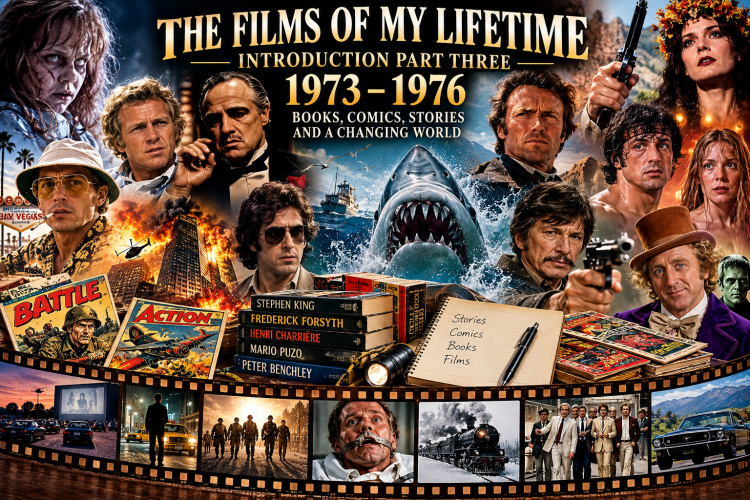
| Introduction Part Three Before Everything Changed: 1973–1976 |
| By 1973, I was ten years old, living in Australia, and already developing interests that would stay with me for much of my life. Films were certainly part of my childhood, but they weren’t yet the dedicated hobby they would eventually become. I watched relatively few while we lived in Australia, though I remember the occasional family visit to a drive-in cinema. Books, magazines and comics, on the other hand, were becoming increasingly important, and I was beginning to discover just how much pleasure I could find in collecting stories. My father was a great reader, and I followed suit. By twelve, I was reading books across different genres, collecting comics and enjoying writing stories of my own, particularly horror. I read British comics such as Battle and Action, alongside American pulp comics, Marvel and DC titles. I loved the stories and illustrations, and I was already cataloguing my collections. I knew I was a collector of some sort even before I knew it, if that makes sense. Reading was largely a solitary pleasure, and I was quite happy with that. I was a quiet geek, always looking for another story to enjoy. Books came from jumble sales, charity shops, second-hand bookshops and market stalls, where I could sometimes swap what I had finished for something new. I had many favourite authors, but I wasn’t especially selective about genres. Horror was a particular passion, yet I would read almost anything that caught my attention. I was hungry for words, and the habit of searching for books, reading them and moving on to the next discovery became firmly established before films began competing seriously for my attention. |
| 1973 — Stories on the Page and the Screen The films of 1973 illustrate particularly well how books and cinema eventually came together for me. The Exorcist is an obvious example. I read William Peter Blatty’s novel in 1984 but didn’t see the film until the late 1990s. I thought the adaptation followed the book remarkably closely, which is perhaps unsurprising given Blatty’s involvement in writing the screenplay and producing the film. It was genuinely terrifying, even when I eventually watched it, and remains one of the most frightening films I have seen. Papillon was another favourite, bringing together Steve McQueen and Dustin Hoffman, two actors I greatly admired. I had read Henri Charrière’s Papillon and Banco before watching the original film, and although I enjoyed the later remake, I still prefer the 1973 version. The Day of the Jackal followed a similar pattern. I read Frederick Forsyth’s novel when I was fourteen, in 1977, and saw the original film around 1980. It was excellent, and I also thoroughly enjoyed the later television adaptation starring Eddie Redmayne. These are good examples of stories that remained interesting to me across different formats and decades. Other films appealed for entirely different reasons. The Sting had a wonderful plot, excellent writing and a tremendous cast, while American Graffiti combined familiar actors, a fabulous soundtrack and an enjoyable sense of nostalgia. The Wicker Man was excellent but decidedly bizarre, with a memorable twist and some terrific performances. Enter the Dragon, which I watched on video during the 1990s, introduced another dimension through Bruce Lee and the way the film brought martial arts into mainstream international cinema. One film from 1973 has a much more immediate childhood connection. I remember seeing Live and Let Die at a drive-in cinema in Australia with my parents towards the end of that year. My father enjoyed James Bond, whereas I could generally take the films or leave them, although I particularly enjoyed Roger Moore’s interpretation and, much later, Daniel Craig’s. The drive-in itself is part of the memory, a reminder that the films we associate with a particular year are not always the ones we encountered decades afterwards. 1974 — Horror, Humour and Disaster The following year brought another extraordinary mixture. The Godfather Part II was part of the trilogy I eventually watched on video during the 1990s, and I thought the films were terrific, particularly for their outstanding casts. I had also read Mario Puzo’s The Godfather and The Sicilian during the 1980s, alongside other Mafia-related crime fiction, so the literary connections were already there. Chinatown was another excellent film, with Jack Nicholson and Faye Dunaway giving wonderful performances in a story that captured the atmosphere of classic noir cinema. Horror was becoming increasingly prominent among the films that interested me. I first saw The Texas Chain Saw Massacre on video as a teenager, and its reputation for controversy was almost as memorable as the film itself. Tobe Hooper’s production was disturbing, and that final chainsaw sequence is difficult to forget. It belonged to a developing style of horror that would become enormously influential, and it appealed to the darker side of my taste in stories. At the other extreme were Mel Brooks’s Blazing Saddles and Young Frankenstein, both wonderfully funny films with excellent casts. I watched them much later, but they remain good examples of comedy that I thoroughly enjoyed. Murder on the Orient Express brought Agatha Christie into the picture and helped establish my affection for Hercule Poirot, while Death Wish introduced another memorable Charles Bronson role. I eventually watched the Death Wish films together on video during the late 1990s, enjoying both Bronson’s performances and the supporting actors who appeared throughout the series. Then there was The Towering Inferno, one of the decade’s great disaster films. I had read the novels associated with its development, and the film brought together an extraordinary cast, including Paul Newman, Steve McQueen, Faye Dunaway, William Holden, Fred Astaire and Richard Chamberlain. I had already enjoyed The Poseidon Adventure, and this was another example of a genre that would remain a favourite. Watching so many familiar performers face an enormous catastrophe was irresistible, especially when the story kept you guessing about who would survive. 1975 — The Film That Stayed Of all the films released during these early years, Jaws occupies a place entirely its own. I have watched countless films since, but this remains my all-time favourite, and I have returned to it every year since 1981. I have watched it on video, DVD and television, and it has never really lost its appeal. I have always been fascinated by sharks, enjoyed the Hookjaw stories in comics, and admired Peter Benchley’s writing, so the subject already interested me enormously. My first viewing, however, was memorable for reasons that had very little to do with the film itself. In January 1977, my family was travelling by ship from Australia back to Britain, and I watched Jaws with my father. A lady with an exceptionally tall hairstyle was sitting directly in front of me. When Ben Gardner’s severed head suddenly appeared through the damaged boat, she jumped so violently that I missed the moment altogether. Of all the things to remember from a first viewing of Jaws, that is the one that has stayed with me. Fortunately, I have had plenty of opportunities to see the scene since. What makes Jaws different from so many other films is its extraordinary ability to entertain me again and again. I know the story, the performances, the dialogue and what is coming next, yet I still enjoy watching it. Some films can be excellent without inspiring a second viewing, while others somehow remain enjoyable no matter how familiar they become. Jaws belongs firmly in the second category, and I have never found another shark film that surpasses it. Plenty of other excellent productions came out in 1975. One Flew Over the Cuckoo’s Nest, adapted from Ken Kesey’s novel, was a disturbing but brilliant film, with Jack Nicholson giving one of his finest performances. The Rocky Horror Picture Show was wonderfully entertaining. At the same time, Dog Day Afternoon was an impressive, uncomfortable crime drama with a tremendous cast, even if it was never a particular favourite of mine. The Stepford Wives was another memorable slow-burning horror story, demonstrating that science fiction could sometimes appeal to me when it crossed into psychological horror. The Man Who Would Be King was a terrific adventure, bringing Michael Caine and Sean Connery together with Christopher Plummer. In contrast, The Return of the Pink Panther brought Peter Sellers back as Inspector Clouseau. Sellers was one of those performers who could make a film worth watching almost on his own. Of the original eight films we selected from 1975, The Day of the Locust is the only one I haven’t seen, which is a useful reminder that even after decades of watching cinema, there are still plenty of gaps. 1976 — Approaching a Turning Point The final year of this introduction brings us closer to the point when watching films became a much more deliberate interest. Taxi Driver was a remarkable production, dark, brutal and disturbing, with Robert De Niro giving an extraordinary performance under Martin Scorsese’s direction. It is a film that can leave an impression without necessarily being comfortable entertainment. All the President’s Men was another brilliant film, bringing Dustin Hoffman and Robert Redford together in the story of the Watergate investigation. I had also enjoyed the book by Bob Woodward and Carl Bernstein, so once again the written and filmed versions of a story became connected in my memory. Marathon Man offered another excellent Dustin Hoffman performance, this time in a tense thriller. At the same time, The Outlaw Josey Wales brought Clint Eastwood back into the Western genre I enjoyed so much. The Omen, with Gregory Peck and Lee Remick, was a superb supernatural horror film, and I went on to watch the series and read the associated books. Carrie, adapted from Stephen King’s novel, was another deeply unsettling horror story that I eventually encountered on video. Not every film appealed. I watched the first four Rocky films on video and DVD but found them relatively boring, despite their popularity, and never felt particularly inclined to continue with the series. The 1976 remake of King Kong was another film that didn’t impress me especially. I much preferred the original 1933 production, which again shows that newer versions don’t necessarily improve on their predecessors. Looking across these four years, the connections are becoming increasingly obvious. Horror, thrillers, gritty Westerns, disaster films and memorable actors appear repeatedly, while books continue to provide another way into the stories. I could admire a film without particularly enjoying it, dislike a popular production and return to a favourite year after year. A film’s reputation mattered far less to me than whether it actually entertained or interested me. Before the Films Took Over These early years helped me understand that I was a collector long before I became a dedicated film enthusiast. I collected comics, books, magazines and stories, and I catalogued my collections from a young age. I loved writing horror stories, following favourite authors, and discovering books in the most unlikely places. Reading was largely a solitary pleasure, but I never regarded it as a chore. I loved it. By the time we returned to England in January 1977, I was reading perhaps five to eight paperbacks a month. During my fourteenth year, that appetite increased considerably, sometimes reaching thirty or forty. I was a bit of a quiet geek, perfectly happy with my books and comics, and the films were gradually becoming another source of stories, performances, memorable lines and information to collect. I don’t think films replaced reading. They became another part of the same curiosity, giving me faces, voices and moving images to accompany the characters and stories I had already discovered on the page. Sometimes I read the book first, sometimes I watched the film first, and occasionally one led me back to the other. The pleasure was in discovering something interesting and then finding out what else was connected to it. And so we arrive at 1977, the year I turned fourteen, returned to Britain and began watching films with a much greater sense of purpose. The first fourteen years of my life had already provided an extraordinary collection of cinema, much of which I would only discover later. But my reading, writing, and collecting habits were firmly established, and my appetite for stories showed no sign of diminishing. I had been hungry for words for years. Now I was becoming increasingly hungry for pictures, too. |
| Next: The Films of My Lifetime — 1977 |
| About our writing & imagery Most articles are grounded in our real gardening experience, observations and reflections. AI may assist with research, drafting and editing, but the experiences, opinions and editorial direction are our own. Featured images may include our photography, original AI-generated visuals or, where stated, images credited to others. All published content is reviewed and shaped by Earthly Comforts before publication. |


Oh Rory, you’ve sent me on a wonderful trip down memory lane with this post! 😂❤️
While you were enjoying your British comics, we had our Afrikaans photo comic books, like Die Ruiter in Swart, Beau die Ontembare and Tanya. Quite a few of us collected those little books and exchanged them with one another. We even had our own little library corner dedicated to them! Those were such fun times, and you’ve brought back some lovely memories.
As for the movies, goodness, so many of yours were favourites of mine too! I absolutely loved Roger Moore as James Bond, and of course Bruce Lee. Murder on the Orient Express remains one of my favourites, and I still enjoy a good mystery. I’m also partial to supernatural horror, sci-fi, comedy and, more recently, Korean dramas. 😂
I’m not particularly fond of the blood-and-gore variety of horror, but give me a spooky supernatural story with a good mystery and I’m happy! And Freddy Krueger from A Nightmare on Elm Street was an exception, of course! 🤣
It’s lovely how certain books and films can take us straight back to another time in our lives. Thank you for sharing these memories, Rory. Your post has certainly given me a few happy ones of my own to revisit! ❤️
LikeLike