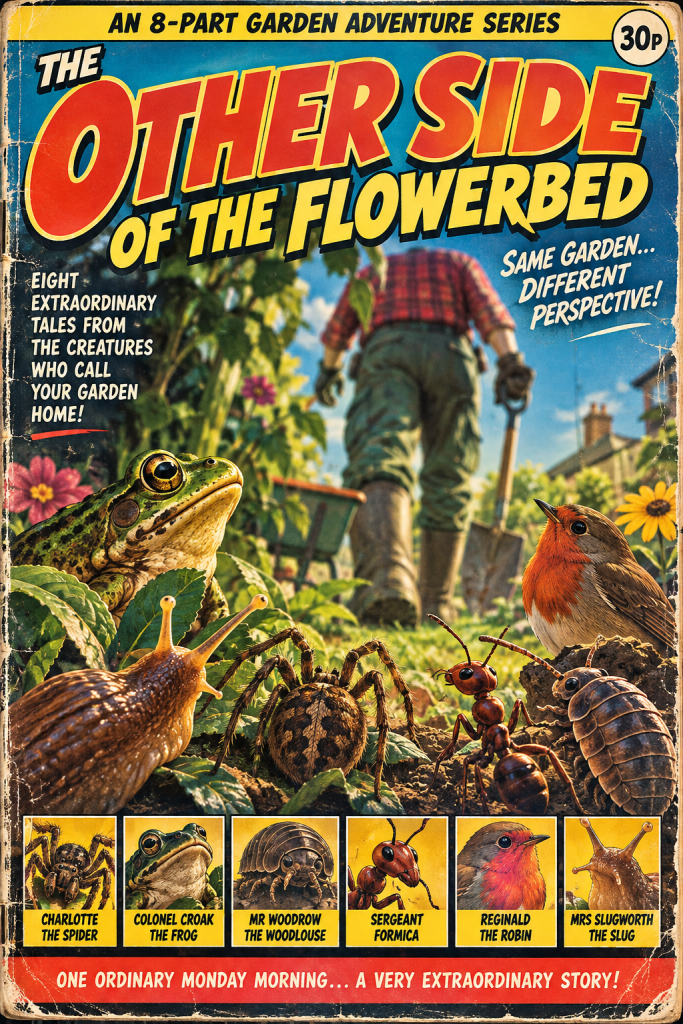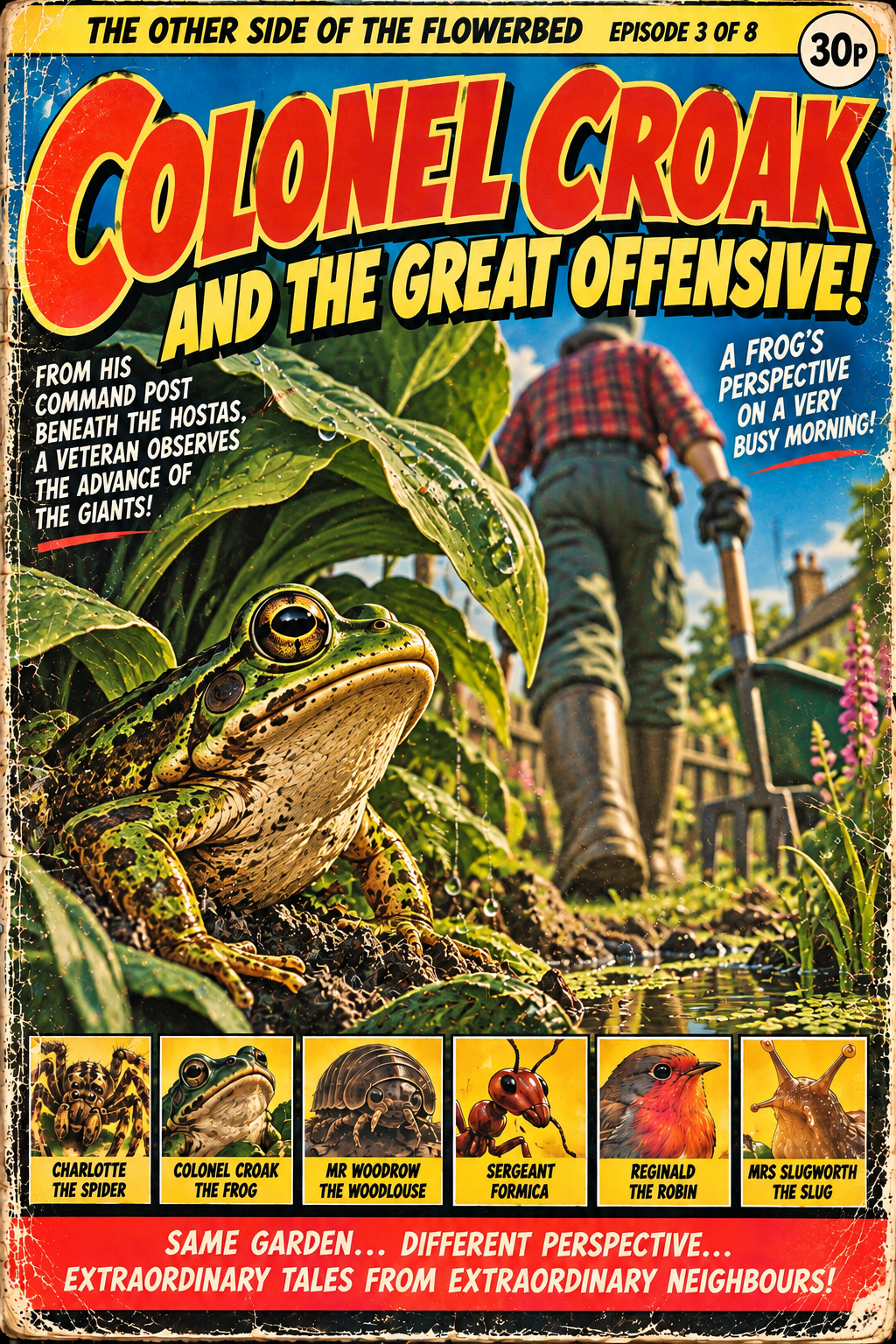
| Episode 3 Colonel Croak and the Great Offensive! |
| Colonel Croak had always maintained that complacency was the greatest danger facing the garden’s inhabitants. Predators could be avoided, unfavourable weather endured, and even the occasional territorial disagreement could be resolved through a combination of intimidation and strategic withdrawal. Complacency, however, was another matter entirely. It encouraged otherwise sensible creatures to abandon their natural caution, underestimate potential threats and behave as though the world beyond their immediate shelter existed solely for their convenience. The Colonel had witnessed enough disturbances during his many seasons beneath the hostas to know that such attitudes invariably ended badly, particularly when the enormous two-legged creatures returned to interfere with the landscape. Every seven days, with a regularity that he considered both suspicious and deeply provocative, the Giant appeared at the garden gate. Sometimes it arrived carrying long-handled implements, sometimes it brought containers and unfamiliar equipment, and occasionally it unleashed a dreadful mechanical contraption that roared across the lawn and removed the tops of perfectly respectable grass stems. Whatever the nature of its visit, the result was invariably the same: vegetation was disturbed, familiar landmarks disappeared, and the entire community was forced to reconsider arrangements that had been functioning perfectly well before its arrival. The Colonel had devoted considerable time to studying these incursions. From his headquarters beneath a particularly substantial hosta, he had observed the Giant’s movements, identified its preferred routes and developed a comprehensive understanding of what he regarded as its principal weapons. The long-handled fork was classified as a ground-penetrating implement of exceptional danger, while the spade was considered capable of inflicting catastrophic structural damage. The secateurs, although smaller, could sever vegetation without warning, and the lawnmower was regarded as a mobile instrument of destruction best avoided under all circumstances. His fellow residents were less impressed by these observations than he believed they ought to be. Charlotte considered his military terminology unnecessarily dramatic, Mr Woodrow preferred to discuss matters through properly constituted committees, and Sergeant Formica maintained that the ant colony already possessed an entirely satisfactory command structure. Reginald the robin was worse than all of them, openly welcoming the Giant’s arrival and behaving as though the appearance of a creature carrying enormous metal implements was something to celebrate. The Colonel found this attitude almost impossible to comprehend. On the morning in question, the Giant had already entered the garden and begun attending to the borders. The Colonel watched its arrival with growing concern, issuing several warnings to passing insects and trying to persuade a nearby beetle that the situation warranted immediate evacuation. The beetle listened politely, then continued toward a promising patch of decaying vegetation, leaving the Colonel to conclude that standards of civil defence had deteriorated considerably since his younger days. Now, from the comparative security of his hosta, he observed the Giant moving steadily along the flowerbed. The creature appeared to be removing unwanted plants, occasionally pausing to examine the soil before placing the offending vegetation into a large green container. To the human, this was straightforward garden maintenance. To Colonel Croak, it was a systematic clearance operation designed to eliminate cover and expose the garden’s inhabitants to attack. “Textbook manoeuvre,” he muttered, watching another weed disappear. “Remove the outer defences, open the ground, force the occupants into the open. I’ve seen it all before.” He had, in fact, seen precisely this activity the previous Monday, although he preferred not to dwell upon the observation that everybody had survived it. The Colonel’s headquarters occupied a particularly desirable position beneath a broad hosta leaf, close enough to the damp soil to remain comfortable while offering several concealed routes towards the rear of the border. A shallow depression beneath the plant provided excellent daytime shelter, and the surrounding vegetation attracted a satisfactory supply of small invertebrates. By frog standards, it was an exceptionally pleasant residence, although the Colonel insisted on calling it Forward Command Post Croak. He had identified three principal escape routes. The first led towards the compost heap, where the loose organic material provided numerous hiding places. The second passed behind a cluster of hardy geraniums and eventually reached the pond, which he regarded as the ultimate defensive position. The third was a narrow passage between two stones, suitable only for emergencies and creatures about his size. Unfortunately, the Giant was now approaching the entrance to the second route. The Colonel watched as an enormous boot descended beside the geraniums, followed by the unmistakable scraping sound of a hand fork entering the soil. Several small plants were removed, and a quantity of loose earth was disturbed. A startled ground beetle emerged from beneath a clod and hurried away, apparently deciding that whatever business it had been conducting could be resumed elsewhere. “Enemy advancing on the eastern corridor,” the Colonel announced to nobody in particular. “Defensive position compromised. Reinforcements required.” A passing woodlouse paused beside the hosta. “Are you talking to me?” “Naturally. You’re the only one here.” “What reinforcements?” The Colonel found the question disappointing. He explained that a coordinated defensive response required cooperation from all available inhabitants, especially those who could operate under cover. The woodlouse listened with growing uncertainty, then noted that it was mainly interested in finding somewhere damp and had no desire to get involved in a military campaign. “Typical,” the Colonel muttered as the woodlouse departed. “No sense of duty whatsoever.” A few moments later, Sergeant Formica appeared along a narrow ant pathway that passed close to the hosta. He supervised a small group of workers transporting plant fragments toward the colony, and the Colonel immediately saw an opportunity to secure assistance from an organisation that at least understood the importance of discipline. “Sergeant!” he called. “I require a situation report.” Formica stopped and looked up at the enormous amphibian looming above him. He had encountered the Colonel on several previous occasions. He regarded him as a well-meaning but excessively excitable neighbour whose enthusiasm for military terminology was matched only by his complete lack of practical understanding of ant logistics. “Situation report concerning what, Colonel?” “The Giant. Its movements. Its intentions. Its probable line of advance.” Formica glanced toward the gardener, who knelt beside the border, pulling a persistent weed. “Large creature. Moving plants. Disturbing soil. Same as last time.” “Precisely! A sustained offensive. I propose we establish a joint command structure.” The Sergeant’s antennae twitched. He had no intention of placing his carefully organised colony under the direction of a frog whose principal tactical achievement appeared to be remaining motionless beneath a leaf. “With respect, Colonel, our workers are occupied with essential transport operations. We have supplies to move, routes to maintain and a recruitment problem involving Private Derek. We cannot spare personnel for an imaginary war.” “Imaginary?” the Colonel repeated indignantly. “An enormous enemy is advancing through the border!” “Yes,” replied Formica. “And he’ll eventually leave, just as he always does.” The Colonel regarded this response as a particularly dangerous example of complacency. Before he could formulate a suitable reply, the Sergeant had resumed his duties, leaving the frog to contemplate the extraordinary difficulty of organising a defence when nobody seemed prepared to acknowledge the existence of an enemy. A familiar cheerful voice from above interrupted his thoughts. “Morning, Colonel! Lovely weather for it.” Reginald had landed upon a low branch overlooking the disturbed soil. He seemed in excellent spirits, having already enjoyed a small worm exposed by the gardener’s work, and was now watching the Giant with undisguised anticipation. “Lovely weather for what?” demanded the Colonel. “For gardening, of course. He’s doing a splendid job.” The Colonel stared at him. “A splendid job? He’s removing our cover, disturbing our homes and advancing towards my headquarters with a weapon!” Reginald tilted his head thoughtfully. “Well, I suppose that’s one way of looking at it. Personally, I think he’s improving the place. You should have seen the worms under that last clod.” The Colonel drew himself up as far as his squat amphibian proportions allowed. He had never understood how a creature so apparently intelligent could display such extraordinary disregard for the welfare of its neighbours. Reginald’s enthusiasm for the Giant, in the Colonel’s opinion, bordered on treachery, although the robin seemed entirely unconcerned by the accusation. “You’ll regret your collaboration when he turns that fork upon you,” the Colonel warned. Reginald considered this possibility before replying that he was reasonably confident he could fly away, an observation that brought the conversation to an abrupt, unsatisfactory close. The Giant, meanwhile, had reached the hostas. He stood beside the plants for a moment, examining several older leaves that had begun to yellow and collapse towards the ground. Some were damaged, others were reaching the end of their useful life, and a little tidying would improve the border’s appearance. He collected his secateurs and crouched down. Colonel Croak watched the enormous figure descend towards him. For one dreadful moment, the entire world seemed to consist of red-checked fabric, enormous gloved hands, and a pair of metal jaws moving through the foliage above his head. The familiar shelter of his headquarters trembled as the Giant lifted an outer leaf, and a shaft of daylight penetrated a corner that had remained comfortably shaded for weeks. The Colonel froze. Frogs can remain motionless when threatened, relying on camouflage and concealment to avoid attracting attention. Colonel Croak was particularly accomplished in this respect, although he preferred to describe the behaviour as tactical immobility rather than hiding. He flattened himself against the damp soil, lowered his head and waited while the enormous creature inspected the vegetation above him. “Steady,” he whispered. “Maintain position. Do not engage.” The Giant removed a damaged leaf several inches away. The stem was cut cleanly, and the leaf disappeared upwards into the enormous green container standing beside the border. A second leaf followed. Then a third. The Colonel’s carefully maintained defensive canopy was being dismantled before his eyes. He considered retreating towards the compost heap, but the route required crossing a narrow strip of exposed soil directly beneath the Giant’s arm. The pond offered better long-term security, although reaching it would involve passing through the geraniums where the gardener had already disturbed the ground. For perhaps the first time that morning, the Colonel found himself confronting a genuinely difficult tactical decision. Then the Giant lifted another leaf. Sunlight flooded the entrance to Forward Command Post Croak. The Colonel decided that the time for strategic contemplation had passed. With a sudden powerful movement of his hind legs, he launched himself from beneath the hosta and landed several feet away among the geraniums. The leap was entirely successful from a practical standpoint, although it lacked the dignity he generally associated with military manoeuvres. A second bound carried him behind a stone, where he remained perfectly still as he tried to recover his composure. The Giant had noticed the movement. “Oh, hello, mate,” he said, looking towards the frog. “Didn’t see you hiding there.” He paused, giving the little creature time to settle, then carefully moved his working position away from where the frog had landed. There was no reason to disturb it further, and plenty of other tasks remained. Colonel Croak, naturally, interpreted the encounter rather differently. He had escaped a direct assault upon his headquarters, evaded capture and successfully reached an alternative defensive position. The Giant’s immediate withdrawal was, in his opinion, evidence that the manoeuvre had achieved its intended purpose. “Ha!” he whispered triumphantly. “That showed him.” A small beetle sheltering beneath the same stone regarded him with interest. “What showed him?” “My counterattack. Forced him to abandon the position.” The beetle looked towards the Giant, who was now working several feet away. “Didn’t you just jump out of the way?” The Colonel fixed him with a cold stare. “A tactical withdrawal followed by successful enemy disengagement. There is a difference.” The beetle decided that arguing with an elderly frog was unlikely to improve its morning and returned to its own affairs. From his new position, the Colonel watched the Giant continue working. The creature moved steadily along the border, occasionally standing to stretch before kneeling again to remove another weed or tidy a plant. It appeared remarkably unconcerned by the confrontation, an attitude the Colonel attributed to the arrogance of an enemy that had not yet appreciated the seriousness of its defeat. The situation grew more complicated when Mrs Slugworth emerged from beneath a neighbouring hosta leaf and demanded to know why so much of her accommodation had suddenly disappeared. She had been resting peacefully after a substantial nocturnal meal and was thoroughly displeased to discover that several of the older leaves surrounding her shelter had been removed. “Some of us,” she announced indignantly, “are attempting to sleep.” The Colonel explained that the Giant had launched a direct assault upon the hosta district and that he had personally conducted a successful defensive operation. Mrs Slugworth listened without enthusiasm, inspected the remaining foliage and concluded that the principal consequence of the morning’s activities was an unacceptable reduction in available shade. “Well, I hope you’ve done something useful about it,” she replied. “I forced the enemy to withdraw.” “Did you put the leaves back?” “That is not how military operations work.” “Then I fail to see what you’ve accomplished.” She withdrew beneath the remaining vegetation, leaving the Colonel to reflect that civilian populations rarely appreciated the sacrifices made on their behalf. Some time later, Charlotte called down from her damaged web near the lavender. She had witnessed part of the incident and was curious to know whether the Colonel had survived his encounter with the Giant. He informed her that he had successfully repelled an incursion into the hosta sector and was currently overseeing the reorganisation of local defences. Charlotte examined the shortened hosta leaves, the disturbed soil and the enormous gardener continuing his work. “Repelled him, did you?” “Most effectively.” “Funny. He seems to be doing exactly what he came here to do.” The Colonel chose to ignore this observation. Charlotte was an accomplished builder, certainly, but she understood little of military strategy and had already shown an unfortunate tendency to question his professional judgement. As the morning advanced, the Giant gradually moved away from the hostas and towards another section of the garden. The Colonel waited until the vibrations had diminished, then cautiously returned to inspect his former headquarters. Several damaged leaves had been removed, and the entrance was now more exposed than before, but the deeper shelter beneath the remaining foliage was still intact. The soil retained its comfortable dampness, the surrounding vegetation still offered protection, and the route towards the pond remained accessible. The position was, he reluctantly admitted, still perfectly serviceable. He settled into the shallow depression and considered the morning’s events. The Giant had arrived, interfered with the garden and withdrawn from the immediate vicinity of his headquarters. The Colonel had identified the threat, maintained his composure under extreme pressure and executed a successful escape manoeuvre. By any reasonable military assessment, the operation had been a triumph. He decided to prepare a formal account for future generations. Unfortunately, no one was available to record it. Sergeant Formica was occupied with his transport network, Charlotte was rebuilding her web, and Mr Woodrow was reportedly attempting to convene a meeting concerning unauthorised alterations to the garden’s residential arrangements. Mrs Slugworth had returned to sleep, while Reginald remained enthusiastically engaged in exploiting the Giant’s soil disturbances. The Colonel sighed. Leadership, he reflected, was frequently a lonely responsibility. A little later, the Giant passed the hostas once more, carrying a container of weeds towards the gate. He glanced at the plants, appeared satisfied with their improved appearance and continued walking. Colonel Croak watched him from beneath the remaining leaves, noting that the creature had made no further attempt to approach his headquarters. “Thought better of it,” he murmured. Above him, Reginald landed upon a low branch and enquired whether the Colonel had enjoyed an exciting morning. “Exciting?” the frog repeated. “I’ve survived a direct assault, defended a strategic position and forced a superior enemy to withdraw. I should think that qualifies as considerably more than exciting.” Reginald looked towards the gardener, then back at the frog. “Was that when he moved the old leaves?” The Colonel’s expression hardened. “You wouldn’t understand.” “Probably not,” Reginald agreed cheerfully. “Still, he was very careful not to tread on you. Nice of him, really.” For a moment, the Colonel said nothing. The suggestion that the Giant might have deliberately avoided harming him was so contrary to his established understanding of the situation that he could scarcely entertain it. He had spent seasons regarding the creature as a relentless enemy, and the possibility that its activities were neither hostile nor particularly concerned with frogs presented an entirely unwelcome complication. “Nonsense,” he replied at last. “He was intimidated by my manoeuvre.” Reginald wisely decided not to pursue the matter. He had spotted movement in the freshly disturbed soil and was far more interested in securing another worm than in debating military history with an elderly amphibian. Colonel Croak watched him depart, then turned his attention to the garden gate. The Giant would eventually leave, as it always did, and the garden would gradually return to its customary routines. Charlotte would rebuild, the ants would reorganise their pathways, the woodlice would resume their meetings, and Mrs Slugworth would continue eating the hostas as though nothing had happened. But the Colonel knew better. He had seen the enemy’s methods, studied its movements and survived another encounter with its formidable equipment. There could be no doubt that further preparations were necessary, particularly now that the hosta sector had suffered a partial reduction in cover. He would require a revised defensive plan, improved communication between neighbouring residents and perhaps a new emergency escape route beneath the geraniums. The existing arrangements were adequate, but adequacy was no substitute for preparedness, and he had no intention of being caught unawares during the next incursion. After all, the Giant would return in seven days. The Colonel settled deeper into his shelter, closed his eyes and allowed himself a moment of satisfaction. “Another victory,” he murmured. From somewhere beneath the neighbouring flowerpot came the faint sound of Mr Woodrow calling an emergency meeting. The Colonel opened one eye. Perhaps, he thought, there was still time to organise a proper defence committee. |
| To be continued in Episode 4 — The Under-Pot Housing Crisis! |
| Wander through the Article Directory and see where curiosity takes you next. |
| Author’s Note The Other Side of the Flowerbed is an original work of humorous fiction. All characters, personalities, dialogue and events are fictional. Any similarity in character names to those appearing in existing literary works or other fictional creations is coincidental and does not imply any connection with, or endorsement by, their respective creators or rights holders. © 2026 Rory Matier. All rights reserved. |
| Story inspired by Sonel of The Creative Soul |