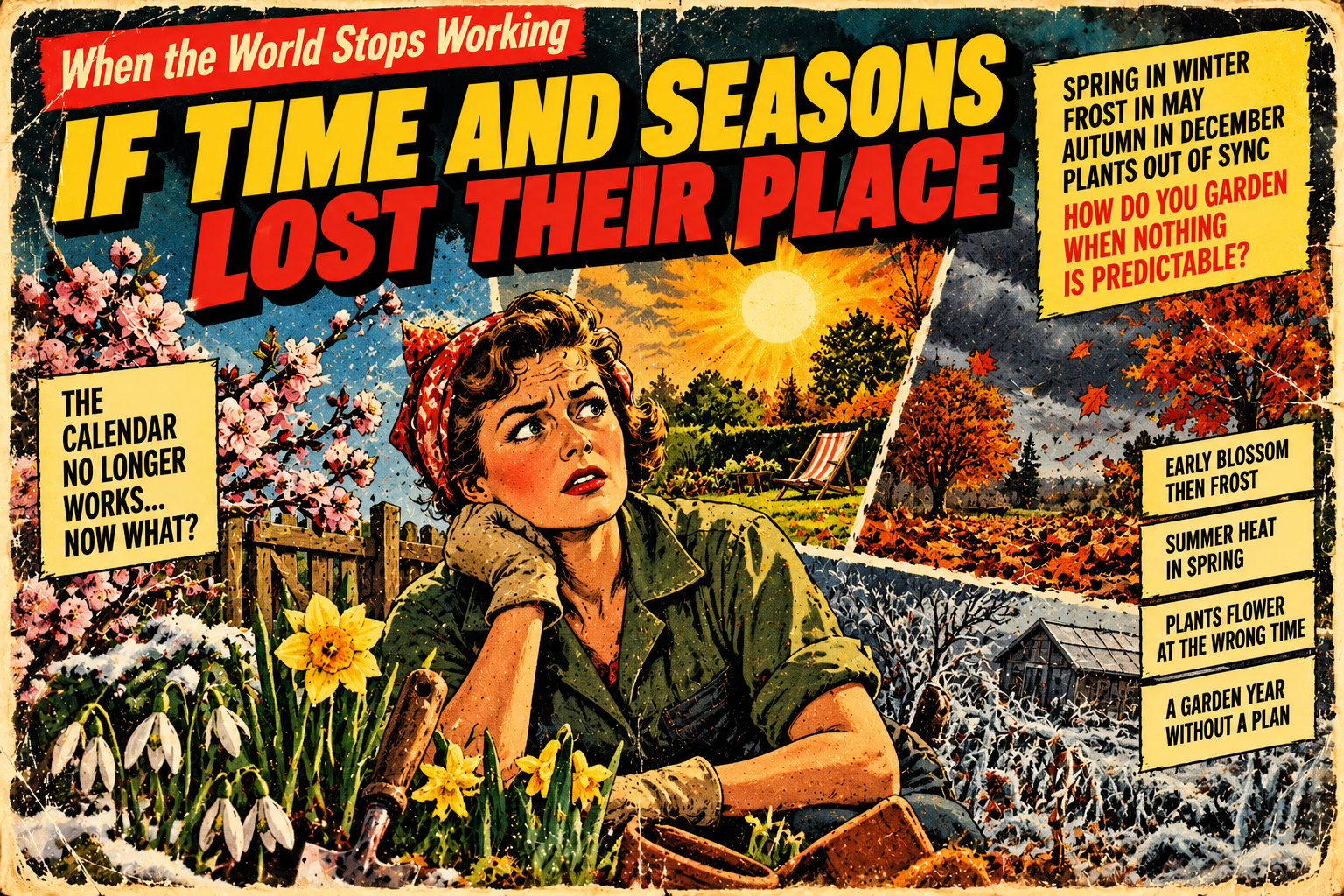
| Gardeners have always had an unusual relationship with time. We live by the ordinary calendar like everybody else, but underneath it sits another one that isn’t printed quite so neatly. There is the first proper grass cut, the first daffodil, the week when the hedges suddenly start moving, the moment the soil becomes workable, the arrival of blossom, the first frost and that unmistakable point in autumn when a garden begins shutting itself down. We might talk about March, June or October, but much of gardening really happens according to what the plants and weather are doing rather than the number printed at the top of the diary. The trouble is that we’ve become accustomed to those two calendars roughly agreeing. Spring arrives somewhere around spring. Summer generally behaves like summer. Leaves tend to fall in autumn and plants go dormant through winter. There are always exceptions, of course, and gardeners are probably among the least surprised people when the weather ignores the forecast. We’ve all experienced warm Februaries, wet Julys, late frosts and autumns that seem reluctant to end. But underneath those variations there has usually remained a broad seasonal structure upon which gardening depends. So what happens if that structure becomes unreliable? Imagine that the seasons don’t disappear completely. Britain doesn’t suddenly acquire a tropical climate, and winter isn’t abolished. Instead, the familiar sequence begins losing its shape. January contains ten days that feel like April, followed by a hard frost. March becomes colder than February. May produces two weeks of summer heat before June turns wet and cool. Autumn stretches almost into Christmas, plants continue growing when they would normally be slowing down, and then winter arrives abruptly rather than gradually. The following year the pattern is different again. At first, gardeners would probably do what gardeners always do: complain about the weather and carry on. A mild spell in February would be welcomed as an opportunity to get ahead. Lawns might receive an unexpectedly early cut, borders could be tidied, and a few jobs normally left until March might be brought forward. Garden centres would fill with customers, encouraged by sunshine into believing spring had arrived, and trays of young plants would begin appearing beside supermarket entrances because apparently three warm afternoons are all it takes to convince Britain that winter is over. Then the frost would return. That would be the first lesson. The problem wouldn’t necessarily be unusual weather itself; gardens already experience unusual weather. The problem would be false signals. Plants respond to temperature, day length, moisture and other environmental cues. If some of those begin arriving at the wrong time, growth can start when conditions aren’t yet reliably suitable. Buds open, shoots extend, and blossom appears, only for a sudden return of cold weather to damage vulnerable growth. Fruit growers would notice immediately. A fruit tree can tolerate winter cold perfectly well while dormant, but flowers are different. If mild conditions encouraged blossom earlier and frost subsequently returned, an entire year’s crop could be affected in a few nights. The tree itself survives perfectly happily; what disappears is the fruit we expected it to produce. A garden can therefore look healthy while something important has already gone wrong. Ornamental gardens would experience their own confusion. Bulbs might appear earlier, shrubs could flower at unfamiliar times, and herbaceous plants might begin emerging only to be checked repeatedly by cold spells. Some species would cope better than others, and after several years gardeners would begin noticing which plants could tolerate uncertainty rather than which could tolerate a particular temperature. Reliability would acquire a new meaning. Professional gardening would become increasingly awkward because so much of our work is seasonal even when we don’t explicitly describe it that way. There are jobs suited to winter, jobs that belong in spring, jobs we avoid while birds are nesting, pruning tasks associated with particular stages of plant growth and lawn work that depends upon temperature and moisture. We organise maintenance rounds partly around what gardens are likely to require at different points in the year. If those points started moving, the diary would become considerably less useful. You might arrive in February expecting winter work and discover that the lawn needs cutting. In April, when mowing should be routine, persistent rain might make the ground too wet to touch. A hedge expected to put on its strongest growth in May could begin weeks earlier, while another plant remains dormant because its own environmental triggers haven’t occurred. By September, some gardens might still be growing vigorously, leaving little opportunity for the quieter autumn period when we normally catch up on jobs postponed during summer. The gardening year wouldn’t necessarily become longer. It would become less predictable, and those are not the same thing. That unpredictability would affect nurseries and garden centres too. Horticulture relies upon timing. Plants need to be propagated, grown, transported and ready when customers want them. Retail demand itself follows the seasons: people buy bedding plants when they believe summer is approaching, spring bulbs in autumn and vegetable plants when they think it is safe to put them outside. If the weather repeatedly encouraged people to plant early and then punished them for doing so, the old retail calendar would begin losing credibility. Seed packets would start looking strangely confident. Sow March to May sounds straightforward when March to May broadly represents a progression from early to late spring. It becomes much less useful if March is warmer than May. Gardeners would increasingly ignore the month and start asking about soil temperature, recent weather and what was actually happening outside. Perhaps that would be one of the better consequences. For all our technology, gardeners have always relied upon observation. Long before weather apps, people watched plants, animals and conditions. They knew when certain trees came into leaf, when particular insects appeared and when soil could be worked without sticking to every tool. Local knowledge mattered because spring didn’t arrive in Cornwall on precisely the same morning it arrived in Scotland, and even gardens a short distance apart could behave differently depending upon altitude, shelter, aspect and soil. If the seasons became unreliable, that observational gardening would return with considerable force. Instead of saying, “We always do this in March,” we’d ask whether the conditions were right now. Before sowing, we’d check the soil rather than the calendar. Before pruning, we’d look at the plant. Before moving something, we’d consider moisture and temperature. The date would remain useful, but it would stop being an instruction. There would still be things we couldn’t simply adapt around. Wildlife depends upon seasonal relationships too, and those relationships can be remarkably precise. Plants flower at particular times, insects emerge, birds breed, and food becomes available. If one part of that sequence shifts faster than another, the consequences can travel through the ecosystem. A flower appearing unusually early isn’t particularly useful to a pollinator that hasn’t emerged yet, while an insect population peaking before young birds need it creates a different problem. Gardeners would start noticing these mismatches because gardens provide excellent places to observe them. Perhaps a familiar butterfly appears earlier than expected. Bees become active during a warm winter spell, then disappear when the cold returns. Birds begin investigating nesting sites while we are still mentally in winter. Plants we associate with particular months become less dependable markers of where we are in the year. That might be the strangest effect of all. Gardening isn’t simply work arranged around seasons; seasons shape how gardeners experience time. Snowdrops mean something because of when they appear. Daffodils aren’t merely yellow flowers; they announce something. Blossom carries the promise of spring, roses belong to early summer, fallen leaves smell of autumn, and bare branches tell us the garden has entered its quieter period. If those signals became scrambled, we’d lose more than a convenient maintenance schedule. We’d lose part of the rhythm. Vegetable gardening would probably become increasingly technical as growers tried to protect themselves from uncertainty. Cloches, fleece, cold frames, greenhouses, and polytunnels would become even more valuable because they let gardeners create small pockets of predictability inside an unpredictable climate. Successional sowing would become more important: rather than risking everything on one planting date, growers might sow smaller quantities at intervals so that a sudden weather reversal didn’t destroy the entire crop. Crop diversity would matter for the same reason. If you grow one variety of one crop and conditions happen to be wrong for it that year, you have very little resilience. Several varieties with different tolerances and maturation times spread the risk. The vegetable garden of the future might therefore look less efficient on paper but prove much more dependable in practice. Water storage would become part of the seasonal problem too. A wet winter doesn’t necessarily help if the water arrives months before plants need it and runs away. A dry spring followed by torrential summer rain isn’t the same as regular rainfall spread through the growing season. Gardeners would become increasingly interested not simply in how much rain fell during a year, but when it fell and whether the garden could retain any of it. This is where soil, once again, enters the story. Healthy ground that can accept water during heavy rain and retain some of it through dry periods becomes enormously valuable when weather patterns are erratic. Mulches help reduce evaporation. Organic matter helps improve many soils. Shade reduces stress. Planting suited to local conditions reduces the amount of intervention required. One by one, the scenarios we’ve explored in this series begin to overlap because gardens are interconnected systems. Gardening businesses would also face practical consequences. The traditional distinction between a busy growing season and quieter winter could weaken. If lawns continue growing into December, they still need cutting. If February becomes mild, clients begin calling earlier. If summer heat makes certain jobs impossible for several weeks, that work doesn’t disappear; it moves elsewhere in the calendar. The workload becomes less of a predictable curve and more of a series of peaks arriving whenever conditions allow. We’d probably have to become more flexible with clients. Instead of saying a particular job would be done in November because that’s when we always did it, we’d explain that we’d do it when the plant and conditions were ready. Some years that might still be November. Another year it could be considerably later. Gardening would become less about scheduling nature and more about watching for opportunities. There is an uncomfortable element to this particular What If? because, once again, we don’t have to travel very far into fiction to find parts of it. Gardeners already talk about seasons shifting, unusually early growth, prolonged autumns, late frosts and weather arriving in patterns that don’t quite match what they remember. Individual years have always varied enormously, so no single strange spring or warm autumn tells us very much by itself. What matters is what happens over longer periods and how plants, wildlife and gardeners respond. Perhaps the greatest mistake would be trying indefinitely to preserve an old calendar after the conditions that created it had changed. If spring no longer reliably behaved the way our gardening books expected, we’d have to stop treating the printed month as more authoritative than the garden outside the window. That might require us to recover something gardeners once possessed almost automatically: patience. Not passive patience, but observational patience. Wait until the soil is workable. Wait until the frost risk has genuinely reduced. Watch the buds. Watch the rainfall. Look at the forecast, certainly, but also look at the garden. Don’t sow something simply because it is the first Saturday in March and that is when you’ve always sown it. The seasons might lose their place, but gardening wouldn’t. We would have to find our place within them again. I can imagine John and me standing beside the van one February morning in shirtsleeves because the temperature had somehow reached seventeen degrees. The grass would be growing, daffodils would be open, and a bumblebee would be investigating something in flower. It would feel completely like spring. John would look across the garden. “Do you reckon winter’s finished?” I’d look at the forecast on my phone. Minus two on Thursday. “No.” We’d get the mower out anyway. Because whatever the calendar said, the bloody grass still needed cutting. |
| About our writing & imagery Most articles are grounded in our real gardening experience, observations and reflections. AI may assist with research, drafting and editing, but the experiences, opinions and editorial direction are our own. Featured images may include our photography, original AI-generated visuals or, where stated, images credited to others. All published content is reviewed and shaped by Earthly Comforts before publication. |

