
| Episode Two Giants and Heavyweights |
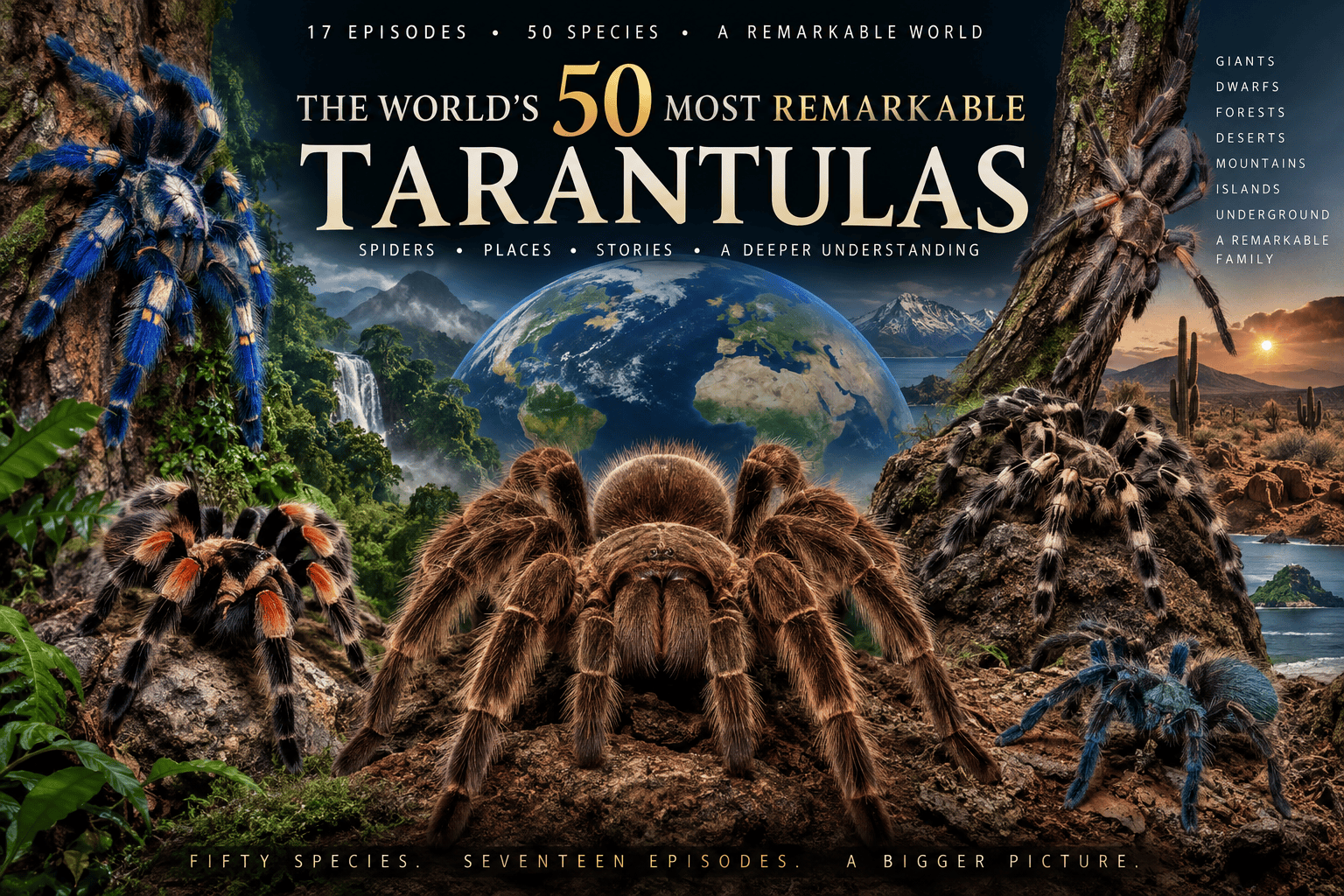
| Something about a very large spider captures the human imagination in a way few other invertebrates can. A butterfly may be admired for its colours, a beetle for its extraordinary armour and a mantis for its remarkable appearance. Still, a tarantula of truly substantial proportions tends to provoke a rather different reaction. Even people who have little interest in natural history can find themselves fascinated by the sheer scale of an animal that belongs to a group we generally associate with creatures small enough to disappear beneath a skirting board. In our opening episode, we met Theraphosa blondi, the Goliath birdeater, and discovered that its reputation as one of the world’s largest spiders concealed a much more interesting animal. For our second instalment, we stay with the heavyweights, but this time we explore three species whose stories show that enormous size isn’t necessarily the most remarkable thing about them. They come from different parts of South America, occupy different environments and demonstrate that even among the giants, evolution has produced considerable variety. Our journey begins with another member of the Goliath family, Theraphosa apophysis, before moving to Brazil and the imposing Lasiodora parahybana. Finally, we travel towards the forests of Peru and Bolivia to meet Pamphobeteus antinous, a spider whose dark appearance and flashes of metallic colour make it one of the more intriguing members of an already fascinating genus. |
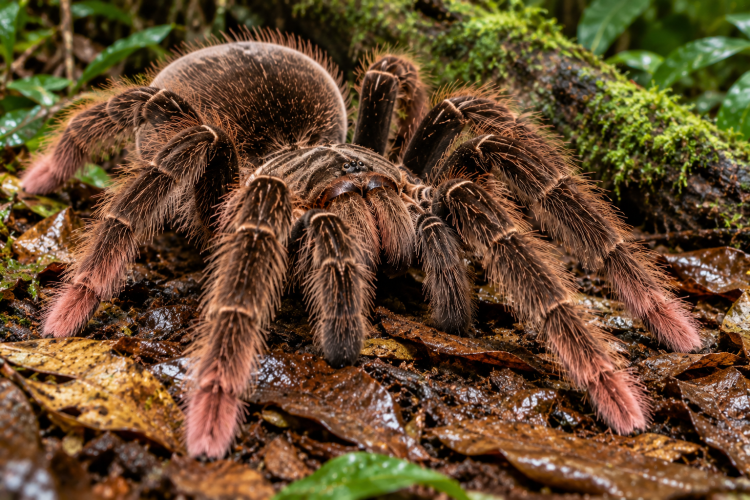
| The Pinkfoot Goliath Theraphosa apophysis Having introduced the Goliath birdeater in Episode One, it might seem a little excessive to return immediately to another member of the same genus. Yet Theraphosa apophysis offers an excellent opportunity to show something often overlooked when people discuss enormous tarantulas: two closely related species can share much of their general appearance while differing in important ways in anatomy, development, and evolutionary history. Scientists described the pinkfoot Goliath in 1991, long after its famous relative, Theraphosa blondi. Originally placed in the genus Pseudotheraphosa, researchers later transferred it to Theraphosa as they reassessed relationships among these enormous South American spiders. That change was not simply a matter of replacing one label with another. Scientific names reflect our understanding of evolutionary relationships, and revising them can reveal how apparently separate groups are connected. Its known distribution includes Venezuela, Colombia and Brazil, placing it within the northern South American landscapes where humid tropical forests support some of the world’s largest terrestrial spiders. The forest floor provides a complicated environment of decomposing vegetation, roots, fallen timber and sheltered spaces, all of which can offer opportunities for an animal that spends much of its existence close to the ground. Like its relatives, T. apophysis is strongly associated with terrestrial and burrowing habits, relying upon concealment and suitable retreats rather than the elaborate prey-catching webs constructed by many familiar spiders. The common name comes from a particularly attractive feature of younger animals. Juvenile pinkfoot Goliaths can display noticeably pinkish colouring towards the ends of their legs, producing a contrast with their darker bodies. As the animals mature through successive moults, that youthful appearance becomes less pronounced, and adults take on the more subdued brown colouring associated with the genus. It is a useful reminder that a tarantula’s appearance is not necessarily fixed throughout its life. A spider may change substantially between its earliest stages and maturity, sometimes making photographs of juveniles and adults appear almost like images of different species. In terms of overall size, T. apophysis belongs firmly among the giants. Adult females are heavily built and can reach leg spans of roughly 25 centimetres, although exceptionally large measurements should always be treated cautiously. As we established in Episode One, comparing spiders by leg span alone can be misleading because a long-legged animal is not necessarily heavier than one with a more compact build. The extraordinary proportions of Theraphosa are better appreciated through the combination of body mass, powerful limbs and the sheer physical presence of a mature specimen. One particularly interesting feature concerns the anatomical structures mature males use during mating. The scientific term apophysis refers to a projection or process, and mature males possess distinctive tibial structures that help distinguish the species. Such features may appear rather insignificant beside an enormous hairy body, but they are precisely the kinds of details taxonomists examine when separating closely related animals. To the casual observer, two Goliath tarantulas may look almost identical; to a specialist, small differences in reproductive anatomy can provide valuable evidence of their identity. Becoming such a large animal also comes with a biological cost. Tarantulas grow by moulting their external skeleton, a process that requires the spider to withdraw from its old covering and expand a new one before it hardens. For a heavy-bodied species, this period is especially vulnerable. A successful moult allows further growth and replaces some damaged structures, but the process leaves the animal temporarily soft and poorly equipped to defend itself. Its shelter therefore becomes much more than a convenient place to spend the daylight hours; it can be essential to surviving one of the most physically demanding events in a spider’s life. The defensive biology of T. apophysis follows the broad pattern associated with its genus. Urticating hairs discourage predators without necessarily resorting to biting, while concealment and withdrawal remain important responses to disturbance. Formidable fangs do not mean every encounter is resolved through aggression. A large spider that can avoid injury by retreating has good reason to do so, particularly when an injured limb or damaged body could compromise its ability to hunt or survive a subsequent moult. What makes the pinkfoot Goliath particularly worthwhile among our fifty is that it encourages us to look beyond the obvious similarity to Theraphosa blondi. It has its own developmental characteristics, anatomical distinctions and taxonomic history, while belonging to a group whose extraordinary size continues to attract scientific and public interest. Two giants may look broadly alike, but their differences remind us that evolution does not produce species merely to fill convenient categories in our imagination. |
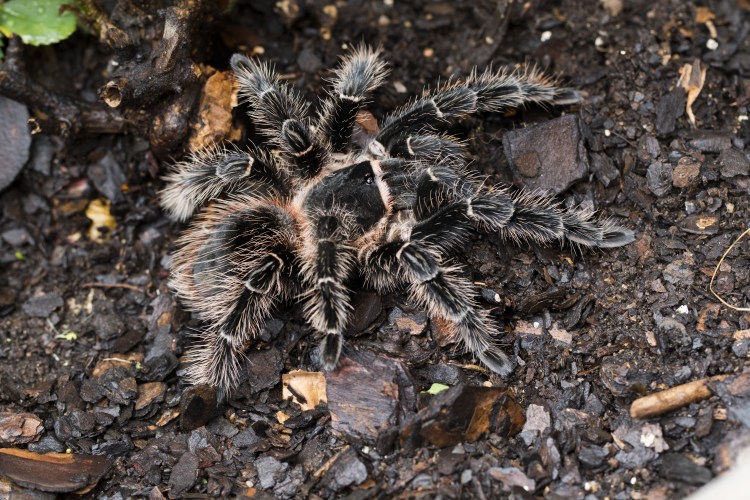
| The Brazilian Salmon Pink Birdeater Lasiodora parahybana From the humid forests of northern South America, we now travel to Brazil, where another enormous tarantula has become familiar to enthusiasts worldwide. Lasiodora parahybana, commonly known as the Brazilian salmon pink birdeater, is a magnificent terrestrial spider whose appearance is dominated by a dark body covered with long, contrasting hairs. Those hairs can produce a salmon-pink or reddish effect, particularly across the legs and abdomen, giving the animal a rather distinctive appearance without the brilliant blues and oranges associated with some other tarantulas. The Brazilian arachnologist Cândido Firmino de Mello-Leitão described the species in 1917, one of the key figures in the study of South American spiders. Its scientific name refers to Paraíba, the Brazilian state historically associated with its discovery, and its placement within the genus Lasiodora links it to a group of large terrestrial tarantulas native to Brazil. Although the name is familiar, its scientific history is not entirely straightforward. Taxonomic reassessment has continued to examine the boundaries between Lasiodora species, showing that even large, conspicuous spiders can pose identification challenges when closely related forms share similar anatomical characteristics. Unlike the rainforest giants of Theraphosa, the Brazilian salmon pink is associated with northeastern Brazil, where conditions and vegetation can differ considerably from the permanently humid forests further north. It is important not to imagine the whole country as one continuous rainforest. Brazil contains an extraordinary range of habitats, and its tarantulas have adapted to very different combinations of temperature, rainfall, soil and vegetation. A terrestrial spider occupying sheltered ground-level retreats in northeastern Brazil faces a different environmental setting from one living beneath the dense canopy of the Guiana Shield. The species is another genuine heavyweight, with large females capable of developing impressive leg spans and substantial body mass. Figures approaching 25 centimetres are often repeated, although these should be understood as exceptional or approximate measurements rather than guaranteed adult dimensions. More interesting than the maximum figure is the way such a large spider operates as a predator. L. parahybana does not require an elaborate aerial web to capture food. Instead, like other terrestrial tarantulas, it relies upon detecting nearby movement, responding to vibrations and overpowering suitable prey with its powerful front appendages and fangs. This hunting strategy illustrates a fundamental difference between tarantulas and the familiar orb-weaving spiders found in gardens. An orb-weaver constructs an intricate structure that intercepts flying insects, whereas a terrestrial tarantula generally waits for prey to come within reach. Both approaches can be remarkably successful, but they represent very different solutions to the same problem. In L. parahybana, a substantial body allows it to tackle comparatively large prey, although its everyday diet remains centred on appropriately sized animals encountered within its habitat. The long hairs that contribute so much to its appearance also have a defensive role. As a New World tarantula, L. parahybana has urticating hairs on its abdomen, which it may release when disturbed. These specialised structures can irritate predators and discourage an attack before physical contact becomes necessary. It is tempting to describe a spider of this size as formidable, but that should not obscure the importance of avoiding confrontation. A tarantula has relatively delicate internal tissues protected by an external skeleton, and even a large individual can suffer serious injury from a fall, crushing pressure or an encounter with a determined predator. Another aspect of its biology deserves attention: reproduction. Female tarantulas can produce substantial egg sacs containing numerous developing young, but the emergence of spiderlings is only the beginning of a difficult process. Tiny juveniles face a world filled with predators, competition and environmental hazards, and only a proportion will survive to adulthood. Large adult size does not translate into large offspring, nor does producing many young guarantee rapid population growth. Growth takes time, and females of many large tarantula species may live for years while males generally have shorter adult lives. The Brazilian salmon pink has become particularly well known through captive breeding, making it a familiar species within the international tarantula hobby. That familiarity is worth considering because the animals most commonly encountered in collections are not necessarily the most abundant or best understood in the wild. Captive observations can tell us a great deal about feeding, moulting and reproduction. Still, they cannot automatically provide a complete picture of natural population density, habitat selection or ecological relationships. I find that distinction important when revisiting animals familiar in the exotic livestock world. A species may become so commonplace in captivity that people almost forget its extraordinary origins. The Brazilian salmon pink is not simply a large spider that happens to breed successfully under managed conditions; it is a native Brazilian predator occupying a particular ecological setting, shaped by environmental pressures long before anyone gave it a common name. Its inclusion among our fifty therefore rests upon more than size or popularity. Lasiodora parahybana lets us explore the relationship between terrestrial hunting, growth, reproduction, and the extraordinary variety of Brazilian habitats. It also reminds us that familiarity can sometimes conceal just how remarkable an animal actually is. |
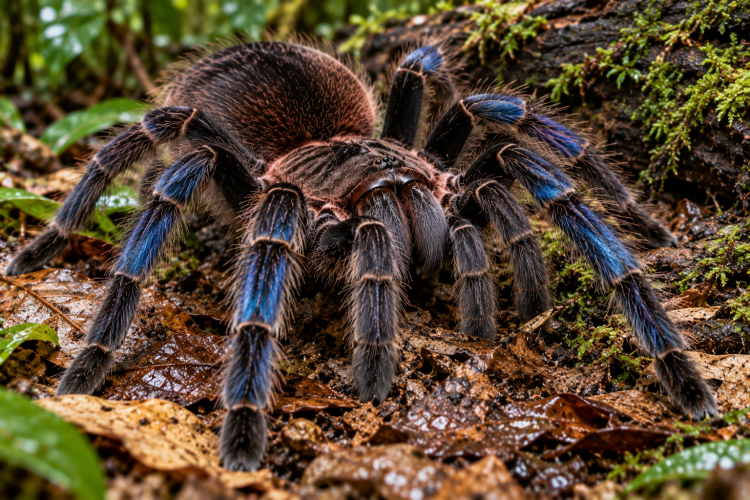
| The Bolivian Blue-Leg Pamphobeteus antinous Our final heavyweight takes us to the forests of Peru and Bolivia, where Pamphobeteus antinous offers a different combination of size, colour, and scientific history. Commonly called the Bolivian blue-leg, it is a substantial terrestrial tarantula whose dark appearance can be interrupted by a metallic blue sheen on the legs, particularly in mature males. The effect is more restrained than the brilliant colouring of the Gooty sapphire ornamental we encountered in Episode One. Still, it can be equally striking when the light catches the animal correctly. The species was described in 1903 by the British zoologist Reginald Innes Pocock, whose work contributed substantially to the scientific understanding of spiders and other arachnids. Its original description highlighted the animal’s dark, somewhat woolly appearance and the steel-blue lustre visible on parts of its legs. That historical detail is especially appealing because it shows the colour was not simply a modern observation by tarantula enthusiasts. More than a century ago, the same characteristic was sufficiently distinctive to attract the attention of a scientist examining preserved material. Pamphobeteus antinous is recognised from Peru and Bolivia, with records placing it in several tropical and subtropical environments. Research on Bolivian tarantulas has documented the species in Amazonian and pre-Andean forest regions, as well as other suitable habitats. Individuals may shelter beneath fallen timber, among roots and leaf litter, or within burrows, using the complex structure of the forest floor. These retreats protect them from predators and environmental extremes while allowing access to prey moving through the surrounding vegetation. The animal’s substantial proportions make it another appropriate member of our heavyweight episode, although variation between individuals, sexes, and measurement methods complicates reliable comparisons. Rather than attaching undue importance to a claimed maximum leg span, it is more useful to recognise P. antinous as a large, robust terrestrial species whose physical structure reflects the demands of its environment. Powerful legs, substantial fangs, and sensory hairs allow it to hunt effectively while staying closely connected to the shelter and stability the ground provides. One of the most interesting features of this species is the difference in appearance between males and females. Sexual dimorphism is widespread among tarantulas, but it does not always take the same form. In some species, males develop longer, more slender legs or noticeably different proportions as they mature. Colour can also vary, and the metallic blue associated with male P. antinous provides a striking example of how the two sexes may differ in appearance. These differences reflect the contrasting demands of adult life. Female tarantulas often remain associated with established retreats, continuing to feed and moult over many years, while mature males typically leave their familiar surroundings in search of receptive females. That movement exposes them to additional risks, including predators, unsuitable environments and the possibility of failing to locate a mate. The relatively brief adult phase of many male tarantulas therefore differs greatly from females’ longer reproductive lives. The genus Pamphobeteus has also attracted considerable taxonomic attention. Researchers have examined historical specimens, described additional species and reassessed the characters used to distinguish members of the group. This work matters because external appearance alone can be misleading. Two large, dark tarantulas may look remarkably similar while possessing anatomical differences that reveal separate evolutionary histories. Conversely, individuals that appear different in colour or proportions may belong to the same species. This offers a useful lesson about the relationship between popular names and scientific identity. “Bolivian blue-leg” is memorable and descriptive. Still, it does not tell us that the species also occurs in Peru, nor does it explain the anatomical features that distinguish it from its relatives. Common names are convenient introductions, but they are not substitutes for taxonomy. As we continue through the fifty, we will encounter many examples where a familiar name tells only a small part of the story. Conservation provides another reason to take a closer look at P. antinous. Research examining Bolivia’s tarantula fauna has reported relatively scarce populations in surveyed areas despite records from several protected landscapes. That observation should not automatically be interpreted as proof of an overall population decline, because large terrestrial spiders can be difficult to detect and their apparent abundance depends heavily upon survey methods. Nevertheless, it highlights the importance of field research in understanding animals whose impressive appearance may give a misleading impression of security. The presence of a species within a protected area does not, by itself, tell us everything about its future. Habitat quality, land-use changes, local environmental conditions and the species’ own ecological requirements all influence its prospects. Large spiders may be capable predators, but they remain dependent on functioning ecosystems, and their survival ultimately rests on the availability of suitable shelter, prey, and breeding opportunities. For me, Pamphobeteus antinous earns its place among our fifty because it combines the physical presence of a heavyweight with a subtler story of sexual differences, scientific classification, and the difficulties of understanding wild populations. Its blue colouring may catch the eye at first glance, but its real interest lies in the biological complexity behind that appearance. |
| More Than a Question of Size Our second episode introduced three substantial South American tarantulas, but the journey took us far beyond a comparison of leg spans. Theraphosa apophysis has shown us how closely related giants can differ in development and anatomy. At the same time, Lasiodora parahybana has demonstrated the ecological importance of terrestrial hunting, reproduction and adaptation to Brazilian landscapes. Finally, Pamphobeteus antinous has introduced sexual dimorphism, continued the development of tarantula taxonomy, and highlighted the difficulties of understanding populations that spend much of their existence concealed from view. There is something rather satisfying about discovering that even among the largest members of a family, size is only one characteristic among many. An enormous body may help a spider overpower prey, but it also demands shelter, successful moulting, and protection from injury. A large female may survive for many years, yet her offspring begin life as vulnerable juveniles, while a mature male may face an entirely different set of risks as he searches for a mate. The heavyweight tarantulas are therefore not simply enlarged versions of smaller spiders; their biology reflects a complicated balance between opportunity and vulnerability. We have now met six of our fifty species, and the range of habitats, appearances, and behaviours is already expanding. Our next episode takes us to Mexico, where three beautifully marked tarantulas introduce a different chapter in the relationship between spiders, conservation, and human fascination. |
| Next: Episode Three — Mexico’s Remarkable Tarantulas Brachypelma hamorii · Brachypelma boehmei · Brachypelma emilia |
| About our writing & imagery Most articles reflect our real gardening experience and reflection. Some use AI in drafting or research, but never for voice or authority. Featured images may show our photos, original AI-generated visuals, or, where stated, images credited to others. All content is shaped and edited by Earthly Comforts, expressing our own views. |

