| Episode 5 Living Mulch — Can Plants Really Replace Weeding? |
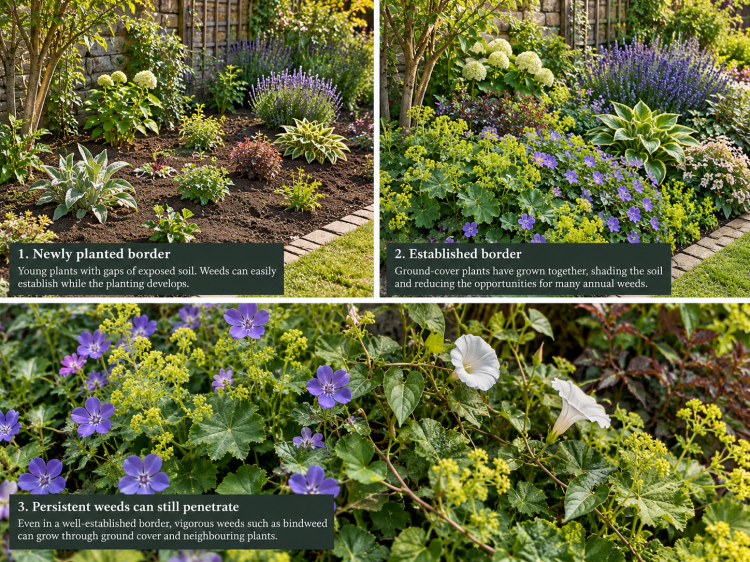
| A particular optimism accompanies planting ground cover. We look at a freshly prepared border, admire the small plants arranged across the soil and imagine how the space will appear once they have grown together. The bare earth will disappear beneath a continuous layer of foliage, the border will look more settled, and perhaps, best of all, we shall no longer have to spend quite so much time removing weeds. It is an appealing prospect, particularly for anyone responsible for maintaining several gardens, but it raises a question that deserves a rather more considered answer. Can ground-cover plants genuinely replace weeding, or are we simply exchanging one form of maintenance for another? The expression living mulch has become increasingly popular in gardening discussions. It describes using living plants to cover and protect the soil, performing some of the functions traditionally associated with materials such as bark, compost, or leaf mould. Instead of spreading a layer of organic material across the ground, we establish plants whose foliage and roots occupy the space, helping to moderate soil conditions and compete with unwanted vegetation. It sounds wonderfully straightforward, and in many circumstances it can be remarkably effective. Yet there is a difference between reducing opportunities for weeds and preventing them from growing altogether. I have spent enough time working in gardens to appreciate that weeds rarely disappear simply because we would prefer them to. They exploit opportunities, and some are extraordinarily good at finding them. A narrow gap between established perennials, a patch of disturbed soil beside a shrub, or a little light reaching the ground after a plant has been cut back can provide everything a seedling needs to begin growing. Ground cover changes those opportunities, sometimes quite dramatically, but it does not remove every possibility. Understanding what it can achieve is the key to using it successfully. What living mulch actually does A conventional mulch works primarily by covering the soil surface. Depending on the material and its depth, it can reduce light reaching weed seeds, moderate temperature fluctuations, limit evaporation and gradually contribute organic matter as it decomposes. Living mulch performs some similar functions, but it does so through plant growth rather than an applied covering. The most obvious contribution is shade. When low-growing foliage forms a sufficiently dense canopy, less light reaches the soil beneath it. Many weed seeds require specific environmental signals to germinate, and light can be an important factor for some species. A shaded soil surface therefore becomes less favourable for certain weeds, particularly those that thrive in open, disturbed ground. Established ground-cover plants also occupy space above and below the soil, competing with emerging seedlings for water, nutrients and room to develop. Other benefits are less immediately visible. Foliage can reduce the direct impact of heavy rain on exposed soil, while roots help bind the upper layers together. A well-established planting may also moderate conditions near the ground, reducing the extremes bare soil experiences during hot or windy weather. The effect depends on the density, height and seasonal behaviour of the plants. Still, the general principle is familiar from natural vegetation: soil that remains covered is often less exposed to the elements. However, living plants are not passive materials. Unlike bark or compost, they need water and nutrients themselves. Their roots may compete with neighbouring plants, and their foliage can intercept rainfall before it reaches the soil. A dense planting can also make it harder to see what is happening underneath. These are not necessarily reasons to avoid living mulch, but they remind us that replacing an inert covering with growing plants introduces a different set of relationships. The weeds that ground cover can discourage One of the greatest advantages of established ground cover is its ability to make life more difficult for annual weeds. Many familiar garden weeds rely on exposed or recently disturbed soil, where their seeds can germinate, and seedlings develop without substantial competition. Hairy bittercress, groundsel, annual meadow-grass and chickweed are among the plants that can appear rapidly in suitable conditions, particularly where gaps remain between ornamental planting. When ground cover forms a continuous layer, some of these opportunities are reduced. A seed landing beneath dense foliage may receive insufficient light to develop successfully, while a seedling that does emerge must compete with established roots and leaves. This does not mean every seed fails to germinate, but fewer may develop into the substantial plants that would otherwise demand our attention. The distinction is important because the benefits often become apparent gradually. A newly planted border with small ground-cover specimens may still produce an impressive collection of weeds during its first growing season. The plants have not yet occupied enough space to make a significant difference, and the disturbed soil between them may provide ideal germination conditions. As the planting develops, the amount of exposed ground decreases, and the maintenance pattern can begin to change. In a mature border, this can be a considerable advantage. Instead of repeatedly hoeing or hand-weeding broad areas of open soil, the gardener may find that most attention is concentrated on occasional gaps, edges and places where unwanted plants have managed to establish. The work has not disappeared, but its nature and frequency may be quite different. The weeds that refuse to surrender Unfortunately, some of the most troublesome garden weeds are not especially concerned about whether the soil is already occupied. Established perennial weeds have resources and growth strategies that let them compete with ornamental planting, sometimes with remarkable persistence. Bindweed is a familiar example. Its underground roots and creeping growth let new shoots emerge among established plants, while its twining stems climb through surrounding foliage in search of light. A carpet of ground cover may conceal the emerging shoots for a while, but it is unlikely to prevent an established bindweed infestation from continuing. Indeed, once bindweed becomes entangled amongst desirable plants, removing it without causing damage can be considerably more difficult. Couch grass presents another problem, with its underground rhizomes capable of travelling through the soil and producing new growth amongst the roots of other plants. Ground elder can behave similarly, establishing extensive underground networks that make complete removal difficult when it has become thoroughly mixed with ornamental planting. Brambles, too, can emerge through lower vegetation, using their vigorous shoots to reach the light above. These weeds remind us why ground cover should not be treated as a substitute for proper preparation. Planting a collection of attractive perennials over an established network of troublesome roots is unlikely to produce the low-maintenance border we imagined. More often, it makes unwanted plants harder to reach, and the desirable planting suffers during repeated removal attempts. Where persistent perennial weeds are present, dealing with them before introducing ground cover is usually the more sensible approach. That may involve careful digging, repeated removal of regrowth, or other appropriate control methods over time. The exact approach depends on the weed, the site and the surrounding plants, but patience at this stage can prevent years of frustration later. The difficult years of establishment Almost every ground-cover planting has a development period when the gardener must do considerably more work than the finished result might suggest. The plants are still small, the spaces between them remain open, and weeds often quickly exploit the newly cultivated ground. This is the stage when expectations can become unrealistic. A photograph of a mature border covered with healthy foliage tells us very little about the work required to establish it. We see the finished carpet, not the watering, weeding, occasional replacement planting and adjustments that may have taken place over several seasons. Nor do we see the plants that failed because the soil was too dry, the shade too deep or the competition from surrounding roots too intense. During establishment, conventional organic mulch can be particularly helpful. A suitable layer of composted bark, leaf mould or another appropriate material between young plants may reduce weed germination and help retain moisture while the ground cover develops. Avoid burying crowns or piling excessive mulch against woody stems, but combining temporary surface mulch with developing vegetation can be more effective than relying on either approach alone. Plant spacing also deserves consideration. It is tempting to place ground-cover plants very close together in the hope of achieving immediate coverage, but this can increase costs and competition, particularly where moisture is limited. Planting too widely, on the other hand, may leave substantial areas exposed for several years. The right spacing depends on the species, its expected spread, the growing conditions and how quickly the gardener hopes to achieve a reasonably continuous planting. There is no universal formula, and that is perhaps the most important point. Establishment is a process, not a single afternoon’s work, and even plants that will eventually tolerate difficult conditions often need extra attention while young. The difference between less weeding and no weeding When gardeners describe a border as low maintenance, I sometimes wonder whether we are all imagining the same thing. For one person, it may mean spending an hour every few weeks keeping the planting tidy. For another, it means leaving the garden largely unattended for months without noticeable deterioration. Those are very different expectations, and ground cover is more likely to satisfy the first than the second. A dense planting can certainly reduce routine weeding, particularly once it has established and you have already controlled persistent perennial weeds. But you will still have edges to manage, seedlings to remove, and occasional gaps where unwanted plants take advantage of the available space. Some ground-cover species may also need dividing, trimming or reducing when they begin to compete too strongly with their neighbours. In other words, the work changes. Instead of repeatedly cultivating exposed soil, the gardener spends more time observing and managing the relationships between plants. That may be a far more rewarding kind of maintenance, especially in an established ornamental garden, but it remains maintenance nonetheless. There is also a practical advantage to reducing unnecessary soil disturbance. Every time we dig, hoe or repeatedly cultivate a border, we may bring buried weed seeds closer to the surface, where conditions can favour germination. Careful hand-weeding amongst established ground cover can sometimes disturb considerably less soil than repeatedly working a largely open bed. This is another reason why mature, layered planting can become easier to maintain over time, provided we do not allow persistent weeds to establish within it. When the ground cover becomes the work Episode 4 explored the beautiful bullies: plants whose enthusiasm for spreading can become a problem in its own right. That discussion is particularly relevant here because some of the most effective weed-suppressing plants are also those most likely to require control. A vigorous ground cover can occupy space rapidly and compete strongly with unwanted seedlings, but it may show equally little consideration for neighbouring ornamental plants. A border dominated by one species might contain fewer weeds, yet the gardener could find themselves spending considerable time preventing that species from overwhelming everything else. This is where the promise of reduced maintenance needs careful examination. A plant that suppresses weeds but requires constant cutting back may not offer much practical advantage over a more varied border that needs occasional hand-weeding. The balance depends on the situation, the plant’s behaviour and the standard of maintenance expected. In large, relatively simple planting areas, a vigorous species may be entirely appropriate. Beneath established shrubs, along difficult banks or across areas where access is awkward, its ability to occupy ground can be invaluable. In a small mixed border, however, a slower-growing and more restrained selection may produce a better long-term result, even if it takes longer to establish. The objective should not be to eliminate every possible weed at the expense of the planting itself. It should be to create a garden in which the work required is reasonable, predictable, and compatible with the plants we actually want to grow. Living mulch and the wider garden Another aspect of living mulch deserves attention beyond its usefulness in reducing weeds. A planted soil surface can contribute to a garden’s ecological richness in ways a bare or uniformly covered surface cannot. Low-growing flowering plants may provide nectar and pollen for visiting insects, while their foliage creates shelter and a more varied environment close to the ground. Different species’ roots occupy the soil in different ways, and the gradual accumulation of fallen leaves and other plant material adds organic matter to the soil system. A mixed planting can also create a range of small habitats, from cooler, sheltered spaces beneath dense foliage to more open patches where sunlight reaches the ground. These benefits depend on the plants you choose and how you manage the area. A dense evergreen carpet is not automatically more valuable for wildlife than a varied planting containing seasonal flowers, grasses and small gaps. Nor is every patch of exposed soil undesirable. Some solitary bees, for example, require access to suitable bare ground for nesting, and a garden containing a variety of conditions can support a wider range of organisms than one managed to a single uniform standard. This distinction matters because it prevents us from treating ground cover as an absolute requirement. The objective is not to cover every inch of the garden indiscriminately, but to understand where living vegetation provides a useful function and where other conditions may be equally valuable. A well-designed garden can include densely planted borders, mulched areas, seasonal openings, lawns, paths, and occasional undisturbed patches, none of which is inherently wrong. What matters is how those elements work together. A more realistic way to think about weeding Perhaps the greatest benefit of ground cover is not that it allows us to stop weeding, but that it changes our relationship with the soil and the planting above it. Instead of treating every exposed patch as somewhere weeds must continually be removed, we begin asking whether a suitable plant could occupy that space more productively. In an established border, this can gradually reduce the cycle of bare soil, weed germination and repeated cultivation. The planting becomes fuller, the soil surface is better protected, and the gardener’s attention shifts towards maintaining the balance between desirable plants rather than continually defending empty ground. This approach feels satisfying because it works with plants’ natural tendency to fill available space. We are not trying to prevent vegetation from growing; we are choosing the vegetation we would prefer to see there. The distinction may sound simple, but it represents a considerable change in how we think about maintaining borders. It also encourages patience. A garden does not become low maintenance simply because we plant something described as ground cover. It becomes easier to manage through appropriate plant selection, careful establishment, realistic expectations and the gradual development of a planting that suits its surroundings. So, can plants really replace weeding? The answer, I think, is both yes and no. Yes, because established ground cover can significantly reduce opportunities for many annual weeds, protect the soil surface, and make some borders considerably easier to maintain. In the right situation, it can transform an area that previously required repeated attention into a settled planting needing only occasional intervention. But no, because it cannot reliably prevent established perennial weeds from growing, and it introduces its own requirements for establishment, observation and control. A living mulch is still a collection of living plants, and living plants do not remain permanently unchanged simply because we have assigned them a particular job. The most successful approach lies somewhere between those two answers. Rather than expecting ground cover to abolish weeding, we should see it as one of several ways to make garden maintenance more effective and the planting itself more resilient. I would much rather spend time adjusting an established border, removing the occasional unwanted seedling and allowing desirable plants to develop naturally than repeatedly working the same exposed soil to keep it empty. That, to me, is where living mulch earns its place. Not as a miracle cure for weeds, but as a practical, attractive way to let the garden do more of the work for itself. And with that question answered, we arrive at the final stage of our exploration. We have considered why bare soil rarely remains bare, how ground cover behaves in sun and shade, the problems created by overly vigorous plants and the realistic benefits of living mulch. What remains is to bring those ideas together and consider how we actually build a successful lower layer of planting. That will be the subject of Episode 6, Building the Layer Beneath the Border, where we shall look at turning the principles of ground cover into a practical approach to planting and maintaining real gardens. |
| Most articles are grounded in our real gardening experience, observations and reflections. AI may assist with research, drafting and editing, but the experiences, opinions and editorial direction are our own. Featured images may include our photography, original AI-generated visuals or, where stated, images credited to others. Earthly Comforts reviews and shapes all published content before publication. |

