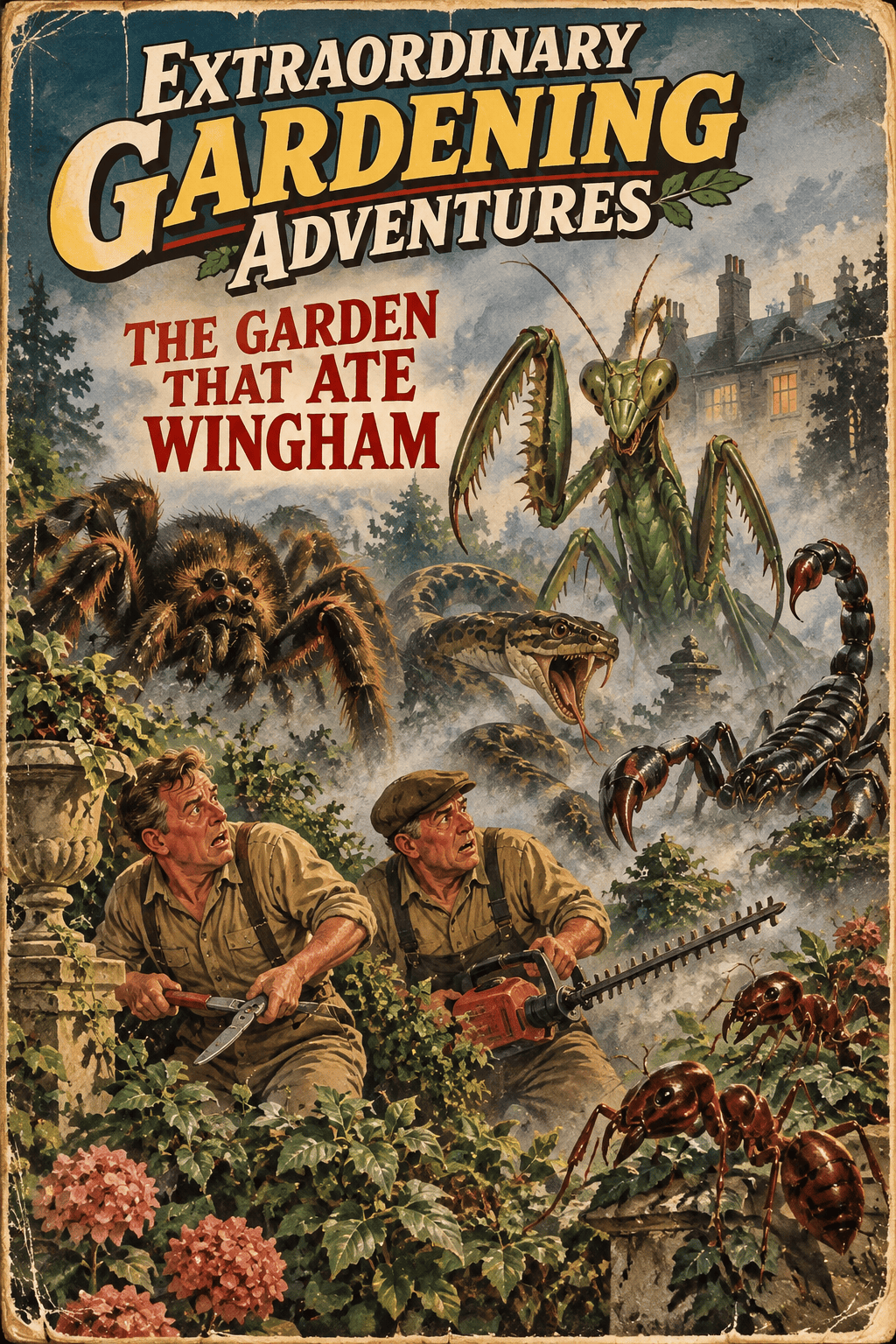
| Halloween Special The Garden That Ate Wingham |
| An entirely improbable tale of two gardeners, one mysterious client and several creatures that had absolutely no business being in the Kent countryside. |
| Some things a gardener expects to encounter when arriving at a country property in late October. Overgrown hedges, fallen leaves, brambles with territorial ambitions, and perhaps a wasp nest hidden somewhere inconvenient. What one does not generally anticipate is a giant scorpion, a praying mantis the size of a garden shed, or a spider capable of making a respectable meal out of a Labrador. Looking back, I suppose the fog should have been our first warning. However, fog is hardly unusual in Kent, and neither John nor I had any reason to believe that an ordinary gardening appointment would become an experience that made the average 1950s science-fiction film look like a wildlife documentary. Shortly after nine, we left Sandwich, heading towards Wingham for what had been described as a straightforward autumn garden clearance. Our new client, Mrs Blackwood, wanted several overgrown borders cut back before winter, together with some hedge trimming and general tidying. She had sounded perfectly reasonable on the telephone, although I remembered one unusual remark about the wildlife. Apparently, the insects had been particularly troublesome that month. I assured her that insects were part of gardening and that we were accustomed to working around them. Had she mentioned that some could carry away a wheelbarrow, I might have reconsidered. The morning was damp and grey, with the sort of persistent drizzle that soaks clothing without ever becoming proper rain. John was driving while I considered the day’s work and whether we might finish early enough to squeeze in another appointment. Somewhere beyond Ash, the mist began thickening, and by the time we reached Wingham, it had become a dense white fog that swallowed the hedgerows and reduced the road ahead to a narrow strip of wet tarmac. The satnav became confused, insisting that we were crossing an open field, before losing its signal altogether. John slowed almost to walking pace, muttering that he could barely see the road, and I was about to suggest turning around when two stone gateposts appeared through the whiteness. Between them hung a weathered sign announcing BLACKWOOD HOUSE. The drive was longer than expected, bordered by enormous yew hedges that seemed to lean towards the van as we passed. Eventually, we reached a gravel courtyard in front of a substantial old house, vaguely Georgian in appearance, although several additions suggested that successive owners had disagreed about its architectural merits. We began unloading the equipment, and I noticed immediately that the garden was unusually overgrown. Dense shrubs crowded the paths, neglected climbers covered much of the brickwork, and thick strands of what looked like cobwebs stretched between two large rhododendrons. Before I could investigate, an upstairs window opened, and a woman’s voice called down a cheerful good morning. Mrs Blackwood apologised for being unable to come outside, explaining that she was rather tied up with friends. She told us to start at the back and cut down whatever seemed necessary, adding almost as an afterthought that we should be careful of the insects and snakes, which had been unusually numerous recently. John stopped unloading the hedge trimmer and looked up sharply. “Snakes?” he repeated, but the woman merely assured us that we would manage perfectly well before closing the window. John watched her disappear and remarked that her reassurance was not particularly reassuring. I suggested that she probably meant grass snakes, which would hardly be surprising around a large rural garden, although I admitted that describing them as troublesome was rather peculiar. The rear garden was enormous, or at least it appeared to be, since the fog made its boundaries impossible to judge. A broad lawn disappeared into the whiteness, flanked by neglected borders and towering conifers, while a greenhouse stood to one side and a wooden summerhouse was just visible farther away. I began cutting back a sprawling shrub near the terrace while John tackled an overgrown hedge, and for the first ten minutes everything seemed perfectly ordinary. Then I noticed an ant dragging a dead mouse across the paving. Ants possess extraordinary strength relative to their size, but this particular specimen was approximately six inches long, with mandibles resembling miniature bolt cutters. It paused when I approached, raised its head and appeared to consider whether I might also be worth carrying away. I called John over, and together we watched three more ants emerge from beneath a paving slab to assist their companion. Their dark reddish-brown bodies and enormous heads reminded me of tropical species, although the proportions were entirely wrong. John said they were the size of sausages and suggested we leave them alone, but I crouched for a closer look, fascinated despite myself. One snapped its jaws toward me, making an unpleasant clicking sound, and John caught the back of my shirt and pulled me away. “Whatever they are, Rory, they can stay over there,” he muttered, adding that he had no intention of being carried underground by something that ought to fit inside a matchbox. We retreated towards the lawn, where a rustling sound came from a dense clump of ornamental grasses. Something long and dark moved between the stems, followed by an enormous head covered in brown-and-gold scales. The snake kept emerging until several feet of muscular body lay across the path, with no indication the rest was close to arriving. John asked whether it was a grass snake, then an adder, before finally suggesting a python. I admitted that the last possibility seemed rather more likely, although finding one loose in a Kent garden was hardly encouraging. The creature raised its head, tasted the air with its tongue and began moving towards us, at which point we decided that further identification could wait. We had barely reached the greenhouse when something struck its roof with a crash, sending glass and broken pots tumbling onto the staging. I shone my torch through the damaged doorway. I illuminated two enormous pincers emerging from beneath a bench, followed by a black armoured body and a segmented tail curving upwards over its back. At the end was a sting approximately the size of a carving knife. The creature was unmistakably a scorpion, measuring perhaps four feet from pincers to tail, and it advanced with its claws clicking against the concrete floor. I suggested that we avoid sudden movements, but John pointed out that standing still while a giant scorpion approached was not an especially attractive alternative. When the creature lunged, we abandoned the discussion and hurried towards the house. We reached the back door and hammered on it, calling for Mrs Blackwood, who eventually answered from somewhere upstairs. When John informed her that there was an enormous scorpion in her greenhouse, she responded with surprising cheerfulness. “Oh, yes. Gerald. He does get rather excitable. He’s quite harmless, really, provided he doesn’t catch you.” John turned towards me with an expression that suggested he was seriously reconsidering his employment and announced that he wanted to go home. Unfortunately, the fog had thickened so much that the lawn was barely visible, and the side passage was now occupied by an enormous spider’s web stretching between the house and a nearby cedar. Several leaves, a dead pigeon, and what looked like a garden rake hung in the web. At its centre sat a spider whose abdomen was the size of a football, with long hairy legs and two substantial fangs beneath a cluster of glittering eyes. John whispered that it was a tarantula, and I began explaining that the web suggested something closer to an orb-weaver, although the anatomy was unlike anything I had encountered. He interrupted to make it clear that he had absolutely no interest in the creature’s classification. The spider began moving towards us, testing the strands with its front legs, and when one brushed the brickwork beside my shoulder, we decided to seek another route. Unfortunately, that route led across the terrace, where something enormous was moving through the fog. At first I thought a tree had fallen, but then the shape unfolded, raising two long, jointed forelegs lined with wicked-looking spines. A narrow triangular head swivelled towards us, supported by an elongated thorax, while behind it stretched an enormous green abdomen and folded wings that rustled like heavy canvas. It was a praying mantis, approximately twelve feet tall, standing perfectly still as it studied us. John asked whether it might be an elaborate garden ornament. Still, the creature answered by striking at him with extraordinary speed, slicing through a wooden chair where he had been standing a fraction of a second earlier. We dived behind a stone planter while the mantis began dismantling the terrace furniture in search of us. Under normal circumstances, mantises are fascinating insects that use their powerful raptorial forelegs to seize prey with astonishing precision. Their ability to remain motionless makes them formidable ambush predators, although I had never previously encountered one capable of looking through an upstairs bedroom window. John asked whether I had any ideas, and I admitted that I generally worked with creatures considerably smaller than the client. When the mantis lifted the planter, we ran across the lawn, pushed through a border of towering dahlias and found refuge inside the summerhouse, slamming the door behind us. The summerhouse contained dusty gardening books, a rusted watering can and a collection of old film posters covering the walls. One showed an enormous spider looming over a desert town; another depicted giant ants attacking terrified people; others featured a monstrous scorpion and a colossal praying mantis menacing an American city. I recognised them immediately, having spent many years watching and collecting horror and science-fiction films. Tarantula, Them!, The Black Scorpion and The Deadly Mantis were all represented, each featuring creatures remarkably similar to those currently destroying Mrs Blackwood’s garden. John wondered why anyone would decorate a summerhouse with such a collection, and I was beginning to suspect the resemblance was more than coincidence. We peered through the window and discovered that the situation outside had deteriorated considerably. The mantis had become entangled in the spider’s web, and the enormous arachnid was descending toward it while the mantis thrashed its forelegs to break free. Nearby, the scorpion attacked a stone birdbath, while the python emerged from the ornamental grasses and coiled around a tree. It was like watching several decades of creature-feature cinema attempting to occupy the same screen, with no director available to explain what should happen next. John opened the summerhouse door, intending to make a run for the van, only to discover a procession of giant ants crossing the lawn in organised ranks. Several were carrying pieces of garden furniture above their heads. He quietly closed the door again and announced that there had been a slight change of plan. I returned to the posters and noticed another partly hidden behind a cupboard. It showed a woman standing beside an enormous laboratory apparatus, surrounded by giant insects, with the words The House of a Thousand Monsters printed across the top. Beneath the title, a smaller line described an experimental motion-picture experience in which imagination became reality. Before I could investigate further, something heavy landed on the summerhouse roof, and a long hairy leg appeared through the window. The spider had evidently escaped its encounter with the mantis and was now investigating our hiding place. We abandoned the building through a rear window, landed in a patch of damp compost and hurried towards the house, deciding that Mrs Blackwood owed us an explanation. The front door stood open, and inside the hallway smelled of damp wallpaper and something unpleasantly sweet. We followed the sound of voices upstairs until we reached a large room filled with old projectors, battered cinema reels and shelves of horror-film memorabilia. Mrs Blackwood sat in an armchair facing a large screen, apparently comfortable despite being bound to it by thick strands of spider silk. Several smaller spiders crawled across her shoulders, a snake was coiled around the fireplace, and enormous beetles occupied the sofa. Something resembling a camel spider investigated a bowl of biscuits, while beside an ancient projector stood a man in a white laboratory coat who greeted us enthusiastically, as though he’d expected us. The man introduced himself as Professor Erasmus Blackwood, specialist in experimental cinematography, biological enlargement and the occasional unfortunate side effect. Mrs Blackwood confirmed with a weary sigh that he was her husband. He explained that he had spent his life fascinated by the great monster films, particularly the giant-insect classics of the 1950s, but had always believed they lacked one essential ingredient. John suggested that the missing ingredient might have been common sense, but the professor ignored him and announced triumphantly that what they lacked was reality. His experimental projector, he explained, could somehow transform cinematic images into living organisms, although the process had proved rather difficult to control. Apparently, every film he screened produced another creature somewhere in the garden, while the fog prevented them from wandering beyond the property. Unfortunately, he had spent the previous evening enjoying a marathon of thirty creature features, ranging from respected classics to productions whose special-effects budgets had evidently been assembled from loose change. Mrs Blackwood observed that the resulting complications had made entertaining visitors rather difficult, although the professor insisted that his work represented an extraordinary scientific achievement. A tremendous crash came from downstairs, and John asked whether the professor had included Anaconda in his marathon. The man’s embarrassed expression provided all the answer we needed. I noticed that the projector was still running, and on the screen something resembling an enormous camel spider was emerging from a desert landscape. The professor admitted that the controls had jammed, while scratching noises from the bedroom door suggested that another of his cinematic creations was approaching. I cut through the silk binding Mrs Blackwood with my secateurs, taking care to avoid the smaller spiders, while John searched behind the projector cabinet for the electrical supply. Eventually he located the plug and pulled it from the socket, bringing the machine to an abrupt halt. For a moment the house fell silent, and then the fog outside began glowing with an unnatural white light. A strange vibration passed through the building, followed by a succession of increasingly distant roars, clicks and shrieks from the garden. We hurried to the window and watched as the enormous mantis faded into the whiteness, followed by the scorpion and the snake. The giant ants dissolved like smoke, while the spider’s web collapsed into a shower of silver dust. Within seconds the monsters were gone, leaving the professor staring at his silent machine with an expression of profound disappointment. He murmured something about his life’s work, but John put the plug firmly in his pocket and declared that the professor’s life’s work could remain switched off. Mrs Blackwood apologised for the inconvenience, explaining that she had hoped the garden would be rather quieter that morning. Through the window, I could see the fog thinning, revealing an ordinary, neglected country garden. The greenhouse appeared intact, the summerhouse stood undamaged, and even the broken terrace furniture had returned to its original condition. She assured us that she would settle our invoice in full and suggested that perhaps we might return another time. I told her that we would consider it once the projector had been permanently disposed of, which produced an expression of horror from her husband almost as impressive as anything we had encountered outside. By the time we reached the van, the fog had almost disappeared, and beyond the gates the Kent countryside looked perfectly ordinary. Birds sang in the hedgerows, a tractor worked in a distant field, and the faint sound of traffic came from the main road. We drove back towards Sandwich without speaking for several minutes, each of us presumably considering the morning’s events and wondering whether there was any sensible explanation for what we had experienced. Eventually John asked whether we were going to tell anyone, and I replied that I doubted anybody would believe us if we explained that we had spent the morning being chased around a garden by giant insects and a python. He seemed satisfied with that answer and suggested stopping somewhere for lunch, although he insisted that wherever we went should not have a garden. We reached Sandwich shortly before lunchtime, and by then the entire experience was beginning to acquire the strange unreality that sometimes follows a particularly vivid dream. John appeared content to regard the episode as an unusually unpleasant gardening appointment and was already discussing what we ought to charge for the work. Only when we were unloading the equipment later did I notice something moving across the dashboard. A reddish-brown ant, about six inches long, crawled toward the windscreen, occasionally pausing to investigate the plastic trim. I stared at it for several seconds, hoping that my eyes were deceiving me, but the creature turned towards me and clicked its enormous mandibles. I called John over, and he leaned into the cab, took one look at the ant and slowly straightened up again. For a moment, neither of us spoke, then he sighed with the weary resignation of a man who had finally discovered the limits of what could reasonably be expected of a gardener. “I’m putting that on the invoice,” he said, before walking away to put the kettle on. Somewhere in the distance, a dog began barking, although after the morning we had endured, I was no longer entirely confident that it was a dog. |
| Author’s Note The Garden That Ate Wingham is a Halloween spoof inspired by the wonderfully imaginative, frequently ridiculous and occasionally genuinely frightening tradition of giant-creature science-fiction and horror cinema. From the atomic-age monsters of the 1950s to the increasingly outrageous productions that followed, these films have given generations of audiences enormous insects, improbable reptiles, and scientists who really ought to have known better. Rory and John will return to their more conventional Extraordinary Gardening Adventures. However, whether either of them will ever look at an ordinary garden ant in quite the same way again remains to be seen. |
| Wander through the Article Directory and see where curiosity takes you next. |
| About our writing & imagery Most articles reflect our real gardening experience and reflection. Some use AI in drafting or research, but never for voice or authority. Featured images may show our photos, original AI-generated visuals, or, where stated, images credited to others. All content is shaped and edited by Earthly Comforts, expressing our own views. |

