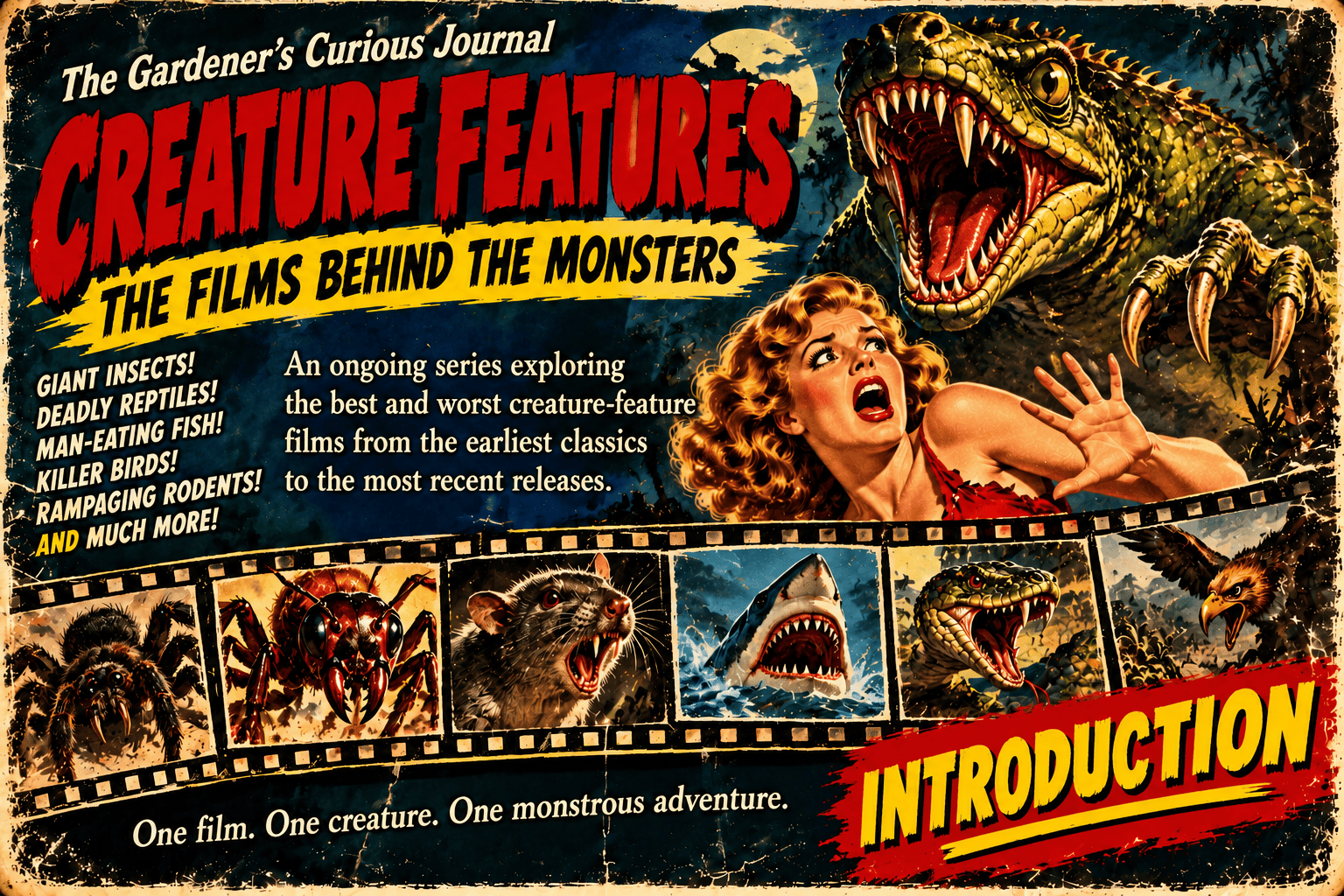
| The Films Behind the Monsters Introducing a New Journey Through Cinema |
| There was a time when an ordinary garden insect could threaten civilisation simply by wandering too close to a radioactive laboratory. A spider could grow to the size of a house, a prehistoric reptile could emerge from the depths of the ocean, and a perfectly respectable flock of birds could suddenly decide that humanity had enjoyed its dominance of the planet for quite long enough. Welcome to Creature Features: The Films Behind the Monsters, an ongoing exploration of one of cinema’s most imaginative, entertaining and occasionally ridiculous traditions. For as long as filmmakers have been able to point a camera at something frightening, they’ve found ways to turn the natural world against us. Sometimes the results have been genuinely terrifying. At other times, audiences have been expected to believe that a rather unconvincing rubber monster, accompanied by a suitably dramatic musical score, represented humanity’s imminent destruction. And I have always believed there is room to appreciate both. |
| When Nature Became the Monster Long before computer-generated creatures could demolish entire cities, filmmakers experimented with models, puppets, stop-motion animation, mechanical effects, and whatever else their budgets would permit. The results were often extraordinary. During the 1950s, the arrival of the atomic age provided Hollywood with an apparently inexhaustible supply of monstrous possibilities. Giant ants marched across deserts, enormous spiders threatened isolated communities, and prehistoric creatures emerged from places where they had supposedly been minding their own business for millions of years. Science was advancing, the world was changing, and cinema discovered that almost anything could become dangerous with enough radiation. By the 1970s, the emphasis had shifted towards environmental anxieties and nature fighting back. Sharks, rats, snakes, birds, insects and practically every other animal imaginable were recruited into an expanding army of cinematic antagonists. The following decades introduced increasingly elaborate practical effects, animatronics, genetic experimentation and eventually computer-generated monsters. Yet the underlying fascination remained remarkably consistent. What happens when the creatures we share this planet with stop behaving as we expect? The Brilliant, the Bizarre and the Spectacularly Dreadful This collection is not intended to be a celebration exclusively of great filmmaking. Certainly, there will be genuine classics, productions that changed cinema, influenced generations of directors or demonstrated remarkable technical ingenuity. Films such as King Kong, Them!, The Birds and Jaws deserve their reputations, and their contributions to the genre are considerable. But what about the others? What about the giant grasshoppers climbing across photographs of buildings? The enormous reptiles whose movements suggest that someone inside the costume is having considerable difficulty seeing where they are going? Or the unfortunate actors required to deliver perfectly serious dialogue while confronting a creature that looks suspiciously as though it was assembled in somebody’s garden shed? These films have their own peculiar charm. Behind many of them were filmmakers working with limited money, impossible deadlines and ambitions that greatly exceeded the available technology. Some succeeded brilliantly. Others produced something so gloriously absurd that their creations have remained entertaining long after more respectable productions have been forgotten. We shall give them all a fair hearing, although I cannot promise that every monster will emerge with its dignity intact. A Little Natural History Along the Way Being part of The Gardener’s Curious Journal, this collection will occasionally wander beyond the cinema screen to consider the real animals behind these extraordinary creations. After all, ants are remarkable enough without growing to the size of buses. Spiders have hunting abilities that require little cinematic exaggeration, and sharks’ behaviour is far more interesting than their reputation as indiscriminate eating machines might suggest. The natural world has supplied filmmakers with an astonishing variety of characteristics to exaggerate, misunderstand or occasionally portray with surprising accuracy. We’ll explore some of those connections along the way, though this remains primarily a journey through film history rather than a series of zoological lectures. One Film at a Time Each instalment of Creature Features will examine one individual film, exploring its story, the creature at its centre, the people responsible for bringing it to the screen and whatever interesting production history lies behind it. We shall travel from the earliest experiments in creature-centred cinema through the great atomic-age monster films, the ecological horrors of the 1970s, the practical-effects extravaganzas of the 1980s and onwards into contemporary film making. There will be no strict chronological order, no predetermined number of episodes and certainly no shortage of potential subjects. Some films will be familiar favourites. Others may be productions you have never encountered, possibly for very good reasons. And that is part of the attraction. Having spent a considerable part of my life enjoying, collecting and exploring films, including several years involved in the DVD business, I have always found that cinema’s less respectable corners can be every bit as fascinating as its celebrated achievements. Sometimes even more so. The Monsters Are Waiting Somewhere in cinema history, an enormous insect approaches a small American town. A prehistoric beast is preparing to flatten a city. Something unpleasant is moving beneath the water, and an unfortunate scientist is about to discover that his latest experiment has developed a rather unfortunate appetite. Hundreds of these films are waiting to be rediscovered, revisited, and occasionally subjected to a little affectionate ridicule. Some will frighten us. Some will impress us. Others will leave us wondering how on earth anybody managed to persuade a film studio to finance them. Whatever their merits, they form part of a wonderfully inventive cinematic tradition, and one that deserves considerably more attention than it sometimes receives. So, welcome to Creature Features: The Films Behind the Monsters. One film. One creature. One monstrous adventure. And somewhere out there, something enormous is getting hungry. |
| Wander through the Article Directory and see where curiosity takes you next. |
| About our writing & imagery Most articles reflect our real gardening experience and reflection. Some use AI in drafting or research, but never for voice or authority. Featured images may show our photos, original AI-generated visuals, or, where stated, credited images shared by others. All content is shaped and edited by Earthly Comforts, expressing our own views. |

