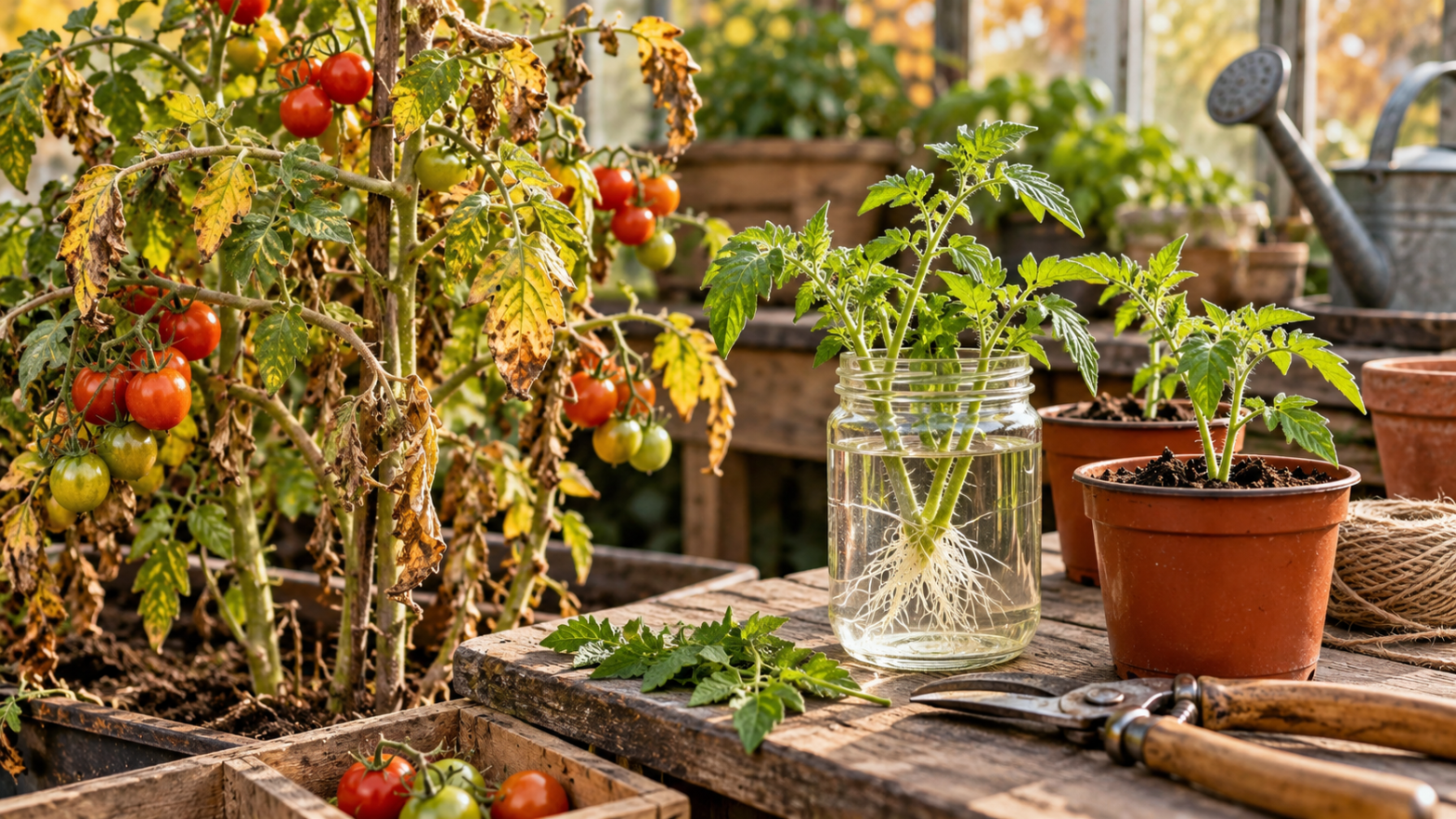
| Giving a successful tomato plant a second chance at life |
| At some point in every gardening year, we find ourselves looking at the remains of our summer crops and wondering whether everything really must come to an end. The tomatoes have been particularly productive; the last fruits are ripening reluctantly in the shortening days, and the plants that provided so generously throughout the summer are beginning to look decidedly tired. Convention tells us to pull them up, clear the beds, tidy the greenhouse and begin thinking about next spring. But what if some of those plants are worth keeping? It is a perfectly reasonable question, particularly when a tomato plant has performed exceptionally well. Perhaps it produced an abundance of wonderfully flavoured fruit, remained remarkably healthy throughout the season or outperformed every other variety in the greenhouse. After months of nurturing, consigning it to the compost heap merely because October has arrived feels rather wasteful. The interesting thing is that tomato plants are not naturally annuals in the strict botanical sense. Although we generally cultivate them as annual crops in Britain, tomatoes are tender perennials that can survive and keep growing for more than one season under suitable conditions. They originate in the warmer regions of western South America, where frost-free conditions allow them to behave quite differently from the plants we know in our British gardens. This raises an intriguing horticultural possibility. Instead of beginning entirely from scratch every spring, could we preserve our most successful tomato plants, encourage them to produce new growth and perhaps even take cuttings to create another generation of plants? The answer is yes, although several important considerations remain, and success depends as much on understanding how tomatoes grow as on providing a suitable place for them to spend the winter. |
| Understanding the Tomato Plant’s Natural Life Cycle The cultivated tomato, Solanum lycopersicum, belongs to the Solanaceae family, alongside potatoes, aubergines and peppers. Despite their differences in appearance and culinary use, these plants share an interesting evolutionary background, and several can survive beyond a single growing season when conditions permit. In Britain, our climate largely limits the tomato to an annual existence. As autumn progresses, falling temperatures, increasing humidity, and declining daylight gradually undermine the plant’s ability to grow productively. Frost is particularly destructive because tomato tissues contain considerable quantities of water and are not adapted to freezing conditions. Yet colder weather does not necessarily mean the plant has reached the natural end of its life. A healthy tomato grown in a warm, bright, and protected environment may keep producing leaves, shoots, and flowers long after its outdoor counterparts have disappeared. The difficulty is that keeping a tomato alive and keeping it productive are two very different achievements. A plant may survive through winter without producing a single worthwhile tomato, particularly when daylight becomes insufficient to support vigorous growth. For the gardener, the objective is often not to maintain continuous fruit production but to preserve a healthy, living plant that can resume vigorous growth when conditions improve. Can We Save an Established Tomato Plant? If you have a particularly successful tomato plant growing in the ground, you can lift it carefully and transfer it into a container before the first frost. The challenge is the plant’s extensive root system, which may have spread considerably during the summer. Digging up an established tomato inevitably damages some of those roots, reducing the plant’s ability to absorb water and nutrients. Right now, it needs to recover from that disturbance, and it is also facing shorter days and cooler temperatures. It is not an ideal combination. If attempting this, select a healthy plant free from visible disease and lift it with as generous a root ball as practicable. Transfer it into a suitably sized container containing fresh, free-draining compost, water it carefully and place it somewhere sheltered from cold winds and frost. Plants already growing in pots have an obvious advantage because their root systems can remain relatively undisturbed. Moving a container-grown tomato indoors or into a heated greenhouse is considerably easier than rescuing one from an established vegetable bed. Even so, an older plant may be carrying pests or infections that are not immediately apparent. Whitefly, aphids, spider mites and fungal diseases can all become troublesome when introduced into a protected winter environment. Any plant brought indoors should therefore be examined carefully and, ideally, kept apart from other plants initially. Practicality also matters. A large tomato plant that has spent the summer reaching towards the greenhouse roof may not be particularly convenient to accommodate on a kitchen windowsill. Fortunately, a more manageable alternative exists. Taking Cuttings — Creating New Plants from Old Ones One of the most useful characteristics of tomatoes is their remarkable ability to produce roots from their stems. Gardeners sometimes notice this when small white bumps appear along the lower part of a tomato stem, especially in humid conditions. These are often root initials, structures that can develop into functioning roots when conditions are right. This ability makes tomatoes surprisingly straightforward to propagate from cuttings. Instead of trying to preserve an entire mature plant, we can select healthy young shoots and encourage them to develop independent root systems. The resulting plants are genetically identical to the parent, meaning that the characteristics of an exceptionally successful tomato can be preserved without relying upon seed. This is especially valuable when growing F1 hybrid varieties. Seeds collected from an F1 tomato may produce offspring with varying characteristics, whereas a cutting preserves the original plant’s genetic identity. The process itself is refreshingly uncomplicated. Select a healthy, non-flowering shoot approximately 10–15 centimetres long, preferably from relatively young growth. Remove the lower leaves and place the stem either into a small container of water or directly into moist, free-draining propagation compost. If rooting in water, keep the container somewhere bright but out of intense direct sunlight, and change the water regularly. Under favourable conditions, roots may begin appearing within a week or two, although cooler autumn temperatures can slow the process considerably. Once a reasonable root system has developed, transfer the cutting into a small pot containing fresh compost. Plants rooted directly in compost can remain there until their roots have established sufficiently to justify moving them into larger containers. Maintain gentle warmth, avoid waterlogging and provide as much useful daylight as possible. The objective is to establish a compact, healthy young plant rather than encourage rapid, weak growth during the darkest months. Remember that cuttings can also reproduce any systemic infections carried by their parent. Select only healthy material, and do not use plants showing symptoms of tomato blight or suspicious wilting for propagation. What Happens If All the Side Shoots Have Been Removed? Now we arrive at a rather interesting situation, one that may occasionally arise when a particularly enthusiastic gardener has been given responsibility for pruning the tomatoes. Imagine discovering that every side shoot has been removed, leaving a rather lonely main stem standing where a magnificent tomato plant once flourished. Your immediate reaction might be to wonder whether the plant has undergone unnecessarily radical horticultural surgery. Before assigning blame, however, we should consider the type of tomato being grown. Cordon tomatoes, also known as indeterminate varieties, are commonly trained as single-stemmed plants. Their side shoots, which emerge from the junction between the main stem and the leaf stalk, are routinely removed to direct growth into the principal stem and its developing fruit trusses. In other words, removing side shoots from a cordon tomato is not only acceptable but often desirable. Bush tomatoes, or determinate varieties, behave differently. They naturally develop multiple productive stems and generally require considerably less pruning. Removing all their side shoots can substantially reduce the number of flowering and fruiting branches, potentially diminishing the harvest. The crucial distinction is between removing side shoots and removing the plant’s leaves or growing points. If the main stem retains healthy leaves and an active growing tip, a cordon tomato can continue growing quite normally. If you also remove the growing tip, the plant may still recover by developing new shoots from viable buds lower down the stem. However, if virtually every leaf, shoot and growing point has disappeared, recovery becomes considerably less certain. A bare green stem may remain alive for a time, but without enough foliage to produce energy through photosynthesis, its prospects worsen quickly. Occasionally, a surviving bud may produce fresh growth, and tomato plants can be surprisingly resilient. Nevertheless, recovery depends on the stem’s condition, the presence of viable growing tissue, and the amount of stored energy remaining in the plant. A tomato reduced to something resembling a walking stick is therefore not necessarily dead, but it would be unwise to expect miracles. Can Tomatoes Continue Growing Through a British Winter? Theoretically, yes. Practically, the answer depends upon the growing environment. An unheated greenhouse protects from wind and rain but does not guarantee protection from frost. During prolonged cold weather, indoor temperatures can drop close to outdoor temperatures, making it unsuitable for reliably overwintering tender tomato plants. A heated greenhouse offers considerably better prospects, although maintaining suitable temperatures throughout winter can become expensive. Tomatoes generally prefer warm growing conditions, with temperatures around 18–24°C during active growth, although established plants may survive at lower temperatures as long as they stay safely above freezing. For practical overwintering, maintaining temperatures above approximately 10–12°C is preferable, but warmth alone is insufficient. The other major obstacle is light. Between November and February, British daylight hours are short, sunlight is relatively weak and prolonged periods of cloud are common. Even a warm greenhouse may receive insufficient light to support strong, productive growth. Under these conditions, tomatoes often become elongated and pale as they stretch towards whatever light is available. Flower production may decline, fruit development can become unreliable, and the plant may consume resources without producing a worthwhile harvest. Supplementary horticultural lighting can overcome some of these limitations, particularly when combined with appropriate heating and ventilation. However, growing productive tomatoes throughout winter is a different undertaking than simply preserving a few cuttings until spring. For most domestic gardeners, maintaining small plants in a bright, frost-free environment is the more sensible objective. Keeping Tomato Cuttings Alive Until Spring Once rooted, you can keep tomato cuttings in relatively small pots during winter. The challenge is to balance temperature, light, moisture and growth so that the plants remain healthy without becoming excessively large. A bright conservatory, heated greenhouse or suitable indoor growing area can provide the necessary protection. A south-facing windowsill may be sufficient for survival, although supplementary lighting often produces stronger plants during the darkest months. Watering should be restrained but consistent. Do not let compost remain permanently saturated, particularly when growth is slow, because cold, wet conditions encourage root problems. Feeding should also reflect the plant’s actual growth. A small cutting maintained through winter requires considerably fewer nutrients than a mature tomato carrying several trusses of developing fruit. As shoots extend, occasional pruning can help keep the plant compact. Healthy shoots removed during this process can themselves be rooted, creating additional plants from the original specimen. This introduces another interesting possibility. Rather than maintaining one increasingly large tomato plant throughout winter, the gardener can preserve a variety through successive generations of cuttings. A cutting taken in autumn can produce new growth during winter, from which the gardener can take another cutting later. In principle, this lets you maintain the genetic identity of a successful tomato plant without keeping the original ageing root system indefinitely. Of course, this approach requires vigilance. Poor lighting, pests, disease and excessive watering can undermine the entire exercise, and maintaining several generations of cuttings is not automatically easier than sowing fresh seed. Nevertheless, for gardeners who enjoy experimenting, it offers an appealing way to extend the life of a particularly valued plant. What About Saving Tomato Seeds Instead? Before investing time and energy in overwintering plants, consider whether saving seed might be the simpler option. For open-pollinated tomato varieties, collecting and storing seed can be an excellent way to preserve a successful crop for future seasons. Properly processed and dried tomato seeds can remain viable for several years when stored under suitable conditions. However, seed propagation and vegetative propagation are not the same. Seeds from open-pollinated varieties will generally reproduce the variety’s characteristics when pollination remains true to type, although occasional crossing can occur. Seeds collected from F1 hybrids, by contrast, may produce plants that differ substantially from their parents. Cuttings avoid this genetic uncertainty because they clone the original plant. If a particular F1 tomato has produced exceptionally well, retaining it through cuttings may therefore offer an interesting opportunity to grow the same individual again. There is one caution worth mentioning. A successful season does not necessarily mean that every characteristic of the plant is genetically exceptional. Weather, soil conditions, watering, feeding and even its position within the greenhouse may all have contributed to its performance. A cutting preserves the plant’s genetics, but it cannot guarantee an identical harvest under different growing conditions. Is It Actually Worth Overwintering Tomato Plants? This is perhaps the most important question. Commercial tomato growers and experienced gardeners generally favour fresh, vigorous plants for each new cropping cycle, particularly where disease prevention and reliable productivity are priorities. Older plants may become increasingly difficult to manage, and preserving them through winter requires space, attention and sometimes considerable energy expenditure. Freshly raised tomato seedlings often establish quickly in spring, developing strong root systems and productive growth without the complications associated with overwintered plants. Yet gardening is not always about choosing the most efficient method. Sometimes it is about curiosity, experimentation, and discovering what plants can do when we give them opportunities beyond their conventional growing season. There is something rather satisfying about taking a cutting from a tomato that has performed exceptionally well, nurturing it through the winter and watching it begin growing again as the days lengthen. Even if the eventual harvest proves no greater than that of a freshly sown plant, the experience offers useful insight into plant physiology, vegetative propagation, and the remarkable resilience of familiar garden crops. If you have the space, I suggest selecting one or two particularly healthy plants and taking several cuttings before cold weather causes serious deterioration. Keep them somewhere warm and bright, monitor their progress, and treat the exercise as an experiment rather than a guaranteed way to improve next year’s harvest. At the same time, sow fresh tomato seeds when the appropriate season arrives. That way, the experiment doesn’t put the following year’s entire tomato crop at risk. A Second Life for the Summer Tomato As autumn settles over the garden, it is tempting to regard the remaining tomato plants as little more than exhausted remnants of summer. Their leaves may be yellowing, the last fruits may be reluctant to ripen, and the greenhouse may already be awaiting its winter clean. Yet beneath that tired appearance lies a plant with considerably more potential than its traditional annual cultivation might suggest. With suitable warmth, light and protection, a tomato can survive beyond its first season. With a little care, a healthy shoot can develop roots and become an entirely new plant. And with a modest amount of experimentation, you can carry a particularly successful variety into another growing year. Not every attempt will succeed, and there are perfectly good reasons why most British gardeners continue to start each spring afresh. But the possibility remains, and for the curious gardener, that is often reason enough to try. As for the unfortunate tomato that has had every side shoot removed, there may still be hope. If the main stem retains healthy foliage, a growing tip, or viable buds, it could still surprise its owner with another flush of growth. And if it doesn’t, perhaps the lesson is simply that gardening secateurs, however enthusiastically wielded, are best accompanied by a little botanical understanding. After all, even the most experienced gardeners occasionally discover that the difference between careful pruning and enthusiastic destruction is rather smaller than they imagined. |
| Author’s Note This article was inspired by an exceptionally successful tomato-growing season and a conversation about whether our best plants really need to be discarded once autumn arrives. It also raised the entertaining question of what happens when someone removes rather more side growth than originally intended. Rather than simply starting again next spring, the intention is to experiment with preserving a few healthy plants through cuttings and see whether they can be encouraged into another growing season. Gardening has always been as much about asking questions as following established routines, and sometimes the most interesting discoveries begin with a plant that refuses to behave quite as expected. |
| Wander through the Article Directory and see where curiosity takes you next. |
| About our writing & imagery Most articles are grounded in our real gardening experience, observations and reflections. AI may assist with research, drafting and editing, but the experiences, opinions and editorial direction are our own. Featured images may include our photography, original AI-generated visuals or, where stated, images credited to others. All published content is reviewed and shaped by Earthly Comforts before publication. |

