| Part Four 1977: A New Country, a New Chapter and a World of Films |
| Some years in life stand out for reasons that have little to do with the films released during them, and 1977 was certainly one of those years for me. In January, my family returned to Britain from Australia, ending the life I had known there since 1965. I would turn fourteen that year, and alongside the considerable changes involved in returning to England, my interests were beginning to develop in new directions. I was already an enthusiastic reader, a collector of books, comics and magazines, and someone who enjoyed writing horror stories. Films were becoming increasingly important, but something else was happening as well. I was beginning to discover music. Looking back at the films released in 1977, what strikes me is the extraordinary variety. There were enormous science-fiction productions, gritty war films, supernatural horror, political thrillers, romantic comedies and spectacular adventures. Some became worldwide phenomena, others developed cult followings, and a few have largely disappeared from popular conversation. I have watched almost all thirty films selected for this year’s exploration, though not necessarily when they first came out. As with the earlier instalments, I assembled the selection with AI assistance, while the memories, opinions, and personal favourites are mine. This isn’t an attempt to establish the greatest films of 1977. It’s a look at what they meant to me, both then and in the years that followed. |
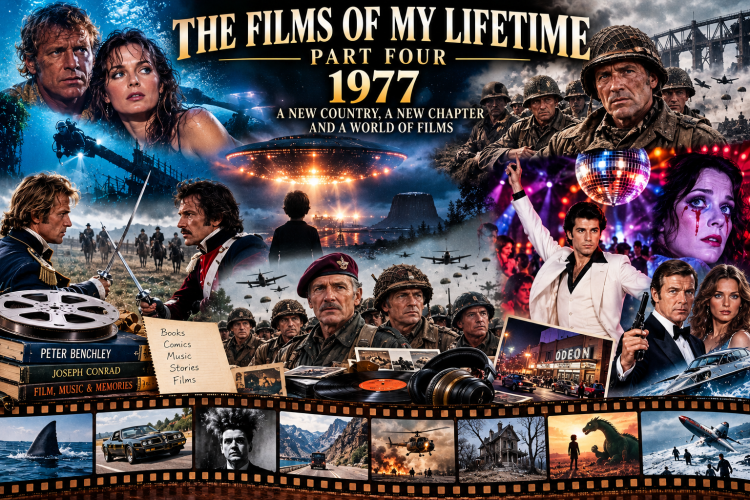
| The Films That Brought Me Back If I had to identify the film from 1977 that has given me the greatest pleasure over repeated viewings, The Deep would be an exceptionally strong contender. Based on Peter Benchley’s novel, it brought together several things I already loved: a maritime setting, underwater danger, an intriguing mystery and a tremendous cast. I had read Benchley’s books before seeing their film adaptations, and I particularly enjoyed The Deep. Nick Nolte and Jacqueline Bisset were excellent, and I must confess that I had something of a crush on Bisset. Louis Gossett Jr., another actor I greatly admired, also appeared, along with Robert Shaw, whom I already associated with Jaws. Once again, Shaw found himself involved in a story where the sea played an important part. I have probably watched The Deep at least a dozen times, which says considerably more about my affection for it than any critical rating could. I followed Benchley closely, and The Island was another of his novels that eventually reached the screen. I enjoyed making those connections between books, films and performers, discovering where else an actor had appeared or which other novels an author had written. I’d been following those threads for years, and cinema offered more opportunities. Another film I have returned to repeatedly is The Duellists, Ridley Scott’s remarkable feature-film debut. Starring Keith Carradine and Harvey Keitel, it follows two officers whose bitter rivalry stretches across the Napoleonic era. I have watched it perhaps half a dozen times, partly because I enjoy the historical setting and performances, but also because it is visually magnificent. The landscapes, costumes and atmosphere give it an almost painterly quality. It was adapted from a Joseph Conrad story inspired by historical accounts, which made it even more interesting to me. Here was another film with a literary connection and a story rooted, at least in part, in the past. A Bridge Too Far was another tremendous production, and one that reminds me just how extraordinary the great ensemble films of the 1970s could be. Its cast included Sean Connery, Michael Caine, Anthony Hopkins, Dirk Bogarde, James Caan, Robert Redford, Gene Hackman, Laurence Olivier, Edward Fox and many others. These were not simply recognisable faces filling minor roles; they represented an extraordinary concentration of acting talent. I thought the film was brilliant, and the performances matched the scale of the production. Watching a film like that today also brings home how many of those actors are no longer with us. Some were already established veterans in 1977, while others would continue working for decades afterwards. I sometimes find myself thinking about the careers they had, the performances they left behind and the extraordinary number of films in which they appeared. We all live, and we all die; what we do in between makes the difference and leaves the mark. Cinema has a rather wonderful way of preserving some of those marks, allowing us to revisit performers long after their final appearance. Science Fiction, Spectacle and Changing Tastes It’s impossible to discuss 1977 without mentioning Star Wars. I watched the original three films and enjoyed them at the time, although my feelings about the franchise have changed considerably over the years. With so many additional films and television productions now available, I find much of it terribly repetitive and, frankly, rather boring. That doesn’t mean I have forgotten the enjoyment the original trilogy gave me. It simply means that something which once seemed fresh and exciting doesn’t necessarily retain the same appeal indefinitely. Close Encounters of the Third Kind, on the other hand, represents the sort of science fiction I genuinely enjoy. It has mystery, atmosphere, memorable characters and a sense of wonder that doesn’t depend entirely on spaceships, battles or elaborate fictional histories. In that respect, it has something in common with E.T. the Extra-Terrestrial, another film that appealed to me. Science fiction has never been a genre I automatically embrace or reject. Some productions fascinate me, while others leave me completely cold, and Close Encounters is a good example of how well the genre can work when the human story matters as much as the spectacle. I have never believed that enjoying one film in a particular genre means I must enjoy everything else that resembles it. My tastes have always been broader, and sometimes more contradictory, than that. I can happily watch an imaginative science-fiction story one evening and find a celebrated space adventure tedious the next. The same applies to horror, comedy and almost every other type of cinema. The individual film, rather than the label attached to it, ultimately matters. Music, Laughter and Familiar Faces The year 1977 also marked the beginning of my growing interest in music, which makes Saturday Night Fever particularly appropriate for this chapter. I enjoyed the film, and John Travolta was an actor I liked then and still like today. Its soundtrack became one of the defining musical releases of the period, but what interests me personally is how films and music were beginning to occupy more space in my life at roughly the same time. They were different interests, certainly, but both offered opportunities to discover performers, follow careers and develop new favourites. Smokey and the Bandit was another thoroughly enjoyable film, largely because of Burt Reynolds. Who didn’t like Burt Reynolds? I certainly did, and I particularly admired his work in Deliverance, Gator and, later, Sharky’s Machine. He had tremendous screen presence and could move between humour, action and much darker material. Smokey and the Bandit was hardly intended to be profound cinema, but it didn’t need to be. Sometimes a film succeeds simply because it is entertaining, and Reynolds understood that exceptionally well. The Spy Who Loved Me offered another example of the pleasure of watching familiar performers. Roger Moore, Barbara Bach and Richard Kiel made a memorable combination. Although I have never been a devoted follower of James Bond, I particularly enjoyed Moore’s films. Slap Shot, meanwhile, was a surprisingly enjoyable sports comedy starring Paul Newman. I have never been especially enthusiastic about sport, but I can enjoy a sporting film when it has humour, interesting characters or a feel-good quality. Slap Shot entertained me despite my general lack of interest in ice hockey on film – l, did play ice hockey for a while as a teenager, admittedly l, preferred field hockey. Then there was Annie Hall, a film I loved despite never being a particularly enthusiastic admirer of Woody Allen. Diane Keaton was a tremendous performer, and the supporting cast included Carol Kane, Shelley Duvall, Paul Simon and Christopher Walken. That was part of its attraction for me: so many interesting people appearing in the same production. I also enjoyed New York, New York because of Robert De Niro, although Liza Minnelli was never a particular favourite of mine. The Goodbye Girl was less successful as far as I was concerned. I watched it because I liked Richard Dreyfuss, but the film didn’t hold my attention, and I think I may even have fallen asleep. Julia, starring Jane Fonda and Vanessa Redgrave, was a very different proposition. I have long admired the Fonda family, and I thought it was an excellent political drama. It was also a film I only needed to watch once. That distinction matters because an excellent film isn’t necessarily one I want to revisit. Some productions leave their impression after a single viewing, while others become familiar companions that I can enjoy repeatedly. Horror, Unease and the Unforgettable Horror continued to occupy a substantial part of my viewing, and 1977 offered some particularly memorable examples. Dario Argento’s Suspiria was extraordinary: vibrant, garish, bloody and visually overwhelming. It was enough to make anyone think twice about ballet schools. What fascinated me was the way its almost extravagant beauty existed alongside such disturbing material. It presented horror with the intensity of a nightmare, showing how striking the genre could become when a director was willing to abandon ordinary realism. Wes Craven’s The Hills Have Eyes appealed to another side of my interest in horror. Its story of a family threatened by cannibals in an isolated landscape has often been linked to the legend of Sawney Bean, and cannibal stories have always fascinated me, alongside zombie films. I enjoyed the original, although I understand that some viewers consider the 2006 remake superior. I haven’t seen that version, so I can’t compare. Eraserhead was something else altogether. David Lynch’s debut feature was surreal, psychologically disturbing, and at times almost impossible to describe. My reaction was bewilderment: what on earth had I just watched? Its ability to unsettle reminded me of the much later Jacob’s Ladder. If ever a film could make an audience feel as though it were approaching the edge of insanity, Eraserhead would be a strong candidate. I wouldn’t necessarily describe it as enjoyable entertainment, but it was certainly unforgettable. The supernatural films were a mixed collection. Exorcist II: The Heretic was a disappointment, and having watched five films from the original Exorcist series, I still consider the first and third the strongest by a considerable margin. The second film seemed unnecessarily confusing, and it lacked the creative involvement of William Peter Blatty and William Friedkin, who had been so important to the original. The Sentinel was more interesting than its reputation might suggest, although its treatment of disability and disfigurement remains deeply uncomfortable. Audrey Rose, starring Anthony Hopkins, Susan Swift and John Beck, was an intriguing psychological horror film. Beck also appeared in Rollerball, the excellent 1975 film starring James Caan, another example of how one performer can lead me to memories of an entirely different production. Kingdom of the Spiders was far less successful for me. I have never been a great William Shatner enthusiast, and I found his performance rather hammy. More troubling are the reports of live tarantulas being harmed during production. I enjoy horror, and I have a fascination with spiders and other creatures, but fictional horror is one thing, and the suffering of real animals is quite another. It is certainly not a film I have any particular desire to revisit. Thrillers, War Films and the Less Familiar The remaining releases included some excellent thrillers and dramas. Black Sunday, adapted from Thomas Harris’s novel, was a particularly good suspense film featuring Robert Shaw, Bruce Dern and Marthe Keller. It is a fictional thriller rather than a dramatisation of an actual terrorist plot, and it offered another opportunity to enjoy Shaw’s work. Cross of Iron was a gritty, uncompromising war film, with James Coburn giving a brilliant performance. I have always enjoyed Coburn, particularly when he played characters who were difficult, cynical or morally complicated. The Gauntlet brought Clint Eastwood and Sondra Locke together in a solid action thriller. I enjoyed it well enough, but it was never among my favourites. Sorcerer, starring Roy Scheider, was another capable thriller that didn’t particularly capture my imagination, despite my admiration for Scheider in Jaws and, later, Blue Thunder. Rolling Thunder, featuring William Devane and Tommy Lee Jones, was a darker, grittier production with a strong cult reputation, and its revenge-driven story fitted comfortably within the harder-edged cinema of the period. I also watched The Last Wave, Peter Weir’s unusual Australian film starring Richard Chamberlain, although I didn’t see it until roughly thirty years after its original release. It was a strange, atmospheric production with apocalyptic elements, and I found it interesting, though I wasn’t entirely convinced. Chamberlain was another actor whose work I had followed through productions such as Dr Kildare, Shōgun, The Thorn Birds and King Solomon’s Mines. Thinking about Australian cinema also brings to mind Picnic at Hanging Rock, another remarkable Peter Weir film, although it belongs to 1975 rather than 1977. The White Buffalo was one of the more unusual productions I encountered much later, during the 1990s. Starring Charles Bronson, it combined elements of the Western with something approaching horror or fantasy. I watched it once and decided that was sufficient. The Airport franchise was another mixed experience. I have seen all four of the original films, released in 1970, 1974, 1977 and 1979, and for me the first two were excellent, the third merely acceptable and the fourth dreadful. The disaster genre could be wonderfully entertaining, but the same formula had limits. On the lighter side, I enjoyed Disney’s The Rescuers, particularly because of Bob Newhart, and I also liked Pete’s Dragon. Neither would necessarily sit among my most important films of the year, but both demonstrate how varied my viewing could be. I wasn’t exclusively interested in disturbing horror or violent thrillers, and a good family film could be just as enjoyable when the mood was right. What 1977 Left Behind Looking back, the films of 1977 remind me that my enjoyment of cinema has never been determined entirely by reputation, awards or popularity. I can appreciate why Star Wars became such an enormous phenomenon, even as I find much of the later franchise tedious. I can admire the achievement of Eraserhead without wanting to watch it regularly, and I can enjoy a relatively straightforward entertainment such as Smokey and the Bandit without needing to justify it as anything more ambitious. What stands out most strongly, however, is the importance of performers and the connections between films. Robert Shaw led me from Jaws to The Deep and Black Sunday. Richard Dreyfuss could persuade me to watch a film that ultimately sent me to sleep. Richard Chamberlain, James Coburn, Clint Eastwood, Paul Newman and Burt Reynolds all brought their own histories into the productions I watched. Sometimes I followed an actor from one film to another, sometimes a book led me towards an adaptation, and sometimes a familiar face reminded me of something I had seen years earlier. Time also played a role. When I watch these films today, I see performers who were once familiar presences on cinema and television screens, many of whom have since died. Their films remain, along with the memories of first encountering them. I don’t think that makes cinema more important than other interests, but it does give it a particular ability to connect different periods of a person’s life. In January 1977, I had returned to Britain with my family, carrying with me an established love of books, comics, horror stories and collecting. By the end of the year, films and music were becoming increasingly significant parts of that world. I couldn’t have known how many productions I would eventually watch, how many performers I would follow or how large my collection would become. I was discovering things I enjoyed, one story, one film and one familiar face at a time. And as we move into 1978, another side of my film tastes is waiting to make itself heard. Among the year’s releases was National Lampoon’s Animal House, a film that would become one of my favourites. The irreverent comedy, the memorable characters, and the sheer enjoyment of watching performers have a wonderful time on screen proved just as important to me as the darker films I loved. But that’s a story for the next chapter. |
| About our writing & imagery Most articles are grounded in our real gardening experience, observations and reflections. AI may assist with research, drafting and editing, but the experiences, opinions and editorial direction are our own. Featured images may include our photography, original AI-generated visuals or, where stated, images credited to others. All published content is reviewed and shaped by Earthly Comforts before publication. |

