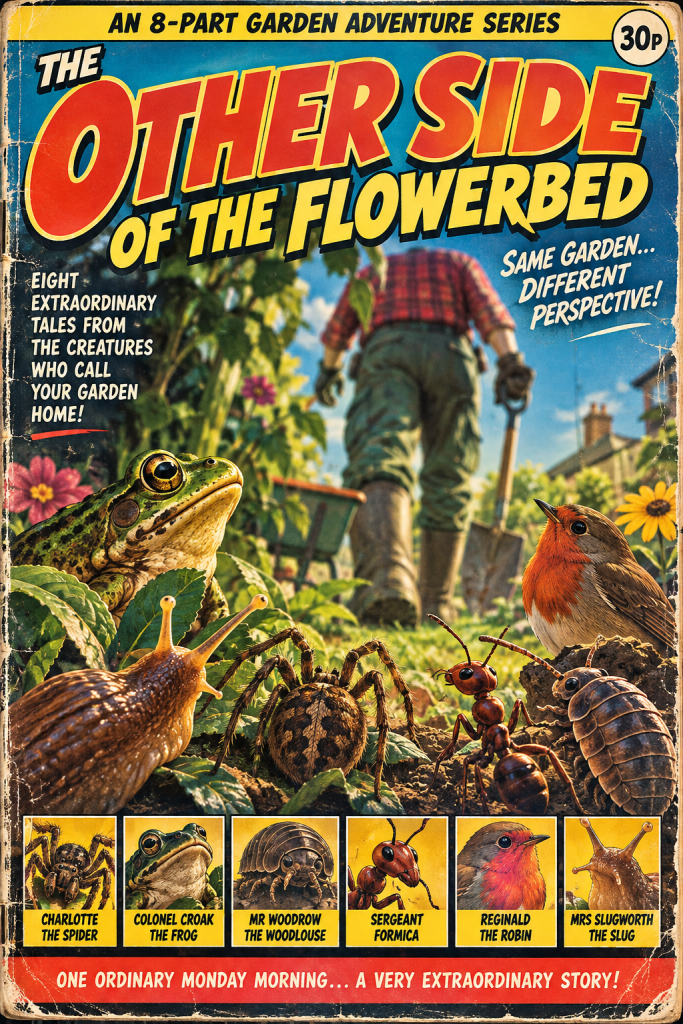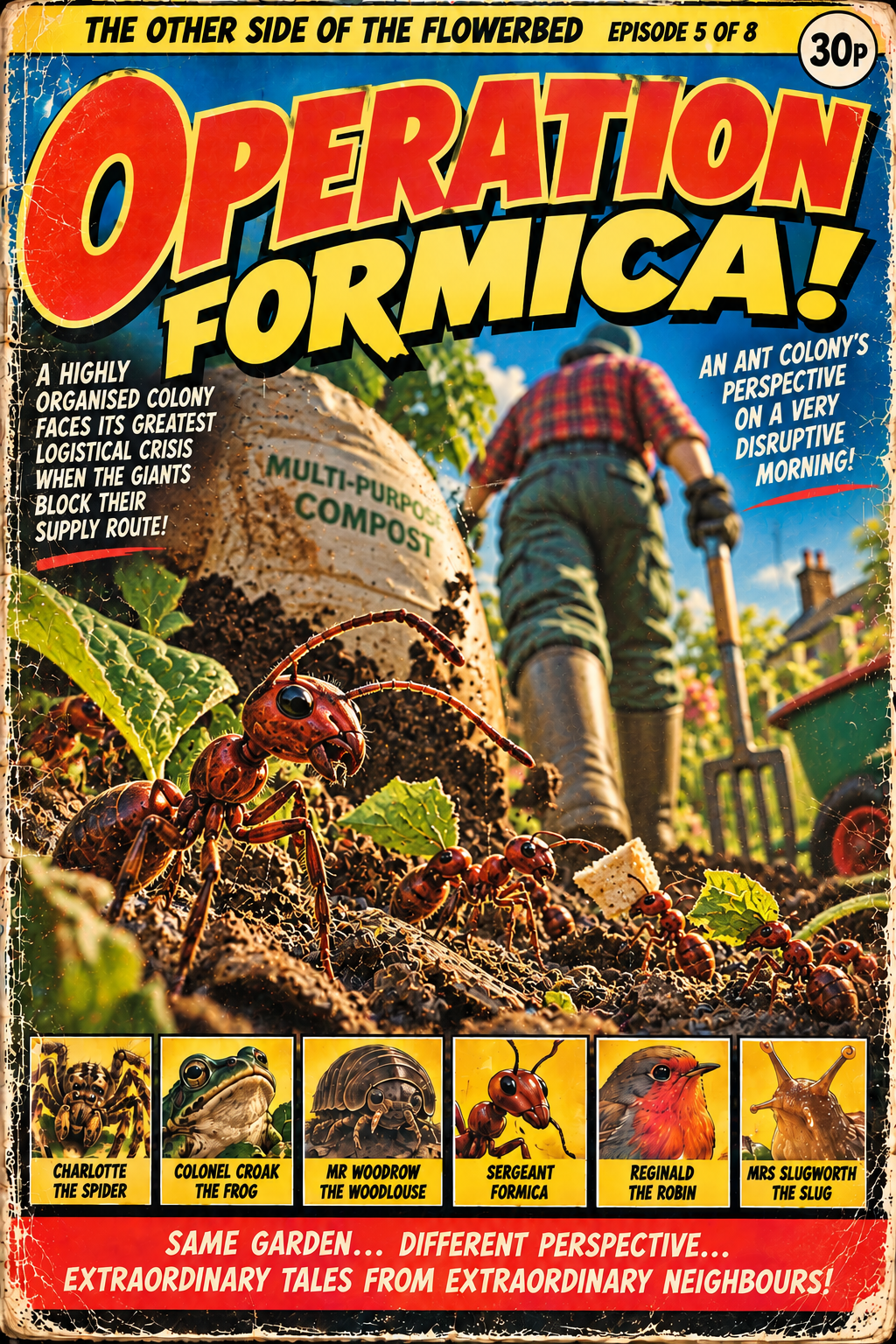
| Episode 5 Operation Formica! |
| Sergeant Formica believed in organisation. He believed in discipline, efficiency, clearly defined responsibilities and the importance of moving essential supplies from one location to another without unnecessary conversation. Above all, he believed that an ant colony should function as a single, coordinated enterprise in which every worker understood its duties and carried them out with the minimum of fuss. Unfortunately, the colony in which he served contained several hundred individuals whose interpretation of these principles varied considerably, and one particular worker whose continued existence presented a daily challenge to the Sergeant’s understanding of natural selection. Private Derek was not a bad ant. He was enthusiastic, reasonably strong and generally willing to undertake whatever task was assigned to him. His difficulties arose from an unfortunate tendency to become distracted, misunderstand instructions and arrive at destinations that bore little resemblance to those originally intended. On several occasions, he had successfully transported useful materials back to the colony, although these achievements were usually accidental and occasionally involved objects that nobody had requested. The Sergeant had once dispatched him to investigate a promising food source near the compost heap, only for Derek to return with a dead beetle’s leg and a detailed account of an interesting stone he had found along the way. Despite these shortcomings, Derek remained a member of the workforce, and Sergeant Formica remained determined to make something useful of him. The colony itself occupied a network of underground chambers beneath the southern edge of the lawn, where the soil was reasonably well drained and the surrounding vegetation offered access to a variety of food sources. Narrow tunnels connected the principal chambers, while several entrances opened onto established surface routes that carried workers towards the borders, the compost heap and a particularly productive area beneath the old apple tree. The ants maintained these routes through chemical trails, allowing individuals to follow established pathways and communicate information about food, obstacles and changing conditions. To the casual observer, the constant movement of workers might have appeared chaotic. To Sergeant Formica, however, it represented the finest logistical organisation in the garden, and he took considerable pride in the colony’s ability to maintain its operations despite the unpredictable behaviour of larger creatures. The morning had begun satisfactorily enough. Workers were moving along the principal supply routes, several promising food sources had been identified, and a group of foragers had returned with fragments of insect remains that would make a useful contribution to the colony’s stores. The Sergeant had finished his inspection of the southern entrance and was preparing to review activity along the compost route when the first vibrations announced the Giant’s arrival. He recognised the disturbance immediately. Every seven days, the enormous creature appeared in the garden and interfered with the landscape in ways that made absolutely no sense from an ant’s perspective. Plants disappeared, soil was turned over, pathways were obstructed, and familiar landmarks were rearranged without warning. The colony had survived these visits before, but each one required adjustments to established routes, and the Sergeant regarded such disruption as an entirely unnecessary complication to an already demanding schedule. Nevertheless, he was determined to continue the morning’s operations. “All units maintain assigned routes,” he instructed the workers nearest the entrance. “Report significant obstacles, avoid unnecessary exposure and do not abandon established trails unless conditions require it. We have supplies to move, and I will not have the entire operation brought to a standstill merely because the Giant has decided to rearrange the scenery again.” The workers continued their duties, exchanging information through their antennae and following the familiar chemical trails that guided them across the soil. For a while, everything proceeded normally. The Giant was occupied among the shrubs, and the colony’s principal routes remained unaffected. Then the compost sack arrived. The gardener had been clearing weeds from the borders and decided to add a little compost to a patch of tired soil near the southern edge of the lawn. He collected a large sack from beside the shed, carried it across the garden and placed it temporarily on the ground while he fetched a hand fork. Unfortunately, he chose a spot directly across the colony’s main supply route. To the Giant, the sack was an ordinary gardening product, conveniently positioned for the next stage of his work. To Sergeant Formica, it was an enormous, dark-sided obstruction that had descended from the sky and severed the most important transport corridor in the entire southern district. The first workers approaching the obstacle stopped abruptly. Those behind them pressed on, creating a rapidly expanding crowd of ants trying to understand why the familiar route had suddenly disappeared beneath an enormous wall of unfamiliar material. Chemical signals spread through the gathering workers, some indicating alarm, others encouraging exploration, while several individuals began investigating the edges of the obstruction in search of an alternative passage. Sergeant Formica arrived to find complete disorder. Workers moved in conflicting directions; several had begun following one another around the same patch of soil, and a particularly determined group was attempting to climb the side of the sack despite no obvious reason. The Sergeant surveyed the situation with growing disbelief before demanding an immediate explanation from the nearest worker. “Obstacle across the main route, Sergeant,” came the report. “No direct passage. Alternative access being investigated.” Formica examined the enormous structure. It extended across the entire width of the pathway and appeared to continue for a considerable distance in both directions. Its surface was smooth in places, wrinkled in others, and carried a strong, unfamiliar scent that suggested damp organic material somewhere inside. “Right,” he announced. “We shall establish a diversion around the western edge. All transport units are to follow the new route until further notice. No climbing, no unnecessary exploration and absolutely no improvisation.” At that moment, Private Derek appeared from beneath a small fragment of leaf, carrying a piece of dried vegetation considerably larger than his own body. “Morning, Sergeant. Bit busy, is it?” Formica stared at him. “Derek, where have you been?” “Collecting supplies, Sergeant.” “You were assigned to the eastern route.” “Yes, Sergeant.” “Then why are you approaching from the west?” Derek paused to consider this question. He had, in fact, become distracted by a particularly interesting scent, followed it around a small stone and eventually returned to the main pathway from the opposite direction. He explained this as clearly as he could, although his account involved several unnecessary references to the stone and an unfortunate encounter with a piece of moss. The Sergeant listened for as long as his patience allowed. “Never mind. Put that leaf down and report to the diversion team. We need workers establishing a new trail around the obstacle.” Derek placed his burden carefully beside the pathway. “Which way round, Sergeant?” “West.” Derek looked towards the enormous compost sack, then towards the surrounding soil. “Is that left or right?” Sergeant Formica closed his eyes. It was going to be a very long morning. While the diversion was being established, the Sergeant began assessing the wider consequences of the obstruction. The compost route carried a considerable proportion of the colony’s food and useful materials, and any prolonged interruption would reduce the efficiency of the entire transport network. Alternative routes existed, but they were longer, less familiar and passed through areas where larger creatures occasionally hunted. The western diversion appeared the most promising. It skirted the edge of the sack, passed beneath a low-growing geranium and rejoined the original route near a small stone. The extra distance was inconvenient but manageable, and the Sergeant was confident the colony could adapt if the workers maintained a consistent chemical trail. Unfortunately, maintaining consistency was exactly where Derek struggled. Assigned to help with the diversion, he set off enthusiastically along the western edge of the sack, following several workers already investigating the route. For a while, he made good progress. He negotiated a small depression, passed beneath a fallen leaf and reached the base of the geranium without incident. Then he noticed a promising scent leading away from the pathway. It was faint, but interesting, and Derek decided that investigating it might produce useful information for the colony. He followed the trail around a small clump of soil, beneath a twig and towards a patch of decaying vegetation where several other ants had recently been exploring. By the time he realised that he had wandered away from the diversion, he had lost track of the route entirely. Rather than returning to the last familiar point, Derek attempted to correct the mistake by following another scent trail, which happened to lead back towards the original pathway. This might have been useful had he not approached the compost sack from the opposite side and concluded that he had completed the diversion. He was enormously pleased with himself. When Sergeant Formica eventually encountered him again, Derek announced that the new route was working perfectly. “Excellent,” the Sergeant replied cautiously. “Where does it lead?” “Back here, Sergeant.” “Back where?” “Here.” Formica looked around. They were standing beside the same obstacle, a short distance from where the diversion had begun. “Derek, you’ve gone round in a circle.” “Have I?” “YES!” Derek considered this information. “Well, at least we know the route works both ways.” The Sergeant briefly entertained the possibility of assigning Derek to permanent underground duties, preferably in a chamber with only one entrance, before remembering that the colony required every available worker. Meanwhile, the Giant had returned to the compost sack. The gardener knelt beside it, opened the top and began removing handfuls of compost to spread around the nearby plants. The enormous obstruction trembled as its contents were disturbed, sending fresh vibrations through the soil and causing several workers to abandon their attempts to climb its sides. Sergeant Formica watched the activity with mounting concern. “Movement at the obstacle,” he announced. “All units maintain a safe distance. Do not approach the structure until conditions stabilise.” The Giant reached into the sack again, lifted a quantity of compost and scattered it across the border. Small fragments of organic material fell onto the soil, causing a sudden, unexpected change in the surrounding environment. To the ants, the falling compost resembled a shower of dark debris. Workers scattered beneath leaves and stones while the Sergeant tried to maintain order, issuing instructions most ignored as they focused on avoiding the unfamiliar material falling around them. One particularly large fragment landed beside Derek, who examined it with considerable interest. “Sergeant!” he called. “Supplies!” Formica turned towards him. “That is compost, Derek.” “Yes, Sergeant.” “We do not need to transport an entire lump of compost.” Derek inspected the fragment again. “Could be useful.” “For what?” Derek had no immediate answer, although he felt strongly that anything falling from the sky ought to be considered an opportunity rather than a problem. The Sergeant instructed him to leave it alone and return to the diversion team. For several minutes, the Giant continued working, spreading compost across the border and gently incorporating it into the upper layer of soil. The disturbance attracted Reginald, who landed nearby and began investigating the freshly turned earth for small invertebrates. The robin’s arrival created an entirely new difficulty for the ants. Sergeant Formica regarded birds with considerable suspicion. Although Reginald was generally more interested in worms and larger prey than in individual workers, his enormous feet, sharp beak and unpredictable movements made him a creature best avoided whenever possible. Reginald, however, appeared entirely unconcerned by the colony’s activities. “Morning, Sergeant!” he chirped from the border. “Busy as ever, I see.” Formica looked up at him, irritated. “Extremely busy, thank you. The main supply route has been obstructed, our diversion is incomplete, and several workers have been displaced by falling material.” Reginald glanced towards the compost sack. “Oh, that. He’ll move it in a minute.” The Sergeant regarded this statement with scepticism. “And how, precisely, would you know?” “Because he always does. He puts things down, moves them about and eventually takes them somewhere else. Rather useful, actually. Disturbs all sorts of interesting things.” Formica considered the robin’s explanation. He disliked relying upon information from creatures who displayed so little concern for proper procedure. Still, Reginald had observed the Giant’s activities over many visits and was often surprisingly accurate in predicting its behaviour. Nevertheless, the Sergeant was not prepared to suspend operations on the strength of a bird’s cheerful optimism. “We shall continue establishing the diversion,” he declared. “The colony cannot simply wait for circumstances to improve.” Reginald nodded pleasantly, spotted a small worm emerging from the disturbed soil and promptly lost interest in the conversation. The ants resumed their work. Gradually, the western route became clearer. Workers explored the new passage, reinforced its chemical trail and began transporting materials around the obstruction. The process was slower than the original route, but the colony was adapting, and Sergeant Formica allowed himself a moment of professional satisfaction. Then Private Derek returned. This time, he carried a small fragment of compost. The Sergeant stared at him. “Derek.” “Yes, Sergeant?” “Why are you carrying that?” “Found it near the Giant, Sergeant. Thought it might be useful.” “I specifically instructed you not to collect compost.” “Yes, Sergeant.” “Then why have you collected compost?” Derek hesitated. “Forgot, Sergeant.” Formica examined the fragment, then the enormous obstruction, then the long line of workers attempting to negotiate the new diversion. He had spent much of the morning restoring order to a transport network disrupted by circumstances entirely beyond his control. Yet, somehow, the greatest challenge remained a single ant who could not reliably distinguish between instructions and suggestions. “Put it down,” he said quietly. Derek complied. “Now return to the colony and report to the entrance supervisor.” “Which route, Sergeant?” “The one you came from.” Derek looked around. “Ah.” The Sergeant decided that further explanation would only make matters worse. By now, the Giant had finished spreading the compost. He folded the top of the sack, lifted it from the ground and carried it towards the shed, leaving behind a patch of slightly flattened soil where it had been resting. The enormous obstruction vanished almost as suddenly as it had appeared. For several moments, the ants seemed uncertain how to respond. Workers approaching the former blockage stopped, investigated the exposed ground and gradually began following the familiar chemical traces that remained beneath and around the disturbed area. Sergeant Formica watched the scene in silence. The principal route was open again. The diversion, which had required considerable effort to establish, was now unnecessary. Several workers had already abandoned it and returned to the shorter passage, while others continued following the western route simply because the chemical trail remained strong enough to attract them. The Sergeant felt an uncomfortable mixture of relief and irritation. Reginald landed nearby, having secured another worm from the freshly disturbed soil. “Told you he’d move it,” the robin remarked cheerfully. Formica looked up at him. “Yes. Thank you.” “All sorted, then?” “Not entirely. We have to restore the original route, redirect the transport units and ensure that nobody continues following the diversion unnecessarily.” Reginald considered this with mild curiosity. “Seems a lot of fuss over a sack.” The Sergeant did not reply. At times, he wondered whether winged creatures could ever appreciate the difficulties faced by those required to travel everywhere on foot. As the colony’s operations gradually returned to normal, Sergeant Formica conducted a final inspection of the affected area. The original route was functioning again, the workers were moving supplies efficiently, and the disturbance had caused no permanent damage to the underground chambers. The morning had been inconvenient, certainly, but the colony had adapted successfully. He was beginning to feel the situation was resolved when a familiar voice called from behind a small stone. “Sergeant!” Formica turned. Private Derek approached from the western diversion, carrying the same fragment of dried leaf he’d had earlier that morning. The Sergeant regarded him with disbelief. “Derek, I sent you back to the colony.” “Yes, Sergeant.” “Then why are you still here?” “Got lost, Sergeant.” “How?” Derek considered the question carefully. “Followed the diversion.” “But the diversion is no longer required!” “Yes, Sergeant. That’s what confused me.” Formica looked toward the colony entrance, clearly visible only a short distance away. He then looked at Derek, who appeared genuinely pleased to have found somebody capable of explaining the situation. For a long moment, the Sergeant said nothing. Finally, he stepped aside and pointed towards the entrance. “Headquarters. Straight ahead. Do not turn left. Do not turn right. Do not investigate anything interesting. Do not collect anything. Walk until you reach the entrance.” Derek nodded enthusiastically. “Understood, Sergeant.” He set off. Sergeant Formica watched him go, determined not to intervene unless necessary. Derek walked several body lengths in the correct direction, passed a small pebble and approached the entrance. Then he stopped. Something had caught his attention. A tiny fragment of leaf lay beside the pathway, and Derek regarded it with the expression of a worker who had just discovered an exceptionally valuable resource. He looked back towards the Sergeant. Formica stared at him. “DEREK!” The private immediately abandoned the leaf and hurried into the colony. For the first time that morning, the Sergeant allowed himself to relax. He surveyed the restored transport network, the workers moving efficiently along their familiar routes and the enormous garden beyond, where the Giant continued attending to its incomprehensible activities. The colony had survived another disruption. Supplies were moving, order had been restored, and the workers were once again fulfilling their duties with something approaching the efficiency he expected. Sergeant Formica considered the morning a qualified success. There would, of course, need to be a review of emergency diversion procedures, and he intended to introduce additional training for workers assigned to route reconnaissance. He also planned to issue clearer instructions on collecting unfamiliar materials, although he suspected no amount of training would fully resolve the difficulties presented by Private Derek. Nevertheless, the colony was functioning, and that was what mattered. He turned towards the entrance, preparing to return underground and complete his report. A faint voice came from somewhere inside the colony. “Sergeant?” Formica stopped. It was Derek. “Yes, Private?” “Where do you want this leaf?” The Sergeant closed his eyes. He reflected that even the finest logistical organisation in the natural world could never entirely overcome certain challenges. And Private Derek was undoubtedly one of them. |
| To be continued in Episode 6 — Reginald’s Excellent Morning! |
| Wander through the Article Directory and see where curiosity takes you next. |
| Author’s Note The Other Side of the Flowerbed is an original work of humorous fiction. All characters, personalities, dialogue and events are fictional. Any similarity in character names to those appearing in existing literary works or other fictional creations is coincidental and does not imply any connection with, or endorsement by, their respective creators or rights holders. © 2026 Rory Matier. All rights reserved. |
| Story inspired by Sonel of The Creative Soul |