| Centaurea The Flower That Never Quite Learned to Behave |
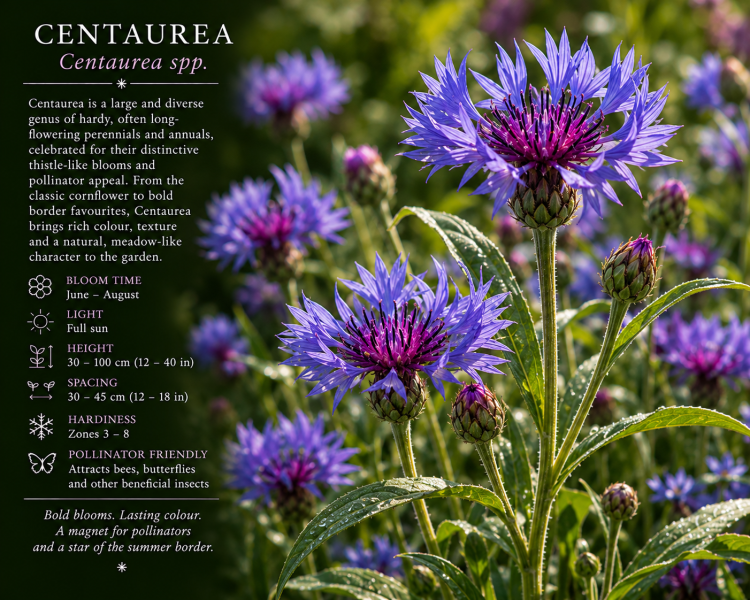
| There comes a point in most gardens when you begin to wonder whether everything has become a little too organised. The borders have been edged, the shrubs have been pruned, and the plants are standing more or less where they were instructed to stand. Everything looks respectable, which is generally what we are trying to achieve, but occasionally something is missing. A little spontaneity, perhaps, or the sense that the garden can still make a few decisions without consulting its owner. That is usually when a plant such as Centaurea begins to look particularly appealing. The name covers a surprisingly varied collection of plants, from the familiar blue cornflower to the purple-flowered knapweeds of British meadows and the larger, more elaborate perennial species found in ornamental borders. They belong to the daisy family, Asteraceae, although their flowers don’t always resemble the daisies we recognise. Instead, many produce distinctive heads of slender, sometimes fringed florets, giving them an appearance somewhere between a thistle and a particularly enthusiastic shaving brush. They are not always tidy plants, but they are seldom dull. One of the most familiar garden species is Centaurea montana, the perennial cornflower. Its striking blue flowers emerge in late spring and early summer, with finely divided outer florets surrounding a darker central disc. The foliage is soft and slightly silvery, and an established clump can make a handsome addition to a mixed border. White, pink, and darker purple cultivars also exist, though the familiar blue remains particularly attractive. What makes the flowers interesting is their construction. What looks like one flower is actually a collection of many small florets gathered into a single flower head. The showy outer florets help attract attention, while the smaller central florets provide much of the reproductive machinery. Many members of the daisy family share this clever arrangement, though in different forms. The insects certainly seem to appreciate it. Bees, hoverflies and butterflies visit many Centaurea species, and our native knapweeds are particularly valuable in wildlife-friendly grasslands. Common knapweed, Centaurea nigra, is a familiar sight in meadows, roadside verges and rough grassland, where its purple flower heads provide nectar for a wide range of insects. However, remember that a meadow plant’s needs are not necessarily the same as those of its ornamental relatives. Different species have evolved for different conditions, and treating the entire genus as one interchangeable garden plant would be a mistake. That distinction becomes important when deciding where to grow them. Centaurea montana is generally accommodating in British gardens, tolerating a range of reasonably drained soils and flowering well in sun or light shade. It can spread through its underground growth and sometimes self-seeds, so an established clump may eventually require dividing or reducing. Cutting back tired flowering stems after the first flush can encourage fresh foliage and, in favourable conditions, a second scattering of flowers later in the season. It is not a plant that demands constant attention, although it occasionally benefits from a reminder of its boundaries. Annual cornflowers, now generally known as Centaurea cyanus, behave differently. They grow best from seed in an open, sunny spot, flowering generously before completing their life cycle. Their association with traditional arable fields is particularly interesting. Once widespread amongst cereal crops, wild cornflowers declined dramatically in Britain as agricultural practices changed, particularly through improved seed cleaning and more effective weed control. There is a certain irony in a flower once regarded as an agricultural nuisance becoming something gardeners deliberately purchase in packets. Yet perhaps Centaurea’s most appealing quality is its refusal to look excessively cultivated. Even the ornamental varieties retain something of their wild ancestry. Their flowers are intricate without appearing artificial, their stems move naturally amongst neighbouring plants, and their growth can be just untidy enough to prevent a border from looking overly arranged. Of course, there are limits. A plant spreading into something more delicate may need lifting, and a border that has become completely overgrown is not necessarily more natural simply because nobody has maintained it. Good gardening often involves deciding how much freedom to allow rather than choosing between total control and complete neglect. I rather like plants that make us think about that distinction. We spend considerable effort improving gardens, selecting varieties for larger flowers, stronger stems, longer flowering periods and increasingly predictable behaviour. Those developments can be useful, but there is also something worth preserving in plants that retain a little individuality. Centaurea offers colour, intricate flowers and genuine ecological value without insisting upon being the centre of attention. Some species belong in carefully maintained borders, others are better suited to wildflower areas, and a few will happily occupy the uncertain territory between the two. Perhaps that is why they deserve another look. A garden needn’t be untidy to feel alive, but no plant needs to behave as though it has been measured with a ruler. Sometimes a little botanical independence is exactly what the border needs. |
| Wander through the Article Directory and see where curiosity takes you next. |
| About our writing & imagery Most articles reflect our real gardening experience and reflection. Some use AI in drafting or research, but never for voice or authority. Featured images may show our photos, original AI-generated visuals, or, where stated, credited images shared by others. All content is shaped and edited by Earthly Comforts, expressing our own views. |


Rory, I absolutely LOVE that title! 😂❤️
“The Flower That Never Quite Learned to Behave” 😅😂 I think you’ve given this gorgeous flower a personality before we’ve even had a chance to admire it properly!
And what a beauty it is! Those lilac colours are absolutely gorgeous. I could quite happily imagine having a whole garden filled with them. Just think of all the butterflies, bees and little insects that would come visiting. It would be a little paradise for our six-legged friends! 🦋🐝
I love flowers that attract wildlife and bring a garden to life. There’s something wonderful about sitting back and watching all those little visitors going about their business.
I wonder whether this particular flower knows just how beautiful it is, or whether it’s still too busy misbehaving! 🤣
Another lovely discovery, Rory. Thank you for sharing it with us. I’m thoroughly enjoying this series! ❤️🌸🤗
LikeLiked by 1 person
I am really pleased – thank you Sonel 🙂
LikeLiked by 1 person
You are very welcome my dear friend. Always a pleasure visiting your awesome blog. 🤗❤️
LikeLiked by 1 person