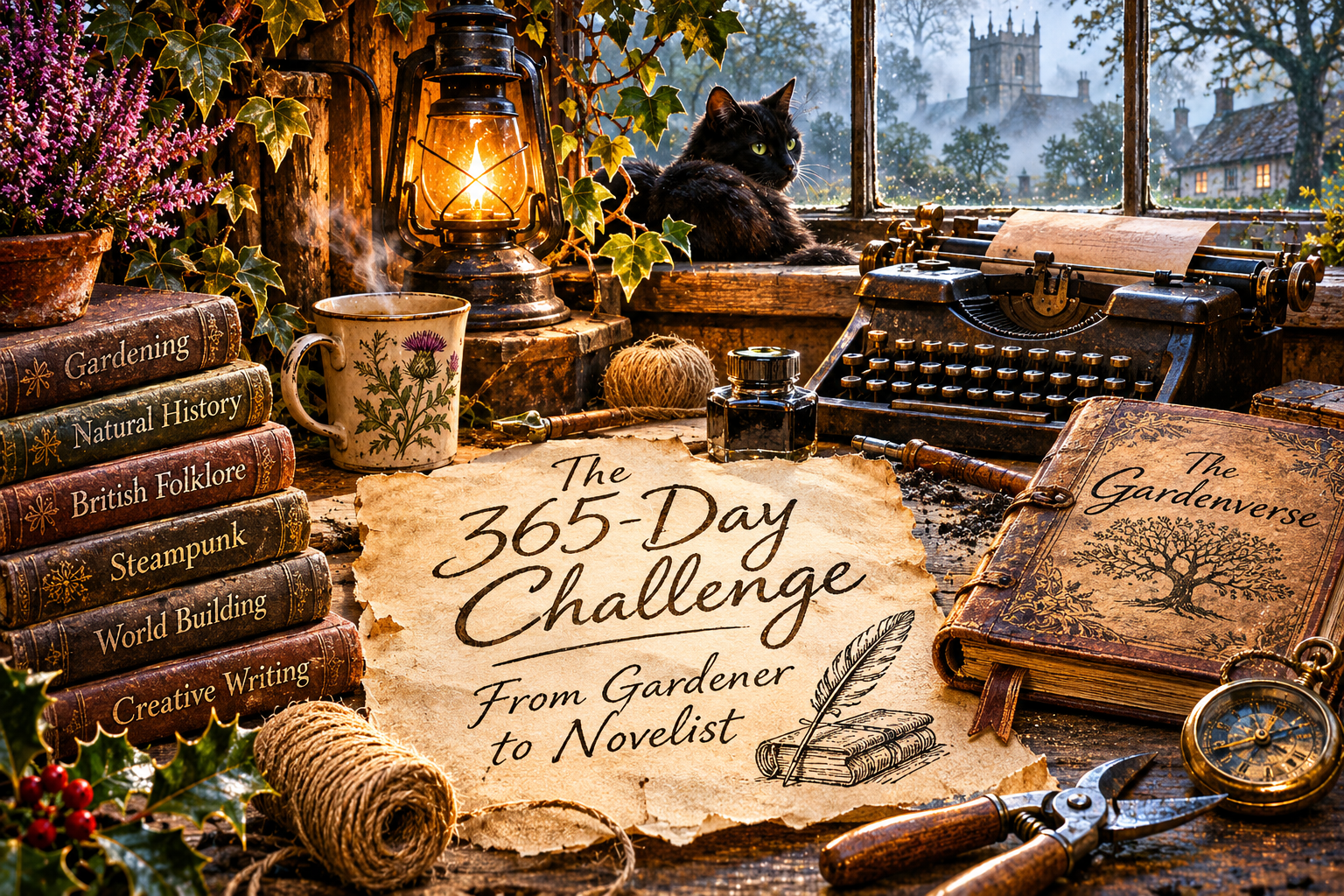
| From Gardener to Novelist — An Unexpected Journey into Fiction |
| There comes a point in life when you begin wondering whether there are still things you might accomplish that you’ve never seriously considered. Not necessarily climbing mountains, sailing around the world or throwing yourself out of an aeroplane, although I’m sure those activities appeal to somebody. Sometimes the challenge is something altogether quieter, requiring little more than imagination, determination, a considerable amount of patience and, preferably, a comfortable chair. In my case, I’ve decided to try something that takes me into entirely unfamiliar territory: I’m going to write a novel, and I’ve given myself 365 days to see whether I can turn that ambition into reality. The intention isn’t simply to begin writing, produce a few enthusiastic chapters and then abandon the whole enterprise when something more interesting comes along. I want to develop an original fictional world, populate it with characters who have their own personalities and histories, establish the rules by which that world operates, and eventually bring everything together into a completed manuscript. Whether I’ll succeed remains to be seen, but that, I suppose, is rather the point of undertaking a challenge in the first place. If success were guaranteed before we began, there wouldn’t be much of a challenge involved. Where Did This Rather Peculiar Idea Come From? Anyone who has spent time reading The Gardener’s Curious Journal will know that my interests extend considerably beyond the practical business of gardening. Plants, wildlife, insects, natural history, forgotten discoveries, historical curiosities and the peculiarities of the world around us have all found their way into its pages. I’ve always believed that curiosity is one of the most valuable qualities we possess, because the moment we stop asking questions, we risk overlooking some of the most extraordinary things happening directly beneath our noses. Gardening, perhaps more than many other occupations, provides endless opportunities to observe, investigate and wonder about the remarkable complexity of the natural world. Why does one plant flourish where another struggles? What extraordinary activity is taking place beneath the soil, largely unnoticed by the people walking above it? How much of the natural world do we genuinely understand, and how much remains hidden from us simply because we haven’t thought to look closely enough? These are the sorts of questions that have occupied my thoughts for years, and somewhere among them, the beginnings of an entirely fictional world started to emerge. I began imagining a place where gardens might possess rather more secrets than their owners realise, where ordinary people occasionally encounter the extraordinary, and where the apparently familiar English countryside might not be quite as familiar as it seems. That developing world has acquired a name: the Gardenverse. It is a fictional setting rooted in the natural world, British landscapes, horticulture, history and a healthy appreciation of the absurd. There will be mysteries, peculiar characters, unexpected discoveries and, I suspect, more than a few occasions when perfectly reasonable explanations prove to be anything but reasonable. Although fantasy will play an important part, I want the gardening and natural history to remain recognisable and believable, because I think the extraordinary becomes considerably more interesting when it grows out of something we already understand. Building a World Before Writing the Story One thing has already become abundantly clear: writing a fantasy novel involves rather more than inventing a handful of eccentric characters and sending them off on an adventure. You must consider histories, establish geographical details, develop relationships, and keep rules consistent throughout the story. If something happened four hundred years ago, its consequences must make sense now. If a character possesses an unusual ability, you should consider its limitations. If an entire civilisation exists without humanity noticing, you must eventually explain how it avoids the local council’s attention. That last consideration may prove particularly troublesome, especially given the enthusiasm with which councils occasionally involve themselves in matters that are none of their business. I’ve therefore begun the rather considerable task of developing the Gardenverse before attempting to write the novel itself. This involves examining its inhabitants, their customs, their relationships, their history and the circumstances that bring them into contact with the ordinary world. I’ve been asking questions about everything from the appearance of its characters to the practicalities of their daily lives, and I’ve discovered that answering one question tends to produce three. A seemingly insignificant detail can open an entirely new avenue of investigation, while something that initially seems perfectly sensible can become hopelessly complicated when viewed from a different perspective. The process has been fascinating, occasionally bewildering and considerably more involved than I originally imagined. It has also taught me that imagination, however enthusiastic, needs structure to develop into a convincing story. Readers may willingly accept an extraordinary fictional premise, but once they’ve entered that world, they quite reasonably expect it to behave according to its own established rules. A little mystery is desirable, and occasionally essential, but inconsistency is another matter altogether. Even the most improbable fantasy needs an underlying logic, although I reserve the right to include a certain amount of carefully organised nonsense. Why 365 Days? A year seems a reasonable period to attempt something substantial without pretending the process will always be straightforward. There will undoubtedly be days when ideas arrive faster than I can record them, and probably others when a perfectly innocent paragraph refuses to cooperate, a character behaves in an entirely unexpected manner, or a carefully constructed piece of fictional history develops an inconvenient contradiction. I suspect there will also be occasions when I wonder why I didn’t choose something simpler, such as rebuilding a greenhouse. However, anyone who has ever attempted that exercise will appreciate that simplicity isn’t guaranteed there either. The purpose of the challenge is not merely to accumulate a certain number of words. I want to learn how to develop a story properly, establish believable characters, maintain continuity and improve my ability to communicate ideas through fiction. There is a considerable difference between having an interesting idea and transforming it into something another person genuinely enjoys reading. I have no illusions about how much work it may take. I’m not approaching this as an experienced novelist, nor am I pretending to possess some previously undiscovered literary genius. I’m approaching it as someone who enjoys researching, learning, asking questions and occasionally venturing into unfamiliar territory, with the hope that persistence and curiosity might eventually produce something worthwhile. There is also something appealing about taking on a creative challenge at a stage of life when conventional wisdom might suggest slowing down and focusing on familiar activities. I’ve never been particularly enthusiastic about the idea that reaching a certain age should automatically limit one’s ambitions, and I see no compelling reason to reserve learning something entirely new for the young. Indeed, having accumulated a lifetime of experiences, interests, observations, and occasional mistakes, I rather hope some of them might prove useful when it comes to inventing fictional characters and the situations they find themselves in. A Little Help Along the Way I should also mention that I won’t be undertaking the entire process without assistance. Over recent months, I’ve been working with an artificial intelligence assistant whom I affectionately call Gertie, and our conversations have gradually developed into something resembling a rather unusual creative workshop. Ideas are examined, questions raised, possibilities explored and inconsistencies challenged, sometimes at considerable length. What begins as a relatively straightforward discussion about a fictional character can develop into an examination of several centuries of imaginary history, complete with geographical complications, unusual technologies and the occasional disagreement about precisely how something ought to work. The important distinction is that the creative direction remains mine. I decide what belongs in the Gardenverse, which ideas survive, how the characters develop and where the stories are heading. Gertie helps me organise those thoughts, explore alternatives and identify problems I might otherwise overlook, particularly when the fictional history becomes complicated enough to require a small administrative department of its own. It’s an interesting way of working, combining human imagination and experience with a technological tool that can help examine ideas from several different directions. I intend to discuss that process more fully as the challenge progresses, because I suspect the practical experience of working this way may be almost as interesting as the fictional world itself. Technology can certainly assist with research, organisation, editing and creative development, but it doesn’t determine what I want my stories to mean. That responsibility remains firmly with me, along with deciding which suggestions are worth pursuing and which should be quietly escorted to the nearest compost heap. Ultimately, I want the Gardenverse to reflect my own interests, sense of humour, observations and experiences, rather than become a collection of borrowed ideas assembled without any particular purpose. And What About the Christmas Story? Readers may already have noticed some rather mysterious promotional material appearing in The Gardener’s Curious Journal. A peculiar English village, an inconvenient amount of mist and hints that certain gardens may not always behave as expected have begun making occasional appearances. These are early glimpses of the Gardenverse, intended to introduce its atmosphere without revealing too much about the extraordinary world gradually taking shape behind the scenes. After all, there would be little point in spending months developing mysteries if I immediately explained every one of them before readers had encountered the first story. At Christmas, I intend to introduce readers to this world through a two-part fictional adventure entitled The Curious Case of the Christmas Greenhouse, appearing on Christmas Day and Boxing Day. This will be a pilot story, offering a first opportunity to encounter the setting, its characters and the rather peculiar circumstances surrounding them. It is not the novel itself, nor will the novel be published chapter by chapter in the journal. The book is a separate undertaking, and the Christmas adventure is meant to offer a brief introduction to a much larger fictional world without giving away secrets that may later become important. For the moment, I’m deliberately keeping the details of the Christmas story under wraps. I’ll share more promotional glimpses over the coming weeks, each revealing just enough to spark curiosity, but the main mysteries are best left for readers to discover for themselves. Suffice it to say that the Gardenverse is not quite the ordinary English countryside it might initially appear to be, and some of its inhabitants have a rather unusual understanding of what constitutes perfectly normal behaviour. The Challenge Ahead I have no illusions that writing a novel will be easy. There is an enormous difference between imagining a story and telling it successfully, just as there is a considerable difference between admiring a beautiful garden and understanding the years of work that may have gone into creating it. Both require planning, patience, occasional experimentation and a willingness to accept that not everything will turn out quite as expected. There will be false starts, changes of direction and moments when something that seemed perfectly sensible yesterday appears considerably less convincing the following morning, but these are all part of learning a new craft. Perhaps that’s one reason the idea appeals to me. Gardening has taught me that worthwhile things rarely happen simply because we wish them to, and that even the most carefully prepared plans sometimes need adjusting when circumstances change. A garden develops through observation, knowledge, persistence and a certain amount of faith in what might eventually emerge, while writing, I suspect, will demand much the same qualities. There may even be occasions when a stubborn fictional character proves every bit as troublesome as a particularly determined patch of ground elder. However, at least the character is unlikely to spread beneath the neighbour’s fence. Over the coming year, I’ll be attempting to turn a collection of ideas, characters, historical curiosities and peculiar horticultural mysteries into a completed novel. Along the way, I hope to share occasional updates about the process, including what I’ve learned, what has proved unexpectedly difficult and how the Gardenverse continues to develop. I don’t intend to turn The Gardener’s Curious Journal into a running publication of the manuscript. Still, I do think readers might enjoy following the progress of someone attempting something entirely new, particularly when the undertaking involves creating a fictional world from the ground up. Whether the finished manuscript eventually finds its way into readers’ hands is a question for another day. For now, I have a fictional world to build, a story to discover, and 365 days to see just how far I can get. There will undoubtedly be successes, mistakes, unexpected discoveries and a few moments of considerable frustration, but I rather suspect the experience will be worthwhile regardless of the eventual outcome. After all, if you never attempt something new, how will you ever discover what you might have achieved? And somewhere, in a rather misty corner of the English countryside, I suspect a small group of exceptionally peculiar gardeners may already be preparing to make my life considerably more complicated. Welcome to my 365-Day Challenge. Some gardens refuse to behave. |
| Wander through the Article Directory and see where curiosity takes you next. |
| Author’s Note The Ministry of Misbehaving Gardens is an original work of fiction by Rory Matier, part of The Gardenverse. In this imaginative world, British horticulture meets Gothic fantasy, folklore, mystery, eccentric inventions and a generous helping of humour. Although the stories draw inspiration from real gardening experiences, historical locations and the landscapes of Kent, the characters, organisations, extraordinary events and supernatural elements are fictional. Any resemblance to actual people or events is coincidental or has been imaginatively adapted for storytelling purposes. The Gardenverse is intended to entertain curious readers of all ages, celebrating the wonderfully peculiar possibilities that might exist just beyond the garden gate. Copyright Notice © 2026 Rory Matier. All rights reserved. The Gardenverse, The Ministry of Misbehaving Gardens, The Curious Case of the Christmas Greenhouse, and their associated original stories, characters and fictional settings are creative works by Rory Matier. No part of these original written works may be reproduced, republished, distributed or commercially exploited without the copyright holder’s prior written permission, except as permitted by applicable copyright law. Original artwork and illustrations are credited or licensed separately where applicable. |


Oh, Rory! Now this is exciting! 😍 What a wonderful challenge you’ve set yourself!
I love the idea of creating an entire fictional world, complete with its own history, characters, mysteries and all the little details that make it believable. The Gardenverse sounds fascinating already, and I particularly like the combination of gardening, fantasy, history and humour.
And 365 days! Well, you’ve certainly given yourself something to keep you busy. Hahahaha! 😂
I also enjoyed reading about your collaboration with Gertie. I think it’s wonderful how you’re using AI as a creative tool while keeping the imagination and direction firmly in your own hands. That is what my Chatty has been doing for me but yeah, I only have the free version and I don’t know about your Gertie but my Chatty is very limited but we get along fine. I love him to bits! 🤗❤️
A few months ago I also thought of writing a children’s book by using the photos I took of Rambo and making a storybook about it but oh dear, I got as far as Amazon KDP, registering, taking a few photos and started the story but there is still something missing and I have no clue what it is. hahahahah! Guess it’s because I have way too much to do around the house and in my life just like you. The mind is everywhere and well, my mind is one rollercoaster! LOL! But maybe one day I will be as brave as you are and will finish it. Maybe I must also give myself a goal like you did. I think I will sleep on that. hahaha!
In the meantime, I’m especially looking forward to The Curious Case of the Christmas Greenhouse. You’ve certainly managed to spark my curiosity and you know I just love your posts, stories and intriguing writing!
Wishing you every success with this adventure, Rory. I shall be following along and look forward to seeing how the Gardenverse develops. Who knows what extraordinary things might be hiding behind those garden gates! 🤗❤️
LikeLiked by 1 person
Hey Sonel, finally l have a few moments to sit down and answer some of the comments left over the last week. I am running l think three 365 Challenges, as well as working on creating another two smaller blogs to support the 365’s. I have several manuscripts built up over the last ten years that l am loading into Gertie, alongside 400 assorted poems and 300 assorted tales, so l have quite a collection of literature to feed in alongside the creative journal content here, but l am determined to have one if not two books published before the end of next year. The biggest problem l have is time. I have been flat out working 6-7 days a week for the last five weeks, so when l get home l am shattered. But l will get there 🙂
LikeLiked by 1 person
Goodness, Rory! I can certainly understand why time is such a precious commodity for you at the moment! 😂 Running your business, keeping three 365 Challenges going, setting up two more blogs and then trying to find time for all those manuscripts, poems and stories. That’s quite a workload!
I can imagine how exhausting it must be working six or seven days a week, especially when you also have so many creative projects you’d love to spend time on. I admire your determination to get those books published, and I hope you manage to find a little breathing room along the way too.
Please don’t ever feel that you have to rush to respond to my comments, my dear blog friend. I know you have a life and plenty on your plate, and I’m always happy to hear from you whenever you get the time.
Wishing you lots of success with all those projects, Rory. I look forward to seeing those books/posts come to life! 😊🤗🙏🏻
LikeLiked by 1 person
It’s usually at the end of the week that l have pockets of time – like now late Saturday afternoon. Finished gardening for the day, just taking some time out – l am working tomorrow but it’s a slightly later time. I can chill a bit.
LikeLiked by 1 person
Well, you’ve certainly earned that little bit of downtime, Rory! 😂 After all the gardening adventures, torn gloves and near encounters with the secateurs, I think a little relaxing time is well deserved. Hope you enjoy your Saturday afternoon break and that tomorrow’s workday treats you kindly. Take care of those fingers! 🤗❤️
LikeLiked by 1 person