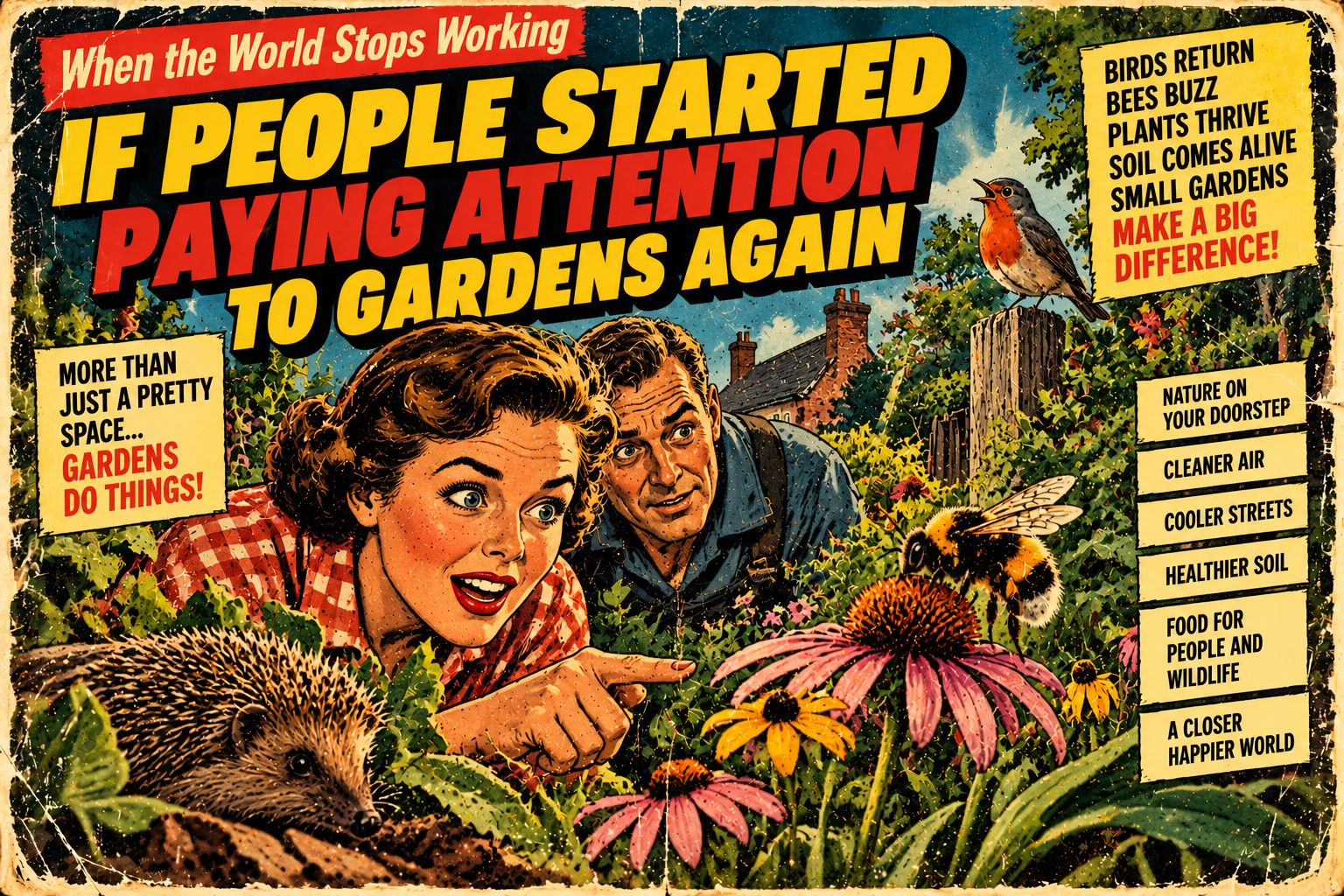
| Something rather strange about the modern garden: we spend enormous amounts of money creating them, look at photographs of them, discuss house prices partly in terms of whether a property has one, and complain bitterly when neighbours let theirs become untidy. Yet for something occupying such a significant part of our domestic landscape, gardens can also become remarkably invisible. We walk through them on the way to the car, look across them through kitchen windows and occasionally sit in them when the weather behaves itself, but much of what is actually happening there passes completely unnoticed. Gardeners have a slightly different relationship with them because our work requires us to notice things. You see that a plant is beginning to struggle before it actually looks dead. You notice the first bindweed emerging through a shrub, the lawn becoming stressed, a branch beginning to obstruct a path or aphids gathering on new growth. You also notice things that aren’t problems: the first bumblebee on a warm morning, birds investigating a hedge, a plant flowering particularly well or the extraordinary speed with which a border changes after several days of warmth and rain. When you spend your working life moving between gardens, you gradually realise how much activity is occurring in spaces most people regard as relatively static. But suppose people started noticing it too. No catastrophe would be required for this particular What If?. Perhaps the change begins because other parts of life become less dependable. Food becomes more expensive, summers get hotter, water needs managing more carefully, and wildlife decline becomes harder to ignore. People begin spending more time at home and looking more closely at the piece of land immediately outside the door. The garden stops being merely an attractive accompaniment to the house and starts looking like something that actually does things. The first discovery might be that gardens are not nearly as passive as they appear. A tree isn’t simply standing there looking attractive; it creates shade, intercepts rainfall, provides habitat, affects temperature, and changes the conditions beneath its canopy. A hedge isn’t merely a boundary; it is shelter, nesting space, a route for wildlife and protection from wind. Soil isn’t just the brown material that holds plants upright. A compost heap isn’t merely somewhere to hide grass clippings. Even a lawn, depending on how it is managed, does more than provide a place for a table and chairs. Once people began seeing gardens in those terms, some familiar decisions might look rather different. Removing a mature tree because it drops leaves onto the patio would still sometimes be necessary, but the leaves would no longer be the only thing considered. Replacing a hedge with a solid fence might gain privacy while losing habitat and shelter. Covering a front garden with impermeable paving could provide parking but alter where heavy rainfall goes. Every decision would begin to have consequences beyond whether the finished result looked tidy. I don’t think this would suddenly turn everybody into a gardener. Plenty of people have neither the time nor inclination to become fascinated by pruning groups or soil structure, and there is nothing wrong with that. What might change is the assumption that gardens require attention only when something becomes visibly untidy. People could begin regarding them more like houses: systems that benefit from occasional thought before a small problem becomes an expensive one. A young tree leaning after strong winds is much easier to correct before it has spent several years growing that way. A climber reaching a gutter is easier to manage before it has disappeared beneath the roof tiles. A patch of invasive growth is easier to tackle when it occupies a square metre rather than half the garden. Soil compaction, drainage problems and deteriorating lawns often give warning long before they become serious. Simply looking properly can be surprisingly effective garden maintenance. Professional gardeners might therefore find clients asking different questions. Instead of pointing at something already enormous and asking us to make it smaller, they might ask how large it will eventually become before planting. Rather than waiting for a border to become completely overwhelmed, they might ask which plants were beginning to dominate. The conversation could shift from fixing consequences to anticipating them, which would make gardening considerably easier for everyone involved. Plant buying would probably change as well. Garden centres are extraordinarily good at encouraging optimism. A plant sits beautifully in a two-litre pot, flowering magnificently beneath a label showing an equally magnificent mature specimen, and somehow the small print explaining that it eventually reaches three metres is less memorable than the flowers. People who paid closer attention to their gardens might start reading that part. They might ask where the plant came from, what conditions it needed, how much water it would require and whether the space available was remotely appropriate for its eventual ambitions. There might even be fewer plants bought simply because they looked nice on Saturday afternoon. I realise this is becoming dangerously utopian. Wildlife would probably be one of the greatest beneficiaries of people looking more closely. Many creatures living in gardens are noticed only when they become inconvenient. Wasps appear when somebody wants to eat outside. Caterpillars become visible when leaves acquire holes. Moles announce themselves through lawns, while ants receive attention after choosing somewhere we would rather they hadn’t. Yet spend enough time watching a garden and a much richer picture appears. Hoverflies patrol flowers, solitary bees investigate tiny cavities, beetles disappear beneath logs, spiders construct webs across improbable distances, and birds use different layers of planting for feeding, shelter and nesting. Once you’ve watched those relationships, it becomes harder to regard every imperfect leaf as a problem requiring intervention. A plant can lose some foliage without needing rescue. A few aphids may be feeding something else. Dead stems can shelter insects. Leaves beneath a hedge can provide habitat while breaking down naturally. The garden doesn’t need to become wild or neglected, but the definition of tidy might need to be a little more generous. That could be particularly important because British gardens collectively represent an enormous patchwork of habitat. Individually, a suburban garden may seem insignificant. Connect it mentally to the gardens on either side, those behind them, the street beyond and thousands of similar streets across towns and cities, and something much larger appears. Wildlife doesn’t recognise property boundaries. A hedgehog trying to move through a neighbourhood encounters fences, walls, and roads rather than the neat rectangles shown on estate-agent plans. People paying attention might therefore begin noticing connections. A small opening beneath a fence could matter. A hedge connecting two areas of cover could matter. A pond might support creatures far beyond the person who dug it. One flowering plant is useful; dozens of gardens providing flowers across different seasons are considerably more useful. One gardener’s actions don’t transform an ecosystem, but many gardens doing modestly useful things can create something surprisingly substantial. Water would become another subject people noticed because gardens reveal rainfall remarkably well. After heavy rain, you can see where water gathers, which surfaces shed it immediately and which areas absorb it. During drought, you see which plants wilt first, where the soil cracks and which shaded areas remain cooler. A homeowner who watches those patterns for several years acquires useful knowledge that no generic gardening book can provide because it belongs specifically to that piece of ground. That knowledge could change garden design. Water butts might appear because people notice how much rain comes off a roof during a single storm. Shade trees become more valuable after experiencing a hot summer beneath one. Mulches make sense when you see how quickly exposed soil dries. Plants suited to naturally damp areas go where water already wants to go, rather than continually trying to persuade it to go somewhere else. The garden becomes something you work with, rather than a blank surface upon which a design is imposed. Food might creep back into gardens too. Not necessarily enormous vegetable plots, because we’ve already explored what happens when gardens have to feed more than one household, but smaller productive elements could become ordinary again. An apple tree earns its place as both a tree and a food source. Herbs sit beside the kitchen door. Strawberries spread beneath other plants. A few beans climb a sunny fence. Once people begin looking at gardens in terms of what they can do, the distinction between ornamental and productive planting becomes less rigid. Composting would benefit for the same reason. Somebody who pays attention to what leaves a garden eventually notices the odd circular journey of bagging up organic material, paying for its removal, and then buying organic material in another bag several months later. Not every garden can retain everything it produces, but the more closely you observe the system, the more obvious it becomes that at least some of that material could remain useful on site. Perhaps the greatest change, however, would be people’s understanding of time. Gardens operate slowly enough that many consequences are easy to miss. Plant the wrong tree, and it may look perfectly sensible for ten years. Neglect soil and nothing catastrophic necessarily happens that afternoon. Remove habitat and wildlife doesn’t hold an emergency meeting on the patio. Gardens accumulate decisions, and some of the most important effects appear long after the person who made them has forgotten why. Paying attention means remembering. You notice that a particular border struggled during the previous dry summer, so you don’t repeat the same planting. You remember where water sat through winter. You notice that the apple tree flowered heavily but produced little fruit. You realise a shrub has gradually declined rather than suddenly died. Gardening knowledge grows through those observations because the garden is continually providing feedback if somebody is interested enough to watch. That is how much traditional gardening knowledge developed in the first place. People observed what worked, repeated it, discarded what didn’t and passed useful information onwards. Science gives us vastly better tools for understanding why many things happen, but observation remains fundamental. No soil test can tell you quite as directly as standing outside during a downpour where water actually runs across your garden. Children might experience gardens differently too. A garden that adults regard merely as something needing mowing teaches very little. A garden where somebody occasionally stops to show them a spider wrapping prey, a bee entering a flower, or a seed germinating becomes somewhere else entirely. You don’t need a wildlife reserve or an enormous country garden to discover that the natural world is complicated. Sometimes you need to turn over a plant pot. That familiarity matters because people tend to value what they recognise. An insect that is “a bug” is easy to dismiss. Once you begin distinguishing bees from hoverflies, beetles from bugs and one butterfly from another, the garden becomes populated by individual kinds of life rather than an anonymous collection of small moving things. The same happens with plants—a border changes once you know what is growing in it. Professional gardeners could have an unexpected role in all this. We already spend more time in some clients’ gardens than the clients themselves. We notice when something unusual appears, when a plant is performing particularly well or when wildlife has taken up residence somewhere inconvenient. Perhaps part of gardening would increasingly involve explaining what we’re seeing rather than simply cutting it back. “There’s a nest in that hedge, so we’ll leave that section alone.” “Those holes aren’t going to kill the plant.” “That area is struggling because it gets far less sun than it did before the tree matured.” “Don’t throw those leaves away. We can use them.” None of those observations is dramatic, but collectively they change the relationship between owner and garden. The gardener stops being somebody who arrives periodically to restore order and becomes partly an interpreter of what the garden is doing. There is a danger, of course, of paying too much attention. Anyone who has searched the internet after finding one strange mark on a leaf knows how quickly a minor horticultural curiosity can become a suspected outbreak of seventeen fatal plant diseases. Gardens contain blemishes, damage, fungi, insects, dying leaves and things that look alarming under magnification. Most of them don’t require intervention. Paying attention should make us better observers, not turn every homeowner into a horticultural hypochondriac. The useful question isn’t simply, What’s happening? It is also, Does it matter? That may be one of the most valuable things experienced gardeners learn. Not every problem deserves a response. Sometimes a leaf has been eaten. Sometimes a mushroom appears in the lawn. Sometimes a plant looks dreadful for three weeks and then recovers. Knowing when not to interfere can be as important as knowing what to do. Perhaps that is why this episode belongs in When the World Stops Working. The series imagines tools becoming difficult to replace, water becoming scarce, insects disappearing, weather becoming unreliable, soil deteriorating, and gardens being asked to produce more food. Again and again, the useful response begins with the same thing: somebody has to notice what is actually happening. You can’t adapt a garden you aren’t observing. If people started paying attention to gardens again, they might discover that these small pieces of land do far more than decorate houses. They manage water, hold soil, store carbon in plants and soil, provide shade, produce food, support wildlife, moderate local conditions, and give people somewhere to encounter living systems up close. None of those things requires a garden to stop being beautiful. In many cases, understanding them makes the garden more interesting. Perhaps the strangest part is that nothing new was invented. The trees were already providing shade. The worms were already working through the soil. Rain was already coming off the roof. Birds were already moving through the hedge and leaves were already capable of becoming leaf mould. The garden hadn’t suddenly become more useful. We had started looking at it properly. I can imagine John and l finishing a garden one afternoon while the client stands beside a border watching a large bumblebee working its way methodically through the flowers. Normally, we’d pack the tools away while nobody paid much attention, but this time the client might ask what the bee was doing, why it preferred those flowers and whether we could plant something else to extend the flowering season. John would look at me while I answered. Back at the van, he’d shake his head. “We’ll never get anything done if everybody starts asking questions.” I’d look back at the garden. Perhaps not. But at least they’d finally noticed what was out there. |
| About our writing & imagery Most articles are grounded in our real gardening experience, observations and reflections. AI may assist with research, drafting and editing, but the experiences, opinions and editorial direction are our own. Featured images may include our photography, original AI-generated visuals or, where stated, images credited to others. All published content is reviewed and shaped by Earthly Comforts before publication. |


Rory, I absolutely loved this post! ❤️ And I couldn’t agree more with so much of what you’ve written here.
I love how you bring your own gardening experiences and work with John into these stories. It makes everything so much more personal, and you can tell that you really enjoy what you do.
We have plenty of little garden visitors here too, including bees, hoverflies, spiders, beetles, birds and even moles! I actually collect the lovely loose sand they dig up and use it for potting soil. Waste not, want not! 😂
I can sit for ages watching the little bugs and bees going about their business, and of course, trying to photograph them whenever they allow me to get close enough. Some are more cooperative than others! LOL! 📸
I particularly agree with what you said about not treating every imperfect leaf as a problem. Nature has its own little system, and so many creatures depend on things we might otherwise consider untidy. Even weeds have their purpose in my eyes, especially when those little yellow flowers attract the bees. I love seeing them buzzing around them. And mushrooms appearing on the lawn? I rather enjoy those too and taking photos of them as well! 😂
Your point about observing before intervening really struck a chord with me. We once noticed fungi appearing on the leaves of our avocado tree. After doing a little research, we discovered that the thick layer of leaves we’d left around the border of the tree was contributing to the problem. We removed some of them and worked only a few into the soil, and that helped. A little observation and learning can go a long way!
And that line, “We had started looking at it properly.” I love that! Sometimes everything we need to appreciate has been right there in front of us all along. We simply haven’t taken the time to notice.
The ending made me smile too. I can just imagine John wondering how on earth you’re going to finish a garden if every client starts asking questions about the bees! 😂 But perhaps that’s the point.
If people start noticing and asking questions, maybe they’ll begin to appreciate their gardens a little differently too.
A wonderful post, Rory. It reminded me why I enjoy spending time observing and photographing all those little creatures that share our gardens with us. Thank you for this one! 🤗❤️
LikeLiked by 1 person
Thank you Sonel, one of the biggest failings with some of my client base is they don’t think to observe first, they just want to see instant results. recently a client wanted stonecrops cut down because as far as she was concerned they were not doing anything – l told her, just keep watching, they are just starting to come into blossom, two weeks later she was ‘oh look you were right, how did you know? …..
LikeLiked by 1 person
You’re very welcome, Rory! 🤗
And that’s exactly what I mean about observing first. I think we’ve become so accustomed to wanting instant results that we sometimes forget to give nature a little time to do its thing. Those stonecrops were clearly just waiting for their moment to shine and I am glad you were there to tell her to wait. 🌸
I can imagine your client’s surprise when they finally burst into blossom. I bet she looked at them quite differently after that! It’s lovely that you encouraged her to wait rather than simply cutting them down.
I think there’s a lesson in that for all of us. Sometimes the best thing we can do is step back, look a little closer and give things time. Nature doesn’t work to our schedules, and perhaps that’s one of the things we need to learn from it.
Keep spreading the word, Rory! We need more people who understand that a garden isn’t just something to keep tidy and under control. It’s a little world full of life, surprises and wonderful things waiting to be noticed. 🌱🐝❤️
LikeLiked by 2 people
I am at times mortified by the comments l receive from clients who just don’t look past what they think is nothing.
LikeLiked by 2 people
I can imagine, Rory! Sometimes I think people have become so accustomed to seeing a garden as something that must look neat and tidy that they forget it’s a living, breathing little ecosystem.
What one person dismisses as a weed, an untidy corner or something that needs cutting back might be providing food, shelter or a home for all sorts of little creatures.
I suppose that’s why observation is so important. We need to learn to look beyond what we think we’re seeing and appreciate what’s actually happening.
Keep educating your clients, Rory. One garden at a time! 🌱🐝❤️🤗
LikeLiked by 1 person