
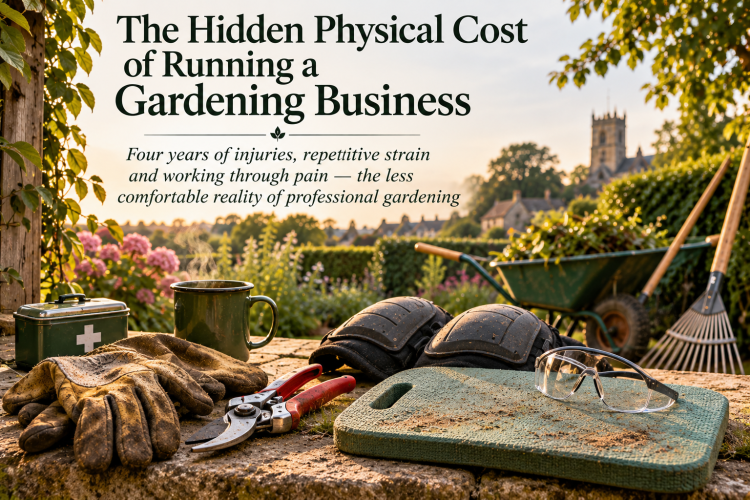
| Four years of injuries, repetitive strain and working through pain — the less comfortable reality of professional gardening. |
| There is something rather contradictory about professional gardening. We spend our working lives improving plant health, protecting the soil, encouraging biodiversity, and creating environments in which living things can flourish. Yet the physical wellbeing of the people responsible for maintaining those environments can sometimes receive remarkably little attention. Gardening is a physical occupation, and much of its appeal lies in working outdoors, remaining active and enjoying the satisfaction of practical work. However, there is a considerable difference between spending a pleasant afternoon tending your own garden and maintaining several clients’ properties, day after day, throughout the changing seasons. What begins as healthy physical activity can become a demanding routine of repetitive movements, heavy lifting, awkward working positions and accumulated fatigue. I began gardening professionally in September 2022, and now, in November 2026, a little over four years have passed. During that relatively short period, I have accumulated an assortment of injuries and physical difficulties that have increasingly influenced how I approach my work and the development of Earthly Comforts. Perhaps the most significant difficulty, however, is not simply sustaining these injuries but finding sufficient time away from the activities that aggravate them. |
| The Difference Between Gardening and Gardening for a Living A keen amateur gardener might spend an entire Saturday digging borders, pruning shrubs and cutting hedges. By the evening, they may feel thoroughly exhausted, perhaps with aching shoulders or a stiff back, but they can usually choose to rest the following day. If a particular task becomes uncomfortable, they can leave it until another weekend. Professional gardeners rarely enjoy quite the same freedom. Clients have appointments, seasonal work must be completed within relatively narrow windows, and the weather frequently interferes with even the most carefully organised diary. A gardener may spend Monday cutting hedges, Tuesday maintaining lawns, Wednesday clearing overgrown borders, and Thursday moving substantial quantities of soil, compost or green waste. Friday and Saturday bring another assortment of tasks, and the following week the process begins again. There is also considerable physical work that clients seldom see. Machinery must be loaded and unloaded, equipment carried between vehicles and gardens, waste collected and removed, and tools cleaned and returned to storage. At Earthly Comforts, we maintain gardens of varying sizes around Sandwich and the surrounding areas of East Kent, many of which present different challenges, including restricted access, uneven ground, mature planting, and substantial quantities of seasonal waste. The difficulty is not necessarily that any individual task is exceptionally demanding. It is the accumulation of physical effort across successive working days, often without sufficient opportunity for recovery. Something that feels relatively straightforward on Monday morning can become considerably less comfortable by Friday afternoon, particularly when the body parts involved are already suffering. Four Years of Gardening: The Physical Price I Have Paid When I look back over the period between September 2022 and November 2026, the assortment of injuries and physical difficulties I have experienced makes for rather uncomfortable reading. I am not suggesting that every condition can be attributed exclusively to gardening, nor that my experiences are representative of everybody working within the profession. Nevertheless, they provide a personal illustration of what this occupation can demand of the human body. My hands have suffered particularly badly. I have severe tendinitis in my left thumb, with similar symptoms now beginning to develop in my right. Interestingly, I am naturally right-handed, yet my left thumb has experienced the greatest difficulty. I also have osteoarthritis affecting my hands and carpal tunnel problems in my wrist. Considering how much of a gardener’s working day involves gripping, squeezing, twisting, pulling and controlling equipment, it is hardly surprising that existing problems can become increasingly troublesome. Even something as straightforward as tying a waste bag or pulling weeds can become uncomfortable when your hands are already painful. My arms have fared little better. I have tennis elbow in both arms, alongside repeated muscular strains and tears affecting my arms, legs and back. In 2018, several years before I began gardening professionally, I fractured the acromion in my right shoulder. That injury has never healed properly, leaving me with limited endurance and sustained power in that arm. Alongside this existing injury, I experience shoulder pain of both a structural and muscular nature. Holding machinery for extended periods, reaching into awkward positions and undertaking repetitive cutting movements can consequently become particularly demanding. Then there are my knees, both of which have deteriorated considerably. I wear knee braces and hard-shell, turtle-shell-style knee protectors every working day. Gardening involves an extraordinary amount of kneeling, crouching, bending and repeatedly getting down to ground level before standing up again. Although protective equipment helps when working on hard or uneven surfaces, it cannot eliminate the physical demands of those movements. Weeding borders, planting, and clearing beneath established shrubs can become tiring simply because you have to change position so often. The smaller injuries are almost too numerous to count. Cuts, scratches, punctures, splinters and blisters are familiar occupational companions. My right arm is scarred from working amongst roses during the summer months, despite wearing gloves. Rose and bramble thorns regularly find their way through clothing or into exposed skin, while dust, loose vegetation and fragments of debris can find their way into the eyes. Protective equipment reduces these risks, but it does not eliminate them. Our tools present another hazard entirely. Secateurs, pruning saws, loppers and powered cutting equipment are deliberately sharp because they need to perform their jobs effectively. Unfortunately, a momentary lapse in concentration or an unexpected movement can result in injury. Most everyday mishaps may involve relatively minor cuts, but the potential consequences include permanent damage or even the loss of fingers. This is one reason why physical fatigue and reduced grip strength should never be dismissed as mere inconveniences. What concerns me most is not any individual injury but their accumulation. A painful thumb might be manageable in isolation, as might an uncomfortable elbow or an aching knee. The difficulty arises when several of these conditions exist simultaneously, and your occupation requires continued use of precisely those parts of the body that are already experiencing problems. You begin changing the way you hold equipment, favouring one arm over another or adjusting your working position, sometimes placing additional strain elsewhere in the process. I do not recount these experiences in search of sympathy. I chose this occupation, I enjoy gardening, and I remain committed to developing Earthly Comforts. However, I believe there is value in discussing the less attractive realities of professional gardening, particularly when the public perception of the occupation is often dominated by pleasant gardens, fresh air and the satisfaction of working outdoors. The Luxury of Time to Recover Perhaps one of the greatest difficulties professional gardeners face is that injuries rarely come with the opportunity to recover properly. When a muscle is strained, a tendon becomes inflamed, or a joint begins causing persistent discomfort, the sensible response is to seek appropriate treatment and reduce the activities that aggravate it. Unfortunately, the commercial realities of operating a gardening business are seldom quite so accommodating. Gardens do not stop growing because the gardener has developed tennis elbow. Lawns still need mowing, hedges need cutting, weeds establish themselves, and clients quite reasonably expect the maintenance visits they have arranged. There are employees to organise, expenses to meet and a working diary that may already be struggling to accommodate appointments postponed through adverse weather. Taking several days away from work can create a backlog that takes considerably longer to resolve. Over the past four years, I have frequently continued working with painful hands, inflamed tendons, troublesome elbows, muscular strains and the limitations imposed by my shoulder injury. Much of the time, we work day in and day out with these injuries. One part of the body might be beginning to improve while another becomes troublesome, and sometimes several conditions cause discomfort at once. Nevertheless, the next morning arrives, the equipment needs loading, and gardens are waiting to be maintained. The difficulty is that continuing to work does not necessarily mean an injury is recovering. Repeatedly undertaking the movements that aggravate a condition can delay improvement or make matters worse. A painful tendon may never receive a sufficient reduction in workload, while a muscular strain can be aggravated by returning too quickly to demanding activities. Gradually, discomfort becomes familiar, but familiarity with pain should not be mistaken for recovery. For the self-employed gardener, there is an unfortunate commercial contradiction. Taking time away from work may protect long-term health but create immediate financial difficulties. Continuing to work protects today’s income and appointments but may increase the risk of a more serious interruption later. Even as a business grows and employs additional people, its owner may remain heavily involved in day-to-day physical operations, making extended recovery periods difficult to accommodate. I suspect many professional gardeners understand this predicament particularly well. It is not necessarily that we are indifferent to our health or unaware of the potential consequences. Often, we know perfectly well that we need to reduce our workload, but cannot see an easy way to do so without creating another set of problems. Nevertheless, persistent or worsening symptoms deserve medical assessment, and there are circumstances in which continuing to work is neither safe nor sensible. A gardener can spend years maintaining everybody else’s garden while repeatedly postponing the maintenance their own body requires. The Accumulated Cost of Repetitive Movement One difficulty with repetitive strain is that the movements involved are often entirely ordinary. Squeezing secateurs, operating a hedge trimmer, pushing a mower or raking leaves are activities that professional gardeners undertake almost without thinking. Yet their cumulative effects can become significant when repeated for hours, days and years. Even a relatively lightweight hedge trimmer places demands upon the shoulders, arms, wrists and hands when held for extended periods. Strimming involves supporting and balancing a machine while manoeuvring across uneven ground, and powered equipment can introduce additional vibration-related risks. Clearing leaves involves repeated pulling movements, bending, twisting, bagging and carrying. Individually, these activities may appear manageable, but combining them across several gardens throughout the working week presents a different proposition. There is also a longstanding tendency within practical occupations to associate physical exhaustion with productivity. Somebody who spends eight hours digging, carrying, and clearing may appear to have worked exceptionally hard, while another person using appropriate machinery to achieve comparable results might appear to have put in less effort. Yet clients employ professional gardeners to maintain their gardens efficiently and to an appropriate standard, not to demonstrate how exhausted we can become. There will always be occasions when traditional hand tools remain preferable, particularly around delicate planting or within restricted spaces. Physical work is an inherent part of gardening, and there is considerable satisfaction in completing demanding tasks well. The key distinction is between necessary effort and avoidable exertion, especially when the same tasks must be repeated. Working Smarter and Protecting the Workforce In our first article, When a Growing Business Outgrows Its Tools, we examined the changing relationship between business development and equipment ownership. Sometimes machinery becomes redundant as a business evolves. Still, there are also occasions when purchasing additional equipment is justified because it reduces the physical demands placed upon the people undertaking the work. At Earthly Comforts, we have been considering equipment such as powered brooms and leaf vacuums. Both offer potential advantages for repetitive maintenance tasks, particularly during autumn and winter. Neither represents a universal solution, and machinery can introduce its own physical demands through weight, vibration, noise and handling requirements. Nevertheless, if appropriately selected equipment can reduce prolonged manual sweeping, raking or bending, its value should be measured through more than the amount of labour time saved. Our increasing reliance upon paired working also provides opportunities to distribute physical effort more effectively. Two gardeners can share appropriate handling tasks, alternate between activities and organise their work according to their respective strengths and capabilities. This does not automatically make every task safer, but it provides greater flexibility than expecting one individual to undertake every aspect of garden maintenance alone. Working smarter also means considering how equipment is transported, whether schedules allow sufficient flexibility, and whether particular tasks can be organised differently. Suitable protective equipment, training, appropriate risk assessment and properly maintained machinery are essential considerations. However, protecting the workforce must also involve examining the physical demands of the work itself, rather than relying exclusively upon protective clothing or expecting people to tolerate discomfort. We will explore machinery and team development in greater detail in forthcoming articles, because both play an increasingly important role in how Earthly Comforts operates. The Financial Cost of an Injured Gardener The physical wellbeing of gardeners is sometimes treated as a separate consideration from business profitability, when in reality the two are closely connected. When a gardener becomes injured or physically unable to work, appointments may need rearranging, colleagues may face additional workloads, and the business may incur costs associated with absence, temporary cover or delayed work. Even when an injury does not result in complete absence, persistent discomfort can affect concentration, efficiency, and the ability to maintain consistent standards. Weather disruption can compound these difficulties. Storms, persistent rainfall and unsuitable ground conditions can interrupt carefully organised schedules, leaving businesses attempting to accommodate postponed work alongside existing appointments. The temptation is to recover every lost hour by working longer or harder whenever conditions improve, but this can place additional demands upon people who may already be physically struggling. A sustainable gardening business needs sufficient flexibility to accommodate the realities of working outdoors, including illness, injury and recovery. That flexibility has a financial cost, but so does its absence. A business that relies upon its gardeners continually working through pain may eventually discover that its apparent productivity has been achieved at considerable human and commercial expense. Building a Business That Does Not Wear Out Its Gardeners When discussing business growth, it is easy to concentrate on the visible signs of development. More clients, additional employees, better machinery and increased turnover all suggest progress. Yet none of these achievements necessarily demonstrates that the business has become more sustainable. We must also consider whether our working methods can reasonably be maintained over the years ahead. My own experiences have made this subject rather more personal than I might once have expected. In just over four years, I have accumulated physical problems affecting my hands, wrists, elbows, shoulders, back, legs and knees. I have frequently continued working with these difficulties because finding sufficient time to recover has proved challenging. Whilst I remain enthusiastic about gardening, I recognise that enthusiasm alone will not protect my body from the cumulative demands of the occupation. As Earthly Comforts develops, I want our working arrangements to become less dependent upon people continually pushing themselves beyond what is physically sensible. That may involve investing in different machinery, sharing tasks more effectively, improving scheduling and creating sufficient flexibility to accommodate injuries when they occur. These changes will not eliminate the physical nature of gardening, nor should they, but they may help reduce some of the unnecessary strain it involves. We devote considerable effort to maintaining the gardens entrusted to our care, and perhaps we should be equally diligent about maintaining the physical well being of those responsible for looking after them. A damaged lawn can be repaired, a struggling border can be rejuvenated, and a worn-out machine can be replaced. The human body is not always quite so forgiving, and no gardening business should lose sight of that. |
| Author’s Note This article draws upon my personal experiences of professional gardening between September 2022 and November 2026, alongside the continuing development of Earthly Comforts GPM Ltd in Sandwich, Kent. Although not every condition discussed can be attributed exclusively to gardening, these experiences have increasingly influenced my decisions concerning machinery, staffing and working methods. The purpose is not to discourage anybody from entering the profession, but to encourage a more realistic discussion about its physical demands and the importance of protecting those who undertake it. |
| About our writing & imagery This article reflects personal experiences and observations from the development of Earthly Comforts GPM Ltd. AI may assist with research, drafting, editing, and creating supporting illustrations. Still, the personal experiences and editorial direction remain the author’s own. AI-generated images are artistic interpretations rather than documentary photographs of actual events. |

